Why campaign totes fail at the buying stage
Printed canvas shopping bags for charity campaigns usually fail because the buying brief is vague, not because the factory cannot sew a tote. The risk starts when a team asks for "good quality" bags without defining the fabric, construction, print method, or acceptable defect level. The factory fills the gaps with its own assumptions, and the quote looks fine until bulk production exposes the missing details.
A charity tote is a visible item. It is photographed, carried in public, and handed out on a fixed date, so the buyer should treat it like a brand asset with a hard delivery deadline. If you are sourcing printed canvas shopping bags for charity campaigns, the quality inspection checklist has to exist before the quote is awarded, not after the goods are already in transit.
- Write one measurable spec for both sample and bulk, so the factory cannot quietly change the build.
- Separate appearance, construction, and packing requirements instead of describing the bag with one generic approval note.
- Assume the bag will be seen at close range, not just from a distance in a catalog photo.
Turn the brief into a measurable bag spec
The right specification begins with the use case. A tote used for brochures and light event handouts can be built lighter than one expected to carry books, packaged goods, or donated items. For most charity campaigns, 8 oz to 10 oz cotton canvas, roughly 280 to 340 GSM, is a practical range because it balances structure, print quality, and cost. If the bag is too light, it loses shape and print clarity; if it is too heavy, freight and sewing cost rise without much value for the campaign.
Lock the finished size, handle geometry, and bag construction at the same time as the fabric. A common format is around 38 x 42 cm with a 10 to 12 cm gusset, but the exact dimensions matter less than consistency across the lot. State whether the bag is flat, boxed-bottom, lined, or includes a pocket or closure. Those details affect sewing time, material usage, packed volume, and the risk of a sample that looks right but ships wrong.
- Define finished dimensions, not cut dimensions, so everyone measures the same endpoint.
- Call out handle length, handle width, and reinforcement at the attachment point in the drawing.
- Ask the supplier to confirm stitch density and seam allowance on the approved spec sheet.
Choose fabric, weave, and handles for print and load performance
Canvas weight alone does not determine how the bag will perform. A tighter weave at the same GSM usually gives cleaner print edges, especially when the artwork includes small text or thin lines. If the campaign logo has sharp type or a fine mark, a smoother face finish can be worth a modest price increase because it reduces the risk of broken print across the weave. Natural unbleached cloth is often economical, but it can show more base-fiber variation than bleached or lightly dyed stock.
Handle construction is where many tote orders weaken. A bag can look finished on a table and still fail in use if the handle attachment is underspecified or the stitch pattern is weak. Ask for self-fabric or webbing handles with bar-tacks or cross-stitches at stress points, and define the exact attachment geometry. For standard campaign bags, 3 to 4 stitches per cm is a reasonable baseline on key seams, but reinforcement at the stress points matters more than a decorative stitch count.
- Choose a smoother weave when the artwork includes small text, thin lines, or fine logos.
- Require reinforcement at the handle attachment points, not just a visible seam finish.
- Test the sample with real contents and a timed load hold instead of only pulling the empty bag by hand.
Match the print method to the artwork
Screen printing is usually the best fit for charity campaign totes because it handles bold logos, simple artwork, and repeat production well. It also gives the buyer more control over opacity and color consistency on canvas. Before approval, ask the factory to confirm screen count, ink system, curing method, and the exact print area. If the print crosses a fold or gusset edge, the sample must prove that the art still reads cleanly after the bag is handled and packed.
Heat transfer and digital print can work, but only when the artwork actually needs them. Use them for small runs, variable names, or image complexity that would make screen printing inefficient. The tradeoff is that canvas texture can expose lifting, cracking, or edge wear more quickly. For campaign totes that will be distributed in bulk, durability and consistency are usually more important than showroom sharpness.
- Use screen print for simple logos, one to three colors, and recurring campaign artwork.
- Use transfer or digital print only when the design needs it and the supplier can show canvas-specific results.
- Require a cured, folded, and rubbed sample if the artwork sits near a seam or handle zone.
Compare suppliers on the same commercial basis
The comparison has to be apples-to-apples. A direct factory quote is usually easiest to evaluate when the buyer already knows the material and structure. Trading companies add coordination value, but they can also blur the identity of the real maker and make it harder to enforce quality standards after award. Local printers or tote converters are useful for short timelines, but their strength is speed, not always scale or repeat consistency.
A broker or marketplace quote often looks cheapest first and turns out most expensive once rework, delays, and undocumented subcontracting show up. Compare suppliers on price transparency, spec control, MOQ flexibility, lead-time reliability, and QC ownership. The question is not simply who is cheapest. The real question is who can deliver the right bag, on time, with the least inspection risk and the least chance of a campaign failure.
- Ask who actually sews, who actually prints, and who signs off final QC before comparing price.
- Include setup fees, sample charges, freight exposure, and likely rework cost in the commercial comparison.
- For annual campaigns, favor the route that makes repeat approval and repeat QC easiest.
Build the RFQ so quotes are directly comparable
A useful RFQ for printed canvas shopping bags should remove room for guesswork. State the finished size, fabric GSM, weave target, handle construction, print colors, print placement in mm, and packing style. If one supplier prices against lighter cloth or a simpler handle build, that quote is not comparable to a quote based on the real spec. The buyer then ends up comparing numbers that represent different products.
Separate the commercial questions from the production questions. Ask for MOQ by color and artwork version, sample fee, screen or plate charge, carton size, carton gross weight, overrun tolerance, and split-shipment policy. If the campaign date is fixed, ask the supplier to split the lead time into fabric purchase, printing, sewing, inspection, and packing. That breakdown shows where the schedule risk actually sits.
- Attach the final artwork file, approved print area, and placement reference to the RFQ.
- State whether the tote is flat, gusseted, boxed-bottom, lined, or pocketed.
- Ask for carton details so the warehouse and freight forwarder can plan handling before shipment.
Approve the sample like a production gate
The pre-production sample should use the same fabric lot, thread, ink system, and handle construction intended for bulk. A showroom sample that was made from different materials does not prove the production line can make the real bag. For canvas shopping bags, the sample is where the buyer confirms print registration, seam behavior, handle symmetry, and fold performance. If the logo cracks where the bag folds, the build is not ready for release.
Review the sample like a receiving inspection, not a design presentation. Measure the bag against the spec, check print placement, rub the cured print, and load the handles with a realistic weight. Reject any sample with twisting, skipped stitches, loose thread bundles, visible skew, or uneven shade. The goal is to approve the bag you will accept on a pallet, not the bag that looks best in a sales photo.
- Keep one signed master sample and one photo record of the approved version.
- Measure the bag flat and under load, because some defects only appear when the seams are stressed.
- Do not approve artwork if the print is attractive but the construction is weak.
Use a bulk QC plan with measurable thresholds
Bulk inspection should move in a fixed order: count, appearance, construction, function, then packing. Use an AQL target instead of a vague pass or fail. For most charity campaign totes, AQL 2.5 for major defects and 4.0 for minor defects is a practical baseline, but highly visible donor-facing campaigns may need a tighter limit. Define major defects before production: wrong size, missing print, open seam, handle failure, off-color print, or a stain that makes the bag unsuitable for handout.
Color and print consistency need their own controls. Compare print against the approved master sample under D65 light, and if the supplier has the equipment, use a Delta E target for the printed area. Natural canvas base cloth will vary more than dyed fabric, so the master sample matters more than a laboratory ideal. For rub-fastness, ask for a dry rub result of at least grade 4 on the grey scale and specify wet rub expectations if the bags may be exposed to humidity or handling during transit.
- Sample cartons from the top, middle, and bottom of the stack so you do not miss hidden variation.
- Record defects by category: size, print, seam, handle, stain, packing, and labeling.
- Write the pass/fail rule before goods land so the receiving team and supplier use the same standard.
Use an inspection checklist that can be executed at receiving
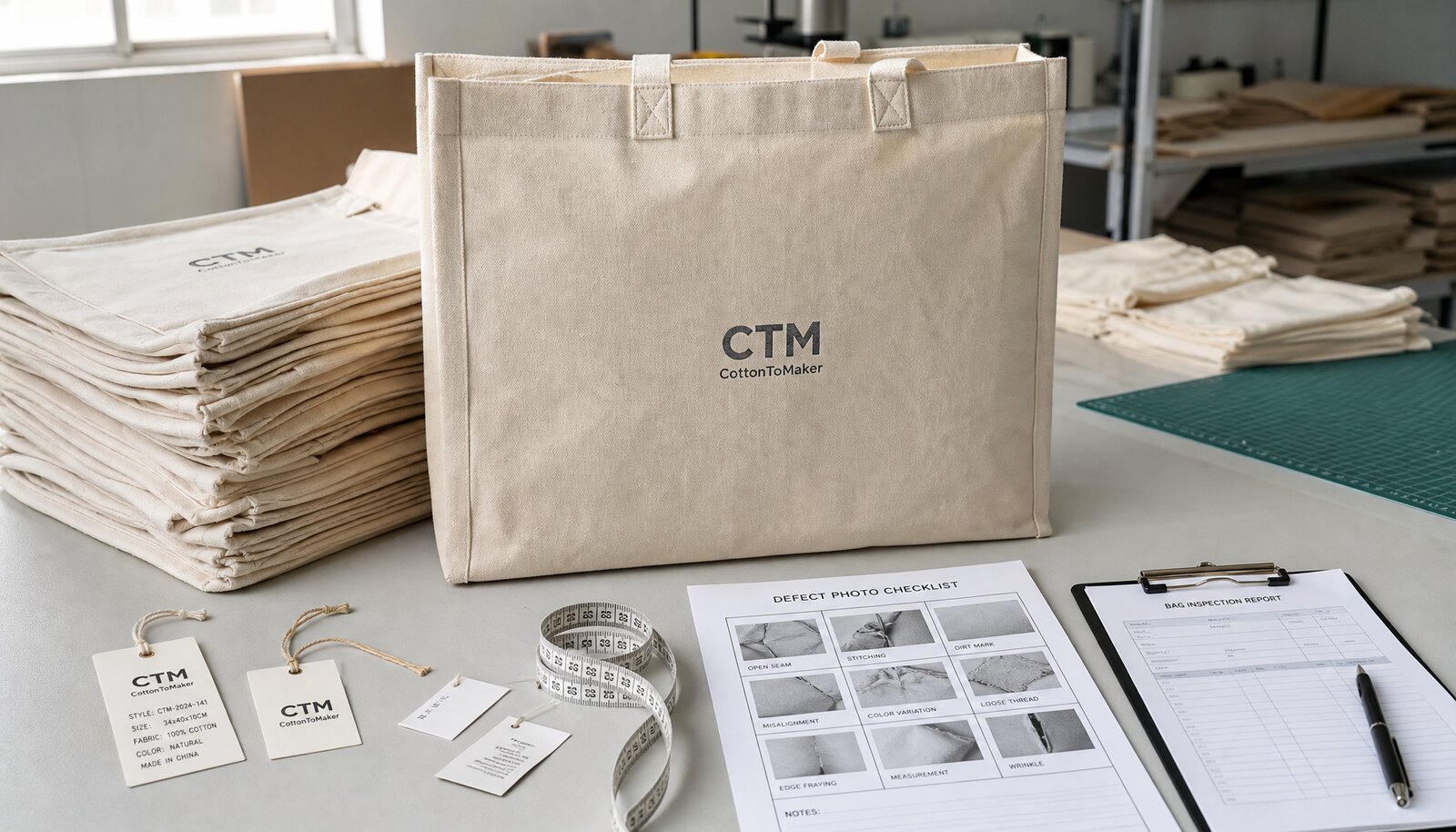
The receiving team needs a checklist they can actually use in the warehouse. Start with a visual defect photo set that shows what is rejectable: skewed print, off-center logo, open seam, skipped stitch, missing bartack, needle hole, oil stain, ink bleed, shade drift, frayed handle, carton crush, and label mismatch. That library should be shared with the factory before bulk shipment and used again at receiving so the standard is not left open to interpretation.
For seam strength, use a simple field test that can be repeated. Clamp or hold the handle and bag body in line, load the bag with the agreed weight, usually 8 to 10 kg for a standard charity tote, and hold it for 60 seconds. Inspect the seam after the hold for thread break, seam creep, bartack lift, or body distortion. For color verification, compare the production bag to the signed master sample under daylight-equivalent light, then spot-check with a spectro reading if the supplier and buyer both use that method. Pass/fail results should be written on the inspection sheet with carton ID, sample count, defect count, photos, inspector name, and disposition.
- Create a defect photo sheet before production so the factory knows exactly what will fail inspection.
- Log receiving results by carton number, not only by lot, so problems can be traced back quickly.
- Quarantine any carton with mixed defects until the buyer decides on release, rework, or rejection.
Pack for distribution, not just for freight
Packing decisions should be made around the event flow, not only around shipping cost. Flat folding reduces carton volume and can improve freight efficiency, but it may crease the print if the fold line crosses a graphic area. Loose packing protects the artwork better, but it increases carton size and can raise transport cost. The right answer depends on whether the bags are going into a warehouse, onto a retail shelf, or straight to an event desk. Ask for a packed-carton photo before shipment so you can inspect the fold pattern and first-bag appearance.
Carton labeling and count control matter as much as the bag itself. Make sure carton marks, SKU, quantity, origin, and destination labels match the packing list. If the order includes multiple colors or multiple artwork versions, keep each lot clearly separated and labeled. This reduces receiving labor and avoids accidental mixing when the bags are distributed to different campaign locations.
- Use flat pack only if the fold line does not damage the printed area.
- Request a carton photo with packing count visible before shipment release.
- Keep mixed artwork or mixed color lots separated by carton and clearly marked.
Specification comparison for buyers
| Evaluation factor | Direct factory | Trading company | Local printer or tote converter | Broker or marketplace seller |
|---|---|---|---|---|
| Price transparency | Usually best on repeat orders if spec is stable | Medium, often includes service margin | Higher unit price but fewer freight surprises | Looks cheap upfront, but hidden costs are common |
| Spec control | Strong if the buyer locks the drawing and sample approval | Variable, because the actual maker may change by order | Good for short runs, weaker on larger production discipline | Weak unless the buyer pushes hard on documentation |
| Lead-time reliability | Strong when fabric and print are in-house | Depends on coordination across parties | Strong for quick turn events, weaker for scale | Highest risk of delays and vague handoffs |
| MOQ flexibility | Best for repeat campaigns and larger runs | Can be flexible, but depends on upstream factory terms | Best for lower-MOQ local programs | Often claims flexibility, but delivery control is thin |
| QC ownership | Clear if the line and final inspection stay in-house | Needs written proof of factory identity and inspection process | Usually simple, but process depth may be limited | Weak unless inspection records are provided before shipment |
| Best use case | Annual charity campaigns, recurring fundraising, stable artwork | Programs needing coordination across mixed products | Local event supply, rapid reprints, low-MOQ trials | Small test orders only, if buyer can absorb risk |
| Buyer check before award | Confirm sewing, printing, and final QC are actually controlled by the factory | Request factory name, subcontracting policy, and sample source | Check bag construction, not just print quality | Demand production photos, defect handling terms, and actual maker identity |
Buyer checklist before sampling
- Define the finished bag spec in measurable terms: canvas GSM, finished size, gusset depth, handle length, handle width, and whether the bag is flat, boxed-bottom, lined, or pocketed.
- Lock the print spec before sampling: artwork version, Pantone references if needed, number of colors, print placement in mm, and the acceptable placement tolerance.
- Require a pre-production sample made from the same fabric lot, thread type, ink system, and handle construction planned for bulk.
- Set the acceptance standard up front: AQL target, seam strength target, color tolerance, rub-fastness requirement, and which defects count as major or critical.
- Ask for packed-carton photos, carton count, carton size, gross weight, and pack method before shipment is released.
- Build schedule buffer for sample revision, bulk production, final inspection, carton correction, customs clearance, and last-mile delivery.
- Request evidence of the real production line or equivalent process documentation instead of relying on catalog images or showroom samples.
Factory quote questions to send
- What is the exact canvas specification in GSM and weave construction, and is the base cloth greige, bleached, or dyed before printing?
- Which print method will you use for this artwork, how many screens or plates are needed, and what setup charges are included in the quote?
- Will the pre-production sample use the same fabric lot, same ink system, same thread, and same handle construction as bulk production?
- What are the target stitch density and bartack details for the main seams and handle attachment points?
- What is the MOQ by color, by artwork version, and by shipment destination if we need mixed packing or split delivery?
- What is the quoted production lead time after sample approval, and which step usually causes delay on your line: fabric, printing, sewing, inspection, or packing?
- What packing format will you use per carton, what is the carton gross weight and carton size, and can you share a packed-carton photo before shipment?
- What inspection standard do you use for final QC, and can you share defect categories, AQL target, and recent inspection photos or reports?
- What overrun or short-shipment tolerance do you plan, and how do you handle damaged, misprinted, or undercounted units?
- Can you confirm whether any printing or sewing is subcontracted, and if so, which operation stays under your direct control?
Quality-control points to confirm
- Fabric weight matches the approved target within the agreed tolerance, with no thin panels, weak spots, or weave distortion that affects print clarity.
- Finished bag dimensions stay within +/- 10 mm of the approved spec, and gusset depth remains even from top to bottom.
- Print placement stays within +/- 5 mm of the approved position, with no obvious skew, drift, or mirrored panel mismatch.
- Ink coverage is even and fully cured, with no pinholes, bleeding, ghosting, tackiness, or visible rub-off after folding and handling.
- Dry rub-fastness meets at least level 4 on the grey scale or the supplier's equivalent standard, and wet rub performance is clearly stated for the chosen ink system.
- Primary seams show no skipped stitches, open stitches, or loose thread bundles, and stitch density stays at the approved level, typically 3 to 4 stitches per cm on key seams.
- Handle attachment points pass a static load test at the agreed campaign-use level, commonly 8 to 10 kg for standard charity totes, with no seam separation or bartack failure.
- Carton count, inner pack count, labels, and carton marks all match the packing list, and sampled cartons from top, middle, and bottom positions show no hidden shade or print variation.
- Use AQL 2.5 for major defects and 4.0 for minor defects unless the campaign is highly visible, in which case tighten the acceptance threshold and predefine critical defects.
- No oil stains, needle damage, fabric holes, odor issues, or adhesive contamination should appear on any bag that will be handed directly to donors or retail customers.