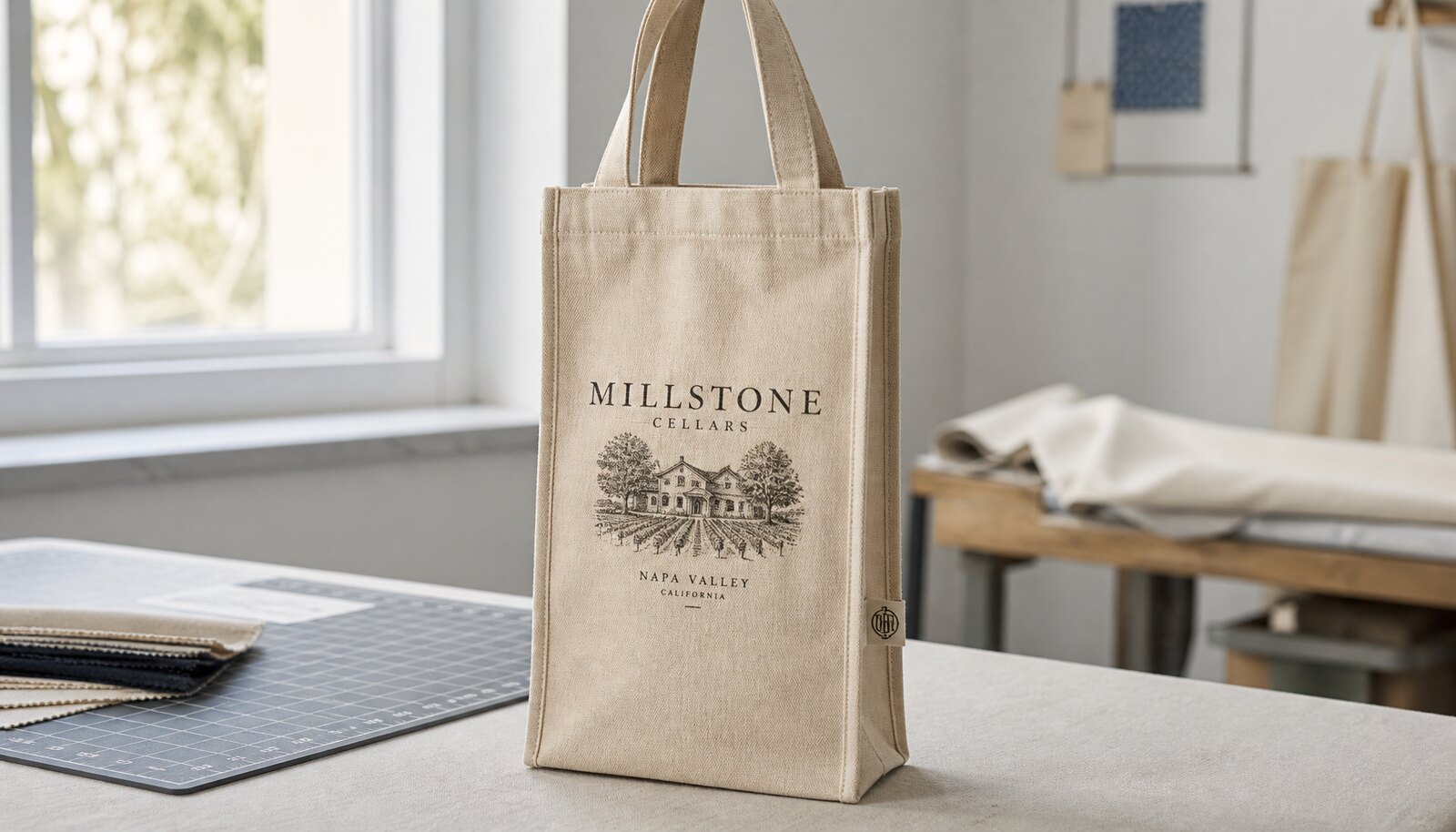
What the sample must prove for a winery program
A winery tote sample is not just a logo check. It needs to prove that the bag works with the actual bottle, the actual retail shelf, and the actual packing method you will use on a live order. A bag that looks clean in a flat photo can still fail when it is filled, carried, stacked, or displayed beside glassware and gift items. For winery buyers, the sample is the only chance to verify whether the product feels suitable for tasting rooms, retail gifting, or distributor programs before the factory makes hundreds or thousands of pieces.
The most common mistakes show up in use, not in artwork proofs. The body may be too shallow for the bottle diameter, the handle drop may be awkward over a coat, the print may sit too close to the gusset, or the canvas may collapse after folding and packing. A proper approval process should use the actual bottle size or a weighted dummy, then check the bag in hand, on shelf, and inside the carton. If the sample only passes visually, it is not a real approval. Keep the test practical: who will carry it, what will be inside it, and how will it be packed for shipment?
In procurement terms, the sample is a control point, not a courtesy. It should tell you whether the spec is repeatable, whether the factory understands the order, and whether the finished product can survive normal handling. That makes sample review a buying decision, not an art review. A good winery tote may need to look premium, but it still has to be cut, sewn, printed, folded, and shipped without surprises. The sample should answer that question clearly before bulk production is authorized.
- Test with the intended bottle size, not a generic insert.
- Review the bag under retail lighting, not only on a white table.
- Compare the sample against the final carton configuration, not only the sewing spec.
Set the structure before you approve the logo
For printed canvas shopping bags for wineries, the structure should lead the design, not the other way around. A single-bottle retail bag can often work in 12 oz / 340 gsm canvas with a moderate gusset and reinforced handles. A two-bottle carrier, a premium gift bag, or a bag that must survive repeated handling generally needs heavier fabric, usually closer to 14 oz / 400 gsm, plus stronger seam reinforcement or a divider. If you skip this step and start with artwork placement, the logo may look right while the bag itself performs poorly.
Handle construction matters more than many buyers expect. A self-fabric handle may look more refined on a natural canvas bag, while cotton webbing can improve strength and consistency across larger runs. The handle drop should be set for actual carry use, not just for a neat product photo. A short handle is a common retail complaint because it makes the bag feel cramped once the customer adds a coat, a second item, or a bottle-shaped gift box. Ask the factory to show the measured handle drop after stitching and pressing, because sewn dimensions can shift from the cut size.
The structure decision should also reflect how the wine bag will be sold. If it is a shelf item, the bag needs a clean front panel and a shape that stands upright enough to stay visible. If it is a tasting-room giveaway, the bag may need simpler construction with a lower unit cost and enough strength for daily carrying. If the buyer expects repeated reuse, then reinforce the stress points first and treat decorative finishing as secondary. This prevents the approval from being driven by appearance alone.
- Use 12 oz / 340 gsm for light retail and 14 oz / 400 gsm for bottle-heavy use.
- Choose a gusset depth that matches bottle diameter and any gift insert.
- Specify the handle drop after sewing, not only the cut length.
- Confirm whether the bag must stand upright, fold flat, or function as a reusable carrier.
Pick the right fabric weight and print method
Screen printing is still the most dependable print method for winery canvas totes because it gives stable coverage, clear edges, and repeatable production once the screen is tuned. It is usually the right choice for 1-3 spot colors, bold logos, and retail artwork that needs to survive folding and handling. Water-based ink can feel softer and more premium on natural canvas, but it needs better curing discipline. Plastisol can give stronger opacity, especially on darker fabrics, but it can feel heavier and may need more care during cure control. Digital printing is useful for samples or very short runs, but most buyers still treat it as a niche option rather than the main bulk method.
Fabric color changes the print result more than many buyers expect. Natural canvas is forgiving, but the shade of the base cloth still matters because off-white, cream, and unbleached canvas all shift the perceived color of the logo. If the artwork includes thin lines, small type, or fine registration between colors, insist on a strike-off or close-up sample shot before approval. The goal is not to chase a perfect swatch in isolation. The goal is to know whether the logo remains readable after production, folding, and handling. For winery retail, the buyer should value legibility and consistency over decorative detail that the printing method cannot hold.
A practical review should include both a visual and a process check. Ask how the factory will control mesh count, ink viscosity, curing temperature, and print flash time if the artwork needs more than one color. For buyers without in-house print expertise, this is where a supplier’s answer becomes useful evidence. If the supplier only says the print is “good” or “clean,” ask for a physical strike-off, a photo under daylight, and a note on how the factory will keep the bulk run consistent. A polished sample that cannot be repeated is a production risk, not an asset.
- Use screen print for stable bulk runs and clear spot colors.
- Treat digital print as a short-run or sample tool, not the default bulk answer.
- Require a strike-off if the logo has thin type, line art, or tight color registration.
- Ask how the supplier will control curing and registration on the bulk run.
What a proper pre-production sample should include
A real pre-production sample should be built from the same core inputs you want in bulk: final fabric weight, final handle material, final print screen or plate, final stitch pattern, and final carton spec. If the factory changes any of those pieces, the sample becomes a reference only. It may still be useful for artwork or shape approval, but it is not a clean basis for production sign-off. This matters because many supplier disputes start with a sample that was made from premium parts while the bulk run used a cheaper or faster substitute.
Ask for a sample package, not only a bag. The package should include the physical sample, a measured spec sheet, a print reference, carton dimensions, and a clear note on what changed, if anything, from the quote version. If the supplier can also provide one neat, presentation-ready sample and one more workshop-level sample, that helps you see both appearance and workmanship. The neat sample shows what the bag can look like after final touch-up. The workshop sample often reveals whether seam lines, raw edges, or stitch tension are being hidden by final cleaning.
For procurement use, the sample package should also show how repeatable the order is. Ask whether the supplier will hold the same fabric lot for bulk, whether the same operator or production line will be used, and whether the print setup will be archived for repeat orders. Keep in mind that repeatability matters as much as first approval. A winery bag that looks right once but cannot be reproduced on reorder creates avoidable work for purchasing, QC, and sales teams.
- Require the sample to use the final fabric weight and handle material.
- Request a measured spec sheet with the sample rather than a verbal sign-off.
- If anything is substituted, mark the sample as reference only.
- Ask the factory to identify which parts are already fixed for reorder control.
Use a checklist that measures function, not just appearance
The approval checklist should be built around measurable points. Confirm bag width, height, gusset, handle drop, and print location against a signed sheet. For standard canvas totes, a practical tolerance often sits around 0.5 cm on the main body dimensions and about 0.5-1 cm on print placement, but your own tolerance should be written into the approval before the factory starts mass production. Do not assume the supplier and buyer share the same standard. If the acceptance limits are not written, every later difference turns into an argument.
After measurement, test the bag as a product. Load it with the actual bottle count or gift weight and carry it by one handle and then two. Check whether the base keeps its shape, whether the bottle leans against the seam, and whether the print stays visually centered after the bag is filled. Open and close the bag if a closure is included. Look for seam twist, corner bulging, loose thread clusters, and fabric distortion around the handle joint. A bag can pass the visual photo test and still fail the use test, which is why retailers and distributors should never approve by artwork alone.
Use a simple rejection rule for buyer alignment: if a dimension or visual position affects fit, brand presentation, or shelfability, it should be treated as a controlled spec, not a flexible suggestion. That includes handle length, gusset depth, print centering, and the alignment of any side label or woven tag. The more the product depends on precise placement, the more important it is to write the target and the allowable variation before approval. That way, the sample is not just approved; it is measurable.
- Measure dimensions, handle drop, and print placement on the actual sample.
- Load-test with the intended bottle count or gift weight.
- Record the tolerance in writing before the bulk order starts.
- Treat carry function and shelf presentation as controlled specs, not preferences.
Compare supplier quotes line by line
The biggest quoting mistake is comparing only the unit price. For printed canvas shopping bags for wineries, the quote needs to show what is included in the base price and what becomes a separate charge. A useful quote should separate blank bag cost, print setup, sample charge, packing, carton marks, and any adders for heavier fabric, lining, divider panels, closures, or special finishing. If two quotes both look competitive but one includes screen setup while the other does not, they are not actually comparable. The buyer who ignores that difference often discovers the real cost only after the first production issue or reorder.
Good quote data also tells you how the supplier thinks about reorders. Ask for price breaks at the MOQ, at twice MOQ, and at five times MOQ, and note whether the same screen or plate can be reused. For a winery program that may repeat across seasons, artwork reuse matters more than the first order discount. If the factory has to rebuild the setup every time, the reorder price will stay high and the product will become hard to scale. The quote should also state the lead time after sample approval, the carton packing configuration, and the incoterm so freight and landed cost do not get mixed into the unit number.
Buyers should also ask for a direct comparison of risk items, not just price items. For example: does the supplier quote a measured sample, or only a visual mockup? Does the quote include one revision round or several? Does it cover production photos, pre-shipment inspection support, or only the sewn bag? Those details do not always appear on a clean price sheet, but they determine how much buyer time the order will require. A quote that looks cheaper may be expensive in follow-up work if the factory is vague on the points that usually cause delays.
- Separate base bag cost from print setup, sample charge, and packing.
- Ask for price breaks at MOQ, 2x MOQ, and 5x MOQ.
- Confirm whether screens or plates can be reused on reorders.
- Ask whether the quote includes measured samples, revision rounds, or only a visual mockup.
Use MOQ and lead time logic that matches winery demand
MOQ is not just a factory policy. It is a signal of how much setup the supplier needs to make the order repeatable. For standard canvas shopping bags with one or two color screen print, a factory MOQ often sits around 500-1000 pieces per design when the bag is simple and the artwork is straightforward. Once you add a custom size, divider, zipper, or several print colors, 1000-3000 pieces is more realistic for a true factory order. Lower MOQ is possible, but it often comes from stock-bag resellers or domestic printers, which may be useful for speed but less efficient for scale.
Lead time should be planned around the winery calendar, not the supplier's convenience. Harvest season, holiday gifting, and new tasting-room launches all create pressure on sample approval and bulk production. A workable plan is often 7-15 days for sample development, 25-40 days for bulk production, and then freight time on top of that. If the order is urgent, the supplier may be able to compress production, but rush orders typically raise risk in the very areas that matter most: print registration, carton packing, and shade consistency. A rushed bag that needs rework is more expensive than a slower one that passes the first time.
For procurement teams, the useful question is not “Can you do it?” but “Can you do it repeatedly at the same standard?” That is why MOQ, lead time, and reorder plan belong in the same discussion. If the winery expects the bag to become a permanent retail item, the supplier should understand that the first order is only the start. Ask whether the same fabric lot, print screen, and packing method can be re-created within a target lead time on the next order. If the answer is vague, the buyer should treat the program as a one-off, not a repeatable supply line.
- Expect lower MOQ only when you accept a higher per-unit cost or a simpler spec.
- Plan sample approval well before the winery season peak.
- Build slack for artwork revision, carton review, and freight booking.
- Ask whether the order can be repeated with the same fabric lot and print setup.
Packing and carton rules that protect retail presentation
Packing should reflect where the bags will be sold or stored. For warehouse and distributor orders, bulk pack by size and artwork version, then keep inner protection to the minimum that still prevents dust, moisture, or scuffing. For retail-ready deliveries, add barcode labels, size stickers, and carton marks that match the purchase order line by line. Mixed cartons are a common failure point because factories sometimes combine versions that look similar but belong to different SKUs. That creates receiving problems, shelf confusion, and slow resale movement.
Wine buyers should also think about carton shape and fold direction. A canvas tote takes a lot of volume if it is folded loosely, and a carton that is too full can leave permanent creases or crush the handles. Ask the supplier to show the intended fold pattern with the actual sample inside the outer carton. If the bag is meant to hang in the tasting room or sit upright on a display shelf, specify how the handles should be folded so the printed panel faces forward after unpacking. This small detail improves the buyer's shelf experience and avoids extra labor at receiving.
Packing decisions should be documented the same way as sewing decisions. If the bag needs a dust bag, polybag, header card, or master carton mark, write it down before production. If the buyer wants no polybags to reduce waste, that should be a planned choice, not a surprise omission. The exact packaging format affects freight volume, retail readiness, and warehouse handling. A clear packing instruction sheet reduces the risk that the supplier will make a reasonable choice that is nevertheless wrong for the order.
- Match carton labels, barcode data, and PO line items exactly.
- Use the intended fold pattern so the bag presents correctly on shelf.
- Keep inner polybags only when dust or moisture control is actually needed.
- Document every packaging choice before bulk production starts.
Landed cost is driven by more than fabric and print
The landed cost of a winery tote can move for reasons that are invisible in a simple unit quote. Handle material, extra stitch rows, divider panels, lining, wash treatment, closure hardware, and individual polybagging all add cost. So does carton volume. A loosely packed bag may look cheap on paper but cost more in freight because it occupies more carton space than a tighter fold. Buyers who only look at the sewn unit price often miss the actual cost driver: shipping a bulky shape across a long lane. For canvas products, smart packing can matter as much as a lower sewing rate.
The lowest-cost sourcing route depends on order size and internal control. A domestic printer may be the fastest answer for a very small or urgent launch, especially if the artwork is simple and the buyer values close communication. A direct factory usually becomes more efficient once the spec stabilizes and reorders start to matter. Trading routes can be useful when the buyer needs convenience, but they can also add markup and make it harder to trace the real production source. The right decision is not always the cheapest first order. It is the route that gives you the fewest surprises at bulk approval and the least friction on the next buy.
From a buying standpoint, the cost review should include quality risk. If a lower quote comes from a supplier who cannot confirm fabric lot control, print setup reuse, or carton consistency, the extra risk can erase the savings quickly. In practice, procurement teams should compare not only price and lead time but also how much effort it will take to monitor the order, resolve problems, and repeat the item later. The best supplier is often the one that can show its process, not just its price.
- Treat carton volume and freight as part of the product cost.
- Compare sourcing routes by reorder stability, not just first-order price.
- Do not assume a lower unit quote means a lower landed cost.
- Include quality-control effort when comparing supplier value.
Lock the approval process before bulk production starts
The approval package should be written and dated. Keep the physical sample, spec sheet, print file, carton image, and any signed notes together so the production reference is clear. If the bulk order changes fabric lot, handle tape, print method, or packing format, that is a new approval event, not a casual variation. The best protection is to make the supplier repeat back the exact production standard in writing before cutting begins. That gives both sides one shared target and reduces the chance that the bulk run drifts away from the sample.
Rejection triggers should also be clear. Off-color print beyond the agreed tolerance, handle drop shorter than spec, visible skew, loose threads at stress points, odor from coatings or inks, or carton count mismatch all justify a stop or rework request. Buyers do not need a long debate about whether the sample was close enough. They need a standard that tells the factory what happens when the bag is not what was approved. A disciplined sign-off process keeps the relationship commercial and avoids the worse outcome: accepting a product that will cause returns, complaints, or slow-moving inventory.
A practical approval file should also include retention protocol. Keep one signed sample in purchasing, one photo record in shared storage, and one dated approval note in the order file if the company uses more than one control point. This matters for reorders, dispute review, and internal handoff between procurement and merchandising. If a future buyer needs to know what “approved” means for that winery bag, the record should answer it without relying on memory.
- Keep one dated physical sample with the signed spec sheet and artwork file.
- Treat any change to fabric, handles, print method, or packing as a new approval.
- Define rejection triggers before the bulk order is released.
- Retain the approved sample in a controlled file location for reorders and dispute review.
Specification comparison for buyers
| Spec decision | Recommended option | When it fits | Buyer risk to check |
|---|---|---|---|
| Sampling route | Direct factory pre-production sample from the same line that will make the bulk order | Custom winery artwork, custom sizing, or any order that needs repeatable production control | Ask for evidence that the sample was cut, sewn, and printed in the same facility or same production line intended for bulk. Middleman-only samples can mask actual limitations and create a sample-to-bulk mismatch. |
| Fabric weight | 12 oz / 340 gsm for light retail use, 14 oz / 400 gsm for heavier gifting or bottle carry | One-bottle or two-bottle winery shopping bags that must feel sturdy on shelf and in hand | Check whether the supplier is quoting finished fabric weight, not only raw cloth weight. Too-light fabric can stretch, sag, and make the print look weak after folding. |
| Print method | 1-3 color screen print for most logo-led winery programs | Clear logos, solid shapes, and repeat bulk runs with stable color control | Fine text, gradients, and tight registration can blur or crack if the screens, ink, or curing are not controlled. Ask for a strike-off if the artwork is detailed. |
| Bag structure | Bottom gusset with reinforced base, or a divider if bottles must be separated | One-bottle or two-bottle retail bags and tasting-room gift sets | Flat bags can rub bottles together and fail the visual test on shelf. Confirm whether the structure is for display only or for actual bottle carry. |
| Handle build | Cotton webbing or self-fabric handles with cross-stitch reinforcement | Programs that will be carried often or loaded with glass bottles and heavier gifts | Short handles and weak stitch points create return risk and transit failures. Require a measured handle drop after sewing, not only a cut length. |
| Finishing and packing | Bulk packed by size and artwork version, with only necessary protection inserted | Wholesale orders where warehouse efficiency matters more than retail presentation | Overpacking adds cost and volume, while underpacking can create dust, creasing, or mixed SKUs. Ask for fold direction and carton count by line item. |
| Supplier route | Direct factory with a signed spec sheet, measured PPS, and repeat-order control | Repeatable winery programs and buyers who care about reorders and change discipline | Trading companies can hide production limitations and make every revision cost more. Request the actual factory name, production address, and QC contact before approval. |
| Approval evidence | Measured sample, photo set, stitch review, and packed carton sample | Seasonal launches and high-value retail programs where disputes are expensive | Verbal approval alone leaves no defense if bulk bags differ from the sample. Retain one approved sample with labels, date, and sign-off notes. |
| Reject threshold | Written pass/fail standard with tolerance, load test result, and pack-out match | Any program where the order will be repeated or sold through retail channels | If the supplier will not agree to written rejection criteria, the order is harder to control once bulk starts. |
Buyer checklist before sampling
- Final artwork file with spot colors, minimum line thickness, and approved print position on the bag body.
- Target bag size, gusset depth, handle drop, and intended bottle count or retail load.
- Fabric weight in gsm or oz, plus acceptable color range for natural canvas or dyed canvas.
- Print method, number of colors, and whether the logo must match a Pantone reference or a visual standard.
- Construction details such as bottom reinforcement, divider, lining, closure, and stitch reinforcement.
- Packing format, carton quantity, carton marks, barcode labels, and whether inner polybags are allowed.
- Sample approval tolerance for size, print placement, seam alignment, and handle length.
- Target MOQ, target ship date, chosen incoterm, and the reprint or rework rule if the bulk differs from the sample.
- Retention plan for the approved sample, including who keeps it, where it is stored, and how long it must be held.
Factory quote questions to send
- What exact fabric weight, weave density, and shrinkage allowance will you use for the bulk order, and is that the finished bag weight or the base cloth weight?
- Which print method do you recommend for this artwork, and what setup, screen, or plate charges apply per color?
- Will the pre-production sample be made from the same fabric, handle material, stitch spec, and carton spec as bulk production?
- What is your MOQ, and how does unit price change at MOQ, 2x MOQ, and 5x MOQ?
- What is included in the quoted unit price, and what is excluded as a separate charge for sampling, packaging, labels, or freight preparation?
- What tolerance do you guarantee for bag size, handle drop, and print placement, and how do you measure each point?
- What is the lead time after sample approval, and what factors can extend it, such as material sourcing or artwork revision?
- What packing configuration and outer carton dimensions do you recommend for this order, and how many finished bags fit per carton?
- Can you confirm the actual factory name, production location, and inspection contact if I need to audit the sample-to-bulk transfer?
Quality-control points to confirm
- Confirm the fabric weight, weave consistency, and color against the approved swatch before bulk sewing starts.
- Measure body width, body height, gusset depth, and handle drop against the signed spec sheet.
- Inspect print color, opacity, placement, and edge sharpness under normal retail lighting.
- Check seam reinforcement, stitch density, corner finishing, and loose thread control on all stress points.
- Load-test the bag with the intended bottle count or gift weight and watch for stretch, tilt, or handle pull-out.
- Verify that the fold direction, inner packing, and carton marks match the approved packing method.
- Compare the pre-production sample and the first bulk carton for fabric lot changes, accessory changes, or print drift.
- Reject any batch that changes structure, print method, or packaging without a fresh approval record.
- Inspection quantity guidance: for pilot approval, inspect every sample bag; for bulk receiving, use a documented AQL plan or a fixed lot check, and make sure the lot size, inspection level, and defect classification are written into the PO or QC appendix.
- Pass/fail threshold example: any critical defect that affects carry function, bottle safety, or branded appearance should fail the lot or trigger rework; major defects should fail if they exceed the agreed AQL or if they appear on repeat locations.