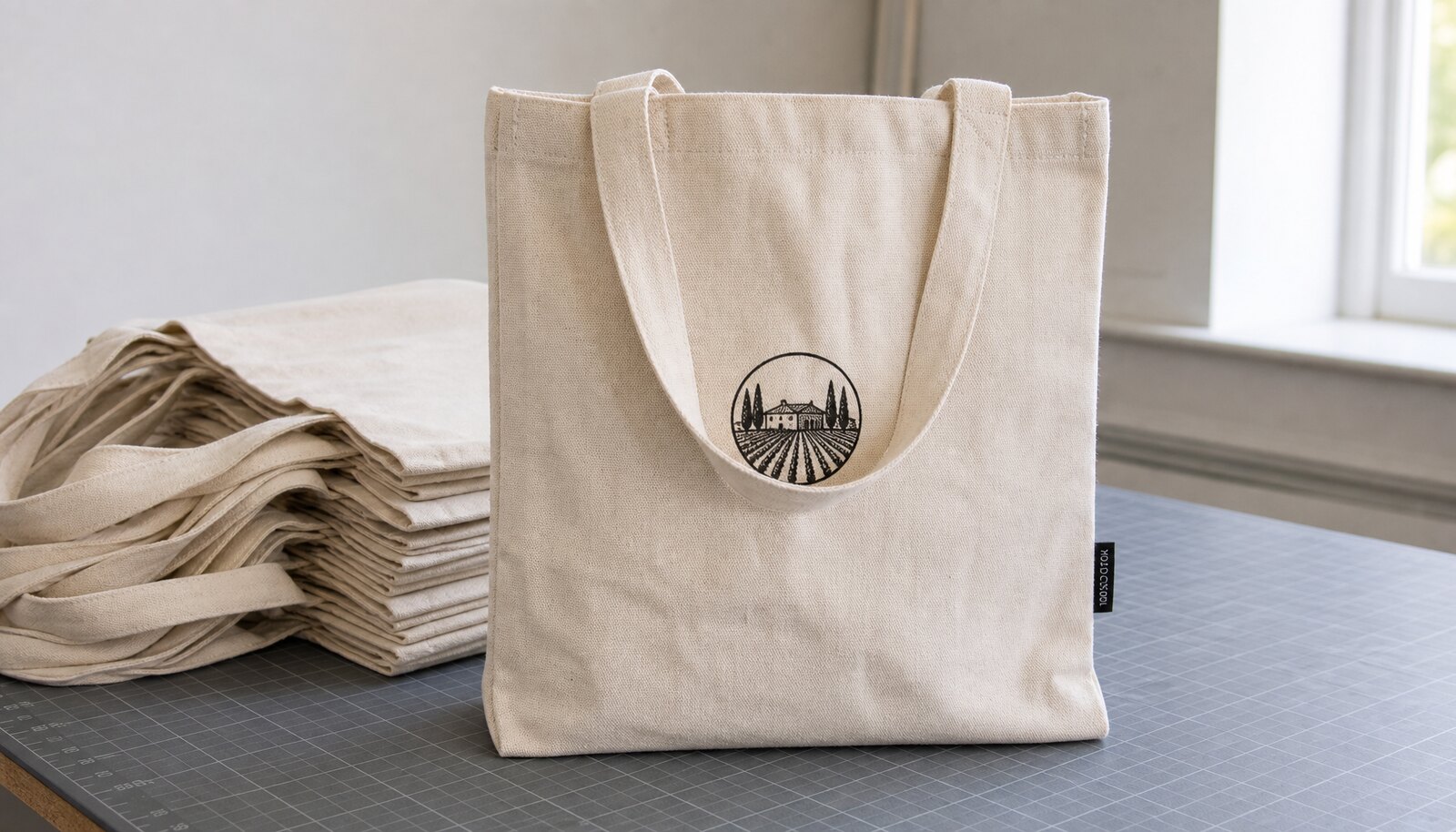
1) Why winery tote programs need a different inspection lens
Printed canvas shopping bags for wineries are not generic promo totes with a logo added at the end. They are used in tasting rooms, sold as retail merchandise, handed to guests carrying glass bottles, and often displayed on shelves where the bag itself becomes part of the brand. That means procurement has to evaluate appearance, load performance, and packing condition together. A bag can look fine on a sample table and still fail in a winery environment if the canvas is too limp, the handles are too short, or the print scuffs after folding.
The first buyer decision is use case. Separate three programs before you request quotes: a single-bottle carrier, a two-bottle carrier, and a general retail tote for wine accessories or mixed purchases. Each one changes the spec. A single-bottle bag may need a narrower body and better bottle restraint. A two-bottle carrier needs stronger handle anchoring and a base that does not collapse. A retail tote may not need dividers, but it still has to look clean enough for shelf presentation.
Do not let the supplier define the bag by artwork alone. Define it by what it must carry, how it will be displayed, and how long it must remain presentable after handling and packing. If those requirements are missing, the factory may optimize for the cheapest workable version rather than the retail result your winery needs.
For repeat programs, keep one approval file tied to a version number. Include the spec sheet, artwork file, approved sample photos, carton marks, and inspection notes. That reduces back-and-forth on reorder and makes it easier to spot if a later batch changes fabric shade, print position, or handle construction.
In procurement terms, the point is simple: the tote is part packaging, part product, and part brand surface. The inspection plan has to cover all three.
- Single-bottle and two-bottle bags should not share one default spec.
- Retail display matters as much as shipping durability.
- Version-controlled approvals reduce reorder disputes.
- The approved sample should match the exact bag style, not only the logo.
2) Fabric weight, weave, and finish: the first cost and quality decision
For winery retail programs, the practical canvas range is usually 10–14 oz, but the right weight depends on the use case. A 10–12 oz canvas can work for giveaways or accessory purchases, but it may look soft when a bottle is inserted and can show more bottle silhouette through the fabric. A 12–14 oz canvas generally gives better body, print stability, and perceived value. The tradeoff is higher material cost, slightly more sewing effort, and a heavier packed carton.
Treat fabric weight as a functional choice, not just an aesthetic one. Ask the supplier to quote the measured post-finish weight, not only a nominal description. Some mills quote greige fabric; others quote washed or calendared canvas. Those are not interchangeable. The same nominal canvas can feel very different after finishing, and that affects shape retention, print sharpness, and whether the tote stands up properly.
Also ask for the weave description and finish method. Buyers often assume “natural canvas” means one standard material, but batches can vary in weave tightness, surface smoothness, and shade. If the winery is using a light ink, metallic ink, or a detailed logo, this matters because the weave texture affects print clarity. Shade variation is normal within a defined range, but it should be controlled and documented rather than discovered after shipment.
If the tote must stand upright on a shelf or counter, ask for a firmer base solution. That may be a base board, bottom reinforcement, or a construction choice that keeps the lower panel from sagging. For bottle carriers, the bottom should resist collapse when the bag is lifted from the handles. Buyers do not need to prescribe the engineering, but they do need the supplier to prove that the bag shape and load path have been considered.
Ask for a sample card that shows the actual fabric basis, finish, and shade reference used for approval. Then keep that card with the golden sample so later reorders can be checked against a real physical reference.
- Quote fabric after finishing, not just greige or loom-state weight.
- Use 12–14 oz when the bag must carry bottles or hold its shape better.
- Set a shade range for natural canvas instead of assuming all natural rolls match.
- Request a base-stability solution if the bag must stand upright.
3) Print method and artwork control for winery logos
Most winery logos print best on canvas with screen printing when the artwork is simple, repeatable, and used across more than one order. Screen print usually gives the best balance of coverage, durability, and cost for one- or two-color designs. But the artwork has to be designed for the fabric, not just copied from a digital file. Small text, thin strokes, and tight reverse-out details can disappear into canvas grain if the mesh, ink deposit, or curing setup is wrong.
Heat transfer can be useful for short runs or more detailed artwork, but it should be treated as a conditional option, not a default upgrade. Transfers can show gloss differences, edge lift, or a less premium hand feel after repeated folding. If the bag is being sold in retail, not just used as a giveaway, that matters. The buyer should ask how the print will look after handling, not only on a flat sample board.
Make the print location measurable. Define the centerline, the distance from the top edge, and the maximum print area in millimeters or inches. That helps both the factory and the inspector. A vague instruction like “centered logo” is not enough for a repeat order. A dimensioned print window lets procurement compare first-off samples and spot drift before the run continues.
The sample must be checked after folding, handling, and light abrasion. A logo can look clean before packing and still pick up marks on the fold line or transfer tint to the back panel in the carton. Ask the supplier to show dry rub and fold rub results for the actual ink system. If the print is intended to be tactile or textured, set a separate standard so the finish is not mistaken for tackiness or cure failure.
For winery projects, consistency is often more valuable than decorative complexity. A clean, well-placed one-color logo on the right fabric usually outperforms a more elaborate design that cannot be repeated cleanly in bulk.
- Screen print is often the best fit for simple winery logos and repeat orders.
- Use heat transfer only when the artwork complexity or run size justifies it.
- Define print placement with dimensions, not only “centered.”
- Check the logo after folding and light abrasion, not just on a flat sample.
4) Handle strength, bottle load, and the tests that matter most
The handle is where tote failure usually shows up first. A winery bag often carries a denser load than a normal shopping tote because glass bottles are heavy, rigid, and hard on seams when the bag swings or tips. A handle that looks neat in a photo can still fail in use if the bartack is short, the stitch density is inconsistent, or the handle attachment sits too close to the top edge. Procurement should treat handle construction as a load-bearing requirement, not a cosmetic detail.
The quote should state handle width, drop length, reinforcement method, stitch pattern, and how the handle joins the bag body. If the bag is for bottle carry, ask the supplier to demonstrate a loaded-hold test using the intended bottle count and approximate total weight. Lifting the fully loaded bag by the handles is more relevant than an empty-bag pull test. Inspect for stitch opening, seam stretch, needle damage, and fabric tearing at the handle root.
If the bag carries two bottles, the load distribution matters. A divider or insert can reduce bottle contact and help the bottom stay flat, but it also adds QC risk. Ask whether the divider is stitched in, glued, loose, or built into the seam. A loose insert can shift. A glued insert can warp if the adhesive is uneven. A stitched insert may cost more but can hold shape better and be easier to inspect.
Handle length should match the real carry scenario. Handles that are too short make a bag awkward to carry from the tasting room to the car, while handles that are too long can drag, twist, or tangle in packing. Ask the winery team how guests will actually carry the bag. Shoulder carry, hand carry, and retail display each imply different dimensions. Standard catalog handle lengths are not a substitute for the intended use.
A good factory should be able to tell you not only how the handle is sewn, but how the handle has been tested. If the supplier cannot describe the test, the number of stitches, or the reinforcement layout, that is a procurement warning sign.
- Test the bag with the actual bottle count and weight.
- Require handle width, drop, reinforcement, and stitch details in the quote.
- Ask how the divider or insert is built and whether it can shift in use.
- Set handle length for the real carry route, not a generic tote dimension.
5) Inspection checklist with acceptance criteria buyers can actually use
A workable inspection plan for printed canvas shopping bags for wineries should follow the production flow: incoming fabric, cutting, printing, sewing, final packing, and carton release. The mistake many buyers make is checking only the finished bag. By then the factory has already invested labor, and the defect is expensive to correct. A staged checklist catches issues earlier and gives the supplier a clear stop point before a lot becomes a shipment.
Use defect classes so the factory knows what is unacceptable. Critical defects are safety or function failures, such as open handle stitches or a bag that cannot carry the agreed bottle load. Major defects affect retail appearance or usability, such as wrong dimensions, wrong print placement, or a visible seam issue on the front panel. Minor defects are cosmetic issues that do not affect function, such as a small loose thread outside the visible face. The important part is to define those limits before production starts.
Below is an inspector-ready table with practical acceptance criteria. It is not meant to replace your own internal standard, but it gives procurement a better starting point than “good workmanship.”
| Inspection item | Critical / major / minor | Suggested acceptance criterion | |---|---:|---| | Fabric weight | Major | Match approved spec within a defined tolerance, such as ±5% to ±8% depending on your bag class | | Shade / color | Major | No obvious lot-to-lot shift versus approved sample under normal retail lighting | | Finished dimensions | Major | Hold within a stated tolerance, commonly around ±0.5 cm to ±1.0 cm for tote dimensions, depending on size and construction | | Handle drop | Major | Match approved drawing within a defined tolerance; no visible asymmetry | | Seam allowance | Major | Use the agreed seam allowance consistently; no exposed raw edge beyond the allowed limit | | Bartack / reinforcement | Critical | No missed bartacks at handle roots or other load points | | Stitch quality | Major | No skipped stitches, open seams, or broken stitch lines in load-bearing areas | | Print placement | Major | Logo stays within the approved print window; no obvious off-center placement | | Print adhesion / cure | Critical | No tackiness, transfer, flaking, or cracking after dry rub and fold rub | | Bottle fit | Critical | Actual bottle count fits and the bag carries without seam stress or closure failure | | Carton count | Critical | Carton quantity must match the packing list; no mixed-count cartons unless approved | | Carton condition | Major | No crushed corners, broken flaps, or damaged edges that affect product integrity |
Continue the inspection at final pack-out. A perfectly sewn tote can still arrive damaged if it is folded against wet print, packed in an oversized carton that lets it move, or mixed across SKUs without clear labels. The acceptance criteria should therefore include fold direction, carton count accuracy, master carton marks, and photo evidence of packed cases before shipment.
If the supplier can send inline inspection photos, first-off photos, and final packing photos, procurement can catch problems while there is still time to correct them. That is especially useful when the shipment is tied to a tasting event or a seasonal launch date.
- Inspect fabric before cutting, not only after sewing.
- Approve the first-off print before the line continues.
- Use critical / major / minor defect classes in the PO or QC sheet.
- Require carton photos before shipment release.
6) Sample approval and supplier qualification: what serious buyers should ask for
Sample approval should not be treated as a courtesy step. It is the only practical way to prove that the supplier can reproduce the spec with the actual materials and production method. For winery bags, ask for a pre-production sample made from final fabric, final handle material, final print process, and final packing method. A lookalike sample is not enough. If the supplier changes the fabric lot or the print system after approval, the buyer no longer has a true reference point.
Procurement should also confirm who is actually making the bag. If you are buying through a trading company, ask for the actual factory name, production address, and which workshop or line will run the order. If you are buying direct from a factory, ask what evidence they can provide for capability: line photos, inspection records, sample retention policy, and the name of the person responsible for final sign-off. This is not about creating paperwork for its own sake. It is about knowing whether the supplier can repeat the approved sample in bulk.
A simple evidence pack is enough for most buyers. Ask for a factory profile, photos of sewing and print areas, incoming-material inspection method, final QC checklist, and a sample retention policy. If the supplier cannot identify where the bag is made or cannot show a sensible inspection flow, that is a procurement risk even if the price is attractive.
For recurring winery programs, keep a sealed golden sample and label it with the spec version, artwork revision, date, and approval owner. Attach it to the purchase order file and carton instructions. That way the factory, the buyer, and the warehouse are all comparing the shipment against the same reference.
The best suppliers welcome this level of control because it reduces rework. The suppliers that resist clear sample control are usually the ones most likely to create surprises later.
- Demand a pre-production sample from final materials.
- Confirm the real factory, not only the trading company contact.
- Ask for QC evidence and the name of the final sign-off owner.
- Keep a sealed golden sample tied to one spec version.
7) Packing, carton limits, and warehouse handling
Packing is often where quality degrades after sewing and print inspection. For winery retail programs, the bag must survive carton compression, vibration, and warehouse handling without print rub, crease marks, or edge damage. A tote that looks perfect on the line but arrives with a shiny scuff across the logo is still a quality failure. That is why packing belongs in the spec, not as a note added at the end.
Choose the packing method by channel. For wholesale and distributor orders, flat packing is usually the most efficient. It lowers carton cost and makes receiving easier. For premium retail sets, individual polybags or tissue wrap may be justified if presentation matters or if the printed face needs extra protection. Do not default to individual wrapping unless the channel requires it, because extra packing increases labor, freight volume, and waste.
Carton data should be part of the quote. Ask for carton dimensions, bag count per carton, gross weight, and stack pattern if the shipment will be palletized. That helps you estimate freight and receiving labor and tells your warehouse whether one person can safely handle the carton. If cartons are too heavy, the bags may still arrive intact, but the receiving process becomes slow and risky.
If the bags are moving through a distribution center, ask about carton compression resistance and edge crush risk. You do not need a laboratory report for every order, but you do need the supplier to choose outer packaging that survives the route. Weak cartons can flatten the bags, distort the print, or create corner damage even when the tote itself is well made.
Make sure every carton has clear SKU labeling, color labeling, and quantity marks. Mixed cartons are not always wrong, but they should be deliberate and documented. For most procurement teams, the safer default is one SKU per carton unless there is a strong operational reason to mix. That reduces receiving errors and helps tasting rooms get the right assortment the first time.
- Match packing style to the sales channel.
- Ask for carton size, gross weight, and bag count before approval.
- Avoid mixed cartons unless the warehouse plan explicitly allows them.
- Protect the printed face from rub and crease damage during folding.
8) Lead time, MOQ, and the schedule risks buyers should price in
Lead time is usually driven by fabric availability, print setup, and sewing capacity. A stock canvas bag with a simple one-color logo is relatively straightforward. A dyed fabric, special finish, custom insert, or multiple print locations makes the schedule more fragile. Procurement should separate sample approval time from bulk production time so the production clock does not start until the sample and carton plan are both locked.
MOQ can be misleading if you do not compare it with setup cost and repeatability. A low MOQ looks attractive, but it may come with higher unit price, fewer finishing options, or weaker packing control. A larger direct-factory order may be more economical if the winery will reorder the same bag through the season. Ask whether MOQ is tied to artwork, fabric color, or bag style, and whether changes to print size or a second print location trigger a new minimum or extra setup charge.
The biggest hidden schedule risk is rework. If the approval feedback is vague, the factory may proceed with the wrong logo placement, the wrong seam detail, or the wrong pack format. That is expensive to fix after the run starts. A buyer can reduce this risk with one marked-up sample, one dimensioned drawing, and one short written note that identifies the critical points: bottle count, handle drop, print window, and carton method.
For time-sensitive launches, build in one extra internal review before sample approval. That small buffer is usually cheaper than an air shipment or a rushed remake. If the supplier knows the schedule is real and the spec is controlled, they can plan cutting, printing, and packing more efficiently.
A practical rule: do not buy speed by accepting uncertainty. In tote sourcing, uncertain specs are what create delays.
- Do not start the bulk clock until sample and carton spec are approved.
- Treat MOQ, setup cost, and repeatability as one commercial decision.
- Build buffer time for internal review and final sign-off.
- Document critical measurements on the sample, not only in email.
9) Procurement comparison table: how to judge options without comparing the wrong numbers
When buyers compare suppliers, the biggest trap is comparing unit prices without the same scope. A lower quote can hide missing handle reinforcement, less control over fabric shade, or incomplete packing. The better comparison is total landed risk: price, MOQ, lead time, sample control, and evidence of factory capability. That gives procurement a much cleaner basis for award decisions, especially when the winery needs the tote to function as both packaging and retail merchandise.
Use the table below as a decision aid, not as a generic spec sheet. It helps teams see which sourcing route fits which program and what evidence should be requested before award. Pair it with the QC checklist and quote questions above.
| Option | Relative cost / control profile | Strengths | Risks | Best procurement check | |---|---|---|---|---| | Stock bag + print | Lower setup, faster start, limited customization | Fast for events and short campaigns | Shade mismatch, size compromise, weaker bottle fit if stock bag is not designed for wine | Confirm exact stock dimensions and bottle load before awarding | | Custom sewn bag | Better fit and brand control | Better shape retention and repeatability | Higher MOQ and longer setup time | Insist on a final-material sample and dimensioned drawing | | Direct factory | Good at scale, stronger process visibility | Better control over sewing, printing, and pack | Requires tighter RFQ discipline | Verify factory identity, QC flow, and carton evidence | | Trading company | Convenient for multiple bag styles | One contact for several SKUs | Less visibility into the actual maker | Ask for producer identity and sample source | | Two-bottle premium carrier | Strong retail value if executed well | Better upsell potential | More seam and insert complexity | Test handle pull, divider build, and carton weight | | Decorated giveaway tote | Useful for events and clubs | Lower decoration complexity | Can feel generic if fabric is too light | Check print rub and presentation after folding |
- Compare suppliers on the same scope, not just on unit price.
- Treat total landed risk as part of sourcing, not only the quote amount.
- Use the same sample and QC file for all offers.
- Do not award until carton and pack assumptions are clear.
10) RFQ close-out checks before you issue the PO
A strong RFQ for winery tote bags should ask for operational details, not just price. If the supplier can only send back a number and a delivery date, you still do not know whether the bag will meet retail or bottle-carry requirements. The best quote questions are the ones that force alignment on the exact material, exact production method, and exact inspection standard. That gives procurement something to compare beyond sales language.
Before issuing a purchase order, close the loop on three areas. First is bottle fit: can the bag hold the real bottle count without stress? Second is retail presentation: do the logo, shade, fold, and finish look clean enough for the tasting room or shelf? Third is shipment readiness: are the carton count, labels, and pack method clear enough for receiving without rework? If all three are confirmed, the order is much less likely to surprise you later.
Use this final buyer screen: is the fabric weight documented, is the print method suitable for the artwork, is the handle construction strong enough for the intended load, is the sample from final materials, and does the carton plan match the receiving location? If any answer is vague, pause the PO and ask for a revised quote or revised sample. A short delay before award is usually cheaper than fixing a bad lot after production starts.
For winery procurement teams, the goal is not just to buy a tote. It is to buy a repeatable branded item that arrives ready for retail, bottle carry, and distribution handling without extra sorting at the receiving dock.
- Require measurable specs, not marketing language.
- Close out bottle fit, retail appearance, and shipment readiness before PO.
- Revise the quote if any answer is vague or scope is incomplete.
- Keep the final approval file with the PO for repeat ordering.
Specification comparison for buyers
| Sourcing / spec path | Typical winery use case | Spec range to quote up front | What to verify before award |
|---|---|---|---|
| Stock canvas bag + custom print | Fast retail promotion, tasting-room giveaway, short seasonal campaign | 10–12 oz canvas; 1-color screen print; standard flat pack; low-decor setup | Confirm stock shade, exact finished size, print placement window, and whether the stock bag can actually hold the intended bottle load |
| Custom sewn canvas tote | Repeat winery retail line, branded gift bag, mixed SKU program | 10–14 oz canvas; custom handle drop; optional gusset or base board; carton pack by SKU | Request final-material sample, seam allowance, bartack plan, and a measured drawing with tolerances |
| Single-bottle carrier | Gift packaging for bottle sales and visitor purchases | 12–14 oz canvas; reinforced bottom; handle reinforcement; bottle restraint or narrower body | Verify bottle fit, upright stability, handle pull performance, and whether the bag protects label and glass corners |
| Two-bottle carrier | Premium retail, holiday sets, club pickup bags | 12–16 oz canvas; divider or insert; reinforced base; stronger handle anchoring | Confirm divider build method, loaded-hold behavior, carton weight, and drop/handling resistance |
| Direct factory source | Repeat programs where price, repeatability, and QC control matter | Quote fabric basis, sewing construction, print process, and inspection standard as one scope | Ask for factory name, line ownership, incoming fabric checks, in-line QC, and final carton photos |
| Trading company / multi-factory source | Buyers managing several bag styles or mixed packaging programs | Useful when one contact manages several specs, but scope must be frozen tightly | Verify the actual maker, sample source, and which plant will run the bulk order |
| Local decorator / reseller | Small runs, urgent reorders, local service requirements | May be convenient, but fabric and sewing control can vary if the bag is sourced elsewhere | Ask who prints, who sews, what bag body is used, and whether a pre-production sample comes from final materials |
| Decorated stock with limited customization | Price-sensitive programs where only logo and pack format change | Lower setup complexity; narrower choice of bag color, weight, and dimensions | Check that the artwork size, print method, and handle load still fit winery use |
Buyer checklist before sampling
- Define the winery use case first: tasting-room retail, event giveaway, bottle carry, club pickup, or premium gift packaging.
- Write the finished bag size, bottle count, and whether the bag must stand upright on a counter or shelf.
- State fabric basis in oz or GSM, plus composition, weave, and finish. Do not accept a quote that only says "canvas".
- Set handle width, handle drop, reinforcement method, and stitching pattern in measurable terms.
- Specify whether the bag needs a gusset, divider, base board, bottom insert, or bottle restraint.
- Lock the artwork with print method, color count, print size, placement tolerance, and any no-print margin.
- Ask for a pre-production sample made from final fabric, final print process, and final packing method.
- Require dimensional tolerances, not only a nominal dimension, so bulk lots can be checked consistently.
- Define carton pack quantity, carton dimensions, gross weight target, and pallet pattern if the bags will be warehoused or shipped by distribution center.
- Tell the supplier where the bag will be used, because winery retail display requirements are different from warehouse-only packing requirements.
Factory quote questions to send
- What is the exact finished canvas weight after finishing, and is it measured per square yard or per square meter?
- Is the fabric 100% cotton or a blend, and what shrinkage range should we expect after printing or washing?
- What weave and finishing method are being quoted, and can you show the measured post-finish weight on the sample card?
- What is the exact handle construction: width, folded or raw edge, reinforcement, bartack count, and stitch density?
- What is the seam allowance on the side seams, bottom seams, and handle attachments, and what tolerance do you hold in bulk?
- Which print method is included, how many colors are covered, and what placement tolerance can you hold from the approved artwork?
- Can you show dry rub and fold-rub results for the print after curing, and what is your acceptance standard for ink transfer or cracking?
- Does the quoted price include base board, divider, insert, gusset, or any reinforcement requested for bottle carry?
- What is the MOQ by bag style, fabric color, and artwork revision? What changes would trigger a new MOQ or setup charge?
- What lead time applies from sample approval to bulk shipment, and which steps most often extend it: fabric sourcing, print setup, rework, or packing changes?
Quality-control points to confirm
- Fabric identity check: confirm canvas type, weight, finish, and shade against the approved sample before cutting starts.
- Incoming fabric inspection: check for oil stains, broken yarns, shade bands, weaving skips, width variation, and visible slubs in the print zone.
- Cutting control: verify panel dimensions, grain direction, symmetry, and cutting consistency so the tote hangs straight after sewing.
- Print setup check: confirm artwork size, placement, registration marks, ink reference, and print window before the line starts.
- Print inspection: look for blurry edges, double hits, ghosting, pinholes, blocked text, overspray, color mismatch, and print drift across the run.
- Print durability check: run a dry rub and a fold rub after curing; reject sticky transfer, cracking, smudging, or tackiness.
- Sewing inspection: verify seam allowance, stitch count, bartack location, loose-thread trimming, and reinforcement at load-bearing points.
- Handle pull check: load the bag with the actual intended bottle count and weight, hold it by the handles, and inspect for stitch opening, seam stretch, or fabric tear.
- Bottle-fit check: insert the actual bottle size used by the winery and confirm fit, upright behavior, closure, and label clearance.
- Dimensional check: measure width, height, gusset depth, handle drop, and insert fit against the approved drawing and tolerance table.