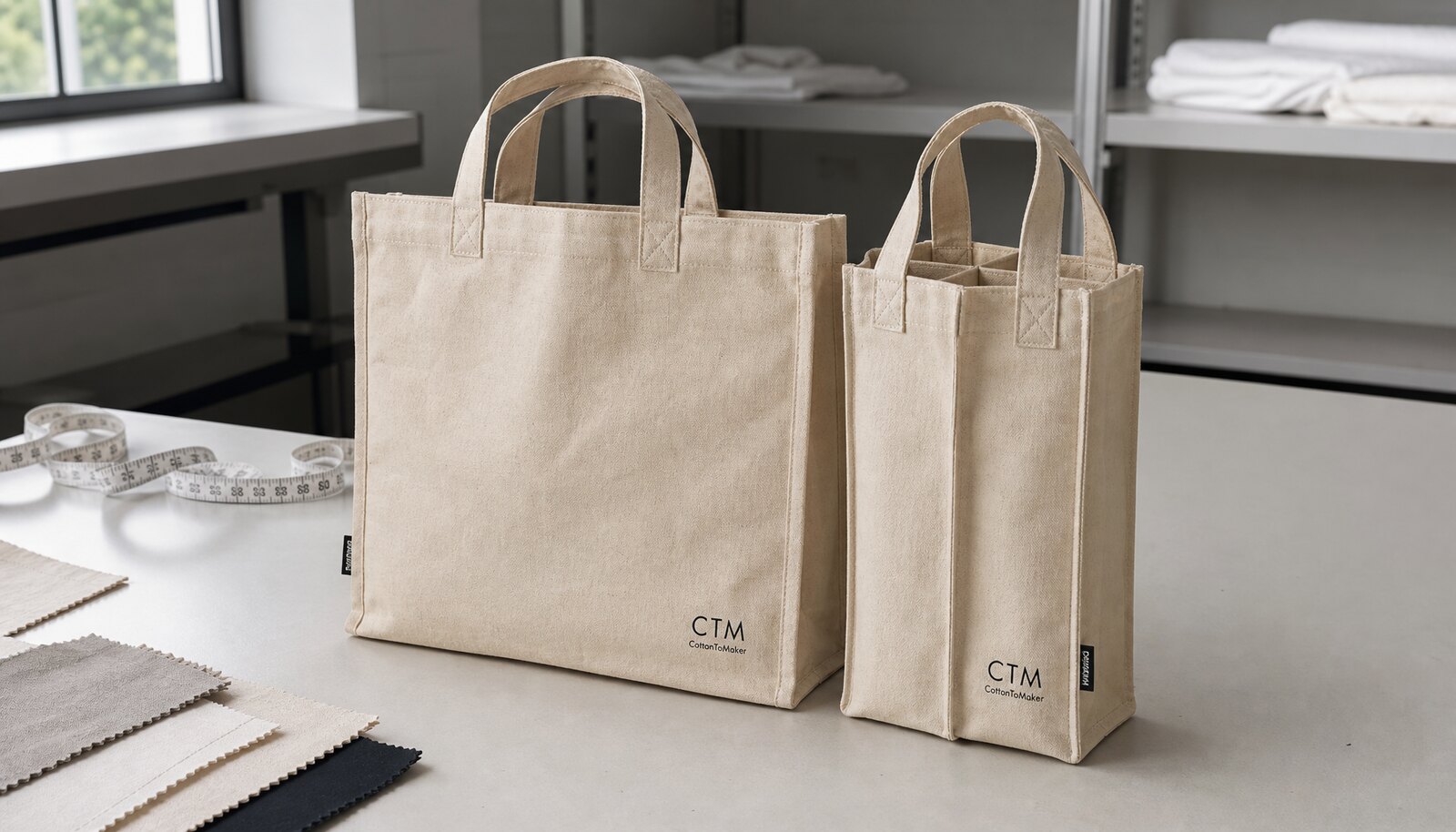
1. Start with the wine use case, not the tote style
Printed canvas shopping bags for wineries do different jobs depending on where they are used. A bag that leaves the tasting room as a gift carrier does not need the same structure as a retail tote sold on the shelf. The first mistake buyers make is quoting a generic canvas bag and assuming the factory will infer the use case. The factory can only price what it can measure, and wine packaging needs more than a logo and a rough size.
For a single 750 ml bottle, the bag usually needs enough internal room for the bottle body, neck, and a little clearance for insertion without scraping the print. A practical target is internal width around 115-125 mm, internal depth or gusset around 90-110 mm, and internal height around 340-360 mm. For larger Burgundy or Champagne formats, the bottle diameter can push the needed width closer to 125-145 mm and the height closer to 360-380 mm. If the bag is for two bottles, plan each compartment from the bottle dimensions first and then add room for a divider and seam allowances. External dimensions alone are not enough, because hems and seams can reduce usable space by 15-25 mm.
The buyer should also define the channel. Tasting-room packaging is often judged on presentation and convenience. Resale retail bags are judged on shelf look, print sharpness, and repeatability. Distributor or event bags may be judged by how safely they move heavier bottles. When you write the RFQ around the use case, the supplier can make better decisions on canvas weight, handle reinforcement, and packing.
- State whether the bag is for tasting-room retail, bottle gifting, distributor promotions, or everyday shopping.
- Confirm whether it must carry one bottle, two bottles, or mixed wine accessories.
- Tell the factory if the bag will be resold as merchandise or used only as protective packaging.
2. Lock fabric weight and finish before you talk about price
Canvas weight drives both the look and the durability of the finished bag. For most winery programs, 10-12 oz canvas is the practical middle ground. It gives enough body to print cleanly, holds shape better than lightweight cotton, and stays cost-effective for repeat orders. If the bag needs to feel more structured or survive repeated bottle carry, 14 oz canvas is the safer choice. If you go lighter than that, the bag may wrinkle excessively, show bottle outlines, and feel less premium after it is printed.
Do not approve a quote that only says 'canvas' or 'heavy cotton.' Ask for oz or GSM, weave density if the factory can provide it, and a sample swatch. Also specify the fabric finish. Natural unbleached canvas usually has a warmer, more rustic look. Bleached canvas gives a cleaner print surface and is easier to match to bright brand colors. Dyed canvas can look more premium, but it adds color consistency risk and can soften the look of the print if the ink does not sit well on the fabric. If the bag will be washed or reused often, ask the supplier to state expected shrinkage and any pre-shrinking process. For most buyer specs, a shrinkage limit of 3%-5% after normal laundering is a reasonable ceiling to request.
The sewing spec matters as much as the cloth weight. A useful minimum is 8-10 mm seam allowance on structural seams, a double-fold top hem around 12-15 mm, and 7-9 stitches per inch on load-bearing seams. Handle anchoring should use bar-tacks or a boxed-X pattern, and the handle should overlap into the body by enough fabric to prevent pull-out. A handle that looks acceptable in a photo can still fail in use if the anchor is too short or the stitches are too sparse.
- 10 oz works for promotional use and light retail packaging.
- 12 oz is the best default for winery retail bags and single-bottle gifting.
- 14 oz is better for premium shelf presentation and heavier carry loads.
3. Write the construction details like a production instruction, not a concept note
A good bag spec is easy for a sewing line to follow. It should show the finished dimensions, the internal usable dimensions, where the handles begin and end, and which seams are reinforced. The buyer should not rely on a simple sketch with a logo placement box. On a wine bag, a few millimeters can decide whether a bottle slides in smoothly or scrapes the side seam. That is why you want the pattern, not just the appearance.
The most important construction points are usually the bottom seam, side seams, handle attachment, and any divider panel. For a single-bottle bag, a reinforced bottom seam or a boxed bottom with an internal or external seam cover can improve durability and keep the bottle stable. For a two-bottle carrier, the divider must be sewn evenly and positioned so the bottles do not strike each other during walking or transit. Ask the supplier to show seam allowance on the sample and to confirm whether the construction uses a plain seam, overlock, flat-felled seam, or a turned-and-stitched finish. If the supplier cannot describe the seam method clearly, the quote is not detailed enough for procurement use.
Handle geometry is another detail buyers often under-specify. A comfortable handle drop for handheld retail use is different from a shoulder-carry tote. For wine retail, many buyers prefer a handle drop in the 220-280 mm range, but the exact target depends on the loaded height of the bottle. Handle width of 25-35 mm is common because it spreads the load and feels better in hand. The handle should be symmetrical, and the two sides should not twist after stitching or after a simple load test.
- Require double stitching or bar-tacks at every handle stress point.
- Ask the supplier to specify seam type, seam allowance, and stitch density in the quote.
- For two-bottle carriers, request a divider sample with actual bottles before approval.
4. Match the print method to the art, the run size, and the reorder plan
The right print method is not the one that looks best on a sample photo. It is the one that balances durability, color accuracy, unit cost, and reorder stability. For most winery logos, screen print is still the best default. It handles one or two colors cleanly, gives good opacity on canvas, and usually survives repeated handling better than a transfer-based process. If the brand artwork is simple, screen printing also tends to keep the surface feel more natural, which matters on a fabric tote meant to feel premium rather than plastic-coated.
Heat transfer or DTF can make sense when the art is complicated, the order is small, or you need to avoid the setup cost of screens. That said, the buyer should test for sheen, edge lift, and cracking on folds. Canvas is textured, so fine lines and very light halftones can break up if the supplier does not control pressure and curing well. Digital print is useful for highly detailed artwork, but on coarse canvas it may look softer than expected and can vary more from batch to batch. If the winery expects to reorder the same bag next season, the best strategy is often to pay the setup once, keep the artwork locked, and preserve the screens or digital settings for future runs.
A useful procurement rule is to specify the artwork in a way that can be measured. State the Pantone target or another clear color reference, the maximum color count, the print area in millimeters, and the minimum line thickness that must survive on canvas. If the logo contains fine details, ask the factory to confirm the minimum printable line width and the minimum gap between elements. On coarse fabric, very small negative spaces fill in quickly, and the result can look muddy even if the proof looked sharp on screen.
- Screen print for simple logos, high repeat volume, and the most durable finish.
- Heat transfer or DTF for short runs, seasonal artwork, or complex multicolor designs.
- Ask for a strike-off or printed sample and inspect it in daylight, not only under factory lighting.
5. Compare supplier routes on execution risk, not only on unit price
Procurement teams often compare canvas bags only by unit price, but the cheaper quote can hide more risk than savings. The real difference between suppliers is usually in accountability, sampling discipline, and how much of the process they control directly. A direct factory is usually strongest when the spec is already clear and the buyer expects a repeatable program. A trading company can be useful when the order combines multiple packaging items or when the buyer wants a single point of contact. A domestic converter can be the right choice when the schedule is short and the team values response speed over lowest landed cost.
The same is true for print methods. Screen print may cost more to set up but less per unit at scale. Heat transfer may look cheaper for a small run but can become expensive if the bag has to be reprinted after the first season. Digital print can reduce setup friction, but it may create variability if the artwork is not built for fabric. If you compare these options honestly, you can see where the money is going: not just into the bag, but into the reliability of the bag program.
A good sourcing comparison asks a simple question: what has to go right for this supplier to deliver the same bag twice? If the answer is unclear, the quote is not procurement-ready. The table below separates the main buying routes and process choices so the buyer can see the tradeoffs without relying on generic sales language.
- Ask every supplier to quote the same spec, same tolerance, same carton count, and same incoterm.
- Separate the price of the shell, print, label, packing, and freight so hidden margin is easier to spot.
- Compare repeat-order behavior, not only first-order pricing.
6. Put the dimensional spec into RFQ language the factory can follow
The fastest way to get an accurate quote is to write the bag like a product spec, not a brand concept. The RFQ should state the finished size, the usable internal size, the bottle type, the handle drop, the handle width, the seam allowance, and any divider or insert requirement. If the winery needs the bag to fit a known bottle line, include the bottle drawing or at least the bottle height, diameter, and closure style. If the bag is meant to carry both wine and accessories, state the combined load and the largest object it must fit.
Internal dimensions matter more than external dimensions because the seam and hem eat space. For example, a quoted body size of 320 x 350 x 100 mm may deliver less internal room once the seams are built. Buyers should ask the supplier to identify the working opening, the internal width at the body, and the maximum width available at the base. On bottle carriers, a few millimeters of clearance can decide whether the bottle slides in smoothly or gets stuck at the shoulder. The same logic applies to handles. A quoted handle length is not useful unless the buyer knows whether it is measured from top edge to top edge or from the cut length before sewing.
If you want a cleaner procurement process, include a drawing with numbered callouts. Call out the body, gusset, top hem, handle, reinforcement, divider, print area, and any label position. Then ask the factory to redline the drawing before sampling. That step catches misunderstandings early and prevents the common problem where the bag looks correct in a photo but does not match the intended bottle fit.
- Quote the bag using both finished dimensions and usable internal dimensions.
- Show whether the handle drop is measured from the finished top edge or from the stitched seam.
- Attach a simple technical drawing with callouts for seams, handles, print area, and divider placement.
7. Approve samples by testing fit, print, and workmanship separately
A sample should be approved in stages, not as a single yes-or-no moment. First check whether the bag fits the actual bottle or retail load. Then inspect the print, the stitching, and the visual finish. Finally, flex the bag and load it to see whether the structure holds up. A bag that photographs well can still fail when a bottle is inserted if the internal width is too tight or the seams pull the opening out of shape.
For winery packaging, a useful sample test is simple: load the actual bottle, lift the bag several times, set it down, and inspect the handle anchoring and bottom seam. Do the same with the bag partially full and fully full if it is supposed to carry more than one item. If the bag is a two-bottle carrier, test the divider under load and verify that the bottles do not collide. If the print will be folded repeatedly, inspect the print face after flexing to see whether it cracks, sticks, or shows white stress lines on the fold. The goal is not laboratory perfection. The goal is to catch predictable production problems before the factory makes hundreds or thousands of them.
The sample approval record should say what was approved. Record the fabric lot, the print method, the Pantone reference or visual target, the measured dimensions, and the exact sample date. Keep a retained golden sample on both sides if possible: one with the buyer and one with the supplier. That is the only practical way to settle a future dispute about whether a reorder matches the original bag.
- Test the bag with the actual bottle, not a generic weight block alone.
- Check print, stitching, handle feel, and bottle insertion as separate acceptance points.
- Retain one approved sample and one sealed reference swatch for reorders.
8. Set QC thresholds before bulk production starts
QC for printed canvas shopping bags for wineries needs to be more explicit than 'looks good.' The buyer should agree on measurable limits before the factory starts mass production. On dimensional control, a practical standard is +/- 5 mm for the body and gusset and +/- 10 mm for handle length unless the design is highly sensitive. On print placement, the logo should stay within +/- 5 mm of the approved position, and the colors should match the approved reference under normal daylight or store lighting. If your team uses lab measurement, a Delta E target of 2.5 or better against the approved master is a reasonable threshold for color-critical branding, but the exact standard should be written into the PO.
Structural testing should be tied to how the bag will actually be used. For a single-bottle tote, ask for a static load test of at least 8 kg for 30 minutes with no handle tear, seam opening, or bottom split. For a two-bottle carrier or a reinforced merchandise tote, 12 kg for 30 minutes is a more realistic control point. Add a simple drop test from 60 cm to a flat surface for five cycles and reject any bag that shows a broken handle, a split seam, or a divider failure. These are not extreme tests; they are just enough to reveal weak sewing or poor reinforcement before the bags ship.
Visual QC should also be defined. Agree on an AQL for major and minor defects, and make the defects concrete. Major defects include oil stains, misprint that changes the brand appearance, crooked handles, broken stitches, open seams, or contamination. Minor defects include small loose threads, faint smudges outside the visible area, or slight variation in fold. For retail-resale bags, buyers should usually be stricter than for back-of-house packaging. If the bags are going onto shelves, the defect tolerance should reflect that role.
- Use AQL 2.5 major / 4.0 minor or tighter for retail-resale bags.
- Reject any bag with oil stains, open seams, broken handles, or print lift that is visible at normal viewing distance.
- Require exact carton counts with zero short-ship tolerance and no mixed SKUs unless approved in writing.
9. Packing, labeling, and warehouse handling should be part of the spec
Packing can help or hurt the program. Flat packing is usually best for export and warehouse efficiency because it keeps cartons compact and makes receiving easier. Retail folding with tissue or an insert can improve shelf presentation, but it adds labor and increases carton volume. The right choice depends on who is opening the carton and where the bag will be used. If the retailer or distribution center values speed and count accuracy, flat pack is usually the better choice. If the bag is a premium gift item, presentation may be worth the extra packing cost.
The buyer should define the carton spec as carefully as the bag spec. Ask for carton count by SKU, outer carton dimensions, gross weight, and carton strength if the bags are heavy or bulky. For export, 5-ply or 7-ply cartons are often more appropriate than thin cartons, especially when the order includes 14 oz canvas or reinforced bottle carriers. Keep the gross carton weight manageable for manual handling, usually below 15-18 kg if the warehouse will receive by hand. Labels should include SKU, size, color, quantity, PO number, carton number, and country of origin. If there is any risk of SKU mix-up, use a barcode or scannable identifier.
One more detail is often overlooked: print cure and folding sequence. If the print is not fully cured before folding and packing, the ink can block or scuff inside the carton. Ask the supplier what curing time they use and whether they pack immediately after printing or after a resting period. That question catches more real-world defects than a generic request for 'good packing.'
- Specify flat pack or retail fold and whether polybags are needed.
- Set carton count, carton label format, and maximum gross weight.
- Ask for photos of packed samples before mass packing starts.
10. Build the timeline and reorder plan around seasonal winery demand
Lead time is a schedule, not a promise. For a first order, sampling often takes 5-10 days if the artwork is ready and the base material is in stock. Bulk production commonly takes 25-40 days after approval, but the schedule can stretch if the factory must dye canvas, build custom labels, wait for screen setup, or coordinate export booking. Seasonal winery programs make this more sensitive because holiday gifting and event calendars are fixed long before the factory quote is finalized. Buyers should work backward from the event date and leave enough time for sample revision, approval, and freight.
A practical timing plan is to freeze the artwork early, approve the sample before the season gets busy, and keep one buffer week for corrections. If the bag is tied to a harvest event, holiday set, or launch window, ask the supplier for the latest safe order date rather than just the nominal production time. The latest safe order date should include the time needed to correct a failed sample, replace materials, and clear export documents if the shipment crosses borders. That is the number procurement should trust, because it reflects the real path to delivery.
For repeat orders, a cleaner process usually means lower risk and better pricing. Keep the approved spec, a golden sample, the print reference, and the carton spec together so a reorder does not rely on memory or old email threads. If the design changes, treat it as a new version and note exactly what changed: size, fabric, print, label, or packing. Stable version control is one of the simplest ways to prevent a winery tote from drifting over time while still letting the buyer improve the program when needed.
- Ask for sample lead time, bulk lead time, and the latest safe order date for your event.
- Reserve extra time if the order needs custom dyeing, woven labels, or revised artwork.
- Keep one approved sample and one written spec file for reorder consistency.
Specification comparison for buyers
| Spec decision | Recommended option | When it fits | Buyer risk to check |
|---|---|---|---|
| Direct factory sourcing | Best for repeat programs with a frozen spec, approved sample, and stable artwork | Use it for annual tasting-room bags, distributor gifts, and reorders where you want the same sewing and print every time | Confirm who actually prints and sews the bag, and ask for a named QC owner instead of a sales-only quote |
| Trading company or sourcing agent | Best when the order mixes bags with other winery packaging items or needs multi-factory coordination | Use it when your team wants one point of contact for bags, boxes, tags, and inserts | Added margin can hide the real factory, blur defect responsibility, and make repeat pricing less predictable |
| Domestic converter | Best for shorter lead times or smaller launch quantities | Use it when the launch date is tight or the winery needs closer communication during sampling | Unit cost is usually higher, and the range of available canvas weights and finishes may be narrower |
| Screen print | Best for simple logos, text, and repeat orders with a stable design | Use it when the art is 1-2 colors and the same bag will reorder across seasons | Setup charges and color registration need proof, and thick ink can feel heavy if the print area is too large |
| Heat transfer / DTF | Best for short runs or complex multicolor art that would be expensive to screen print | Use it for pilot programs, seasonal artwork, or detailed graphics with gradients | Check for sheen, cracking on folds, and lower long-term durability on coarse canvas |
| Digital print on fabric | Best for very small orders where setup must be minimal | Use it when the art is photographic or color-heavy and the run is too small for screens | Canvas texture can soften detail, and print consistency may vary more than screen print |
| 10-12 oz canvas | Best balance of cost, handfeel, and structure for most retail wine totes | Use it for tasting-room retail packaging, single-bottle carry bags, and general shopping use | If the handles are weak or the bag is overfilled, lighter canvas can sag and look thin after print curing |
| 14 oz canvas | Best for a more structured, premium feel and better shelf shape retention | Use it for resale totes, heavier two-bottle programs, or bags that must feel substantial in hand | Higher cost, more carton weight, and sometimes slower sewing because the fabric is stiffer |
| Flat pack with inner polybag | Best for export, warehouse efficiency, and high-volume receiving | Use it when the retailer or DC wants compact cartons and controlled SKU counting | Print can scuff if packed before full cure, and over-compression can crease the canvas face |
Buyer checklist before sampling
- Define the use case first: single-bottle carry, two-bottle gifting, tasting-room retail, or mixed shopping use.
- State the actual bottle dimensions you need to fit, not just the bottle label or nominal size.
- Lock the canvas weight in oz or GSM, the fabric finish, and whether the bag should be natural, bleached, dyed, or washed.
- Provide the print file, Pantone targets, print area, and whether one-side or two-side printing is required.
- Specify handle length, handle width, seam allowance, and whether the handles need bar-tacks, boxed-X reinforcement, or both.
- Set a load target in kilograms and require the supplier to test against that target before bulk release.
- Confirm finished dimensions, acceptable tolerance, divider requirements, and whether the bag must stand upright when loaded.
- Define packing: flat pack or retail fold, inner polybag yes or no, carton count, carton marks, and barcode requirements.
- Ask for a pre-production sample, approved swatch, and one retained golden sample for reorder control.
- Request a written summary of who is responsible for printing, sewing, packing, inspection, and export documentation.
Factory quote questions to send
- What exact canvas weight, weave density, and finish are you quoting, and can you send a swatch or spec sheet?
- What are the finished dimensions, internal usable dimensions, handle drop, handle width, and seam allowance on the quoted bag?
- Is the logo screen printed, heat transferred, or digitally printed, and what is included in the setup charge?
- What is the MOQ by bag style, fabric color, print color count, and any custom label or insert requirement?
- What are the sample lead time, bulk lead time after approval, and the specific steps that can delay production?
- What load test do you use for this bag, and what result do you consider a pass for single-bottle and two-bottle use?
- What is your QC standard for print alignment, stitching strength, dimensional tolerance, and carton count accuracy?
- What packing method is included in the unit price: flat pack, inner polybag, tissue, carton count, and carton marks?
- What is the quote basis: EXW, FOB, CIF, or DDP, and which costs are excluded from the unit price?
- Can you share photos of a similar winery tote you have produced, including close-ups of the seams, handles, and print finish?
Quality-control points to confirm
- Finished dimensions within +/- 5 mm for bag body and gusset, and +/- 10 mm for handle length unless a tighter tolerance is agreed in the PO.
- Print placement within +/- 5 mm of the approved artwork position, with no visible misregistration that distracts from the logo.
- Print adhesion must pass a tape pull or equivalent rub test with no meaningful ink lift, flaking, or cracking after normal folding.
- Single-bottle bags should survive a static load of at least 8 kg for 30 minutes without seam opening, handle tear, or bottom failure.
- Two-bottle or reinforced bottle carriers should survive a static load of at least 12 kg for 30 minutes with no seam opening greater than 3 mm.
- Drop test: loaded sample dropped from 60 cm to a flat surface 5 times, with no broken handle, no bottom split, and no loose divider failure.
- Stitching: no skipped stitches longer than 5 mm, no loose threads longer than 20 mm on visible faces, and no handle twist that affects use.
- Visual defects: agree an AQL of 2.5 major / 4.0 minor or tighter for retail-resale bags, with zero tolerance for oil stains or contamination.
- Carton count must match the PO exactly, with zero short-shipment tolerance and no mixed SKUs in the same carton unless approved in writing.
- Outer cartons must be labeled with SKU, size, color, quantity, PO number, carton number, and country of origin, and all marks must be legible at receiving.