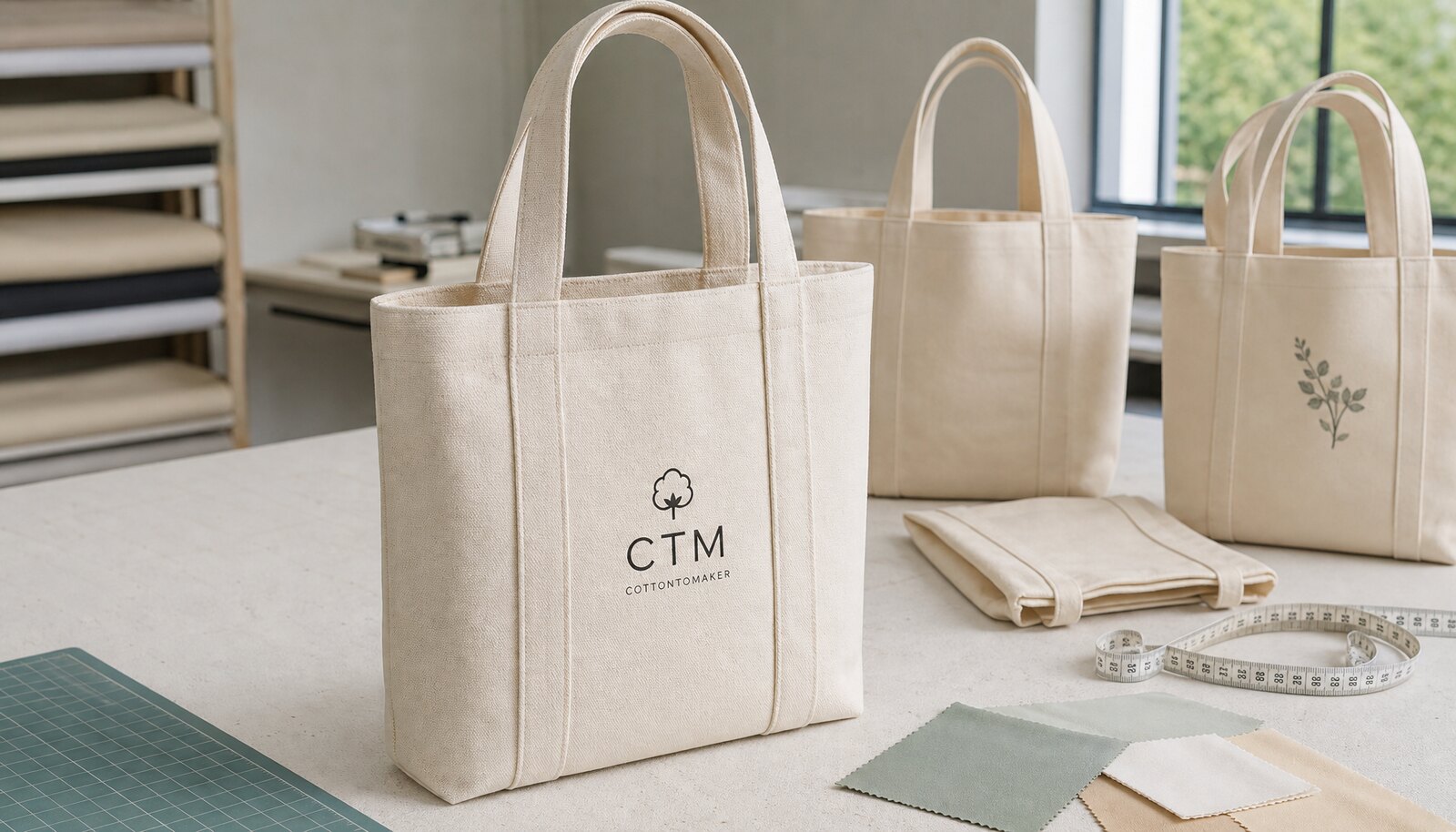
Start with the bag's job, not the logo
Printed canvas shopping bags for wellness brands look simple, but the sourcing brief should begin with the commercial job the bag needs to do. A tote for a spa retail counter, a studio welcome kit, and a subscription add-on can all use the same logo, yet they need very different construction, packing, and price points. If the bag carries glass bottles, jars, or a mixed product bundle, the risk is not the artwork. The risk is seam failure, handle stretch, print wear, or a shape that collapses when loaded.
For procurement, the most useful input is the use case and load case together. State what the bag will carry, how heavy that load is at peak, whether the bag is resold or given away, and where it will be handed over. That one paragraph tells the supplier whether to quote a lightweight promo bag, a structured retail tote, or a reusable bag that needs a stronger canvas and reinforcement. It also helps separate nice-to-have features from what the bag actually needs to survive use.
A buyer checklist that starts with the logo usually gets a quote that is easy to send and hard to use. A buyer checklist that starts with the load, pack-out, and channel gives the factory enough information to price the right fabric, construction, and packing method on the first pass.
- Define the contents and the heaviest expected fill.
- State whether the bag is for resale, event use, or wholesale fulfillment.
- Note whether the bag must feel premium, stand upright, or fold flat for storage.
Turn the concept into a measurable spec
A good tote brief replaces adjectives with dimensions. Size is important, but it is only one part of the spec. Handle drop, gusset depth, top hem, seam allowance, and reinforcement all affect how the bag carries weight and how it presents on shelf. If the bag needs a certain silhouette, ask for a drawing with front, side, and flat dimensions so the factory quotes the same shape you expect to receive.
That spec should also define the print area and safe zones. A logo placed too close to the seam can distort during sewing, while a design placed too low can disappear when the bag is filled. Give the supplier the artwork dimensions, the distance from the top edge, and any no-print areas around the gusset or handle attachments. If the bag includes an inner label, hangtag, woven tag, or barcode sticker, show those placements on the same drawing so there is no ambiguity in production.
For wellness brands that care about presentation, the bag's shape matters as much as the logo. A softer cotton canvas may be fine for a folded gift bag, while a more structured weave may be needed for a retail tote that should keep its form. The supplier can only quote that difference if the brief captures it clearly.
- Specify overall size, gusset, handle drop, and top hem on one drawing.
- Mark safe zones for print, tag placement, and reinforcement points.
- Say whether the bag should hold shape, fold flat, or stand upright when filled.
Choose canvas weight and construction by program type
Canvas weight is where the cost and durability tradeoff becomes real. Lighter canvas can work for promotional use, but it often looks softer and can distort once it is loaded. Midweight canvas is the common middle ground for wellness retail because it balances price, handle feel, and presentation. Heavier canvas gives more structure and a stronger retail impression, but it also adds cost, bulk, and sometimes slower folding or packing.
Weight alone is not the whole story. Weave density, yarn quality, pre-washing, and shrinkage behavior can change how the bag feels and how the print lands. A tight weave usually supports cleaner artwork and a more polished surface, while a looser weave may look more rustic but can soften fine detail. If the bag will be washed or used repeatedly, ask how the canvas behaves after laundering or extended folding. If the bag is a one-time event piece, a simpler build may be enough as long as the print remains readable.
Use the fabric choice to match the program, not the other way around. A studio welcome tote does not need the same build as a retail bag carrying jars and bottles. The best quote is the one that reflects the actual use case, not the supplier's default canvas weight.
- Use lighter canvas for short-life promo programs and tighter budgets.
- Use midweight canvas for most wellness retail and wholesale programs.
- Use heavier canvas when the bag must carry more weight or present as a premium retail item.
Pick the print method and prepare artwork for canvas
Print choice should follow the artwork and the fabric, not brand preference alone. Screen printing is usually the cleanest option for bold logos, simple spot colors, and reorder programs because it is repeatable and cost-efficient at scale. If the artwork has gradients, photographic detail, or many colors, a digital or transfer process may be possible, but it deserves more scrutiny because the finish can behave differently on textured canvas. Embroidery, woven patches, or sewn labels can also be useful when the design needs more texture than ink.
Artwork prep matters as much as the print method. Thin strokes, tiny text, and crowded detail can break up on woven canvas. Ask the designer to simplify the file if needed, and confirm the final print size, color count, and placement before sampling. If the brand uses a precise color, give the supplier a physical reference and a written tolerance, then approve the proof under the same lighting conditions you will use to judge bulk samples. A screen proof on a monitor is not enough when the final material is natural fiber with visible texture.
The print spec should also say how the ink will be cured and how the bag will be evaluated after folding. A print that looks clean at first glance can still crack, smear, or transfer if the curing process is weak or if the bag is packed before it has properly set.
- Use screen print for simple logos and repeat orders.
- Use more complex print methods only when the artwork truly requires them.
- Reduce fine detail if the canvas weave will not support it cleanly.
Compare supplier routes before you compare price
The same tote can be quoted very differently depending on who is actually making it. A direct factory quote usually gives the most transparent pricing and the clearest path to control, but it asks more of the buyer in terms of specification, follow-up, and approval discipline. A trading company can simplify communication and consolidate multiple SKUs, but the buyer must know whether the real factory is disclosed and whether the trading margin is hidden inside the unit price. A sourcing agent can be valuable when local follow-up matters, yet the agent does not own production unless the contract says so.
For wellness brands, the right route depends on program maturity. If the design is locked and the brand expects repeat orders, direct factory sourcing often gives the best blend of cost and control. If the assortment is still changing, a trading partner may reduce friction by managing several variants at once. If the bottleneck is communication or local inspection, a hands-on agent can add value, but only when the scope is explicit and the buyer still gets approval rights on materials, samples, and substitutions.
Domestic or nearshore converters make sense when speed matters more than lowest ex-works cost. They can be a good fit for smaller MOQs, short revision cycles, and programs where the bag is decorated or packed closer to the market. The tradeoff is usually higher unit cost and fewer options on fabric or construction, so they are best used when lead time or flexibility is the real priority.
- Ask who actually sews and prints the bag.
- Require the production site name, not just the sales office.
- Make responsibility for defects and corrective shipment explicit in writing.
Verify certifications, claims, and compliance documents
If the bag uses organic, recycled, or low-impact materials, the claim must be supported by the right paperwork. Buyers should ask for the certificate, the scope, the issuing body, and the link between the claimed material and the ordered lot. A valid document is not enough if it does not cover the actual fiber, the factory, or the transaction path that appears on the invoice and packing list. The same logic applies to social audits and factory compliance records: ask for current documents, not a generic promise.
This is where region-specific tradeoffs matter. Large export hubs in Asia often have deeper access to fabric mills, print capacity, and shipping infrastructure, which can help with scale and repeatability. Nearshore or domestic suppliers may be easier to audit, faster to revise, and simpler to reach when timelines are tight. Neither route is automatically better. The buyer should choose the route that matches the bottleneck: cost, speed, certification visibility, or communication. For a wellness brand that needs both sustainability claims and dependable pack-out, the key is not geography alone. It is whether the supplier can prove the claim, repeat the build, and ship consistent cartons.
If the order must satisfy retailer or marketplace requirements, confirm the exact document set before award. That can include business registration, material certificates, test reports, social compliance evidence, and any country-of-origin documents needed for customs or internal audits. Ask the supplier to tell you what they can provide before you place the order, not after the shipment is ready.
- Match the certificate scope to the actual fiber and lot being ordered.
- Ask for current documents with dates, scope, and issuer visible.
- Confirm whether the factory, mill, or converter is the named holder of the claim.
Build an RFQ that lets you compare like for like
Many tote quotes are impossible to compare because each supplier quietly assumes a different fabric weight, print method, or packing standard. A useful RFQ removes that ambiguity. Ask every supplier to quote the same canvas weight, the same bag dimensions, the same handle construction, the same print method, and the same pack-out. Then require line items for setup, screens or plates, sample charges, packing, and any special inserts. If one quote includes a stronger carton or better print cure, that difference should be visible rather than hidden inside a unit price.
The RFQ should also reflect your actual buying path. If you plan to start with a small test order and then reorder at scale, ask for pricing at the quantities you are likely to buy, not only the supplier's preferred break. A quote that looks cheap at 5,000 units may be less useful than a quote that is stable and transparent at 1,000 and 3,000. Ask about payment terms, price validity, and whether the supplier can hold the same build on reorder without retooling the artwork or changing the fabric source.
A well-built RFQ also makes supplier behavior visible. If a supplier answers with a low unit price but vague exclusions, that is a sign to slow down. If they itemize the quote, explain the process, and point out risks early, that is usually a better commercial partner than the cheapest first number.
- Quote the same spec across all suppliers.
- Separate setup and tooling from unit price.
- Ask for price breaks at the order sizes you actually plan to use.
Treat sampling as a bulk-readiness check
A sample is only useful if it mirrors the final production path. Sales samples can help with early design discussion, but they do not prove the final canvas, the final print method, or the final packing process. The sample you approve should be a pre-production sample built from the final material and sewn or printed in the same way the bulk order will be made. If the supplier sends a photo-only approval, that is not enough for canvas totes where texture, handle feel, and seam finish are part of the product.
When the sample arrives, inspect it like a buyer who expects the bulk lot to look exactly the same. Measure the body, handle drop, and gusset. Check the inner seams, the handle anchor, the print edges, and the top hem. Fold the bag several times to see whether the print cracks, the seams twist, or the handle stretches. If the bag is meant to carry real product, load it with the intended contents and confirm that it still hangs, sits, and carries the way your retail team expects.
Keep one signed golden sample and one signed spec sheet under revision control. That makes it clear which version was approved if the supplier later proposes a shortcut or a replacement material. If the sample is not right, do not move to bulk just because the timeline is tight. Fix the sample first, because the bulk order will only repeat the approved process more times.
- Approve a pre-production sample, not only a sales sample.
- Measure the bag and inspect it under real load.
- Keep one golden sample and one versioned spec sheet for reference.
Write QC checks that reflect the real risk
Quality control for printed canvas shopping bags should be practical, not decorative. The goal is to catch failures that affect use, brand presentation, or shipment. Start with the basics: fabric weight, dimensions, handle drop, seam finish, print placement, and pack-out. Then add a test plan that fits the product. If the tote carries heavy bottles, the handle and seam test should be more demanding than if it only carries brochures or a light retail set. The acceptance criteria should be written in the PO or inspection plan so the factory knows what it is being judged against.
When a supplier cites a test or standard, ask what was actually measured and what method was used. Do not accept a generic pass/fail claim without context. For seam and handle performance, ask for a documented pull or load test that reflects the expected use. For print durability, agree in advance on a rub or handling check appropriate to the print method. For color-sensitive programs, compare the bulk sample to a physical master under standard light, not just a screen file. The point is to tie each check to the failure mode you are trying to avoid.
Packaging belongs in QC too. A good bag can still arrive with crushed corners, count discrepancies, or moisture damage if the carton spec is weak. Inspect case marks, inner counts, carton condition, and whether the packing orientation protects the printed face. If the shipment is long-haul or passes through humid transit, ask for the moisture protection the route actually needs rather than assuming a standard carton is enough.
- Define pass/fail criteria for the real use case, not a generic tote.
- Use documented load or pull tests for handles and seams.
- Inspect carton counts, marks, and protection before the shipment leaves the factory.
Control packing, freight, and reorder consistency
Packing is often the last place where quality slips. Canvas bags crease easily, and loose stacking can make a good product look careless before it reaches the warehouse. Specify the fold direction, inner count, carton count, and whether each bag needs an individual polybag or tissue wrap. If the print face is sensitive to rub, the stack direction should protect the decoration instead of letting it scrape against the next bag in the carton. If inserts, tags, or barcodes are part of the pack-out, define the point in the process where they are added so the warehouse receives the product in the exact state it expects.
Freight terms matter because they affect responsibility. Ask who books the export shipment, what cartons are included in the quoted rate, and whether the supplier understands the route and any pallet or container limits. A quote that looks good ex-works can become expensive if the packing is not compatible with the chosen lane. If you expect repeat orders, document the exact revision of the spec, artwork, carton format, and label template so the reorder does not drift when a different person handles the file later.
For wellness brands, consistency is part of the product. The second order should not feel like a different tote because the supplier changed the canvas source, the print setup, or the carton pack. The best control is a clean spec, a signed sample, and a reorder file that records what was actually approved rather than what was only discussed in email.
- Specify fold direction, pack count, and protection for the printed face.
- Match carton size to the actual freight lane and warehouse handling.
- Keep the approved spec, artwork, and carton format locked for reorders.
Specification comparison for buyers
| Supplier route | Best fit | Strengths | Tradeoffs | What to verify before award |
|---|---|---|---|---|
| Direct factory | Stable programs with repeat orders and a clear spec | Best pricing transparency, direct access to production, easier defect traceability, and stronger control over sample-to-bulk consistency | Requires more buyer time on communication, artwork approval, and factory management; quality can still vary if the site subcontracts work | Confirm the actual production site, in-house versus outsourced sewing/printing, and who signs off on final QC |
| Trading company | Buyers that need multiple SKUs, mixed materials, or a broader sourcing network | Can consolidate orders, simplify communication, and sometimes secure capacity faster than a new factory search | Margin is embedded in the price and the real factory may be hidden, which makes defect ownership and process control less clear | Ask for the factory name, production address, sample source, and written responsibility for defects and corrective shipments |
| Sourcing agent | Programs that need local follow-up, factory visits, and coordination across several suppliers | Useful for on-the-ground communication, sample chasing, and inspection coordination | The agent is not the producer, so authority over schedule and quality can be limited unless the contract is explicit | Define exactly what the agent controls, what evidence they must provide, and whether they can approve substitutions without buyer sign-off |
| Domestic or nearshore converter | Short lead times, smaller MOQs, and programs where decoration or pack-out happens closer to the market | Faster revision cycles, easier communication, and simpler freight for some buyers | Usually higher unit cost and fewer fabric or construction options than a large export factory | Check whether blanks are imported, who handles decoration, and whether the converter can repeat the same spec on reorder |
| Material | 8-12 oz cotton canvas, 120-220 gsm cotton, recycled cotton, or blended fabric selected by use case and target price | Before price comparison | Different cloth weights, backing, or certification claims make quotes hard to compare | |
| Construction | bag size, gusset, handle drop, seam allowance, stitch density, reinforcement patch, and loading expectation | Before sampling | Weak stress points create returns and failed inspections | |
| Decoration | screen print, heat transfer, embroidery, woven label, or hangtag matched to fabric texture and brand durability needs | Before artwork approval | The wrong method can crack, bleed, pucker, or fail on the chosen fabric | |
| MOQ | Base MOQ plus change drivers | During quote review | Custom colors, trims, and packing can change minimums |
Buyer checklist before sampling
- Write the real use case first: retail shopping, event gift, studio merch, subscription add-on, or wholesale fulfillment.
- List the heaviest realistic fill, not just the average product mix, so the bag is built for the worst-case load.
- Lock the size, gusset, handle drop, seam finish, and top hem before asking for pricing.
- State whether the bag must stand upright, fold flat, or hold a display shape on shelf.
- Choose the print method early and simplify artwork if the canvas weave will not hold fine detail cleanly.
- Ask for a pre-production sample made with final fabric, final print method, and final pack-out.
- Request itemized pricing for unit cost, setup, screens or plates, packing, and sample charges.
- Compare at least two quantity breaks that match your actual launch and reorder plan.
- Verify the supplier route, production site, and any subcontracting before placing the order.
- Put defect ownership, corrective action, and replacement freight responsibility in writing.
Factory quote questions to send
- What is the exact fabric weight, fiber content, and weave type, and can you share the mill or material source if requested?
- Is the canvas raw, bleached, dyed, or pre-washed, and what does that mean for shrinkage and print behavior?
- Which print method is included, how many colors are covered, and what are the setup charges for extra colors or artwork changes?
- Is sewing and printing done in-house, or do you subcontract either step?
- What is the MOQ per size, per artwork, and per fabric color?
- What sample do you provide first, and does the pre-production sample match the final fabric, print, and packing?
- What is the lead time for sample, production, inspection, and export booking, and which steps are outside your control?
- How are cartons packed, labeled, and protected, and do you provide carton dimensions and gross weight in the quote?
- Can you quote the same spec at 1,000, 3,000, and 5,000 units, with setup charges separated from unit pricing?
- Which certifications or compliance documents can you provide for the material, factory, and shipment paperwork, and are they current and in scope?
Quality-control points to confirm
- Fabric weight and fiber content should match the approved spec, with any mixed lots or substitutions requiring written approval before cutting.
- Finished dimensions, handle drop, and gusset depth should be checked against the golden sample and the signed spec sheet before bulk packing.
- Seams, handle anchors, and reinforcement points should be inspected for consistent stitch path, no skipped stitches, no open ends, and no loose thread at stress points.
- Use a load test that reflects the actual use case, and require the supplier to document the method and pass/fail criteria rather than relying on a vague strength claim.
- Print placement, coverage, and registration should match the approved artwork proof, with no seam collision, bleeding, or obvious misalignment.
- If brand color matters, approve against a physical reference under standard viewing conditions instead of relying only on a screen proof.
- Rub, fold, or abrasion checks should be agreed to in advance for the chosen print method, with visible transfer or cracking treated as a failure if it affects retail use.
- Cartons should match the PO count, SKU, color, and label format exactly, and the pack-out should be checked for crushing, moisture exposure, and count loss before shipment.