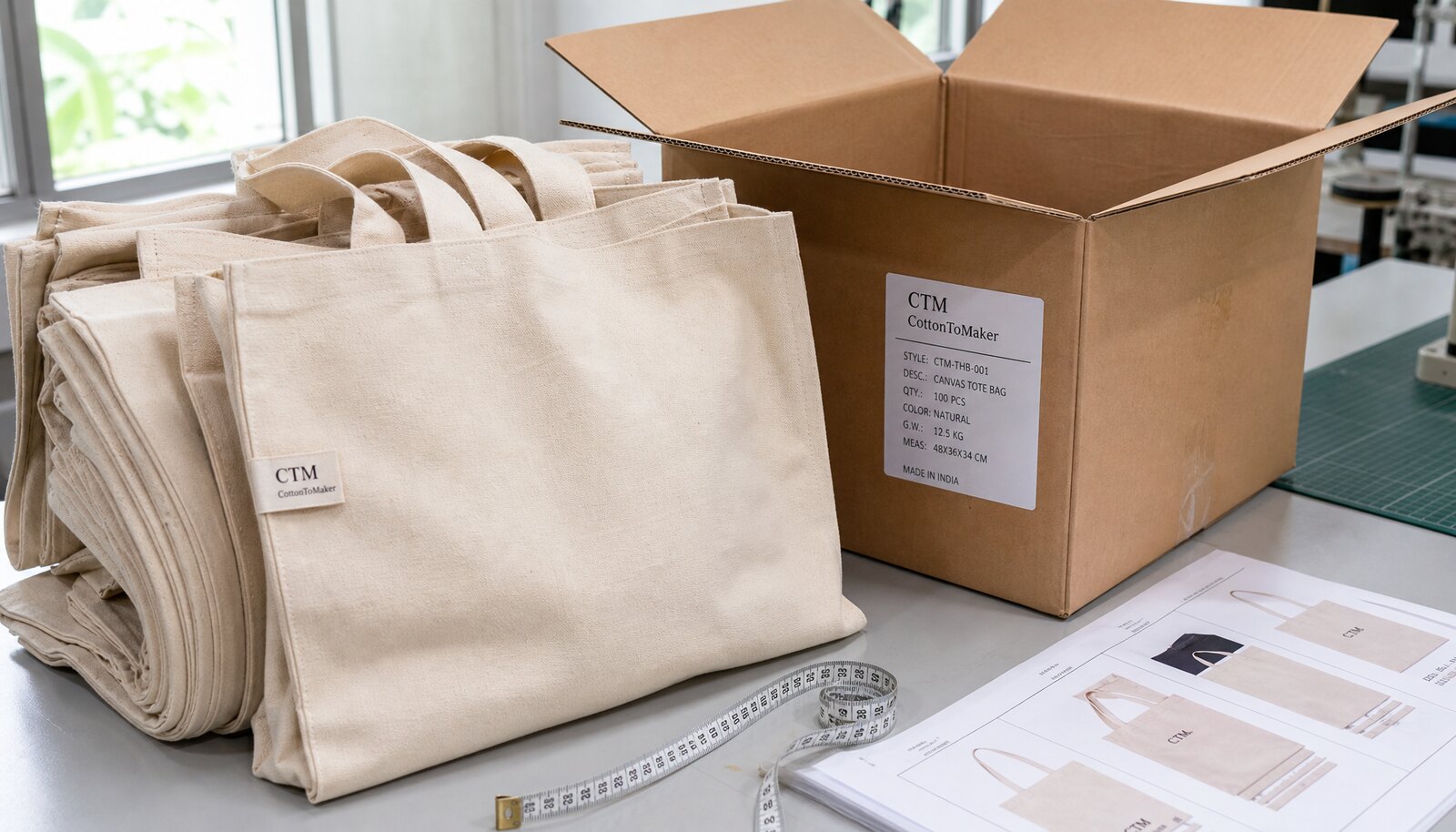
Why printed canvas shopping bags for trade shows fail at the packing stage
Printed canvas shopping bags for trade shows look straightforward on paper: choose a fabric, add a logo, ship the cartons, and hand them out at the booth. In practice, procurement teams usually discover that the bag itself is not the main source of trouble. The weak points are the ones that sit between sewing and the show floor: fold method, carton cube, carton strength, pallet fit, and the way the bags behave after compression in transit.
That is why a buyer should spec the bag from the shipping carton backward. If the carton plan is wrong, the order becomes expensive even when the logo print is technically correct. Freight may rise because the cartons are too bulky. Warehousing may become awkward because the gross weight per carton is too high. The bags may also arrive with deep folds or handle distortion, which makes even a good-looking canvas tote feel less premium when the booth opens.
For B2B sourcing, the real job is not just to buy a tote bag. It is to buy a repeatable packed unit that lands on time, survives handling, and is easy for event staff to issue in a hurry. That means the RFQ should cover bag construction and shipping carton planning together, not as separate afterthoughts.
- The carton is part of the product spec, not a packaging footnote.
- Freight cost is driven by both gross weight and carton cube.
- A bag that looks clean in a sample room can still fail after flat packing and transit.
Start with fabric weight, hand-feel, and load expectation
For most trade show use, the practical canvas range is 8 oz to 10 oz, or about 240 to 340 GSM. That range usually gives enough structure for brochures, catalogs, a notebook, or a light product sample without pushing freight and carton weight too high. If the bag will carry bottles, sample kits, or dense retail items, the buyer should move toward the heavier end and specify stronger seam and handle reinforcement.
Do not rely on vague supplier language such as thick canvas, premium cotton, or heavy-duty tote. Ask for exact GSM, weave density, finish, and whether the fabric is natural, bleached, or dyed. The finish matters because some fabrics accept print more cleanly, while others show weave texture more strongly. A natural, unbleached canvas often works well for trade show branding, but the tone can shift how a white, black, or spot-color logo reads.
If the bags are expected to be reused after the show, load expectation becomes part of the sourcing decision. A bag that is only meant to hold event literature can be lighter and more economical. A bag intended to leave the booth with visitors for everyday use should have more structure, better handle reinforcement, and a carton pack that protects the body shape rather than compressing it flat to the point of creasing.
- Use exact GSM or oz, not only descriptive weight terms.
- Match fabric weight to real contents, not just to the logo presentation.
- Ask whether the fabric was pre-shrunk or finished in a way that changes the final size.
Choose the print method by artwork complexity and order size
Screen print is still the mainstay for printed canvas shopping bags for trade shows when the artwork is simple and the quantity is large enough to absorb setup. It works especially well for one- or two-color logos, repeated campaign graphics, and event programs that will reorder the same design across multiple shows. The economics usually improve as the quantity rises because the screen setup and print preparation are spread across more pieces.
Transfer and digital methods make sense when the artwork changes often, when gradients or small text are involved, or when the run is too short to justify a screen build. These options can be useful for short notice event programs or multi-version promotions, but they need tighter control over proofing and material compatibility. A buyer should also ask how durable the finish is under rubbing, folding, and repeated handling, since trade show bags are often stuffed into cars, carts, and office drawers after the event.
Embroidery can create a more premium look, but it is not the default choice for flat-pack event totes. It adds cost, can stiffen a panel, and may complicate carton packing if the stitched area becomes bulky. For most procurement teams, the right question is not which method is most impressive, but which one gives the cleanest result at the planned quantity, lead time, and freight profile.
- Screen print usually fits simple logos and larger runs.
- Transfer or digital suits shorter runs and frequent artwork changes.
- Embroidery is better reserved for premium use cases where surface texture and added stiffness are acceptable.
MOQ logic and why the cheapest quote is often the wrong one
Canvas tote pricing is rarely linear. A 1,000-piece order may look expensive because the supplier is spreading cutting, print setup, and sewing preparation across a smaller run. At 3,000 pieces, the same bag may price better because the factory can run the line more efficiently and reduce unit labor. Buyers who only look at the headline unit price can miss the point: the real question is whether the quoted minimum quantity matches the event plan and the repeat order strategy.
If your trade show program is still being tested, a lower MOQ can be useful. It may allow a new artwork version, a regional event trial, or a limited sponsor program without overcommitting inventory. But low MOQ is not a free lunch. It often means higher unit cost, less room for carton optimization, and limited leverage on packing standards. If the supplier is quoting a small quantity, ask whether the same spec would become cheaper at 3,000, 5,000, or 10,000 pieces, and whether the carton pack count stays stable as volume rises.
A clean procurement approach is to decide whether this is a trial order or a scale order. Trial orders can tolerate a little more cost if they buy flexibility. Scale orders should drive harder on printing efficiency, carton fit, and freightable weight. Mixing those two buying logics usually creates confusion in the RFQ stage.
- Low MOQ can be useful, but it usually carries higher setup cost per unit.
- Ask for price breaks at the next realistic reorder level.
- Treat trial orders and scale orders as two different sourcing cases.
How to compare supplier quotes without getting fooled by unit price
A low quote is not useful if it hides the variables that drive actual spend. For printed canvas shopping bags for trade shows, the buyer should compare quotes on a landed-cost basis, not on bag price alone. That means reviewing fabric weight, print method, handle construction, carton dimensions, carton count, gross weight, inner packing, and freight assumptions together.
One supplier may quote a lower piece price but pack more loosely, which raises carton count and freight cube. Another may quote a slightly higher unit price while fitting more efficiently into cartons, reducing handling and lowering the final landed cost. If the bags are shipping internationally, that difference can be material because volumetric freight and destination handling often punish sloppy carton planning.
A practical comparison sheet should include at least four lines: production price, packing price, carton cost, and estimated freight impact. That gives the buyer a way to see why one quote may be better even if the unit price is not the lowest. It also makes it easier to challenge vague proposals where the supplier has not disclosed the packing logic.
- Compare quotes only after aligning GSM, size, print coverage, and packing format.
- Request gross weight per carton and estimated carton cube in CBM.
- Separate factory price from freight impact before choosing the supplier.
Supplier routes: factory, trading company, or local converter
The best supplier route depends on how much control you need and how much complexity the order carries. A direct factory is usually the strongest option when the tote is a repeat item, the artwork is stable, and the buyer wants control over sewing, printing, and carton packing. The factory route is especially useful when you need the same bag again for a later show or a second market.
A trading company can work well when the bag is part of a broader event kit, when multiple SKUs need to be consolidated, or when the buyer wants one point of contact to coordinate samples and shipping. The tradeoff is that carton control, factory visibility, and change management can be less transparent unless the trader is disciplined and very specific in documentation.
A local converter is often the fastest route if speed matters more than unit cost. That route can be useful for urgent events, domestic distribution, or orders that need quick sample approval in person. The downside is that the unit price is usually higher, and the carton plan may be less optimized because the converter is balancing convenience and speed rather than exporting at scale. The right choice is the one that matches your event timeline, internal approval process, and warehouse receiving model.
- Direct factory usually gives the best control on repeatable export packing.
- Trading company can help when the order includes mixed items or multiple destinations.
- Local converter is often the speed choice, not the cost choice.
Sample approval: what to inspect before bulk release
Sample approval should test the whole system, not just the logo. For a trade show tote, the pre-production sample needs to show the right fabric, the right print, the right seam construction, and the right folded shape. If the sample looks good when empty but distorts badly when filled with literature or sample packs, the buyer has not really approved the product.
A useful review should include three stages. First, inspect the fabric hand-feel, color tone, and print placement. Second, load the bag with realistic content and check the handle comfort, opening width, and whether the body twists or sags. Third, confirm the folded pack size and carton fit, because a good-looking bag can still create a bad carton if the fold is too bulky or inconsistent. If the artwork is sensitive, ask for a strike-off or first print sample before the full sample is made. That gives the buyer a chance to stop a color or placement issue before sewing and packing are finished.
The point is to avoid a scenario where the sample is approved visually, but the packed carton still becomes a problem later. In procurement terms, the sample is not done until the packed unit has been checked under the same assumptions that will be used in bulk production.
- Review the bag empty and loaded.
- Check the folded size, not only the finished open size.
- Ask for a strike-off if logo color or registration is critical.
Carton planning: size targets, pack counts, stacking, and freight impact
This is where many orders either stay efficient or become unexpectedly expensive. Carton planning should begin before bulk sewing starts, because the fold method and pack count can affect how many bags fit per master carton and how many cartons you will need. For printed canvas shopping bags, the carton target should be set around three things: fit, protection, and freight efficiency.
A good starting point is to ask the supplier for the finished folded dimensions of one bag, then calculate how many layers and rows will fit inside a carton while keeping the cartons easy to handle. For many trade show tote programs, cartons land somewhere between 30 and 100 pieces per carton, but the correct count depends on fabric weight, gusset depth, handle bulk, and whether the bag is flat-packed or lightly folded. If the bag is thicker or more structured, the carton count should come down so the tote is not crushed. If the bag is very flat, the count can rise, but only if the carton stays within a manageable gross weight.
Carton dimensions matter as much as piece count. If the carton is too large, dimensional freight rises. If it is too small, the bags get compressed and arrive with deep fold memory or handle distortion. A buyer should ask for carton dimension targets in centimeters and inches, plus a gross weight target per carton. For export orders, it also helps to request the estimated cube per 1,000 pieces so the buyer can compare suppliers on freight efficiency.
Here is a practical example. Suppose a tote is folded to about 25 x 30 x 3 cm. If the factory proposes a carton of 50 x 35 x 30 cm internal space, the carton volume is 52,500 cubic cm, or 0.0525 cubic meters. If 50 bags fit in that carton, the cube per bag is about 0.00105 CBM, or roughly 1.05 CBM per 1,000 bags before palletizing and overpack allowances. If another supplier uses a carton that is 10 percent larger for the same pack count, the freightable cube rises even though the bag is identical. That is why carton dimensions are a sourcing variable, not just a packaging detail.
Carton construction also matters. For most export shipments, single-wall cartons may be sufficient if the gross weight is controlled and stack height is modest. Double-wall cartons are worth considering when the route is long, the cartons will be re-handled often, or the receiving warehouse expects higher stacks. Ask the supplier to specify carton grade, closure tape, shipping marks, and stack limit. If the cartons are going onto pallets, request pallet pattern and cartons per layer so the buyer can see whether the load will be stable.
Freight impact should be compared across options. A lower unit price with a bulky carton can lose to a slightly higher unit price with a tighter pack. The freight difference is often bigger than buyers expect because canvas totes are light enough for dimensional weight to matter, especially by air or courier. For sea freight, extra carton cube still matters because container space is finite and destination handling is not free.
- Ask for folded bag dimensions before approving carton size.
- Request carton internal dimensions, gross weight, and cube per 1,000 pcs.
- Keep carton weight and stack height within warehouse handling limits.
- Check whether single-wall or double-wall carton grade is appropriate for the route.
- Compare freight impact, not only factory piece price.
AQC-style quality control for print, sewing, and packing
Generic QC language is not enough for a tote bag program that has to arrive before a trade show. The buyer needs a concrete inspection checklist and an acceptance logic that the factory understands. A useful approach is to define defect categories in advance: critical defects that block shipment, major defects that require rework or replacement, and minor defects that may be acceptable within a defined sample plan.
For print quality, inspect registration against the approved placement tolerance. Check whether the logo is centered, whether edges are crisp, and whether there is ink bleed, ghosting, pinholes, or uneven coverage. If the print contains small text, check legibility at the actual viewing distance expected on the show floor. For screen printing, a quick rub test on the approved sample helps reveal under-cured ink or weak adhesion. For transfer or digital print, inspect the edges and corners for lifting or cracking after light folding.
For sewing, confirm stitch count consistency, seam allowance, and reinforcement details. The handle attachment points should be even and secure, with no skipped stitches, loose thread, or crooked placement. Buyers often forget to ask for stitch count or seam allowance because the bag looks fine in photos. That is a mistake. A tote that will be handled all day by visitors needs consistent reinforcement, especially at the top edge and handle base.
For size and shrinkage, measure the finished bag after production, not only the cut panel. If the fabric is washed, pre-shrunk, or heat-set, confirm the process because it changes finished dimensions. A simple acceptance plan can look like this: measure every sample from the first approved piece, define the allowed tolerance for body height, width, and gusset, and reject any carton that contains a mixed dimension profile beyond the agreed threshold. In practical terms, buyers often use an AQL-style review for appearance and function, then add carton-level verification for count and marking accuracy.
Carton QC should not be skipped. Check that the pack count matches the packing list, that bags are folded consistently, and that cartons close cleanly without bulging. For routes involving warehousing, storage, or transshipment, it is worth requesting carton drop and stack testing on representative samples. Even a basic drop check can reveal whether the carton tape, box grade, or packing density is too weak for real handling. If the shipment is long-haul or re-handled often, stack verification becomes especially important because a crushed carton can ruin the folding and make the bags look used before they are ever handed out.
If your internal team needs a clear acceptance rule, use a simple structure: no critical print or stitch defects, limited major defects within the agreed sample threshold, and carton count must be exact. That is more useful than a generic 'QC passed' note. It also gives the supplier a visible standard to work toward.
- Inspect print registration, ink coverage, and rub resistance.
- Check stitch count, seam allowance, and handle reinforcement.
- Measure finished size after production, not only the cut panel.
- Define carton count, fold consistency, and shipping mark accuracy as separate checks.
- Use an AQL-style logic or a clearly written buyer threshold, not vague approval language.
Scenario-based recommendations by event type, budget tier, and destination market
The right tote spec changes depending on where the bags are going and how they will be used. For a premium international trade show, buyers usually care more about print sharpness, stitching consistency, and carton protection because the bags need to survive long transit and still look polished on arrival. In that case, a 10 oz canvas, reinforced handles, and a tighter carton plan usually make sense, even if the unit price rises a little.
For a domestic roadshow or regional event series, the buying logic can be more cost-sensitive. An 8 oz to 9 oz canvas with a simple one-color screen print may be enough if the bags are handed out quickly and the distribution route is short. In that scenario, freight savings and easy replenishment may matter more than premium construction.
For a budget giveaway program, the main risk is not whether the tote feels luxurious; it is whether the bag survives basic use without looking flimsy. Buyers should avoid specifying heavy decoration or overpacking the cartons just to make the sample look premium. That often wastes money without improving event performance. A clean, simple, well-packed tote usually beats a decorative one that arrives late or distorted.
Destination market also changes the carton conversation. If the bags are going into a warehouse and then split to multiple venues, carton marks, master carton labels, and pallet patterns need to be especially clear. If the bags are going directly to a show venue, gross weight may need to stay lower so receiving staff can move cartons quickly. If the route includes humid or variable storage conditions, ask about carton grade, inner packing, and whether any moisture protection is needed. The point is to align the product and the packaging with the distribution method, not to use one default spec for every event.
- Premium international events usually need stronger construction and better carton control.
- Regional roadshows can often use simpler spec and tighter cost control.
- Warehouse-split shipments need better carton marks and pallet logic.
- Venue-direct deliveries should prioritize manageable gross weight and easy handling.
Specification comparison for buyers
| Decision area | Supplier-side option | Procurement tradeoff | What the buyer should verify |
|---|---|---|---|
| Fabric weight | 8 oz / 240 GSM canvas | Lower cost and lighter freight, but less stiffness and lower load tolerance | Ask for GSM, weave density, and whether the fabric is bleached, natural, or dyed; confirm shrinkage and hand-feel against sample |
| Fabric weight | 10 oz / 340 GSM canvas | Better structure, better perceived quality, and better load support, but higher carton weight and freight cost | Request estimated net weight per bag and gross weight per carton before approval |
| Print method | Screen print | Best economics for repeat logos and larger runs; setup cost is front-loaded | Confirm number of screens, curing method, print tolerance, and whether artwork is one side or both sides |
| Print method | Heat transfer / digital transfer | Useful for short runs or changing artwork, but more sensitive to abrasion and fabric texture | Ask for rub test expectations, finish compatibility, and proofing sequence |
| Supplier route | Direct factory | Best control over sewing, printing, and carton packing if the factory is disciplined | Verify QC photo flow, carton spec ownership, and who signs off on packing changes |
| Supplier route | Trading company | Useful when the order includes mixed SKUs, multiple destinations, or tighter coordination needs | Confirm whether they control the factory audit, sample chain, and export carton labels |
| Supplier route | Local converter | Fastest response and easier in-person approval, but often higher unit cost and less carton optimization | Compare landed cost, not just unit price; check if they outsource printing or sewing |
| MOQ strategy | 1,000 to 3,000 pcs per artwork | Usually acceptable for trade show programs with simple print and one size | Ask at what quantity the quote drops and whether carton pack count changes by scale |
| MOQ strategy | 5,000+ pcs per artwork | Better setup absorption and often stronger pricing leverage | Verify warehouse space, carton count, pallet count, and event distribution plan |
Buyer checklist before sampling
- Confirm canvas weight in GSM and oz, plus whether the fabric is natural, bleached, or dyed.
- Approve the print method, number of colors, print location, and curing or transfer process before mass production.
- Lock the final bag size, gusset depth, handle length, stitch reinforcement, and any load expectation such as brochures or bottles.
- Request the supplier’s proposed carton dimensions, piece count per carton, gross weight target, and stacking limit before production starts.
- Ask how the bags will be folded, whether handles are tucked inside or outside, and whether polybags or tissue are included.
- Review one fully printed pre-production sample and one packed carton photo before bulk release.
- Compare quotes on the same spec version, the same packing method, and the same freight assumptions.
- Require a carton mark sample, packing list format, and destination labeling logic if the order will be split to multiple venues or warehouses.
Factory quote questions to send
- What exact canvas weight are you quoting in GSM and oz, and what is the fabric finish or weave density?
- Which print method are you pricing, how many colors are included, and what is the charge for extra screens, plates, or setup?
- What is the MOQ per artwork, per size, and per colorway, and can you combine versions in one production run?
- What are the finished bag dimensions, handle length, seam allowance, gusset depth, and tolerance on cut and sew size?
- How will the bags be folded and packed, how many pieces per export carton do you recommend, and what carton dimensions and gross weight does that produce?
- What is the carton grade, and do you have an ECT, BCT, or carton compression target for export packing?
- What is included in the unit price: polybag, tissue, barcode label, shipping marks, master carton label, and carton tape?
- What proofing sequence do you use: artwork proof, strike-off, blank sample, printed sample, and packed carton approval?
- What is the net weight per bag, gross weight per carton, and estimated carton cube in CBM for one order lot?
- What is your bulk lead time after artwork approval, and how much time should I allow for packing, carton QC, and export booking?
Quality-control points to confirm
- Fabric GSM matches the approved range, and the cloth is even across rolls with no thin spots, slubs, or weave streaks that affect print appearance.
- Shrinkage is within agreed limits after cutting or finishing; if the supplier washes or pre-shrinks the fabric, confirm the method in writing.
- Print registration is centered and within tolerance; check edge sharpness, color density, ghosting, pinholes, overspray, and ink bleed.
- If screen print is used, confirm squeegee marks, flash-cure consistency, and cure resistance by a light rub check on approved samples.
- If transfer or digital print is used, check adhesion at the corners and edges, and verify there is no cracking, lifting, or adhesive halo after handling.
- Stitch count is consistent at handles, side seams, and bottom seams; inspect for skipped stitches, thread breaks, loose ends, and uneven seam allowance.
- Handle attachment points are reinforced as specified, with no crooked placement, twist, or inconsistent bar tack or box stitch pattern.
- Finished dimensions are within tolerance after sewing and pressing, including body height, width, gusset depth, and handle drop.
- Carton pack count matches the packing list, bag folding is consistent, and no carton contains crushed corners, severe creases, or random folding orientation.
- Outer cartons pass agreed stacking and handling expectations: carton grade is suitable, tape seals are intact, shipping marks are legible, and gross/net weights are shown clearly.