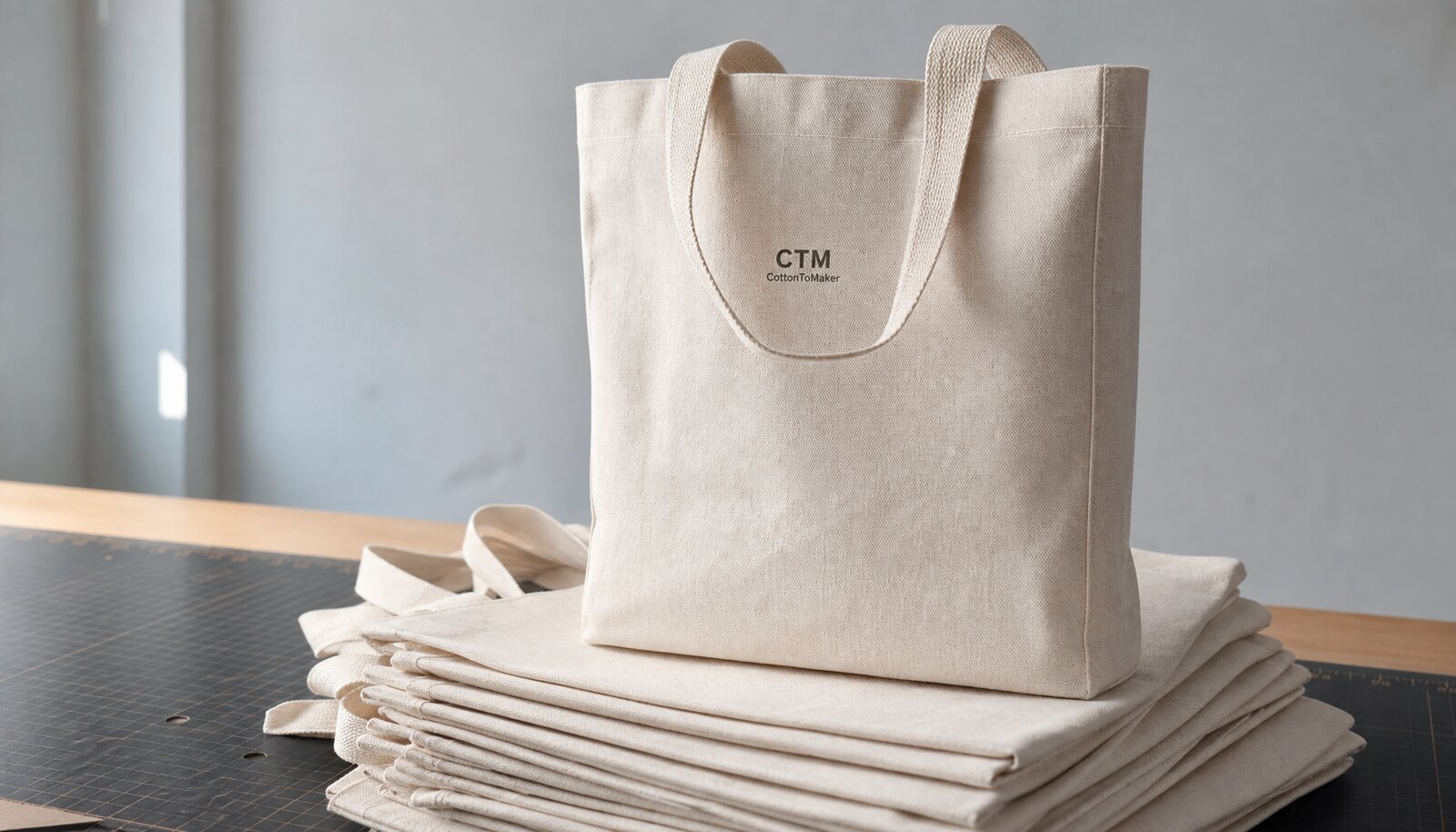
Why trade show tote reorders need version control, not memory
Printed canvas shopping bags for trade shows look simple, but repeat orders are where small changes become expensive. The first run is often approved from a polished sample and a short launch conversation. The reorder is handled later, when the team has moved on and the supplier may be relying on a saved artwork file, a warehouse photo, or a verbal “same as before.” That is exactly when dimensions, print placement, packing, or fabric weight start to drift.
For procurement, the bag should be managed like any other repeat-buy item: one spec sheet, one approved sample, one version number, and one release path. The buyer’s job is to make the next order buildable, inspectable, and comparable to the prior lot. Broad language like sturdy, premium, or eco-friendly does not help a factory sew, print, or pack. Exact instructions do.
Trade show use makes control even more important. These bags are handed out quickly, carried in front of peers, stuffed into overhead bins, and reused after the event. Buyers therefore need a product that looks consistent at the booth and still functions once it leaves the venue. A reorder memo is useful because it prevents the team from assuming the old sample still defines the job. It forces the business to state what will be repeated, what may change, and who owns approval when there is a mismatch.
A good repeat program also reduces internal friction. Marketing wants brand consistency, operations wants a clean receiving process, and procurement wants a quote that can be compared like for like. A versioned tote spec gives all three functions the same reference point. That is the real value of a reorder guide: fewer assumptions, fewer disputes, and fewer surprises when the cartons arrive.
- Treat the tote as a repeatable supply item with version control.
- Use one source of truth for dimensions, print, packing, and approved sample.
- Assume small drift will be visible immediately when bags are handed out in volume.
Lock the bag construction before discussing artwork
The bag structure should be frozen before any artwork discussion. Start with the finished size in width × height × gusset depth, plus a tolerance. A supplier can work from a clear dimension set; it cannot consistently work from “roughly the same size as last time.” If the tote must carry brochures, notebooks, and small samples, the gusset matters as much as the face size because it determines whether the bag stands, folds, and packs cleanly.
For most trade show programs, canvas in the 10–12 oz range, or about 340–410 GSM, is a practical starting point. That is not a universal rule. If the bag is only carrying leaflets, lighter fabric may be acceptable. If the bag is expected to hold boxed samples or heavier giveaways, the buyer should state a load expectation and ask the factory what reinforcement is needed. Ask for the fabric weight in the same unit each time so the supplier does not answer in one format while quoting another.
Handle design affects both user comfort and stitch integrity. A shoulder-carry tote often needs a handle drop around 9–12 in / 23–30 cm, but the right number depends on body size, bag height, and whether the team wants the tote to hang low or sit high under the arm. Also specify whether the handles are self-fabric, cotton webbing, dyed webbing, or rope. That choice affects feel, color matching, stitch bulk at the top seam, and the chance of distortion when the bag is loaded.
If the bag needs structure, name the structural features. Common examples are top hem reinforcement, bar-tacks at handle joins, corner gussets, or a bottom seam that is double-stitched or reinforced. Buyers should not rely on a supplier’s idea of “standard reinforcement” because standard varies by factory and market.
- Start the RFQ with finished dimensions, not artwork.
- Specify whether the bag must stand upright when filled.
- Set handle drop by use case: hand carry, shoulder carry, or both.
Choose the print process for repeatability and touch durability
For recurring trade show reorders, screen print remains the most reliable choice when the artwork is simple. It generally gives the best balance of repeatability, cost, and visual stability on canvas. It is also easier to control across future orders if the factory retains the screen, ink formula, and registration setup. Single-color logos and two-color marks are the safest fit for long-running programs, especially when the logo must appear in the same place on every bag.
Digital print and transfer methods are useful when the artwork justifies them. Fine detail, gradients, regional text changes, or very short runs can make a non-screen method the better commercial choice. The trade-off is that buyers need to inspect edge adhesion, ink hand-feel, and fade or rub resistance more closely. A print that looks clean in a PDF can still peel, crack, or sit too heavily on woven canvas. That matters if the tote will be reused after the event rather than discarded at the end of the day.
The right question is not “Which method is newest?” It is “Which method can the supplier repeat under the same conditions next time?” Ask what is preserved between orders: the artwork files, the screen, the ink formula, the platen settings, curing conditions, and the retained sample. If the answer is vague, the process is not yet controlled enough for a reorder program. For a repeat buyer, consistency is more valuable than novelty.
Also clarify the print area and safe margin. Large graphics near seams can distort once the bag is sewn and pressed. Ask for a strike-off or production sample that shows the exact print position on the final bag shape, not just on a flat panel.
- Use screen print for stable logos and recurring events.
- Use transfer or digital only when the artwork or schedule justifies the extra control burden.
- Ask what the supplier preserves between orders: screens, formulas, settings, and retained samples.
Price the full tote system, not just the unit cost
MOQ should be treated as a pricing threshold, not a magic number. Below that threshold, setup cost, cutting loss, print labor, and packing labor are spread across fewer units, so the unit price rises. A quote that looks cheap may only be cheap because it omits setup, assumes a lighter fabric, or uses a packing method that does not match the receiving plan. Procurement should compare the total landed value of like-for-like specifications, not the headline unit price alone.
The main cost drivers are straightforward but easy to miss when the RFQ is too brief. Fabric weight, handle material, seam count, print colors, print coverage area, and packing format all affect the price. So does whether the order is a clean repeat or a changed spec. A new PMS target, a new bag color, a larger logo, or a revised insert may force fresh setup work. If the supplier says the change is minor, ask what is actually being reused and what is not.
A good reorder quote should separate run cost from setup cost. The buyer should also ask whether the factory is pricing against a stored sample, stored screens, or a completely new production event. That distinction helps procurement understand why one supplier is more expensive but lower risk. It also makes it easier to defend a premium quote when the business asks why the same tote costs more than the last time.
If the business wants a buffer for late-show demand, ask the supplier whether it can hold fabric or finished blank bags for a short replenishment window. Do not assume that material can be reserved for free. If the factory offers hold stock, confirm how long it can be held, whether storage fees apply, and whether the hold is actually committed inventory or just a planning estimate.
- Compare quotes on the same fabric weight, print size, and packing plan.
- Ask for separate line items for setup, run cost, packing, and freight assumptions.
- Treat a design change as a new production event unless the supplier proves otherwise.
Compare supplier routes by control, not by promises
A reorder decision is not only about cost. It is about how many process variables the buyer can control. A direct factory that retains the prior sample, screens, and packing record is usually the cleanest path for a repeated tote program. There are fewer handoffs, which reduces the chance of fabric drift, print mismatch, or carton confusion. If the prior job was approved cleanly, this route often gives the best balance of speed and repeatability.
A trading company can be useful when the buyer wants one commercial point of contact for bags, inserts, and other event materials. The risk is that the production site may change between orders. That does not automatically make the quote poor, but it does mean the buyer must ask for factory disclosure, confirmation that the same plant will run the reorder, and proof that the retained sample corresponds to the actual source of production. Without that, a “repeat” can become a different product with the same logo.
A domestic converter is often the fastest solution when the event date is close or when the business needs a small replenishment. The control issue is different: local speed can be excellent, but buyers still need to check print durability, fabric compatibility, and finished dimensions rather than assuming a local run is automatically safer. Domestic does not mean deviation-free; it only means the response path is shorter.
Use supplier route selection as a risk question. If the event is fixed, the artwork is stable, and the tote will be distributed under brand scrutiny, the supplier should be able to prove repeat control. If it cannot, procurement should treat the order as a new build, not a reorder.
- Direct factory: strongest option for repeat control and lowest process drift.
- Trading company: useful for consolidated buying, but verify the actual factory used.
- Local converter: best for urgency, provided print durability and fabric compatibility are checked.
Use a comparison table to expose weak quotes and hidden trade-offs
The table below is meant for sourcing decisions, not marketing language. It helps procurement see which route fits the event timeline, the risk profile, and the level of verification needed. The key question is not who says they can do it. It is who can repeat the same tote, with the same packing, on the same schedule, and with enough documentation to support the next reorder.
When reviewing responses, ask each supplier to quote the same finished specification version. If one supplier quotes a lighter canvas, a smaller print area, or generic packing, the comparison is not real. Also ask whether the quote includes retained sample access, photo proof of carton marks, and any inspection documentation available before shipment. Those are not extras; they are the evidence that the job was controlled.
- Ask each supplier to quote the same finished spec version.
- Request proof of retained sample or screen storage for reorder jobs.
- Treat any missing packing detail as a cost or risk, not a minor omission.
Approve samples for production behavior, not only appearance
A tote sample can look fine in a presentation and still fail in production. For canvas bags, the useful sample is the one that shows how the item is sewn, printed, pressed, and packed. Buyers should therefore approve a production-relevant sample, not just a digital art proof. A PDF confirms the design intent; it does not confirm the finished bag will stand, carry weight, or arrive neatly packed.
When checking a sample, measure it as if you were receiving the shipment. Verify width, height, and gusset depth after sewing and pressing. Check handle length and handle drop on both sides, because small asymmetries are easy to miss visually but obvious once bags are stacked or distributed. If the tote has a label, care tag, or lining, inspect those details too. Anything that is misaligned on the sample is likely to repeat in bulk unless the factory is instructed to correct it.
Retained sample discipline matters most on reorder programs. Keep one sealed approved sample tied to the PO number, versioned spec sheet, and approval date. On the next order, compare the production sample and final cartons against that retained sample under the same lighting. This is the fastest way to spot shade drift, ink change, or construction changes that do not show up in an email photo. If the supplier cannot produce a retained sample, ask why and treat the reorder as higher risk.
One practical improvement is to keep a short approval note with the sample: date, approver name, accepted tolerances, and any known deviations. That small record can resolve many future disputes because it tells the next buyer exactly what was actually approved rather than what someone remembers approving.
- Approve a production-relevant sample, not only a digital proof.
- Measure size, seam, and print placement against the exact spec sheet.
- Keep one sealed retained sample linked to the versioned PO record.
Build QC around measurable defects and clear thresholds
QC for printed canvas shopping bags should be specific enough that a factory can inspect to it and a receiving team can enforce it. For public-facing trade show bags, use critical, major, and minor defects instead of a vague “good quality” note. A critical defect is something that makes the bag unusable or unsafe, such as a broken handle seam, a missing handle, or a print failure that removes the brand mark. Major defects are visible issues that reduce commercial value, such as crooked artwork, a big size miss, or significant color mismatch. Minor defects are cosmetic issues that do not stop use but still need a limit because the bag is being handed to customers.
AQL is useful when the shipment includes multiple cartons or multiple colorways. The exact sampling plan should be written into the PO or quality agreement before production begins. Do not leave the factory to define acceptance after the goods are packed. Ask the supplier to name the measurement method, the number of bags sampled, and the pass/fail threshold for each defect type. If a defect is “within tolerance,” insist on the tolerance in millimeters, stitch count, or percentage.
For repeat orders, the best QC check is comparative. Match the new production against the retained sample and the prior carton spec. Confirm the fabric source, ink, screen, and packing method are the same unless the supplier has formally notified a change. If there is a change, ask for it in writing before release. That rule matters because many quality problems are really change-control problems that were not surfaced early enough.
Do not forget visible appearance defects that matter in a trade show setting. Oil marks, dust, odor, loose threads, stitching snags, and ink specks are easy to miss at the factory and very easy to notice on a booth floor. If the bags will go directly to a brand warehouse or event kit assembler, the cosmetic threshold should be stricter than it would be for a backroom-use tote.
- Define critical, major, and minor defects in writing before production starts.
- Use AQL inspection for both the first order and every reorder.
- Require the factory to show the retained sample, production record, and any declared material change.
Make packing and carton marks work for receiving, not just for shipping
Packing affects freight cost, warehouse handling, and receiving speed. Because canvas totes are light but bulky, carton dimensions can matter as much as the bag itself. Bulk packing is often the lowest-cost choice, but it only works well if the receiving team can count quickly and if the bags will not get crushed, scuffed, or bent in transit. If the order is headed to several events, regions, or show kits, inner packs may be worth the added cost because they reduce counting errors and make distribution easier.
A quote should state the exact pack plan: number per inner pack, number per carton, carton dimensions, gross weight, and label format. If the bags must be palletized, the supplier should also confirm the pallet pattern, stack height, and whether cartons are oriented consistently. “Standard packing” is not enough for a procurement team. Standard varies by factory and by route, and it rarely matches the receiving logic of a brand warehouse.
Carton marks should also reflect event reality. If there are multiple show dates, color variants, or regional destinations, carton labels should make the lot obvious at a glance. That prevents mixed-lot disputes and reduces the chance of a tote intended for one event being opened early and distributed elsewhere. Ask the supplier to show a carton-mark example during quoting so the format is known before production starts.
If the company uses barcode receiving or warehouse scanning, make sure the pack logic supports that system. A small amount of planning here prevents a lot of manual checking later.
- Write the pack plan into the PO, including inner pack and carton count.
- Use clear carton marks for event dates, colors, and destinations.
- Keep carton dimensions stable across reorders if freight planning matters.
Control lead time by naming the real bottlenecks
Trade show programs usually miss the calendar before production even begins. The common delay points are artwork approval, sample re-approval, fabric booking, and pack-plan confirmation. That is why the buyer should work backward from the event date and identify the latest safe release date for the PO. If the shipment needs freight time, customs clearance, and warehouse receiving, those steps must be included in the plan. Otherwise, a lead time that looks fine on paper can still arrive too late for the event chain.
The supplier should also state when the lead clock starts. Some quotes count from PO issue, others from artwork approval, and others from sample sign-off. Those are not equivalent. For repeat orders, procurement should prefer a lead time that starts only after critical approvals are complete. That prevents the factory from counting days while the buyer is still waiting on internal sign-off.
If a vendor offers a rush option, ask exactly what is being compressed. Sometimes only sewing is accelerated while print curing, inspection, or packing stays on a normal schedule. That may be enough for a short replenishment, or it may still miss the event if the buyer assumed the full job was compressed. A fast quote is only useful if the schedule is broken into real steps and the supplier names which steps are fixed.
For larger trade show calendars, it is worth keeping a simple reorder calendar with three dates: approval complete, production start, and latest warehouse receipt. Those three dates do more to prevent late arrivals than a generic “need by” note.
- Work backward from event date, freight time, and warehouse receiving.
- Clarify the official start point for the lead-time clock.
- Ask which steps can actually be rushed and which cannot.
Specification comparison for buyers
| Supplier / sourcing route | Typical MOQ band | Lead time pattern | Pricing drivers | Print limits / fit |
|---|---|---|---|---|
| Direct factory with retained sample | 500–3,000 pcs per colorway | 20–35 days after sample approval; faster if fabric and screens are already locked | Fabric weight, stitch count, print colors, packed count, and whether existing screens can be reused | Best for 1–3 spot colors and repeat logo placement; large solids need tighter ink control |
| Trading company coordinating one or more mills | 300–5,000 pcs depending on factory allocation | 25–45 days after artwork and sample sign-off; timing can vary by factory assignment | Markup, consolidation fees, print setup, packing changes, and whether the trader is sourcing from the same plant as last time | Flexible on mixed SKUs and inserts, but decoration controls depend on the actual factory |
| Domestic converter / local decorator | 50–1,500 pcs | 5–15 working days if blank stock is on hand | Blank bag cost, local print labor, rush surcharge, and freight | Good for simple logos and late replenishment; less efficient for large coverage prints on heavy canvas |
| Blank import + local print | 100–2,000 pcs | 10–25 days depending on blank stock and local schedule | Blank inventory, local print setup, carton rework, and packaging | Works best with single-color logos or variable artwork by region |
| Fully custom offshore production | 1,000–10,000+ pcs | 30–55 days including sampling, bulk production, and export handling | Tooling, fabric mill lead time, sewing efficiency, print setup, freight mode, and packing complexity | Best when artwork, size, and packing are stable and will repeat across multiple trade shows |
| Short-run digital or transfer route | 100–800 pcs | 7–20 days once artwork is approved | Artwork complexity, color count, print area, curing method, and reject rate | Suitable for detailed graphics, but large solid areas and dark canvas may show process limits |
| Screen-print reorder route with stored screens | 500–5,000 pcs | 15–30 days if screens and artwork files are still valid | Screen storage, mesh wear, ink matching, and setup reuse | Best for repeat logos, exact PMS targets, and simple front/back placements |
| Standard bulk pack to warehouse | 500–10,000 pcs | Usually no effect on sewing time, but can add carton prep time | Carton count, inner pack count, labeling, palletization, and barcode needs | No decoration limit, but packing method must match the receiving plan |
Buyer checklist before sampling
- Confirm finished bag size, including width, height, and gusset depth, so the tote actually fits brochures, samples, or purchased items from the show floor.
- Lock handle length and handle drop in writing. For shoulder carry, buyers commonly specify a handle drop around 9–12 in / 23–30 cm; shorter handles can be awkward in a crowded booth setting.
- Define fabric weight in oz or GSM and state whether the canvas is natural, bleached, dyed, pre-washed, or recycled content if that matters for the brand program.
- Specify print method, exact decoration locations, number of colors, PMS target if relevant, and whether artwork must remain within a defined safe margin from seams.
- State whether the bag needs reinforcement at handle joins, corner gussets, base reinforcement, or bar-tack stitching at stress points.
- Set MOQ by colorway and by print version, and ask whether mixed artwork orders count toward the same minimum or trigger separate setup charges.
- Agree on acceptable overrun and underrun bands before the PO is released; a practical range many buyers use is +3% to +10% overrun and 0% to -3% underrun, but the band should match event demand and warehouse tolerance.
- Specify carton count, inner pack count, carton mark format, and any pallet pattern so receiving can count quickly and avoid mixed-lot disputes.
- Ask for a pre-production sample, a print strike-off, or both; an artwork PDF alone is not enough for a repeat tote program.
- Require a retained sealed sample from the approved run and tie it to the purchase order number and versioned spec sheet.
Factory quote questions to send
- What exact fabric weight are you quoting, and is that weight stated before or after finishing and washing?
- Can you confirm the finished dimensions, handle length, handle drop, and gusset depth you will sew to, not just the cut-panel size?
- What is the print method, how many colors are included, and what is the setup charge per color or per screen?
- If this is a reorder, will you reuse the same screens, artwork files, and retained sample, or are you remaking anything?
- What is your MOQ by color, by print version, and by line item, and do mixed-size or mixed-artwork orders change the minimum?
- What overrun or underrun band do you accept, and how do you handle short shipment against the PO quantity?
- What packing method is included in the price: bulk pack, inner polybag, carton pack, palletization, or custom insert?
- What carton count and gross carton weight do you recommend for this bag size, and what freight assumptions are in the quote?
- How many production days are needed after final sample approval, and which steps are most likely to delay the schedule?
- Can you share recent production photos, a sample inspection report, or a carton-marking example for a similar canvas tote?
Quality-control points to confirm
- Agree a fabric-weight tolerance before production. A practical buyer control is within about ±5% of the approved GSM or oz spec, measured on the approved construction, not a loose fabric swatch alone.
- Measure finished dimensions after sewing and pressing, not from cut panels. Check width, height, and gusset depth on a meaningful sample set from the lot.
- Use AQL logic for receiving inspection. For promo bags that are visible in public, many buyers set an attribute-based critical defect tolerance near zero, a major defect limit that is very low, and a minor defect limit that still reflects the end use; the key is to define the thresholds in the PO, not improvise at receiving.
- Reject visible print defects that will read from arm’s length: registration shift, smearing, pinholes in solid areas, obvious ghosting, or ink that bleeds into the weave in a way that distorts the logo.
- Inspect handle joins, top hem, gusset seams, and bottom seams for skipped stitches, loose threads that unravel, or weak bar-tacks at the stress points.
- Check print placement against a measured template. The logo should land in the same location from sample to sample, not just roughly centered.
- For reorder consistency, compare bulk goods to the retained sealed sample under the same lighting and note any shade drift in the canvas or ink.
- Review carton markings, pack count, and inner-pack logic against the packing list. If the carton says 25 pcs and the receiving team counts 24, the discrepancy should be caught before distribution.
- Screen for oil marks, dust, odor, and fabric contamination, especially if the totes will be delivered directly to a brand warehouse or event kit assembler.
- If the supplier claims the same spec as last time, ask for the original production record, including fabric source, print screen date, carton spec, and final inspection notes.