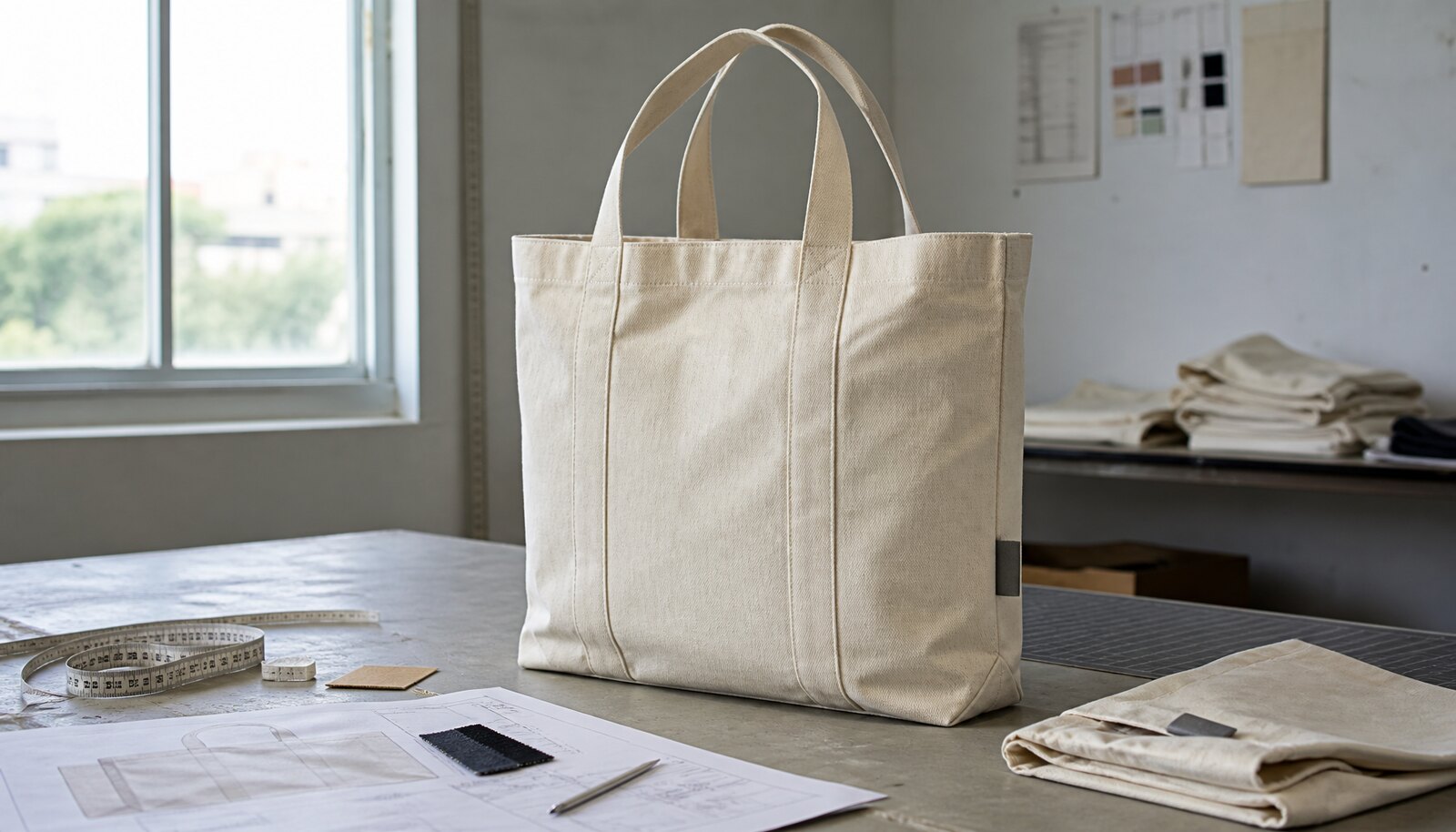
Why subscription box totes need a procurement spec
A printed canvas shopping bag for a subscription box is a different buying problem from a retail tote. In most programs, the bag has to fit inside a carton, look premium at first touch, and survive warehouse handling before the customer ever uses it. That means the factory quote cannot stop at size and logo art. It has to capture fabric weight, print method, trim, packing, and the way the bag behaves when folded for fulfillment.
When buyers send a loose RFQ such as canvas tote with logo, suppliers fill in the blanks differently. One factory may assume 8 oz cloth with a basic one-color print; another may price 12 oz fabric, webbing handles, and individual polybags. Those offers are not equivalent. If the spec is vague, the price spread is not useful and the sample stage becomes the point where hidden cost shows up.
- Define the bag's job first: insert, gift, premium add-on, or resale item
- State whether the tote must fit inside the subscription box or ship as a separate item
- Separate decoration requirements from construction requirements so every supplier prices the same build
Lock the use case before the supplier prices it
The right build depends on how the bag will be used. An insert bag that is meant to feel gift-like can tolerate a softer hand and lighter fabric than a reusable tote that the customer will carry after unboxing. If the bag is only there to improve perceived value in the box, the buyer can optimize for print clarity and fold efficiency. If the bag is expected to become part of the brand's everyday carry, the quote needs to reflect stronger construction and more durable finishing.
This is where many sourcing teams overbuy or underbuy. A common starting point is 10 oz to 12 oz canvas, but that is only a starting point, not a universal default. 8 oz can work for light insert use. 12 oz or above is more appropriate when the bag must feel structured, hold shape, or support repeated reuse. The decision should follow the use case, packed volume, and freight target, not an arbitrary rule.
- Set the bag's role in one sentence: decorative insert, reusable tote, or retail-ready premium
- Decide whether the product must survive repeated consumer use or only one unboxing cycle
- Ask the supplier to quote at least one alternate fabric weight so you can see the cost of moving up or down
Fabric, trim, and finish are the main cost levers
Fabric weight drives much more than appearance. It changes hand feel, print behavior, folded thickness, and carton efficiency. Buyers should specify whether the quoted weight is finished cloth or raw fabric before shrinkage and finishing. Those are not interchangeable. Ask for the actual cloth spec, including fiber content, weave, and whether the material is natural, bleached, dyed, or recycled.
Trim choices also move the quote in ways that are easy to miss. Self-fabric handles are often cheaper than cotton webbing, but webbing can improve perceived value and load confidence. Turned seams look cleaner than exposed overlock, but they cost more labor. A gusset adds material and packing volume, yet it can improve shape and fit. The right question is not which option sounds premium. It is which option supports the real use case and landed cost target.
- Confirm fabric weight as finished GSM or ounces, not a vague canvas description
- Specify whether the bag is pre-shrunk or whether shrinkage tolerance is acceptable
- Ask the factory to quote handle options separately so you can compare structure and cost
- Request the trim and finish changes as line items, not only as a bundled tote price
Print route, artwork prep, and reorder economics
For simple logos, one- or two-color screen print is usually the most predictable route because it can provide strong opacity on natural canvas and stable repeat pricing. If the art includes gradients, fine detail, or many colors, digital print or heat transfer may be more practical for a short run. The tradeoff is not just aesthetics. It is also durability, setup cost, and how much the price changes on reorder.
The RFQ should state the number of colors, print side, exact placement size, and whether the artwork is staying fixed or changing seasonally. If the design is likely to refresh, ask how much of the setup fee repeats each time. A low unit price with a high color charge can look attractive on the first order and become expensive on the second and third. Procurement teams should compare the full reorder path, not just launch pricing.
- Use vector artwork and define print placement in inches or millimeters
- Ask for the setup fee by color and by design change so reorders are easier to forecast
- Treat digital or transfer print as a short-run tool until durability is validated
- Request a printed strike-off or color test before approving a large run
Comparison table: supplier routes, MOQ, and landed cost
A useful comparison is not simply factory versus factory. It is direct factory versus trading route versus low-MOQ workshop, because each route changes price behavior, lead time, and risk. The cheapest unit price can become the most expensive landed result if the MOQ is too high, the packaging is inefficient, or the supplier cannot repeat the same spec without drift.
For subscription box buyers, the best route is the one that can hold the same fabric, print, fold, and carton format across replenishment cycles. If a supplier needs to change the cloth lot, move decoration to a different workshop, or rework packing every time, the quote is less stable than it appears. Award decisions should reflect that operational reality.
- Compare landed cost at the same destination, not ex-factory price alone
- Ask whether the same buyer sample can be reproduced at scale without substitution
- Check whether low MOQ is reducing inventory risk or just pushing more cost into setup and freight
How to qualify a factory before award
A credible factory should be able to explain the production path from fabric to packed carton. Ask who controls cutting, sewing, printing, and packing, and whether each step is in-house or subcontracted. The important issue is not only who owns the building. It is who owns the critical process and who signs off on quality at each stage. A supplier that cannot answer that clearly is harder to manage after award.
Request proof that the factory has real capability for similar work. That can include current photos or video of the cutting table, sewing line, print area, and packing station, plus a recent bulk sample from a comparable bag construction. Ask for company documents, but do not rely on them alone. Procurement teams should look for process evidence: incoming fabric checks, lot tracking, in-process inspection records, and a clear defect-handling flow. If the supplier claims test performance, ask for dated reports rather than a certificate with no context.
- Confirm whether sewing and print are actually in-house
- Ask to see a current bulk example of the same or similar construction
- Request dated test reports if the supplier cites fabric or print performance
- Look for lot tracking, in-process QC sheets, and a defect escalation process
What a useful pre-production sample must prove
A pre-production sample should do more than show the logo. It needs to prove that the final fabric, print method, size, handle construction, and packing format all work together. If the sample uses better cloth, a different ink system, or a loose packing method that will not match bulk production, it is not a reliable approval sample. For a subscription box program, the biggest failure mode is approving a nice-looking sample that does not fit the actual box or fulfillment flow.
The sample should be checked against measurable criteria. Measure the finished dimensions, confirm handle length and symmetry, verify where the logo lands after folding, and test whether the packed bag fits your carton or kit. If the product is going into a mailer, sleeve, or rigid box, try the sample in the actual packout sequence. That is the only way to catch problems like print placement drifting after folding or a bag that looks good flat but reads awkwardly in the unboxing layout.
- Approve the sample only if it uses final or near-final materials
- Check the bag in the same fold or pack format planned for shipment
- Measure the logo position after folding, not just before
- Retain the approved sample and label it with the spec version
QC checkpoints and test standards worth asking for
Quality control should be tied to the bag's actual use, not to generic tote language. For example, if the bag carries light insert contents, the load check can be simple and repeatable. If it is meant to support re-use, the supplier should show a stronger load or seam-strength check that matches the intended duty cycle. Buyers do not need a lab-heavy specification for every order, but they do need a test plan that is explicit enough to be enforced.
When you ask for test support, focus on the standards that match the risk. For fabric strength, ask whether the factory can reference a relevant tensile or seam-strength method, such as ASTM D5034 or an equivalent internal standard, if your market requires it. For print, ask how rub resistance, opacity, and color consistency are checked. For cartons, ask for the packing method and whether the shipment will be protected against crush or handling damage. If the supplier says the bag is drop-resistant or compression-proof, ask them to define the test method and acceptance threshold. Vague claims are not a QC plan.
- Set a real tolerance band for body size, handle length, and print placement
- Check stitch quality, loose threads, and reinforcement at the handle attachment points
- Agree on a simple load test or cycle test tied to the intended use
- Ask for carton and packout verification if goods will move through a fulfillment center
Packing, cartonization, and freight change the landed price
Packing is not a warehouse detail that can be decided after the quote. It is part of the manufacturing cost. If you need the bags folded a specific way, packed into bundles, sealed in polybags, or labeled for a fulfillment center, those steps add labor and materials. The factory should quote the packed unit, not only the sewn bag. This is especially important for subscription box programs because the wrong fold size or bundle count can create labor problems at receiving.
Carton design also affects freight. An oversized master carton adds cubic cost. An underfilled carton can crush the bags or distort the shape. Ask for net weight, gross weight, carton dimensions, bundle count, and whether the supplier will use barcode labels, PO marks, or carton number tracking. If the order ships to a distribution center, those small details affect receiving speed and error rates as much as the tote itself.
- Specify fold direction if the bag has to fit a rigid mailer or insert cavity
- State clearly whether inner polybags are required, optional, or prohibited
- Request bundle count per inner and per master carton
- Include carton mark text, SKU, and PO number in the RFQ
How to compare offers and award without spec drift
A clean comparison starts with the same cost structure across every offer: fabric, sewing, print setup, packing, testing if needed, and freight terms. If one supplier includes bundle packing and another charges it separately, the apparent price gap is misleading. Buyers should compare the same delivery point and the same packout expectation. Otherwise the cheapest quote is often just the least complete quote.
Award decisions should also account for reorder behavior. If the bag will be a recurring subscription insert, the better supplier is usually the one that can repeat the same spec with fewer substitutions and fewer new charges. If the program is experimental, lower MOQ and faster sample turnaround may matter more than the lowest unit cost. The right award is the one that fits the program's forecast and risk profile, not just the first invoice.
- Compare offers on the same Incoterms and destination
- Separate one-time setup fees from repeating unit cost
- Document the approved spec version before placing the purchase order
- Keep the sample, quote, and QC notes tied to the same revision
Specification comparison for buyers
| Supplier route | Unit price shape | MOQ and lead time | Best for | What to validate before award |
|---|---|---|---|---|
| Direct factory with in-house sewing and print | Usually the strongest repeat-run pricing once setup is fixed; the quote is most sensitive to fabric and trim choices | Often higher MOQ, but reorders are steadier and less dependent on third parties | Recurring subscription SKUs with stable artwork and predictable replenishment | Confirm the print process is actually in-house, ask for current bulk photos, and lock tolerances before deposit |
| Trading company managing one or more factories | Can look higher on paper, but sometimes includes more coordination and fewer gaps in communication | MOQ can be more flexible; lead time depends on the hidden factory schedule | Buyers who want sourcing support across multiple specs or markets | Ask which steps are subcontracted, who owns QC sign-off, and whether the same sample can be repeated in production |
| Small workshop or low-MOQ supplier | Often attractive for launch runs, but unit economics and consistency can be weaker at scale | Low MOQ and sometimes faster on simple builds | Seasonal tests, campaign bags, or one-off inserts | Check seam consistency, print registration, and carton counts because process control is usually lighter |
| Integrated high-volume factory | Good landed cost on volume, but less forgiving when specs change | Higher MOQ and more rigid scheduling, especially during peak seasons | Large recurring programs where repeatability matters more than flexibility | Ask for capacity, reorder reservation, and change-fee policy before award |
| Stock blank bag plus local print and pack partner | Can reduce risk on urgent replenishment, but split logistics add cost and handoff points | Useful when artwork changes often or domestic turn time matters | Regional fulfillment or rapid campaign reprints | Confirm who owns the blank inventory and how responsibility is split if the print or packing step fails |
| Material | 8-12 oz cotton canvas, 120-220 gsm cotton, recycled cotton, or blended fabric selected by use case and target price | Before price comparison | Different cloth weights, backing, or certification claims make quotes hard to compare | |
| Construction | bag size, gusset, handle drop, seam allowance, stitch density, reinforcement patch, and loading expectation | Before sampling | Weak stress points create returns and failed inspections | |
| Decoration | screen print, heat transfer, embroidery, woven label, or hangtag matched to fabric texture and brand durability needs | Before artwork approval | The wrong method can crack, bleed, pucker, or fail on the chosen fabric |
Buyer checklist before sampling
- Final finished size by body width, body height, gusset, and handle drop, with agreed tolerances by dimension
- Fabric specification: fiber content, finished weight in GSM or oz, weave type, color, and whether the cloth is pre-shrunk or not
- Artwork file format, number of print colors, Pantone references if required, print placement size, and print-side count
- Print method requested, plus any limits on ink coverage, fine lines, halftones, or gradients
- Handle construction: self-fabric or webbing, handle length, attachment method, stitch pattern, and reinforcement points
- Seam finish: turned edge, overlock, binding, lining, or raw-edge treatment if relevant
- Labeling: woven label, care label, barcode label, or retailer ticket if needed
- Packing format: folded size, inner polybag yes or no, bundle count, master carton count, and carton mark text
- Order split by SKU, size, color, and print version, including whether mixed lots are acceptable
- Required sample stage: visual prototype, pre-production sample, or bulk reference sample
Factory quote questions to send
- What exact fabric specification are you quoting, and is the weight finished fabric weight or greige weight before shrinkage and finishing?
- Are cutting, sewing, printing, and packing all in-house, or are any steps subcontracted? If subcontracted, which steps and where?
- What MOQ applies per size, per color, and per print design, and can partial lots share the same material run?
- What tolerance do you commit to for finished size, handle length, and print placement after sewing and packing?
- Which print method is included in the base price, and what setup fee applies per color or per new artwork version?
- Can you provide a pre-production sample using final or near-final fabric, final print method, and the actual packing format?
- What testing or QC documents can you share for fabric strength, print fastness, seam quality, and carton performance if requested?
- How do you control shade variation across dye lots, webbing lots, and print lots?
- What packaging is included in the unit price: bulk pack, folded pack, inner polybag, barcode sticker, or insert card?
- What is the lead time from sample approval to shipment, and what changes it during peak season or fabric stock shortages?
Quality-control points to confirm
- Measure finished size on a random sample from the first production lot, not only on the sewing approval sample
- Check handle symmetry, attachment strength, stitch density, back-tacks, and bar-tacks or cross-stitch reinforcement at load points
- Inspect print density, registration, edge sharpness, and opacity under normal indoor light, not just on a screen proof
- Rub-test the print on a small sample with dry and lightly damp cloth contact to check for transfer or smearing
- Review shade consistency between approval sample and bulk lot, especially on dyed canvas or colored webbing
- Look for loose threads, oil marks, needle damage, puckering, skipped stitches, and seam distortion on the outer face
- Open a packed carton and verify fold direction, bundle count, carton label accuracy, and SKU consistency before release
- If cartons ship through a fulfillment center, agree on a simple drop or compression check in advance rather than relying on generic drop-resistant claims
- Keep a retained sample from the approved pre-production lot and the first bulk lot so reorders can be compared against the same reference