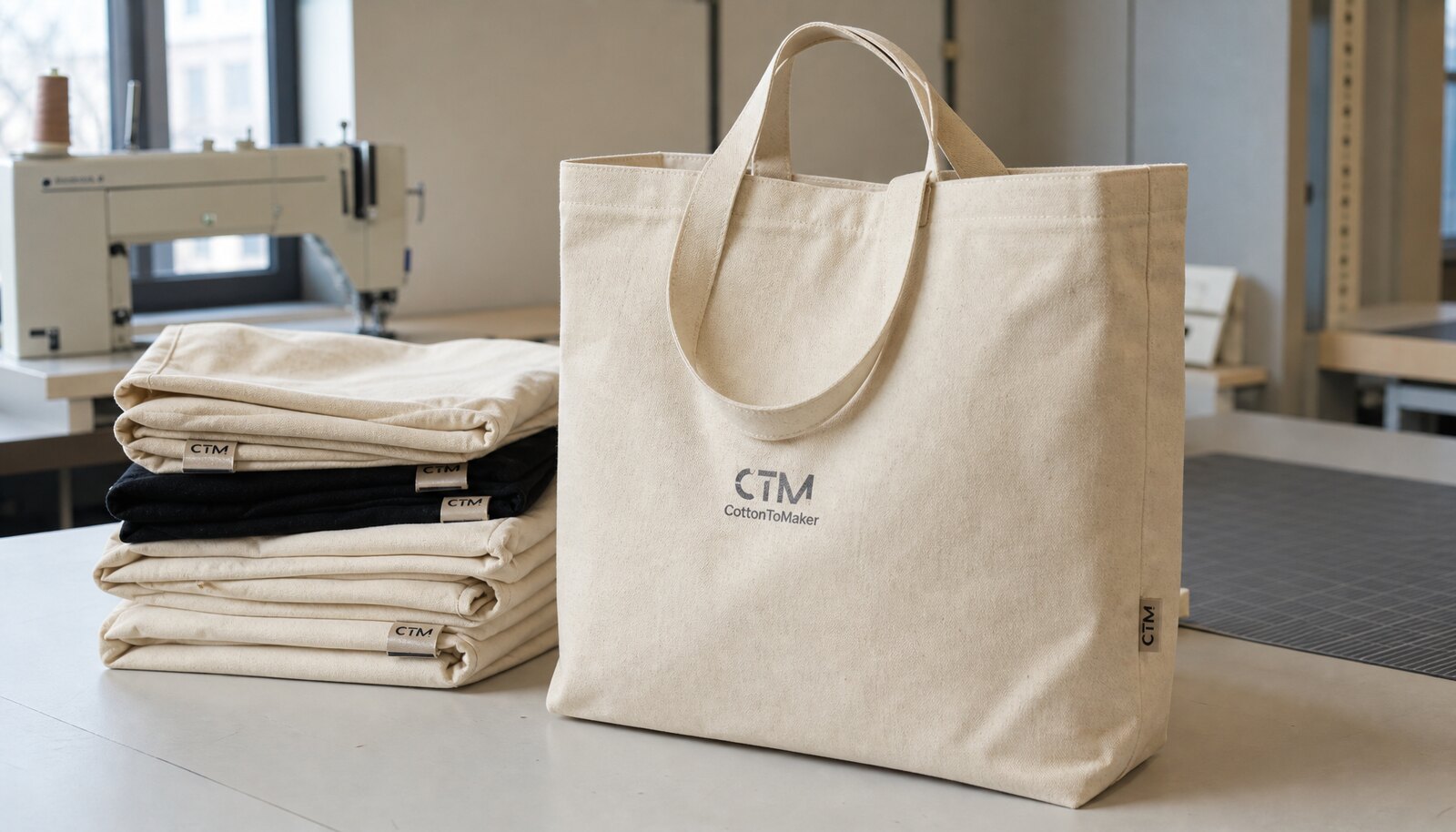
Why reorders fail even when the first canvas tote was approved
Printed canvas shopping bags for subscription boxes are often treated as a simple add-in: pick a size, print a logo, place the order, move on. That works once. The reorder is where the hidden problems show up. The first production may have been made from a fresh fabric lot, a dedicated print setup, and a factory line that had time to adjust. Months later, the same bag can come back with a different hand feel, a slightly shorter handle, a looser hem, or a print that looks a shade darker because the ink batch changed.
For a subscription box team, that is not a cosmetic issue. It affects pack-out speed, customer perception, freight cost, and whether the tote is worth keeping in the assortment. If the bag is supposed to sit neatly inside a box, then be reused for errands or retail, you need the reorder file to capture what the factory actually made, not just what the design team intended. The memo should preserve the approved sample, the measured dimensions, the packing format, and the exact print method. Without that, procurement ends up negotiating from memory, and memory is a poor quality standard.
The other common failure is treating the reorder as a brand refresh rather than a repeat purchase. If the original order was successful, the instinct is to say, “make it again.” But factories do not reproduce by instinct; they reproduce by documents, approved samples, and process notes. If you did not lock the stitch count, curing window, and carton configuration the first time, the second order will be interpreted through the factory’s current workflow. That can still produce an acceptable bag, but it may not be the same bag the customer received in the first box.
In practice, a reorder memo should answer one simple question: what exactly must not change? If the answer is fuzzy, the quote will be fuzzy too. Buyers who control the reference sample and the acceptance criteria usually get better repeatability and fewer emergency emails during pack-out week.
Lock the structure before you compare print quotes
The fastest way to overspend on a tote reorder is to focus on the art file before the structure is settled. Canvas bag cost is shaped by fabric weight, cut size, handle style, seam reinforcement, top hem construction, and packing density. If you change any of those between runs, even a quote that looks “the same” can produce a very different landed cost. For subscription box procurement, the structure should be set first because it determines whether the bag fits the insert, folds cleanly, and survives customer reuse.
For most boxes, a 10 oz to 12 oz canvas body is the practical center point. That range usually gives enough stiffness to look premium without making the tote bulky in carton pack-out. If the bag is meant for a small lifestyle box or a lighter seasonal insert, the lower end of the range may be enough. If the brand wants a more retail-like reusable bag, the upper end can make sense, but only if the freight math still works. Heavier canvas can increase carton weight and reduce the number of pieces per carton, which changes both freight and warehouse handling.
Dimensions should be chosen from the actual box interior and fold pattern, not copied from a generic tote catalog. A bag that is too tall may force awkward folding or wrap around the box contents. A bag that is too wide can look crumpled on arrival and may not re-fold cleanly for the customer. Handle length matters too. A tote for shoulder carry generally needs more handle drop than one intended only for hand carry. If the handle is too short, the bag may still pass an internal sample review but fail when customers try to use it after the box is opened.
The construction details matter because they affect both life cycle and complaint rate. Ask for double-fold top hem, reinforced handle attachment, and consistent seam allowance. If the bag will be reused outside the box, the buyer should also specify whether the handles are stitched into the seam, bar-tacked, or cross-stitched. Those details affect how much load the tote can realistically carry. The goal is not to overbuild it; the goal is to match the tote to the actual use case so you do not pay for unnecessary features or accept a bag that feels weak in the hand.
Build a landed-cost view, not a unit-price view
A reorder quote for printed canvas shopping bags for subscription boxes can be misleading if you only read the unit price. Two suppliers may both quote a tote at the same dollar amount, but one may be using lighter fabric, fewer stitches, a smaller print area, or a thinner carton. The cheaper-looking price can become the more expensive product once you count customer complaints, rework, freight, and receiving labor. Procurement buyers need a landed-cost view that includes the bag itself plus the cost of getting usable bags into the fulfillment center.
Here is the structure that usually matters. First is the fabric and sewing cost. Canvas weight, cutting efficiency, and handle reinforcement change labor time. Second is print setup. Screen printing often has a setup charge, but once the screens are made, repeat production is easier to control. Third is packing. Flat pack, banded pack, or individual polybagging all affect carton volume and warehouse handling. Fourth is freight. A denser, heavier bag may reduce the piece count per carton and increase cubic cost. Fifth is rework risk. A supplier that needs a remake or extra inspection round can erase a small unit-price advantage very quickly.
A practical example helps. Suppose a tote quote is $1.15 per piece ex-works for 5,000 bags, and another quote is $1.26. If the lower quote requires an extra inspection trip, a larger carton footprint, and one percent rework because of print offset, the real savings can disappear. If the more expensive quote packs 20 percent more efficiently and ships with fewer damages, it may be cheaper by the time the bags reach your warehouse shelf. The same logic applies to domestically decorated blanks versus fully cut-and-sewn imports. The apparent savings on the blank can be offset by lower control over fabric consistency or a more fragile print process.
The procurement memo should therefore ask for ex-works price, packing detail, estimated carton dimensions, carton weight, and any one-time setup charge. That is enough to estimate freight and receiving cost without pretending the quote is more precise than it is. If your team knows the lane, you can even compare rough freight by cubic meter. The buyer’s job is not to get the cheapest tote in isolation; it is to buy the lowest-risk tote at an acceptable landed cost for the subscription box program.
Compare supplier routes with the realities of reorders
Not every supplier route is equally useful for a reorder. An original factory, a new direct factory, a trading company, and a domestic converter each solve a different problem. The right choice depends on whether your priority is continuity, speed, contingency, or bundled purchasing. Buyers often get trapped by a low quote from a supplier who cannot actually reproduce the exact bag, or by a familiar supplier who is out of capacity for the launch window.
The original factory is usually the safest route when you still have the approved sample and the same process can be repeated. That does not mean the original factory is automatically the cheapest. It means the process risk is lower. If the first order was made from a cloth lot that is no longer available, the factory should be asked to propose the closest formal equivalent and show how it differs. A good factory will tell you where the risk sits. A weak one will simply say the bag is “same as before” and hope the buyer does not ask further.
A direct cut-and-sew factory can be a strong option if you want control over stitch quality and are willing to do the qualification work. The best version of this route is a factory that can show the line used for the tote, explain how they control print registration, and provide actual production photos from the same process. A trading company can be helpful when your subscription box includes multiple items and you need one point of coordination. But layered sourcing often means layered communication. If the tote fails, it can be harder to identify whether the issue came from the fabric mill, the sewing subcontractor, or the print house.
A backup supplier should be treated as a second controlled process, not as a price lever. That means sample lock, tolerance matching, and document control before any production commitment. Ask the backup source to quote against the same spec sheet and the same approved sample, not against a refreshed design brief. If they cannot reproduce the dimensions, fabric weight, or print finish with confidence, they are not a backup supplier yet; they are just another vendor. For subscription box procurement, that distinction matters because the consumer often sees multiple units across the same campaign. A small difference in tote color or handle style will be noticed immediately.
A real supplier comparison checklist for factory qualification
Before you assign a reorder, qualify suppliers with a structured comparison rather than a casual call. A useful buyer checklist includes process control, sample traceability, fabric sourcing, packing discipline, and response quality. Ask each supplier to answer from the same reference sample and the same measurement sheet. That is how you find out who can actually repeat the bag and who is guessing.
Start with document control. Does the supplier have the original artwork file, the approved sample code, the measurement sheet, and any production notes from the first run? Can they tell you what changed, if anything, between sample and bulk? If a supplier has no record of the original print screen count, fabric lot, or handle stitch detail, then the reorder is not a reprint; it is a new development. That is fine if you budget for it, but it should not be presented as a simple repeat.
Next, look at capacity and process discipline. Ask whether the factory will run your order on the same line that made the sample, whether the print and sewing steps are in-house, and whether any work is subcontracted. Subcontracting is not automatically bad, but it increases risk unless the supplier can show how they control it. You should also ask for realistic production slot timing rather than a promised calendar date. Reorder buyers need to know when raw canvas is booked, when printing starts, when sewing finishes, and when cartons are ready. A single end date is not enough to manage a subscription launch.
Finally, compare quality risk. Ask for the factory’s standard inspection method, their typical defect categories, and whether they have photos of common issues such as print smear, stitch skip, or edge fray. A supplier that speaks plainly about defects is usually easier to work with than one that only speaks in marketing language. For procurement, the most valuable vendor is not the one with the smoothest pitch; it is the one who can show how they prevent the failure modes that matter to your box program.
Quote questions that force real production detail
Generic quote questions produce generic answers. If the buyer asks only for price and lead time, the supplier will answer only in broad terms. For a reorder of printed canvas shopping bags for subscription boxes, the quote request should force the factory to name the materials, methods, tolerances, and responsibilities that actually affect repeatability.
Ask about fabric in a way that prevents substitution. You need GSM, weave construction, pre-shrink status, and whether the cloth is from the same source as the approved sample. If a supplier says the weight is “about the same,” ask them to provide the measured GSM and the tolerance they will accept. Ask the same way about size. Finished width, height, gusset depth, and handle length should all be stated in millimeters with a tolerance range. That stops the factory from using a generic cut pattern that only approximates the original bag.
For print, ask more than the method name. You need ink type, screen mesh, cure temperature, cure time, and the supplier’s own test for full cure. If the design has multiple colors, ask whether registration is done by manual alignment or a controlled fixture. If the logo is supposed to sit a fixed distance from the top edge, ask for that distance in millimeters. Procurement people often skip these details because they feel small. They are not small. They are the difference between a bag that looks like the approved sample and one that looks nearly right in a photo.
Rework terms should also be explicit. If print drifts, if stitching opens, or if cartons fail count, who pays to remake, re-pack, or relabel? If a supplier will only promise to “discuss” the issue after shipping, that is not a real commercial term. The reorder quote should also cover packing format, inner pack count, and carton marks. These are not decorative details. They are the terms that determine whether fulfillment can receive the order without delay.
Sampling, sample lock, and production approval without confusion
A reorder should begin with sample lock, not with a new creative review. The approved sample needs to be treated as the commercial master. Keep one physical reference bag, one measured spec sheet, one clear photo set of front, back, inside, and handle attachment, and one note on any acceptable variation. If the bag was approved in a folded state for subscription packing, keep that folding method documented too. Otherwise the factory may pack the second run differently and still claim the bag is “the same.”
The pre-production sample is where many buyers lose discipline. A production sample that looks good at first glance may still differ from the reference bag in handle length, print shade, or fabric stiffness. Measure it. Do not just compare it visually. Use the same ruler, the same flat surface, and the same measurement points every time. If possible, photograph the sample beside the approved reference with a scale visible in the frame. That makes it easier to resolve disputes later if the bulk run does not match.
Sample approval should also include the actual fulfillment context. If the tote goes into a box, open one mock pack and check how easily the bag folds, how it sits on top of or under the other inserts, and whether the print face remains clean after handling. For subscription boxes, the bag is often judged by the consumer the moment the carton opens. That means the sample should be evaluated in the same orientation the customer will see. A tote that looks acceptable hanging in a sample room can look sloppy if it opens with the wrong crease pattern or if the logo lands too close to a fold line.
Do not approve multiple versions unless there is a documented reason. If a supplier submits two “equivalent” samples, the reorder file becomes ambiguous and the line will improvise. One approved sample version, one tolerance sheet, one packing method, one print standard. That is the shortest path to repeatability.
Quality control standards that are specific enough to use in a PO
A useful QC section does more than say “check for defects.” It should define how many bags to inspect, what defects count, and how to measure them. For a tote reorder, many procurement teams use AQL inspection with Critical 0, Major 2.5, and Minor 4.0 as a starting point. That is not a magic number; it is a practical framework that lets you separate cosmetic variation from functional failure. If your brand is particularly strict, tighten the plan. If the product is low risk and the supplier has a proven record, you may adjust within your quality policy.
Measurement protocol matters because tote dimensions are easy to misread. The bag should be laid flat on a clean table, lightly smoothed without stretching, and measured at the same points every time. Width, height, gusset, handle length, and print placement should be taken in millimeters. If the bag has a top fold, measure from the finished top edge, not from the raw cloth edge. If there is a gusset, confirm whether the measurement includes the full expanded side or the sewn base only. Many disputes come from inconsistent measuring, not from actual manufacturing failure.
Print quality needs its own standard. Ask for a dry rub and a damp rub result on the printed area before bulk approval. A simple buyer-side protocol is 10 back-and-forth rubs with a clean white cloth for each condition. The print should not smudge, transfer heavily, or show premature cracking when folded along a normal crease. If you need a stronger test because the bag will be washed or heavily reused, state the expected end use and ask the factory to describe the test they use internally. It is better to define a practical standard than to use the word “durable” and hope everyone means the same thing.
Seam and handle checks are equally important. Look for even stitch density, clean bar tacks, no skipped stitches, no loose ends beyond the trim allowance, and handle attachment that is symmetrical on both sides. If the bag is intended to carry customer purchases later, the handles need to survive repeated lift cycles, not just an initial hand feel test. Ask the factory to state its seam strength benchmark or its internal pull test if available. If they do not have one, you can still require a simple acceptance rule in the PO, such as no opening after repeated manual lift checks on a representative load.
Carton-level QC is where operational issues surface. Verify count, barcode or SKU label accuracy, packing sequence, and carton condition. For export or long-haul movement, ask whether the outer cartons meet any drop or compression requirement the supplier uses. If the bags are tightly packed, inspect for hard fold marks, distorted print faces, or carton bulge. In subscription box operations, receiving efficiency is part of quality. A bag that arrives in the wrong carton count or with unclear SKU marks costs labor even if the product itself is fine.
Landed-cost math and reorder thresholds buyers can actually use
Reorder planning gets easier when you define a threshold instead of debating each quote from scratch. For example, if your subscription box uses one tote per kit and you know seasonal demand will require 12,000 units, you can decide in advance what unit price increase is acceptable in exchange for lower risk. You can also set a reorder trigger based on inventory coverage. If your current stock covers eight weeks and production plus freight takes six weeks, you have very little cushion. In that situation, a slightly higher price from the original factory may be cheaper than a lower price from a new source that needs fresh development.
A landed-cost model should include more than factory price. Add packaging, internal handling, freight, customs or brokerage if relevant, receiving labor, and an allowance for rework or overage. If the tote is packed flat in master cartons, carton dimensions affect freight cost more than many buyers expect. A small change in fold thickness or inner pack count can reduce the pieces per carton and raise cubic cost. That is why you should ask the supplier for carton dimensions early, even before the final art approval if the structure is stable.
A simple procurement math example makes the point. Suppose a supplier quotes 5,000 totes at $1.18 each, packed 50 per carton, with 100 cartons total. Another supplier quotes $1.08 each but packs only 40 per carton because the bag is thicker or the fold is less efficient. If freight and receiving are charged by volume, the lower unit price may be offset by more cartons, more pallet space, and longer warehouse handling time. The better supplier is the one that gives you the lowest total cost to a usable shelf-ready bag, not the lowest ex-works line.
Reorder thresholds should also account for lost time. If your box program cannot miss a ship date, the cost of running close to zero is not theoretical. It is measured in launch delays, substitute inserts, or expedited freight. A practical threshold is to start a reorder when you still have enough stock to absorb the longest credible combined window: art sign-off, production, inspection, and freight. Buyers who build this buffer usually avoid emergency air shipments. Buyers who don’t often end up paying premium freight to save a few cents on unit price.
A practical reorder memo template for internal use
If your team needs one document to align merchandising, procurement, and fulfillment, use a short reorder memo with controlled fields. Keep it simple enough that the factory can quote from it and the warehouse can receive against it. The memo should list the approved sample code, final bag size, fabric weight, print method, handle specification, packing configuration, carton marks, target ship date, and who owns final sample approval. If any one of these fields is missing, the risk of mismatch rises quickly.
A useful memo also records what should not change from the last run. For example: same bag shape, same logo size, same print placement, same folded pack style, same inner count, same carton label format. That sentence sounds obvious, but it prevents the classic reorder problem where each department assumes a different thing is “obvious.” Merchandising may think the artwork is fixed while operations assumes the packaging can be optimized. Writing down the non-negotiables forces the factory to quote against reality.
When the bag is part of a subscription box assortment, the memo should include the box context. State whether the tote is placed inside the carton as an insert, used as a gift-with-purchase item, or shipped as a retail-style bag. If the customer is expected to reuse it later, add a note on desired feel, handle comfort, and minimum carry usefulness. Those use-case notes help the supplier prioritize the right quality controls. In other words, the memo is not just a document for sourcing; it is a way to stop the product from drifting away from the customer experience it was meant to support.
For repeatability, keep the memo version-controlled. Give it a date, a revision number, and one owner. Save the approved sample photo set alongside it. When the next reorder comes up, the team should update only the parts that changed: quantity, timing, freight lane, or carton count. Everything else should remain locked unless there is a deliberate reason to revise it. That is the most reliable way to buy printed canvas shopping bags for subscription boxes without re-learning the same lesson on every cycle.
Specification comparison for buyers
| Supplier route | Typical cost/lead-time profile | Best use case | Quality and commercial risks to check |
|---|---|---|---|
| Original factory reprint | Lowest re-setup risk, usually the most stable lead time if fabric is still in stock; unit price may be moderate, not always lowest | When the first run was approved from a physical sample and you want the closest repeat | Confirm no silent changes to yarn, GSM, dye lot, ink, mesh, needle setup, or subcontracted sewing; ask for written confirmation of same line or same process |
| Direct cut-and-sew factory | Often best value at scale, with better control over stitching, handle reinforcement, and carton packing; lead time can be moderate | When you need repeatability, acceptable MOQ, and clean control over sample lock and QC | Factory may want to substitute fabric if the original lot is unavailable; inspect seam consistency, shrinkage, and print cure carefully |
| Trading company / sourcing agent | Higher unit price and potentially slower back-and-forth, but can coordinate multiple products in one shipment or provide backup capacity | When the subscription box contains several SKUs and you need one sourcing point | Risks include layered communication, weaker visibility into factory processes, and less clarity on where rework responsibility sits |
| Low-cost backup factory | Can look cheaper on paper, but often comes with higher sample rounds, longer qualification, and more QC time | When you need a second source for contingency or peak season overflow | Watch for different pattern blocks, looser tolerances, lower stitch density, or print color drift; do not assume a photo match means process match |
| Domestic converter / local embellisher | Fast turnaround and easier communication, but usually higher unit cost and limited fabric options | When order size is small, timing is urgent, or you need local compliance oversight | May be relabeling or decorating imported blanks; verify actual origin, blank quality, and whether the decoration process affects print durability |
| Material | 8-12 oz cotton canvas, 120-220 gsm cotton, recycled cotton, or blended fabric selected by use case and target price | Before price comparison | Different cloth weights, backing, or certification claims make quotes hard to compare |
| Construction | bag size, gusset, handle drop, seam allowance, stitch density, reinforcement patch, and loading expectation | Before sampling | Weak stress points create returns and failed inspections |
| Decoration | screen print, heat transfer, embroidery, woven label, or hangtag matched to fabric texture and brand durability needs | Before artwork approval | The wrong method can crack, bleed, pucker, or fail on the chosen fabric |
Buyer checklist before sampling
- Freeze the bag spec: finished size, gusset, handle drop, seam allowance, fabric weight, color, and logo placement before requesting fresh quotes.
- Ask the supplier to quote against the approved physical sample number, not only against a drawing or artwork file.
- Require a written tolerance sheet for finished dimensions, print position, stitch density, and handle length.
- Confirm print method, ink type, curing method, and whether the artwork will be printed before or after sewing.
- Lock packing format, carton count, carton dimensions, and any barcode or SKU label requirements before production release.
- Request one pre-production sample or golden sample photo set with measured dimensions and print placement.
- Set a clear acceptance rule for stains, broken stitches, shade mismatch, print offset, and carton count variance.
- Record rework responsibility in writing: who pays for remake, who replaces cartons, and what happens if a lot fails inspection.
Factory quote questions to send
- What is the exact canvas construction, fabric weight in GSM, and whether the cloth is pre-shrunk, washed, or calendered?
- Is the quote based on the approved production sample, and can you confirm the same fabric lot or a formally approved equivalent will be used?
- What are the finished size tolerances for width, height, gusset, handle length, and print placement in millimeters?
- What stitch specification will be used at the top hem, handle attachment, and side seams, including stitch per inch or stitch density target?
- What ink system, screen mesh, curing temperature, and cure time will be used, and how do you verify full cure before packing?
- What is the acceptable rub/wash test result for this print, and can you share the standard you use for testing?
- How many colors are included in the price, and is there a setup charge, plate charge, or screen charge for reorders?
- What is the MOQ by colorway, print version, and packing format, and can mixed SKUs be packed in the same production run?
- What carton size and inner pack count are included in the quote, and what is the expected gross weight per carton?
- What drop-test or carton compression requirement do you follow for export packing, and can you provide the test method if applicable?
Quality-control points to confirm
- Use an AQL plan before production starts. For visible and functional defects, many buyers set Critical 0, Major 2.5, Minor 4.0 for a full lot inspection, then tighten or relax based on history.
- Measure at least 5 bags per sampled carton and 20 bags per lot segment if the order is large enough. Record width, height, gusset, handle length, print position, and seam allowance in millimeters.
- Accept finished size only within the written tolerance sheet; if no tolerance sheet exists, create one before PO release rather than guessing at inspection time.
- Check fabric weight with a GSM cut sample or supplier certificate, and reject batches that are visibly lighter or show patchy weave, slubs, holes, or uneven dye tone outside the approved reference.
- For print quality, require sharp registration, no pinholes, no smearing, no double image, and no obvious ghosting around the logo edges.
- For cure testing, use a dry rub and a wet rub check on the print area; a simple buyer-side protocol is 10 back-and-forth rubs with a white cloth for dry rub and 10 for damp rub, with no visible color transfer beyond an agreed light trace.
- If wash testing is relevant to the end user, require the supplier to state the test standard used. If you do not have a formal lab standard in the PO, at minimum require a small trial wash and reinspection for cracking, peeling, or severe fade.
- Check seam strength by loading a representative bag and hand-testing the handles with repeated lift cycles; for procurement use, set a minimum pull expectation in writing or ask the factory for its internal tensile or lift benchmark.
- Reject loose threads longer than the trim standard, broken stitches, open seams, missing bar tacks, needle damage, or uneven handle symmetry that affects carry balance.
- Inspect cartons for count accuracy, SKU label correctness, carton marks, and transit damage; if the bag is packed for export, confirm drop-test or corner-crush expectations before shipping.