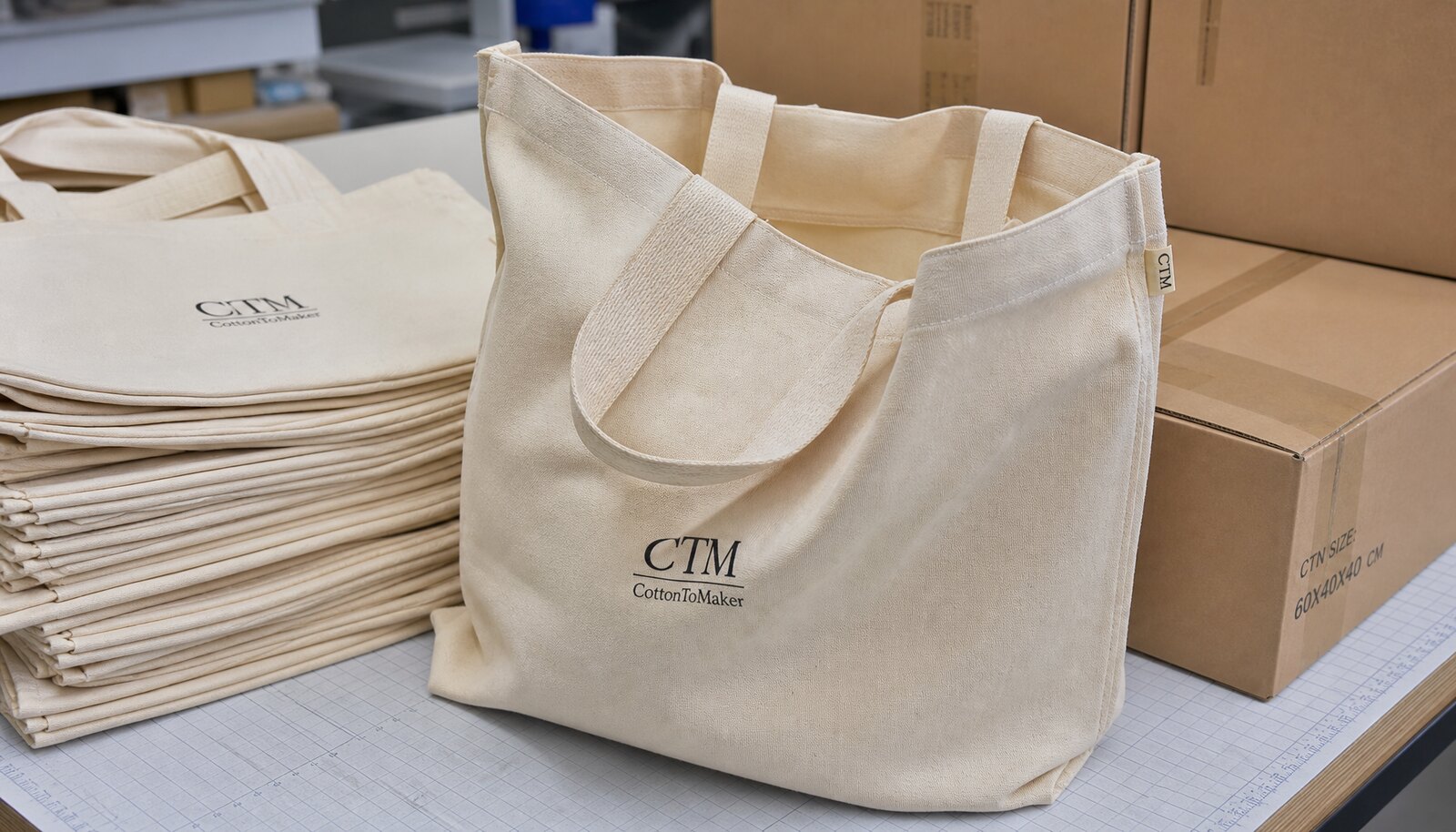
Why carton planning matters as much as bag design
For printed canvas shopping bags for schools, the bag spec is only half the commercial job. The other half is how the bags move after sewing: how they are folded, counted, packed, labeled, stacked, and delivered to one or many receiving points. A good-looking sample can still become an expensive order if the cartons are oversized, too heavy for manual handling, or impossible to palletize efficiently.
School buyers face more destination complexity than a normal retail order. One program may need bags sent to a campus store, a procurement warehouse, and several satellite schools. Another may need one shipment for student orientation and a second for fundraising. Those different paths change the right carton size, the pack count, and the label structure. If the carton plan is not defined early, freight cost and receiving delays usually show up after the PO is already issued.
The practical rule is simple: the bag spec controls appearance and use, but the carton spec controls landed cost and receiving speed. Treat both as approval items, not as packing afterthoughts.
- A lower bag unit price can be erased by poor carton sizing or high rehandling cost.
- Carton dimensions affect pallet fit, cube utilization, and truck or container loading.
- Receiving teams need labels and counts they can sort without opening every box.
Choose a fabric weight that fits the actual school use case
Most school tote programs land in the 10 oz to 12 oz canvas range. That range gives enough body for print clarity, enough stiffness to look presentable at retail, and enough durability for repeated campus use. If the bag is only for event handouts or short-term carry, 8 oz can work, but buyers should accept a softer handfeel and a higher risk of visible creasing after carton packing.
The right question is not just what weight the supplier can source. It is what weight keeps the bag functional without adding unnecessary freight and material cost. A 12 oz bag may be worth it when the tote is sold through a bookstore or used for books and stationery. A 10 oz bag usually makes more sense for welcome kits, PTA events, and school fairs where the bag must look solid but does not need heavy-load performance.
Ask the supplier to quote at least two fabric weights using the same artwork and the same carton plan. That comparison gives you a cleaner view of how fabric weight changes unit price, print sharpness, and carton cube. If the supplier only wants to quote one weight, they may be hiding a cost tradeoff instead of solving it.
- Typical range: 10 oz to 12 oz canvas for reusable school shopping bags.
- Use 8 oz only for light-load event use where durability is not the main selling point.
- If the tote must carry books, err toward tighter weave and reinforced handles rather than the lightest possible fabric.
Match print method to artwork complexity and reorder pattern
For school logos and campus names, screen print remains the default choice because it handles bold text and simple graphics well at a reasonable cost. It is usually the strongest option when the same logo repeats across a large order or across annual reorders. The setup is easy to understand, the color result is consistent when controlled properly, and the economics improve as the run gets larger.
Heat transfer can be practical when the design changes often or when each campus needs a different name, but it should be treated as a use-case tool rather than a blanket upgrade. On rough canvas, transfer films may feel different from the fabric, and very fine detail can degrade if the supplier is not experienced. Embroidery looks premium, but for most school tote programs it adds cost and can distort lighter bags, so it is usually reserved for premium retail merch rather than large procurement runs.
The quote should spell out the print method, number of colors, print size in centimeters, and placement tolerance. If the factory cannot state those details, you are probably comparing artwork concepts instead of production-ready offers. Ask for a physical strike-off or a clearly referenced sample on the same canvas texture, not on a smooth substitute.
- Screen print: best for repeated logos, bold shapes, and low landed cost on volume orders.
- Heat transfer: useful for short runs or variable campus names, but verify rub resistance and edge durability.
- Embroidery: only worth considering for premium retail bags or very small quantities.
Build the carton spec before the order is quoted
Carton planning should start before the supplier finalizes the quote, not after production begins. The carton affects freight, handling, and receiving behavior, so it belongs in the RFQ. A carton that is too small can crush handles or wrinkle the print panel. A carton that is too large wastes cube and may fail stack stability in transit. The best carton is the smallest one that protects the approved fold pattern and stays within your handling limits.
For school buyers, a practical target is usually a carton that stays around 10 to 14 kg gross weight for manual handling unless the flow is fully palletized and forklift-served. That range is not a hard rule, but it is a useful planning point because many receiving teams need to lift and sort cartons by hand. Common starting carton sizes for mid-size totes often fall around 45 x 35 x 30 cm or 50 x 40 x 35 cm, but the final dimensions should follow the actual bag fold and thickness, not a generic template.
Also define whether the carton needs to be pallet-friendly. If the order will cross-dock through a warehouse, ask the supplier for the carton dimensions, pallet layer count, estimated stack height, and gross weight. That allows you to judge whether the order can move cleanly on standard pallets without overhang or excessive top-load risk.
- Target a carton weight that the receiving team can handle safely without special equipment.
- Use the smallest carton that preserves the bag shape and protects the print area.
- Ask for pallet build data early: layers, cartons per layer, stack height, and overhang risk.
Select the sourcing route that gives you the right amount of control
Factory-direct sourcing gives the buyer the cleanest line of sight into the actual production chain. You can ask who is making the fabric, who is printing, who is sewing, and who is making the cartons. That matters because the bag spec and carton spec are linked. If the print house, sewing line, and carton supplier are all visible, it is easier to lock a repeatable standard for future school reorders.
A trading route can still be useful, especially when the buyer needs several artwork versions or a fragmented destination pattern. The tradeoff is control. A trading company may quote one clear line item while the real packing standard is still being decided with the factory later. That can work for simple orders, but it creates risk when the buyer needs strict carton counts, destination codes, or pallet consistency.
For recurring school programs, the best practice is to store the approved carton spec in the master file alongside the approved bag sample. That way, the next order does not need to re-litigate pack count, carton grade, label format, or pallet pattern. Ask the supplier whether the same spec can be reproduced without a fresh engineering discussion each time; if not, reorders will cost time even if the bag itself is simple.
- Factory-direct is better when you need transparency on fabric, print, sewing, and carton source.
- Trading routes can help with multi-design or multi-destination orders, but they often hide packing control.
- Store the approved carton spec as part of the repeat-order master record.
Use sample approval to test the whole pack flow, not only the loose bag
A common procurement mistake is approving a clean-looking loose bag and ignoring how it behaves inside the master carton. For school tote orders, the sample stage should include the actual fold method, the actual carton count, and the actual carton closure method. A bag that looks right on a table may fold badly, wrinkle the print, or cause a carton to overfill once it is packed at volume.
The sample package should answer three questions: does the fabric match the approved handfeel and weight, does the print look correct on that fabric, and does the bag sit correctly in the carton with the planned pack count? If the answer to any of those is no, you still have a design problem. Ask the factory to supply a packed pre-production sample that uses the final sewing line, final print method, and final outer carton marks.
If the supplier cannot provide a packed sample, ask for a packing mock-up. That mock-up should at least show the final carton size, fold pattern, and fill level. The point is not to create paperwork. The point is to catch the kind of failure that only appears once hundreds or thousands of bags are boxed together.
- Approve the bag and the packed carton together.
- Verify the fold pattern, not just the print image.
- Check whether the carton fill level leaves enough clearance for closure and handling.
Use MOQ as a planning tool, not just a price gate
MOQ on printed canvas shopping bags for schools is usually driven by fabric sourcing, print setup, and packing efficiency. If one school logo is repeated across a large order, the factory can spread the setup cost more efficiently. If each campus needs a different name, badge, or event date, the MOQ often rises because print screens, label sets, and packing runs multiply. Buyers should separate total order quantity from per-design quantity in the RFQ.
A better procurement approach is to ask for three quote bands: a pilot order, a standard reorder, and a volume price at full carton efficiency. That tells you whether the supplier is pricing the real setup or just offering a headline number that depends on an awkward quantity. It also exposes whether the carton plan changes at different volumes. Sometimes the lowest unit price comes with a carton configuration that is awkward to handle or expensive to ship, which defeats the purpose.
If the supplier quotes a very low MOQ but refuses to define carton pack count or fabric source, treat that as a warning. The missing cost will usually reappear later as packing fees, relabeling charges, rush freight, or poor cube efficiency. A real procurement quote should let you model the landed cost before you commit.
- Set MOQ by artwork version, not only by total piece count.
- Ask for price breaks that reflect carton efficiency, not only factory enthusiasm.
- If you split campuses or destinations, make sure the MOQ logic is shown per pack group.
Plan lead times around artwork, cartons, and dispatch readiness
School tote lead times fail most often outside the sewing line. Artwork approval slips, carton artwork needs changes, packing instructions arrive late, or raw materials are not actually booked when the quote is issued. A supplier that gives only the sewing time is not giving you the real schedule. For a school program, that is not enough because the delivery date is often tied to a fixed event: enrollment week, an open day, a bookstore launch, or a fundraising campaign.
A useful lead-time split includes sample confirmation, raw material booking, bulk production, packing, and dispatch readiness. If the supplier says production begins immediately after artwork approval, ask whether the fabric, thread, and cartons are already reserved or simply assumed to be available. For split shipments, add extra time for carton relabeling and destination sorting because those tasks are rarely on the critical path in the original quote but often become the delay point later.
The buyer should also ask whether the quoted lead time assumes standard carton format. If a custom carton size or destination label set is needed, that can add a separate pre-press or carton-making step. Build buffer time into the PO if the bags are tied to a school calendar. Once the delivery date is public, you usually do not get a second chance.
- Separate sample lead time from bulk production lead time in the PO.
- Ask whether fabric and carton materials are already booked or only available on request.
- Add time for destination relabeling if the order is split across schools or campuses.
Compare quotes on the details that actually change landed cost
A usable quote should let procurement compare apples to apples. If one supplier quotes loose-packed bags and another quotes carton-packed bags, the lower unit price may be meaningless. You need the same fabric weight, bag size, print method, carton count, carton dimensions, gross weight, and delivery assumption across all offers. Without that consistency, the team is not comparing commercial reality; it is comparing incomplete drafts.
The strongest quote is the one that exposes cost drivers. Setup charges, Pantone matching, extra print colors, woven labels, carton printing, palletization, and split destination handling should all be visible. That gives the buyer room to choose where to spend and where to save. For school shopping bags, the safest place to protect quality is usually print clarity, handle reinforcement, and carton strength. The weakest place to cut cost is often the fabric weight or carton grade, because those choices directly affect usability and shipping damage.
Ask suppliers to show carton dimensions and gross weight alongside the bag price. That allows your freight team to estimate cube and compare supply routes before a PO is released. A quote that hides carton data is not really finished.
- Do not compare unit price without carton data and delivery assumptions.
- Require the same pack count and carton spec across all quotes.
- Treat setup, relabeling, and palletization as real cost items, not side notes.
Set operational QC standards before the factory starts production
QC for school tote bags should be measurable. Vague language like “good stitching” or “nice print” does not help a factory inspect the order or help a buyer reject a bad batch. You need tolerances, sample size logic, and clear defect thresholds. That is especially important for school programs because the bags are often visible to students, parents, and staff, so minor defects can affect how the program is perceived even if the bags still function.
At minimum, the QC plan should cover fabric consistency, bag dimensions, seam quality, handle reinforcement, print placement, carton count, carton condition, and label accuracy. If the supplier has a standard AQL system, ask them to state it clearly and explain which defects are critical, major, and minor. If not, create your own simple acceptance rule tied to the approved sample and to visible defects that matter in use.
For this category, the most useful acceptance thresholds are practical ones. A few loose threads are not the issue. A distorted handle attachment, a misprinted logo, a carton with the wrong destination code, or a batch with inconsistent bag size is the issue. Write the QC so the factory knows exactly what fails the lot and what passes with rework.
- Use measurable standards for print placement, stitch symmetry, carton count, and label accuracy.
- Tie acceptance to a golden sample and, if possible, a packed carton reference sample.
- Define which defects are rejectable versus reworkable before production starts.
Specification comparison for buyers
| Spec decision | Recommended option | When it fits | Buyer risk to check |
|---|---|---|---|
| Fabric weight | 10 oz to 12 oz canvas for most school retail and welcome-kit bags; 8 oz only for light event carry | Best for reusable merch, bookstore sales, PTA fundraising, orientation packs, and daily campus use | Below 8 oz, the bag can feel limp, show print strike-through, and wear faster at the handles; above 12 oz, freight cube and bag weight rise quickly with little benefit unless the bag carries books |
| Print method | 1-color or 2-color screen print for repeat logos; heat transfer only for short-run variable artwork; embroidery only for premium retail items | Best when the art is simple, the same logo repeats across campuses, and the school wants a durable, low-unit-cost finish | Thin serif text, small reversed details, and gradient art often fail on rough canvas; ask for a 1:1 artwork proof and a physical strike-off before approval |
| Handle construction | Self-fabric handles with reinforced stitch box or cross-box stitch at the join | Best for book-carrying totes or bags used more than once per week | Handle tear-out is a common field failure. If the stitch density is low or the join area is not reinforced, the bag may pass visual QC and still fail in use |
| Bag size | Standard mid-size tote around 38 x 42 cm with an 8 to 10 cm gusset | Best for campus stores, welcome packs, and general shopping use | Oversized bags inflate carton cube and freight; undersized bags create usability complaints and reduce perceived value |
| Carton pack count | Pack to a target carton weight of about 10 to 14 kg for manual handling, or up to the site limit if pallets and forklifts are guaranteed | Best when bags move through a warehouse, campus store, or distribution center | Overfilled cartons crush handles and prints; underfilled cartons waste freight cube and raise per-unit shipping cost |
| Carton dimensions | Use the smallest carton that fits the approved fold pattern without bending handles; common starting points are around 45 x 35 x 30 cm or 50 x 40 x 35 cm, adjusted to bag size | Best when the buyer needs stable pallet builds and predictable truck or ocean freight loading | If carton height varies by more than about 10 mm, pallet layers can drift and top-load damage increases |
| Outer carton marks | Plain master carton with SKU, color, size, quantity, destination code, and carton number; add campus name if split shipping is required | Best for schools, distributors, and buyers with multi-drop deliveries | Missing or inconsistent marks slow receiving, create mis-sorts, and make partial deliveries hard to reconcile |
| Carton strength | Single-wall carton for local or low-stack distribution; double-wall when cartons are export-bound, pallet-stacked high, or exposed to longer transshipment | Best when cartons will be stored, moved multiple times, or stacked in a warehouse | A weak carton can fail from humidity, compression, or rough handling before the bags are damaged |
| Supplier route | Factory-direct when you want control over fabric, print, and packing; trading route only when the order truly needs multiple factories or highly fragmented destinations | Best for repeat orders, school retail programs, and buyers who want a fixed carton spec on file | If the supplier cannot name the mill, printer, and carton source, you may not know where the real QC control sits |
Buyer checklist before sampling
- Confirm the final canvas weight in oz or GSM, the weave style, the finished bag size, the gusset depth, and whether the bag is pre-shrunk or washed.
- Lock the print method, color count, Pantone targets if needed, and the exact logo placement with a measured artwork proof.
- Define carton pack count, target carton dimensions, gross weight limit, and whether cartons must be pallet-friendly or hand-carry safe.
- State the destination pattern clearly: single warehouse, regional distribution points, or direct-to-school split shipments.
- Ask for a packed pre-production sample, not only a loose bag sample, so you can verify fold pattern, fill level, and carton fit.
- Require outer carton markings, barcode needs, ship-to labels, and any campus naming convention before production starts.
- Set measurable acceptance criteria for print placement, stitch density, handle reinforcement, carton compression, and label accuracy.
- Request a lead-time split for sampling, raw material booking, bulk production, packing, and dispatch readiness.
- Ask whether any materials are sourced from stock, made to order, or subject to seasonal availability that could affect delivery.
- Confirm who owns final signoff for artwork, carton labels, and packing list accuracy on the buyer side.
Factory quote questions to send
- What exact fabric weight, weave type, and finishing are you quoting, and what tolerance do you allow across panels and handles?
- Which print method is included, how many colors are priced, and what are the setup charges for each artwork version?
- What is your MOQ by fabric color, print color, and destination label? Does the MOQ change if we use one standard carton spec?
- How many bags per carton do you recommend for this size without deforming handles or flattening the print area?
- Can you provide carton dimensions, gross weight, estimated pallet count, and the maximum stack height you recommend?
- What sample do you supply before bulk production: blank sample, printed strike-off, or pre-production sample packed in the final carton spec?
- What QC checkpoints do you apply to fabric thickness, stitch strength, print registration, carton sealing, and final carton count before shipment?
- What is your production lead time after sample approval, and which steps are on the critical path: fabric booking, printing, sewing, packing, or carton procurement?
- Who makes the carton, and can you confirm carton grade, board thickness, and whether the carton is single-wall or double-wall?
- If we split deliveries by school, what extra label, pack, or relabeling cost should we expect?
Quality-control points to confirm
- Fabric weight should match the approved range by lot, with no obvious thin spots, broken weave, or panel-to-panel inconsistency.
- Bag dimensions should stay within the agreed tolerance, and the bag should lay square when folded flat and remain usable when opened.
- Print should be centered within the approved placement tolerance, with no major smearing, pinholes, double images, or color dropout.
- For screen prints, ink coverage should be even and dry to the touch without blocking, set-off, or adhesion failure after basic rub handling.
- Handle attachment should use reinforced stitching; check for skipped stitches, loose threads, asymmetry, or stitch gaps at the join.
- If the order includes stress-sensitive bags, pull-test at least a sample set against the agreed force target or supplier standard before release.
- Carton count should match the packing list exactly, with no under-pack, over-pack, or mixed-SKU cartons unless explicitly approved.
- Carton weight should stay within the handling limit set in the PO, and the stack should remain stable after normal compression.
- Outer carton marks should match the SKU, destination, carton number, and quantity approved by the buyer, with no handwritten corrections unless signed off.
- Cartons should close cleanly, tape should hold under normal handling, and no carton should show crushing, puncture, or moisture damage before dispatch.