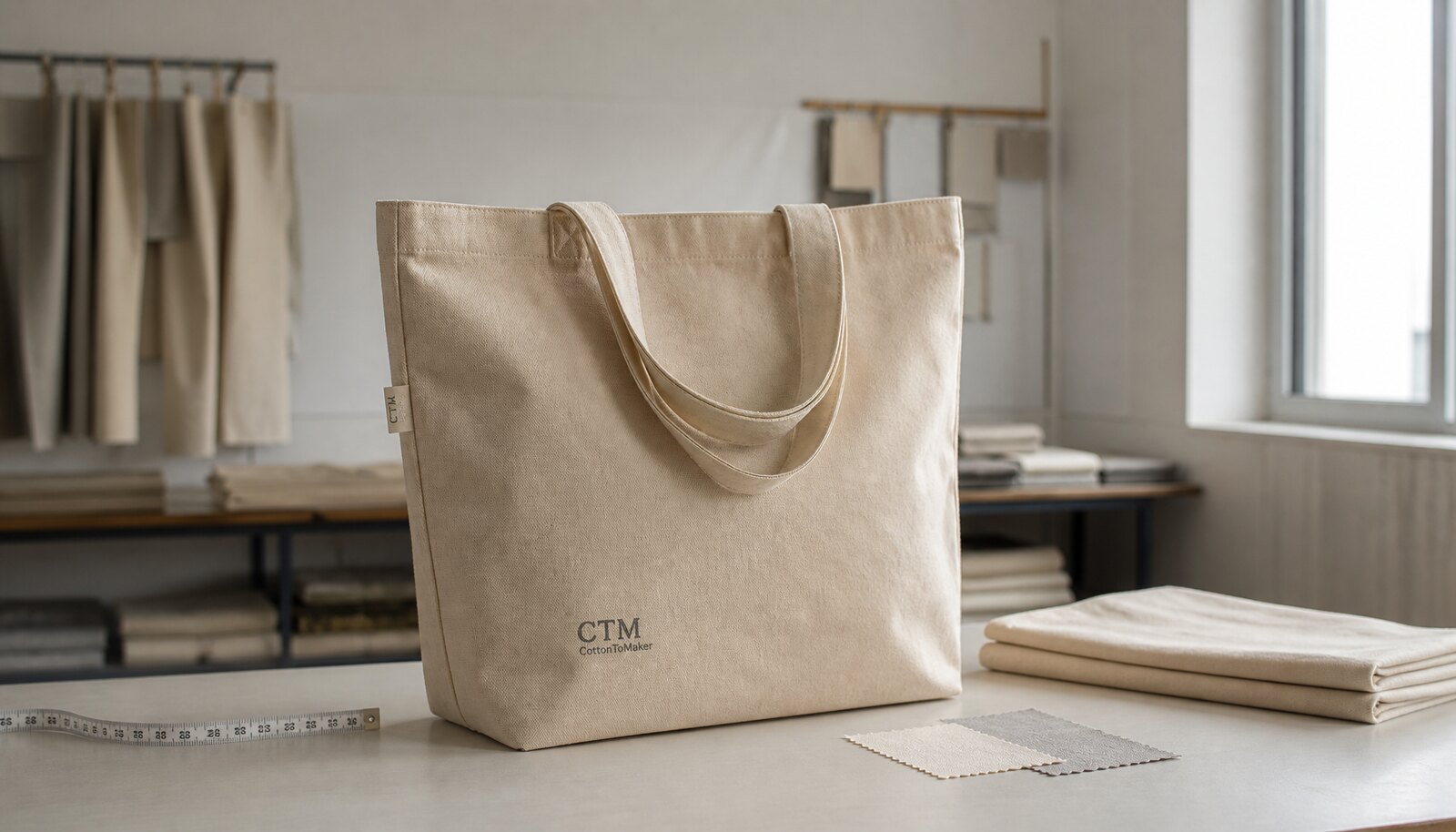
Why School Orders Behave Differently
Printed canvas shopping bags for schools are not just another tote order. The buying problem is usually a mix of fixed delivery dates, repetitive distribution, and a need for a bag that can survive books, stationery, or a few rounds of use without becoming a complaint item. A school buyer is often managing several audiences at once: procurement wants a clean quote, branding wants the logo right, and operations wants cartons that are easy to hand out. That is why school orders fail when buyers treat them like a generic promotional tote. The spec has to reflect the actual use, not only the artwork.
The first mistake is starting with decoration instead of function. If the bag is for bookstore retail, it needs a different finish than a one-day orientation giveaway. If it is for younger students, handle length, opening width, and carry comfort matter more than a premium print effect. If it is for books or notebooks, the fabric and stitching have to support repeated weight. The right buying approach is to define the distribution channel, the bag load, and the deadline before you talk about price. Once those are set, suppliers can quote a useful structure instead of a vague tote price.
- Define the school use case first: books, event giveaway, bookstore retail, or welcome kit.
- Tie the quantity to the real distribution plan, not only to enrollment numbers.
- Freeze the delivery date early because school launches do not tolerate factory delays.
- Treat repeatability and carton handling as part of the product spec.
Fabric Weight, Size, and Build Choices
For school buyers, fabric weight is one of the biggest cost and performance levers. An 8 oz or about 280 gsm canvas can work for light carries, flyers, or soft merchandise, but it feels less structured and gives less margin if the bag is packed with books. A 10 oz or about 340 gsm canvas is often the practical middle ground for school use because it balances cost, body, and print surface. A 12 oz or roughly 400 gsm canvas feels more substantial and is better when the bag will hold textbooks, library books, or heavier kits. The heavier fabric usually lifts the perceived quality, but it also affects sewing speed, shipping weight, and price.
Size and construction should follow the load, not a random template. A medium tote around 38 x 42 cm with a modest gusset is often enough for everyday school use, while a larger format helps if folders or books need to lie flat. Handle width and attachment are easy to under-specify; narrow handles may feel acceptable on a sample but become a complaint when the bag is filled. For school programs, cross-stitch or bar-tack reinforcement at the handle points is not optional if the bag will carry books. If the supplier proposes a lighter build to improve price, make sure the use case can absorb the tradeoff.
- 8 oz / 280 gsm is for lighter loads and tighter budgets.
- 10 oz / 340 gsm is a strong default for mixed school use.
- 12 oz / 400 gsm or above fits heavier books and repeated carrying.
- Use reinforced handle attachment and a stable top hem to reduce early failures.
Print Method and Artwork Limits
The print method is where many school tote quotes look comparable until the details are exposed. Simple one-color screen printing is usually the best value for larger runs because it is durable, straightforward, and efficient when the logo is clean and the artwork is not overloaded with gradients. Multi-color screen printing can still work, but every extra color increases setup and the chance of registration issues. Digital or heat transfer can help with short runs, small logos, or complex art, but the unit cost climbs and the finish can be less forgiving on rough canvas. Embroidery or woven labels can look premium, but they change the bag economics and may not suit a low-cost school program.
Buyers should write the artwork rules into the RFQ instead of assuming the factory will interpret them the same way. State the exact print size, placement, color references, and whether one side or both sides need printing. Keep the logo away from seams, handles, and the bottom gusset so the supplier does not need to distort the art. Ask for vector artwork in a usable format and provide a one-color version as a fallback. For school jobs, a simple design usually prints better, ships faster, and gives fewer reasons for rejection than a busy graphic that needs a lot of hand tuning.
- Use one-color screen print when the logo is simple and the order is volume driven.
- Use digital or transfer only when the design complexity justifies the extra cost.
- Keep print placement clear of seams and stress points.
- Provide vector artwork plus a single-color fallback version.
MOQ Logic and Quote Math
MOQ is not just a supplier preference; it is usually the point where the factory can batch fabric, cut efficiently, and keep print setup worth the labor. A custom school tote needs fabric cutting, sewing line setup, screen preparation or print calibration, and packing that matches the final distribution plan. If the supplier is cutting from standard fabric rolls and using a simple one-color print, the MOQ may be reasonable at 500 to 1,000 pieces. If the bag size is custom, the color is special, or the logo has several print colors, the MOQ often moves into the 1,000 to 3,000 piece range. Higher setup cost is normal when the design is less standard.
The lowest MOQ is not always the best buy. A quote that looks cheap at 300 pieces can become expensive because the setup cost gets spread over very few units, freight becomes a larger share of the total, and the supplier may use a lighter fabric to make the numbers work. Compare the quote on the same basis: bag spec, material, print method, packing, and incoterm. For school buyers, the right question is not only, 'What is the unit price?' It is, 'What is the cost of the finished, usable bag at the delivery point, with the right quality and the right calendar risk?'
- 300 to 500 pcs usually fits stock size and very simple decoration.
- 1,000 to 3,000 pcs is common for a truly custom school tote.
- Repeated colors, custom labels, and special packing all push MOQ upward.
- Compare quotes on the same spec sheet or the numbers will not mean much.
Lead Time: Where the Days Go
Lead time should be broken down into visible steps instead of being treated as one promise. A standard flow is sample approval, material reservation, print setup, sewing, finishing, inspection, packing, and booking. For a simple school tote, sample production can take roughly 5 to 10 working days if the structure is standard and the artwork is clean. Bulk production after approval often lands in the 20 to 35 working day range, but that depends on fabric availability, season, print complexity, and whether the factory has to wait for a buyer decision before it can start. If the order is placed near the back-to-school season, the same factory may need more time even if the quote looks normal.
The schedule risk is usually not sewing itself. Delays come from late artwork approval, changes after the sample is made, missing packaging details, and freight bookings that cannot be secured on the preferred date. School programs need a backward plan from the handover date, not from the purchase order date. If the bags must be on site for distribution, add time for transit, customs, and local receiving. A buyer who leaves only the factory production window in the plan is almost always underestimating the real timeline.
- Sample timing is often 5 to 10 working days for standard structures.
- Bulk production is often 20 to 35 working days after approval.
- Add buffer for peak school season, artwork revision, and freight booking.
- Treat shipping and customs as separate from factory lead time.
Sample Approval and QC Thresholds
A school tote sample should be approved against a simple but disciplined reference. The sample needs to match the size sheet, handle length, print placement, color, and packing method, not just the front view. If the supplier sends one sample and the bulk order changes later, the buyer loses the only objective reference point. The cleanest approach is to keep one golden sample, one approved artwork file, and one spec sheet with measurements and packing instructions. That trio gives procurement, brand, and factory the same target.
For QC, define measurable thresholds instead of vague language like good quality or neat finish. Buyers commonly set acceptable tolerances for bag dimensions, handle length, and print placement, then inspect stitching and visual defects against a sample reference. Because school bags may carry books, a practical load test is worth adding to the acceptance criteria. That does not need to be complicated; it just needs to be repeatable. If the bag fails under a normal carry load, the design is wrong even if the print looks fine.
- Approve a golden sample before bulk production starts.
- State allowable tolerance for size, handle length, and print placement.
- Require a simple load test that matches the school use case.
- Reject bulk goods that drift from the approved color or seam finish.
Packing and Carton Planning for School Distribution
Packing is not a minor detail when the bags are going to schools. A tote that is fine in a factory carton can still create extra work if the folding method is awkward, the carton count is wrong, or the labels do not support distribution by site or by class. Decide early whether the bags will be handed out individually, stored in a school warehouse, or split across multiple campuses. That choice changes the way the bags should be folded, packed, and marked. For example, a school office may prefer manageable carton weights and clean carton marks over a dense pack that is efficient for freight but hard to receive on site.
Individual polybags are not always necessary. In some school programs they add cost and waste without improving the user experience. In other programs, a clean inner wrap can help if the bags must stay dust-free or be distributed as part of a retail pack. The key is to align the pack format with the receiving environment. If the order is going to several campuses, carton marks should show style, color, quantity, and the receiving code. If the program requires exact counts by grade or site, the packing list has to follow that structure from the start.
- Choose a folding method that keeps the bag shape consistent and easy to unpack.
- Use carton marks that support campus, grade, or site-level distribution.
- Avoid unnecessary polybags unless cleanliness or retail presentation requires them.
- Keep carton sizes manageable for school staff or warehouse teams.
How To Compare Supplier Routes and Landed Cost
The comparison table above is meant to stop buyers from comparing the wrong things. A direct factory quote may look lower than a trading company quote until you add export handling, inspection, and the cost of a problem order. A domestic decorator may offer speed, but the bag cost can be much higher once volume grows. For school tote programs, the best route depends on volume, deadline pressure, and how much control procurement needs over fabric and print. If the program is one-off and urgent, speed may outrank price. If the bag will be reordered every term, factory consistency becomes more valuable than a small short-term saving.
When comparing landed cost, line up the same elements across every supplier: bag cost, print cost, sample cost, packing cost, cartons, freight, and any inspection or export handling fee. Ask for EXW, FOB, or another clearly defined term so you know what is included and what is not. A quote that hides packing or uses vague 'all-in' wording is harder to audit and easier to misread. For buyer teams, the real job is to compare the cost of a finished, usable school bag delivered on time, not a theoretical unit price sitting at the factory gate.
- Separate bag cost, print cost, packing, freight, and service fee.
- Use one identical spec sheet for every supplier quote.
- Compare delivery terms, not only unit prices.
- Include schedule risk in the decision, not just the lowest number.
The RFQ Package That Gets Comparable Quotes
A good RFQ for printed canvas shopping bags for schools is short, visual, and specific. It should include the bag size, fabric weight, color, print file, print size, handle length, packing method, target quantity, delivery date, and shipping term. If you send only a logo and ask for a price, the supplier will fill in the blanks with assumptions. That creates quote drift and later disputes. A clean RFQ should also say whether the order is for a school program, a bookstore, a campus event, or a resale channel, because each one implies a different balance between price, presentation, and durability.
The best buyer behavior is to force every supplier to answer the same commercial questions in the same structure. Then the quote can be compared on facts instead of on presentation quality. Once the quote lands, review the lead time line by line. If the factory says it can ship faster than everyone else, find out whether it is using stock fabric, a faster print method, lighter packing, or simply excluding some steps from the promise. That is where school buyers avoid the most expensive misunderstandings.
- Send one spec sheet, one artwork file, and one target delivery date.
- Require each supplier to quote the same incoterm and packing format.
- Ask for a breakdown of sample, setup, packing, and freight-related costs.
- Record any assumptions so the comparison stays clean.
Specification comparison for buyers
| Spec decision | Recommended option | When it fits | Buyer risk to check |
|---|---|---|---|
| Direct factory with in-house printing | Best for custom size, repeat orders, and tighter control of fabric and print | You need a school-specific tote and can plan 1,000 pcs or more | Screen setup, fabric reservation, and packing details must be frozen early or the schedule slips |
| Trading company or sourcing office | Useful when you want one contact across several factories | You are comparing multiple routes, materials, or export terms at once | The factory cost, service fee, and freight can be blended unless the quote is fully separated |
| Domestic decorator using imported blanks | Good for short runs and urgent school event deadlines | The delivery date matters more than the lowest unit price | Blank bag quality may be inconsistent and the landed cost can become high at scale |
| Local manufacturer with in-house printing | Works when you need speed, easier communication, and smaller transport risk | You want shorter transit and straightforward reorder handling | The supplier may only offer limited fabric weights, sizes, or print colors from stock |
| Stock bag supplier with overprint | Fits simple logos and fast replenishment | The design is one or two colors and the bag shape can stay standard | The handle length, seam build, or fabric hand feel may not match your school spec |
| Overseas factory with third-party inspection | Best for importers who need cost control and measurable QC gates | The order is large enough to justify inspection and sea freight planning | Lead time must include inspection, rework, and booking time before shipment |
| Hybrid route with local emergency backup | Useful when the school calendar has a hard launch date | A missed deadline would create a real commercial problem | Both suppliers must use the same artwork file, size sheet, and carton count |
| Multi-category supplier bundling school items | Efficient for buyers who are consolidating several products into one PO | You want fewer vendor touchpoints and shared shipping cartons | The bag program can lose priority if the supplier mainly focuses on other products |
Buyer checklist before sampling
- Define the school use case first: books, lunch, event giveaway, bookstore retail, or orientation kit.
- Lock the bag size, gusset, handle length, and target fabric weight before asking for pricing.
- State the print method, number of colors, print area, and whether both sides need decoration.
- Set a realistic MOQ target and a separate stretch target for urgent or pilot orders.
- Request a pre-production sample or golden sample before bulk sewing starts.
- Specify packing: folded size, inner pack count, carton marks, and whether individual polybags are required.
- Confirm the delivery term, shipping mode, and the date the bags must be available for distribution.
- Ask for the supplier's lead time broken down into sample, material prep, production, and packing.
- Require a clear quote split between bag cost, print cost, packing, sample cost, and freight.
- Plan a reorder path early if the school program will repeat next term or next season.
Factory quote questions to send
- What GSM canvas do you recommend for the expected school load, and what is the practical difference in cost between 8 oz, 10 oz, and 12 oz options?
- Is the quote based on stock fabric or newly woven fabric, and what part of the lead time depends on fabric availability?
- How many print colors are included, what decoration method do you recommend, and what setup cost applies to each method?
- What is your MOQ by size, color, and print method, and how does the unit price change at 500, 1,000, and 3,000 pcs?
- Can you show the sample lead time, bulk production lead time, and the point at which approval is needed to avoid delay?
- What exactly is included in packing, such as folding method, inner pack count, polybag use, and carton marking?
- What tolerances do you hold for bag dimensions, handle length, and print placement, and how do you treat out-of-tolerance pieces?
- Can you quote EXW, FOB, and a rough landed estimate so we can compare suppliers on the same basis?
- What inspection step is built into your process before shipment, and can you share photos or a pre-shipment report template?
- If we reorder the same style later, what can be kept unchanged so the second order moves faster?
Quality-control points to confirm
- Fabric weight and weave match the approved target and the lot shade is consistent across the run.
- Bag body dimensions, gusset depth, and handle length stay within the agreed tolerance sheet.
- Handle stitching, bar-tacks, and side seams look symmetrical and do not show loose threads or skipped stitches.
- Print color matches the approved reference, with clean edges, correct placement, and no visible cracking or smearing.
- The fabric has no oil stains, needle damage, broken yarns, or dirty handling marks before packing.
- The top hem sits flat and the bag opens correctly without twisting or severe puckering.
- A practical load test passes with the expected school contents, such as books or a similar fill weight.
- Carton counts, carton marks, and SKU labels match the purchase order and packing list.
- Inner packing and folding direction are consistent so school staff can distribute bags without rework.
- Random carton checks before shipment confirm the finished goods match the golden sample.