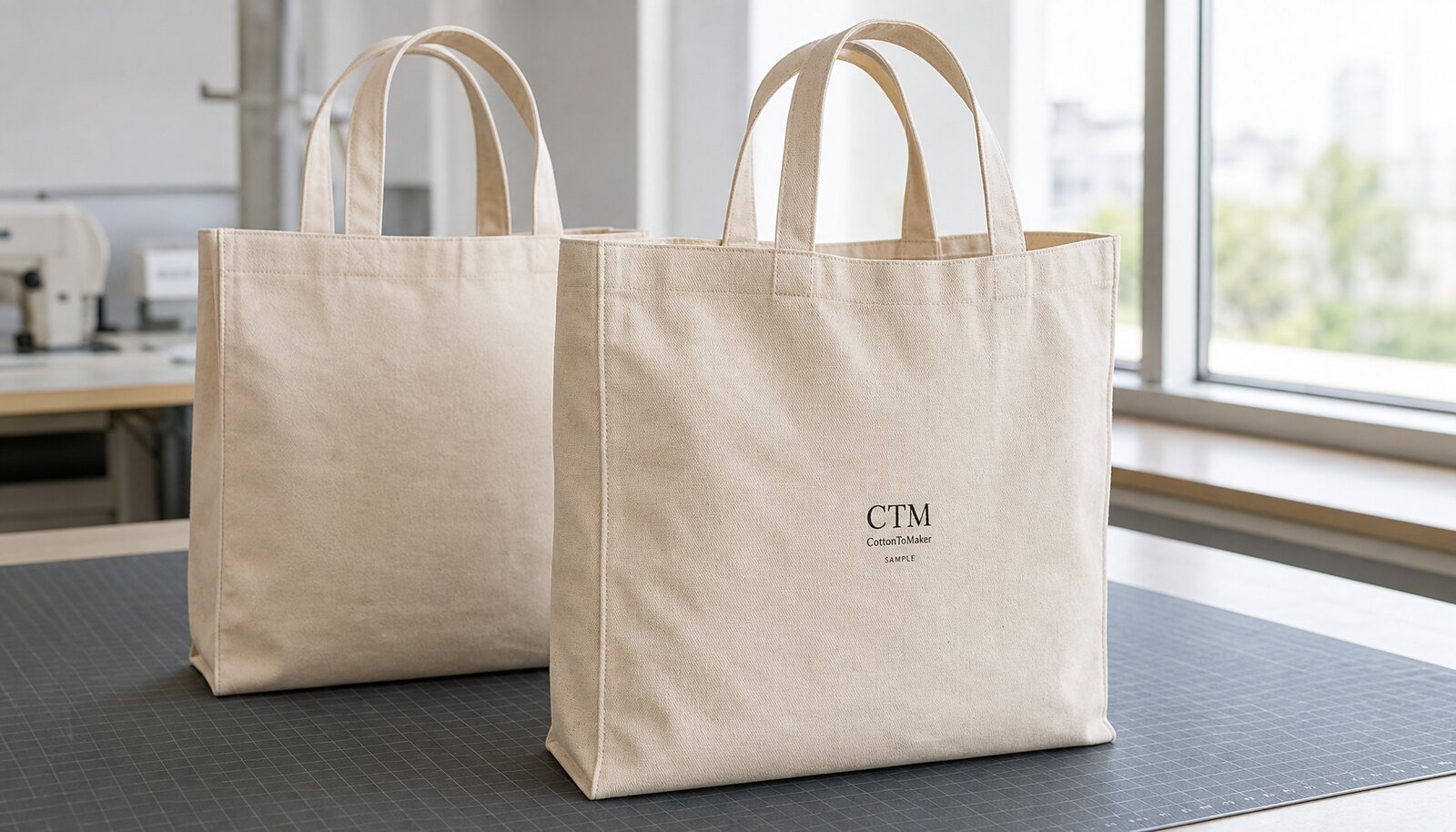
Why school buyers need a tighter spec than a normal tote order
Printed canvas shopping bags for schools look simple on paper, but the buying job is more demanding than a generic promotional tote. A school bag may be handed out to pupils, sold through a campus bookstore, used for open-day kits, or bundled with educational materials. Each use case changes the right fabric weight, handle length, print coverage, and packing method. If you write the RFQ as only 'canvas bag with logo,' the quotes you receive will not be comparable and the factory will fill in the blanks with its own assumptions.
For procurement teams, the real task is to lock down the load requirement first. A bag carrying event flyers needs a different construction from one carrying textbooks, stationery boxes, or retail merchandise. The weight of the cloth, seam reinforcement, and print method should all follow that use case. A clear spec prevents the common mistake of buying a low-cost promotional bag that looks fine in a photo but fails once it is filled.
It also helps to separate the buying channel from the use case. A school district buying for internal distribution may care most about cost, carton efficiency, and simple counting. A bookstore buyer may care about shelf appearance, retail hang tags, and crease control. A parent association or alumni office may want a more premium feel, which usually means better handle tape, cleaner print edges, and a more stable bottom. Those are different commercial specs, even if the artwork is the same.
The best procurement habit is to define the bag in terms of the job it must do. State whether the bag is for A4 folders, notebooks, lunch items, textbooks, merchandising, or event handouts. Then state whether the priority is durability, low unit cost, or retail presentation. When that logic is clear, suppliers can quote on the same basis and you can compare them without guessing what they included.
Fabric weight and build choices that actually change buyer cost
For most school programs, 10 oz to 12 oz canvas is the practical starting point. It gives a better hand feel than flimsy promotional cotton and is usually strong enough for books, lunch items, and classroom materials. If the bag is meant for heavier loads or repeated student use over a semester, move toward 12 oz to 14 oz. That extra weight raises material cost, but it also reduces seam failure and makes the bag feel closer to a retail item than a giveaway.
For buyers who quote in metric, a rough conversion helps compare supplier language. 10 oz canvas is approximately 339 GSM, 12 oz is about 407 GSM, and 14 oz is about 475 GSM. Those are practical order-of-magnitude figures, not lab-certified values, but they help when one supplier quotes in ounces and another quotes in GSM. Ask the factory to confirm whether the number refers to finished fabric weight or greige cloth, because that can change the real result after washing, dyeing, or calendering.
Do not quote only by fabric weight without construction detail. A 12 oz bag with a weak bottom seam and short handles may still perform worse than a well-made 10 oz bag with reinforced stress points. Ask the factory to quote the same design in two fabric weights if your budget is uncertain. That comparison tells you whether the supplier is pricing material honestly or hiding cost in construction shortcuts.
Construction detail matters more than many buyers expect. A clean school tote usually needs side seams with uniform stitch density, a turned hem at the top edge, and handle attachment points reinforced with dense stitching or bartacks. Some factories call this 'reinforced handles' without saying how they do it. Ask for stitch count per inch or per 3 cm, the seam allowance used, and whether the handles are inserted into the side seam or stitched on top of it. Those details affect both durability and appearance.
If the bag is intended for books, the bottom panel should be wide enough to sit flat and the gusset should not collapse under normal loading. A 10 cm to 14 cm gusset is common for school-use totes, but the right number depends on the dimensions of the items inside. A narrow gusset can look neat in a mockup and still fail the real load test because the spine of a book creates pressure at the corner. Ask the factory to show the bag filled with the intended items during sample review. That is faster than debating photos later.
Print method selection for school logos, mascots, and campaign art
Most school logo orders are best served by screen printing if the artwork is one to four solid colors. It is cost-efficient, looks clean, and works well on canvas when the ink deposit is controlled correctly. If the artwork includes many fine lines, gradients, or small lettering, a transfer print may be a better fit for short runs, especially when the school wants a detailed mascot or commemorative design. Embroidery is usually reserved for staff gifts or premium club merchandise because it adds cost and can distort on thinner canvas.
The supplier should tell you the ink type, cure method, and maximum print size rather than simply saying 'custom logo printing included.' On a natural or off-white canvas bag, a dark logo often prints cleanly with lower ink usage. On colored canvas, you may need a base layer or more careful ink matching. That affects quote cost and lead time, especially if the artwork has multiple Pantone colors. For procurement, the useful question is not just 'Can you print this?' but 'What is the approved print area and what finishing standard will you hold?'.
A practical print-area range for school totes is often around 12 cm x 12 cm for a small chest mark, 20 cm x 20 cm for a standard front logo, and 25 cm x 30 cm or larger for a feature graphic, depending on the bag width and seam location. If the artwork is too close to the side seam, it can distort during sewing or fold unevenly when packed. Ask the supplier to mark the printable area on a flat mockup and a sewn sample so you can check whether the logo stays centered after construction.
Screen printing is usually the lowest-cost route for repeat school orders because the setup cost is spread across quantity. The main cost drivers are color count, print area size, and registration complexity. Heat transfer adds film or transfer prep, plus extra labor for pressing and cooling. Embroidery adds digitizing, thread cost, and longer machine time. If procurement needs a clean budget comparison, request the same artwork in two methods and ask the supplier to separate setup, per-piece print, and any curing or pressing charge. That will show the real cost of the decoration choice.
How MOQ logic works when the order is for one school or one district
MOQ is usually driven by print setup, fabric cutting efficiency, and accessory sourcing. For a single school order, the supplier may accept a lower bag quantity if the artwork is one version and the fabric color is standard. The moment you split the order into multiple school names, different mascot versions, or several print locations, the unit price rises because each variation needs separate setup and handling. That is normal, not a sign of poor pricing.
To compare quotes properly, ask for the price break at at least two quantities. For example, request one line at the school's forecast volume and another at a higher tier that covers district-wide or multi-campus demand. This helps procurement decide whether to consolidate orders now or split them later. It also exposes whether the supplier's MOQ is a real production limit or just a pricing threshold. If the price drops sharply at the second tier, you may save money by combining schools into one run and separating them only at packing stage.
Buyers should also ask whether MOQ is tied to each artwork or to each fabric color. That distinction matters when the school wants the same logo on natural canvas, black canvas, and navy canvas for different departments. One design across several bag colors can trigger separate dye lots or separate print-underbase needs. The quote should say whether color changes are treated as a new order line. If not, you can end up with hidden surcharges after the PO is issued.
A useful procurement tactic is to price three scenarios: one school, one district, and one blended order with mixed carton labels. That lets the team see whether the supplier can support a phased program instead of a one-time purchase. It also helps with future reorders, because the buyer can keep the same spec and avoid re-qualifying the bag every term.
Sample approval is where most school bag mistakes are prevented
A paper proof is not enough for a canvas order. You need a physical sample made from the actual fabric, with the actual print process and the final handle material. The reason is simple: canvas absorbs ink differently than paper expects, and bag proportions often look different once sewn. A logo that appears centered on a mockup can shift when the body is stitched and pressed. The sample must show the final print size, handle drop, seam finish, and overall balance.
The best approval sequence is: artwork proof, blank sample if the bag structure is new, printed sample, then pre-production sample after any corrections. On school orders, this sequence is worth the time because rework after bulk cutting is expensive. If the supplier resists a pre-production sample on a new design, that is a warning sign. A good factory should be willing to prove the same structure before cutting bulk fabric. Ask for sample-photo documentation from front, back, side, inside, and a close-up of seams so there is a traceable record of what was approved.
When reviewing the sample, focus on three commercial questions. First, does the logo sit where the school wants it when the bag is filled? Second, does the handle hang naturally without twisting the bag body? Third, does the bag keep its shape after folding and refolding? If the answer to any of those is no, the sample should not be approved, even if the print itself looks good. Procurement often loses quality control by focusing only on artwork and ignoring the physical use case.
For orders that will be split across several schools, request one signed master sample plus a photo sheet that records the key dimensions. Include bag width, height, gusset, print area, and handle drop. That makes it much easier to police repeat orders later, because the reordering team can compare the factory's current proposal against the original approved sample instead of relying on memory.
Buyer checklist for a clean RFQ and comparable quotes
A clean RFQ saves days of back-and-forth and produces quotes that can actually be compared. The most common problem is not missing artwork; it is missing production data. Suppliers then fill the gaps with assumptions, and those assumptions vary. One quote includes reinforced handles, another does not. One uses 12 oz cloth, another uses 10 oz. One packs 50 per carton, another packs 100. The prices look close until you compare what is actually inside the carton.
The checklist below is the minimum needed for school buyers. If you have more detail, include it. If you do not know some items yet, request a two-option quote so the supplier prices both the budget and durable version. That is a better sourcing method than trying to reverse-engineer a quote after the fact. The strongest RFQs also state the school calendar deadline, the distribution channel, and whether the buyer will accept a close color match or requires a strict Pantone target.
It is also worth asking for the supplier's drawing or spec sheet before sampling. A simple technical sketch showing dimensions, seam placement, handle style, and print area reduces mistakes and gives purchasing, design, and quality teams the same reference point. If your organization uses a supplier onboarding file, keep that drawing together with the sample approval photo set and the final PO. That paperwork pays off on reorders.
Useful RFQ attachments include one finished artwork file, one dimension sketch, one load-use statement, and one packing plan. If you have none of those, send the supplier the intended use in plain language and ask them to propose two complete build options. That is still better than asking for a generic tote quote.
What a useful factory quote should include line by line
A serious factory quote is not just a unit price. It should show what material is being used, what print process is included, and what is excluded. For printed canvas shopping bags for schools, quote transparency matters because small spec changes can move cost quickly. A slightly heavier canvas, a larger logo, or a custom inner fold can change both labor and material consumption. Without line-by-line details, procurement cannot tell whether the best price is actually the best value.
If the supplier sends one flat number, return it and request a structured quote. The quote should identify fabric weight, bag dimensions, handle length, print color count, print area, packing count, sample charge, and lead time. It should also state whether the price is for EXW, FOB, or another trade term. That gives distributors and importers a real basis for landed-cost comparison. If the supplier can quote DDP, ask what local charges, duties, and brokerage assumptions sit inside that number so you are not surprised later.
For commercial clarity, a useful quote should also reveal the setup logic. Ask whether the screen fee is charged per color, per side, or per design version. Ask whether the quote covers one proof round or multiple art revisions. Ask whether the supplier is charging for fabric cutting loss, sewing allowance, or overrun tolerance. A buyer does not need every internal factory detail, but enough should be visible to tell whether two offers are truly equivalent.
If you are comparing suppliers across countries or trade lanes, request the same currency and the same trade term from each one. An EXW quote from one factory and a DDP quote from another is not an apples-to-apples comparison. Procurement should normalize freight, testing, and customs handling before deciding. A transparent quote does that work before the PO is issued, not after the goods have shipped.
Packing and carton planning for school distribution
Packing is often ignored until cartons arrive and the school team has to unpack hundreds of bags by hand. For bulk school delivery, a simple folded bulk pack is usually the most efficient route. It reduces packing labor and keeps unit cost under control. If the bags will go directly to retail shelves or gift kits, then individual polybagging or insert cards may be needed, but those should be priced separately because they change both labor and carton volume.
The packing count should match the way the bags will be distributed. If each classroom receives a fixed quantity, carton counts should be easy to count and label. If the bags are going to distributors, ask for carton marks with style, color, quantity, and school code. That saves receiving time and reduces miscounts. For long-distance shipping, the outer carton should be strong enough to prevent corner crush and print rub on the folded surface. A practical carton-count norm for medium canvas totes is often 25, 50, or 100 pieces per carton depending on bag weight and size, but the final count should follow the cubic volume and gross weight target rather than a fixed habit.
Buyers should ask for carton dimensions, gross weight, and inner pack count before freight booking. This matters because a lighter bag in a larger carton can cost more to move than a slightly heavier bag in a denser pack. If the order is split by school, carton labels should show destination, PO number, and carton sequence, for example 1 of 12, 2 of 12. That makes warehouse receiving easier and reduces the risk of distributing the wrong school color or mascot into the wrong carton.
If the bags are intended for direct resale, consider whether the fold direction leaves the logo visible through a polybag or carton window. If the goods are only for internal handout, save the money and use the simpler pack. Packing should serve the route to end user, not an abstract retail standard.
How to verify the factory behind the quote, not just the quote itself
A low quote is useful only if the supplier can actually make the bag at the stated spec. For school programs, supplier verification should go beyond a brochure and a report file. Ask for factory-identification documents that tie the quote to a real production site: a business license or company registration extract, the plant address, the main production process list, and the nameplate or workshop photos showing cutting, sewing, printing, and packing areas. If a seller cannot show where the bag is made, procurement should assume the quality risk sits with the buyer.
Capacity checks should be more concrete than 'please send your annual report.' Ask how many sewing lines are assigned to canvas bags, how many operators work on cutting, printing, and packing, and what the normal daily output is for the exact bag size you need. A useful answer includes the number of machines, the normal line balance, and the current production calendar for your due month. If the supplier can only quote general capacity, ask for a recent production plan excerpt with order quantity ranges and line allocation. That is a better capacity signal than a polished PDF.
Factory audit points should focus on process control, not decoration. Check whether incoming fabric is stored by lot, whether cut panels are labeled through sewing, whether print ink is mixed against a written formula, and whether finished goods move through final inspection before carton packing. For school bags, the most important audit signs are stable stitching discipline, controlled print curing, and traceable packing count. A factory that can show sample traceability from approved sample to production batch is usually easier to work with than one that only talks about price.
Documentation examples are worth asking for before you send a purchase order. A serious factory should be able to provide a fabric composition note, a print process sheet, a sample approval record, a carton packing list format, and if relevant, a simple batch inspection report. For higher-risk orders, ask for test evidence that matches the use case: seam strength, colorfastness, and rub resistance are more relevant than generic marketing claims. If the supplier is exporting to your region, ask for the documents your importer or customs broker actually needs rather than a broad bundle of certificates. That keeps verification practical and avoids paying for paperwork nobody uses.
Region matters as well. If you are sourcing from China, India, Vietnam, or another manufacturing base, lead times, carton labeling conventions, and export document flow can differ. The useful question is not where the factory is located in general, but whether that specific plant has exported canvas tote orders to your market before and can show the shipping document pattern it normally uses. That proof can be a sample packing list, invoice format, or anonymized bill of lading data if the supplier is willing to share it. Buyers do not need a long narrative; they need evidence that the factory already understands the route your order will take.
Lead time, schedule risk, and where school orders slip
School orders are schedule-sensitive because the bags often have to land before orientation, the first term, or a fundraising event. The schedule usually breaks in two places: artwork approval and sample approval. If the buyer delays on color confirmation, the factory cannot reserve print slots. If the sample comes back with revisions after fabric has been purchased, the timeline can extend quickly. That is why a production calendar should be built around approval dates, not just the final ship date.
A realistic schedule usually includes time for artwork review, sample making, sample transit, corrections, bulk production, packing, and export booking. If the order is urgent, simplify the spec instead of forcing a complex bag into a short window. One fabric weight, one print method, and one packing method will move faster than a multi-version assortment. Buyers who want speed should reduce variability first. If the school is ordering for several sites, it may also help to freeze the artwork early even if final quantities are still moving, because print setup is usually the long pole in the schedule.
The biggest hidden schedule risk is a late change to the logo file. A supplier may say the artwork is fine while the print team is still converting file formats, flattening colors, or adjusting line thickness for canvas. Ask for a production-ready file before sample approval and insist on a preflight check that confirms font outline, transparent background handling, and color separation. That small discipline avoids delays that are hard to recover once bulk sewing has started.
If your deadline is fixed, ask the factory to confirm the latest safe order date and the latest safe sample-approval date. Procurement teams often only ask for the factory lead time, but the approval deadline is the real control point. A good supplier should be able to tell you both.
Specification comparison for buyers
| Spec decision | Recommended option | When it fits | Buyer risk to check | Unit cost drivers / commercial notes |
|---|---|---|---|---|
| Fabric weight | 10 oz to 12 oz canvas for general school use; 12 oz to 14 oz for books, bookstore resale, or repeated term-time carry | Good for handouts, club merchandise, open-day packs, and lightweight daily use | A thin cloth may look acceptable in photos but distort after print and fail sooner at the handle seam | Higher GSM/oz increases fabric cost, sewing resistance, and freight weight; ask the factory to quote two weights on the same pattern so you can see the real delta |
| Print method | Screen print for 1 to 4 spot colors; heat transfer for short runs, gradients, or variable names; embroidery only for premium staff or club bags | Best when logo clarity matters and the print area is modest | Small type can fill in on screen print; transfers can crack if cure is weak; embroidery can pucker on thin canvas | Setup charges usually follow screen count or transfer prep; ask whether each artwork change adds a plate/screen fee and whether PMS matching is included or extra |
| Bag construction | Stitched side and bottom seams with reinforced handles, lock stitching at stress points, and bartacks or dense reinforcement where the handle meets the body | School use, library bags, fundraising merch, bookstore sales | Weak handle attachment is the most common early failure point | More reinforcement adds labor but reduces claim risk; request seam detail photos and ask for stitch count per inch rather than a vague 'reinforced' statement |
| Handle spec | 2.5 to 3 cm wide self-fabric or cotton webbing handles with about 24 to 28 cm drop, adjusted for carry style | Hand carry and shoulder carry for older students and staff | Too-short handles make the bag awkward; narrow handles cut into hands when loaded | Webbing handles cost more than self-fabric on some builds but improve comfort and consistency; confirm whether handles are cut from the same canvas or a separate tape |
| MOQ route | Standard factory MOQ with one print setup per artwork; consolidate colors and avoid variable names if volume is modest | Single school, one campaign, one academic term | Multiple versions can push the quote up quickly and distort unit comparisons | MOQ can be by design, by color, or by total order value; ask the supplier to state which one applies and whether mixed sizes count separately |
| Sampling path | Pre-production sample with actual fabric, actual thread, actual print process, and final accessories | Whenever artwork, PMS color, load requirement, or retail presentation matters | Artwork approval alone hides print shrink, seam alignment, and handle balance issues | Sample charges may be credited later or not; ask upfront. Request sample-photo documentation before shipment so any correction is traceable |
| Packing method | Bulk packed in export cartons with a clear inner-count specification; retail folding or polybag only if shelf presentation or hygiene requires it | For distributors, institutional buyers, and school procurement | Over-folding can leave crease marks; loose packing raises count errors and carton damage | Packing adds labor and carton volume; clarify whether inner packs, inserts, silica gel, or barcode stickers are included or separately charged |
| Supplier route | Direct factory with canvas bag experience rather than a general tote trader | When you need fabric control, stitching inspection, and quote transparency | A trading quote may hide the true material source or weaken quality accountability | Direct factories should be able to provide yarn/fabric evidence, stitching photos, and inspection reports; if they cannot, ask what they actually control in-house |
| Quote basis | Quote must state fabric GSM or oz, print area, print colors, handle length, packing count, and sample lead time | For fair supplier comparison and landed-cost planning | Without these details, low quotes are usually incomplete and not comparable | Trade term matters: FOB, EXW, or DDP can change the apparent unit price by freight, export handling, and import-side charges |
Buyer checklist before sampling
- Final artwork file with print size, color count, Pantone references, and safe margins
- Target fabric weight in GSM or oz, plus whether the bag must hold books, folders, or event handouts
- Bag size, gusset depth, handle length, and carry style requirement
- Print method preference and acceptable color shift tolerance
- Packing requirement: bulk pack, folded pack, insert card, barcode, or school-specific bundling
- Required sample type: digital proof, blank sample, printed sample, or pre-production sample
- Target quantity by school, by term, or by total order, including any split sizes or colors
- Required delivery window, ship-to terms, and whether you need carton marks for school distribution
- Any compliance or testing requirement: colorfastness, seam strength, load test, fabric content certificate, or carton drop test
Factory quote questions to send
- What fabric weight do you propose, and can you quote the same bag at two GSM or oz options so we can compare cost and feel?
- Which print method is included in the quote, how many colors are covered, what is the maximum print area, and what is the setup charge per artwork?
- What is the exact bag size, handle length, gusset depth, and seam reinforcement spec you are pricing?
- What is the MOQ by design, by color, and by order total if we keep the same bag spec?
- Will the sample use the same fabric, thread, ink, and print process as bulk production?
- What packing count per carton do you recommend, and what carton dimensions and gross weight should we expect?
- How long for sample production, bulk production, and booking readiness after sample approval?
- What is excluded from the price: freight, testing, label insertion, barcode stickers, polybags, or extra artwork changes?
- Can you share material certificates, test reports, and sample-photo documentation for the approved sample before bulk cut?
Quality-control points to confirm
- Fabric weight should be checked against the approved spec in GSM or oz with an agreed tolerance band before bulk cutting; do not accept an undefined 'heavy canvas' description
- Print registration should keep all text and logo edges aligned within a practical tolerance, with no smearing, pinholes, double images, or uneven ink laydown
- Artwork should be measured for size variation after curing; if the print area shifts beyond the agreed range, the batch should be held for review
- Handle stitching must show secure reinforcement at all stress points, with no skipped stitches, no loose thread tails, and no visible seam opening under hand pull
- Seam strength should be checked on loaded samples using the intended school use case; the bag should not show ripping, stitch burst, or handle separation during a simple load test
- Bag opening and gusset shape should remain square after pressing; a visibly crooked body panel, skewed top hem, or twisted handle set should be treated as a defect
- Color approval should be based on a physical sample under daylight or D65-style light, not only on a screen rendering; minor shade drift should be pre-agreed by tolerance
- Carton count must match the inner pack list and outer carton marks; count errors, mixed schools, or missing cartons should be treated as shipment defects
- Surface wear should be checked with a rub/abrasion pass on the printed area; ink that transfers to a clean white cloth on light rubbing should be reviewed before release