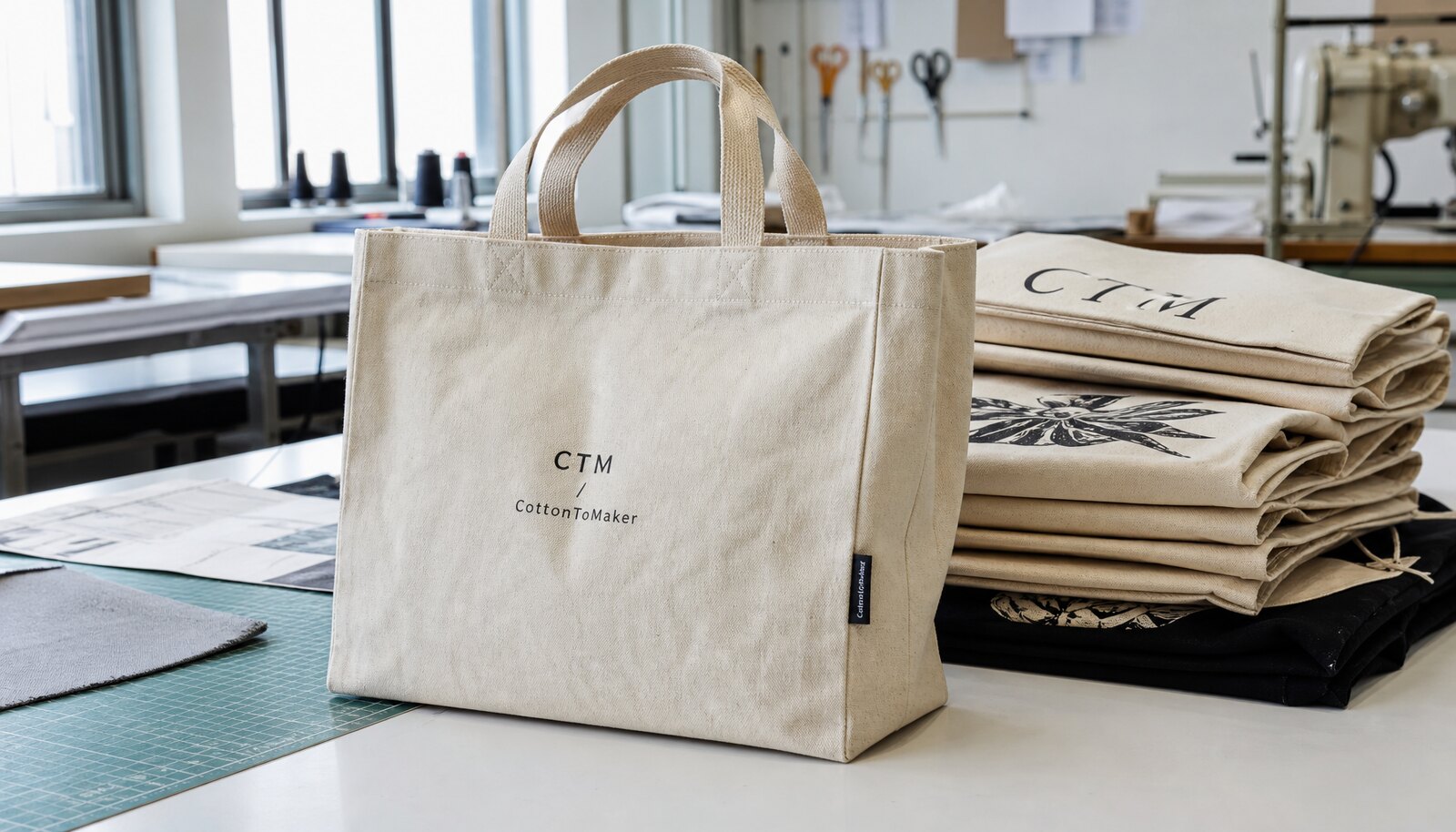
Why retail chain procurement needs a different checklist than a standard promo tote order
Printed canvas shopping bags for retail chains sit between packaging and merchandise. They may be sold at checkout, handed to customers with purchases, or used daily in-store by staff and shoppers. That makes the buying decision broader than decoration. Procurement has to think about how the bag will look at shelf level, how it will behave after repeated handling, how it will arrive at the distribution center, and how easy it will be to reorder without the product drifting over time. A bag that looks fine in a sample room can still create avoidable cost if the handle stitch fails, the print shifts in bulk production, or the carton label does not match the receiving spec.
Retail chain buyers also need to distinguish between the product spec and the operating spec. The product spec covers fabric, print, stitching, and dimensions. The operating spec covers carton count, barcode placement, palletization, and who receives the shipment at the DC. A supplier quote that ignores one side of that equation is not really complete. It may look cheaper only because the missing work gets pushed into the buyer’s warehouse, store operations, or claims process later. That is why this checklist focuses on the points that affect actual chain execution, not just the visual approval stage.
The best sourcing conversations usually separate three questions early: what the bag should look like on shelf, what it must do in daily use, and what it must do in the warehouse. Those are different requirements. A premium-looking bag can still be a weak receiving product if it ships in awkward carton counts or with loose labeling. A technically sound bag can still be a poor retail choice if the canvas is too coarse for the brand position. Procurement works best when those tradeoffs are stated before award, not discovered after the first shipment.
This is also where over-standardized RFQs can hurt. If every request begins and ends with “canvas tote with logo,” suppliers fill in assumptions. One factory uses lighter cloth, another skips reinforcement, another prices without barcode labels, and another assumes a promotional-quality finish that is not durable enough for store resale. The point of a procurement checklist is not to make the order complicated; it is to make the quote comparable. If every supplier is quoting a different interpretation, the price spread tells you very little.
- Treat the bag as a retail supply item, not only a print job.
- Ask whether the bag will be sold, distributed free, or used internally, because the use case changes the spec.
- Control the production spec before comparing price, otherwise the quotes are not truly comparable.
Start with the fabric: weight, weave, finish, and what the bag must carry
Fabric choice drives both the commercial and operational profile of the bag. For most retail programs, 10–12 oz canvas, roughly 340–410 GSM, is the most practical starting point. That range usually gives enough body for shopping use, enough structure for print presentation, and enough sewability to keep unit cost under control at wholesale volume. Below that range, the bag may collapse in use, wrinkle more easily, and feel less premium on a checkout counter. Above it, freight cost rises, sewing slows down, and the bag can become heavier than the application justifies.
But weight alone is not the whole story. Weave density and finish influence print clarity and repeatability. A tighter weave tends to hold fine lines and small letters better. A more open or slub-heavy canvas can create a desirable natural look, but it can also make logos seem less crisp and cause variation in ink coverage from one lot to the next. If the artwork includes a small secondary mark, legal copy, a QR code, or any thin rule lines, buyers should ask for approval on the actual production fabric rather than a smoother substitute cloth.
The intended use should determine how much structure the bag needs. If it must stand upright on a shelf or checkout counter, ask for firmer fabric and consider whether the base needs reinforcement or a more stable seam construction. If it is a foldable retail accessory, softness may be acceptable, but then the buyer should tighten the review on print placement, wrinkle behavior, and finished size tolerance. A bag that will carry groceries, boxed merchandise, or heavy impulse buys deserves stronger handle specs and conservative seam allowances. That extra material is usually cheaper than a rejection or credit note after store rollout.
Shrinkage and finishing matter too, especially when the bag will be printed. Washing, dyeing, or finishing steps can shift size and color feel. If the supplier is using unfinished natural canvas, ask how the cloth behaves after sewing and pressing. If the bag is washed or softened, ask whether the process changes print sharpness or delivery date. These are small details at the RFQ stage, but they become large problems when the first pallet arrives and the bags no longer match the approved sample exactly.
- Ask suppliers to quote fabric in oz and GSM to reduce ambiguity across markets.
- Request acceptable tolerance on fabric weight and shrinkage if the bag will be printed or washed.
- If the bag must stand on display, ask for a heavier fabric or structural reinforcement in the bottom panel.
Decide the print method by volume, artwork complexity, and reorder risk
For most wholesale retail programs, screen print remains the default choice because it is efficient, repeatable, and cost-effective for simple logos. It works especially well when the chain expects replenishment and the artwork will not change often. The tradeoff is that every additional color adds screens, setup time, and registration risk. On canvas, especially on more textured cloth, the printer has to manage ink thickness and mesh selection carefully so the artwork does not fill in or blur. Buyers should ask how the supplier handles small type, thin lines, and edge sharpness before approving the method.
Heat transfer and digital print are useful in the right situations, but they are not universal upgrades. Heat transfer can suit short runs or more complex artwork, yet the buyer should think about how it will age under handling, folding, and friction at checkout. Digital print can be flexible for color-rich designs and smaller orders, but it is not automatically the best fit for every retail tote. Cost, feel, and repeatability can vary depending on the fabric and the equipment used. If the bag is a chain program, procurement should ask not only whether the supplier can print it, but whether they can repeat it next season with the same visual result.
The practical question is not “which method is best?” but “which method is best for this buying pattern?” If the chain expects to reorder the same SKU multiple times, consistency matters more than novelty. If the first launch is a limited test, the buyer may tolerate a more flexible process provided the sample is approved on actual production cloth and the supplier can document the print settings. That is where a realistic buying brief helps. It keeps the supplier from overselling a decoration method that looks impressive but complicates the next reorder.
Retail buyers should also define artwork controls early. Ask for Pantone targets when color matters, request the placement dimensions from the bag edge and centerline, and confirm the minimum readable line thickness on the chosen canvas. If the logo has small text, say so. If the design includes a dark print on natural cloth, ask how the supplier prevents show-through or uneven edge coverage. These are the details that separate a quote for a real retail program from a generic tote run.
- Specify Pantone targets for logo colors whenever the brand standard matters.
- Ask for print placement measurements from bag edge, seam, and centerline—not just “centered.”
- For small text, request the supplier’s minimum readable line thickness on the chosen canvas.
Use supplier comparisons that reflect retail operations, not just headline unit price
Retail buyers usually have three practical sourcing routes: direct manufacturer, trading company, and local distributor or importer. Each one solves a different commercial problem. A direct manufacturer is often the strongest option for repeat programs because the buyer can get clearer control over fabric, stitching, print, and packing. When the bag will be reordered over a season or across multiple store groups, that control is valuable. It also tends to make corrective action easier when a defect is found, because the factory and the quality team are closer to the line. The tradeoff is that the buyer needs a more detailed spec and tighter follow-through.
A trading company can be helpful when the buyer wants to consolidate several product categories, simplify communication, or work through one contact who manages documents and coordination. That convenience can matter in larger sourcing operations. But the buyer should know where the bags are actually made, who approves substitutions, and who carries defect responsibility if the shipment is not right. A lower price is not enough reason to choose a middleman if the supply chain becomes harder to audit or correct later. Procurement should verify production ownership rather than assuming service equals control.
Local distributors and importers are usually the speed route. They can make sense when the chain needs a smaller quantity, a fast replacement, or domestic terms. Their per-piece cost is often higher than factory-direct, but their logistics and billing simplicity can offset that if the order is urgent or if the retail network needs a quick fix. For national replenishment programs, though, the buyer should watch for inventory variation. Distributor stock can create color drift, carton inconsistencies, or uneven size availability if the source lots are mixed.
There is no universal winner. The better route depends on the buying problem. If the program is a stable, repeated SKU, direct manufacturing often wins on control and repeatability. If it is a bundled sourcing project, a trading company may reduce admin friction. If speed matters more than exact unit economics, a domestic distributor may be the most practical answer. The point is to choose the route for the program, not the habit.
- Ask every route to quote the same bag specification so price differences are real, not assumption-based.
- Confirm who owns QC, who owns the factory, and who would handle a defect claim after shipment.
- Check whether a lower price comes from manufacturing efficiency or from reduced construction and packing detail.
A side-by-side buying matrix for chain programs, pilots, and replenishment
A useful comparison is not only about supplier type. Buyers should also compare how the bag behaves across program types. A pilot order has different priorities from a chain replenishment program or a seasonal resale item. The matrix below helps teams think about the commercial fit before they compare spreadsheets line by line.
For a pilot, flexibility and fast approval matter more than squeezing every cent out of the unit price. For a replenishment SKU, repeatability and carton discipline matter most. For a seasonal or promotional launch, the packing and deadline risk can be more important than the absolute fabric spec. This matters because printed canvas shopping bags often look simple, yet they touch multiple departments: merchandising, procurement, DC operations, and sometimes store operations. A good buying decision aligns those functions instead of forcing them to work around a bad spec.
- Normalize all quotes to the same fabric weight, size, print method, and packing format.
- Treat packing and labeling as cost items, not afterthoughts.
- If a quote is much cheaper, inspect the hidden assumptions on fabric, print coverage, and handling steps.
What a serious quote should include, and what missing lines usually signal
A useful quote for printed canvas shopping bags should read like a build-up, not a single number. Procurement should expect to see the fabric basis, print method, number of colors, sewing and reinforcement cost, label cost, packing assumption, and any setup or screen fees. That level of detail matters because retail chain programs often reorder the same bag with small changes. When the original pricing is transparent, later revisions are easier to manage, and the supplier has fewer opportunities to add surprise charges. When the pricing is vague, the first order may look attractive while the follow-up order becomes awkward and expensive.
Just as important, the supplier should state what is excluded. Are carton labels included? Is palletization included? Is there a surcharge for color matching, rush production, or a revised barcode? Does the price assume one fabric lot, or can the supplier substitute a controlled equivalent if stock changes? These questions are not procurement bureaucracy; they are the difference between an accurate landed cost and a quote that shifts expense into receiving, claims, or rework later. A quote that omits handling detail usually pushes cost downstream to the buyer’s warehouse team.
Buyers should also check whether the quote matches the actual use case. A bag for internal staff use may not need the same finishing as a resale item. A bag for a dense product category may require stronger handles and more conservative seam allowances. A quote that does not reflect use can look cheaper for the wrong reason. That is why procurement should ask suppliers to quote against the final application, not a generic tote description. The commercial value of the quote comes from comparability, not from the lowest headline number.
If the buying team uses multiple stakeholders, a transparent quote helps align them. Merchandising tends to focus on appearance; procurement on landed cost and risk; operations on how the cartons arrive. A cost breakdown gives all three teams the same picture. That is especially important when the bag is tied to a launch date or a store-wide promotion, where a missed detail can become a missed deadline.
- Request separate lines for fabric, print setup, sewing, reinforcement, packing, carton marks, and freight term.
- Confirm the quote basis: EXW, FOB, or another term, so landed cost can be calculated consistently.
- Ask whether waste allowance or spoilage is built into pricing, especially for multi-color print.
Sample approval should test production reality, not just appearance
A pre-production sample is only useful if it mirrors the real order. For retail chain buying, the sample should use the same bulk fabric, final print process, final thread, and final packing style as the planned shipment. A hand-finished sample made from a better cloth or printed on a smoother test piece can look excellent while hiding production issues. Buyers should therefore treat the sample as a control point, not a trophy. Its job is to prove that the factory can reproduce the bag at scale within the agreed spec.
Measure the sample rather than judging it visually alone. Check bag width, height, gusset depth if applicable, handle drop, and the placement of the print relative to seams and top edge. If the bag is intended for resale or a branded retail display, also check how it folds and whether the print face stays visible without awkward creases. If the bag will hold heavier goods, test a realistic load and see whether the handles remain comfortable and whether the base holds shape. The point is not to run a full lab program on every order, but to make sure the sample reflects the actual commercial use.
Retail buyers should also lock the reference. Keep one signed master sample with the PO file and save digital images in neutral light. If a dispute arises later, the buyer needs a reference tied to the approved version, not just an email chain. For chain programs with multiple stakeholders, note whether the sample was approved conditionally or unconditionally. That wording matters when later reviewers try to change the standard after bulk production has already started. A clear approval record makes the supplier’s job clearer too, because the factory knows exactly which version it is being held to.
If a supplier offers multiple samples, use them deliberately. One should confirm appearance, one should confirm construction, and one should confirm packing if the carton or fold is important. That sounds more formal than a promo tote purchase, but retail chain orders are not one-off giveaways. They are often repeated, audited, and received by people who were not part of the artwork approval. The sample process should reflect that reality.
- Approve a real sample, not a paper proof or a mockup on different cloth.
- Measure every critical dimension with a ruler or caliper and record the result.
- Keep one physical master sample and one photo record with date and version.
Packing needs to match distribution center receiving, not factory convenience
Packing can save or lose money in retail programs. A bag that is packed loosely may seem cheaper, but it can create more labor at the distribution center. A bag that is overwrapped may protect the print, but it can increase cube and freight cost. Procurement should therefore write packing requirements into the RFQ instead of leaving them for the factory to decide. The best format depends on whether the bags are sold as merchandise, shipped for store use, or sent through a DC with strict receiving rules.
The pack spec should define how the bags are folded, how many go into an inner pack if any, how many go into the master carton, and where the barcode label goes. If cartons will be palletized, the buyer should also specify carton dimensions, gross weight limit, and any stacking preference. These details matter because the same bag can be easy to receive in one network and painful in another. A chain with automated receiving or strict scan requirements will reject a shipment much faster if the carton marks do not match the purchase order style.
Retail buyers should also think about visual consistency. If the bag is sold at checkout, the fold should preserve the front panel and logo face, not bury the print in a messy crease. If the bags are for staff use, bulk packing may be acceptable, but the counts still need to be clean and traceable. In either case, carton verification should be part of final QC: count, labels, print orientation, carton condition, and whether the master carton matches what was approved on the sample or packing image. Receiving issues are often packaging issues in disguise.
One practical point: ask whether the supplier is using the same fold and pack method for all sizes. A mixed-size order can save on freight planning if the pack is standardized, but it can also create confusion if the carton markings are not precise. The best packaging spec is the one your DC can receive without interpretation. That is the standard that should govern the order, not the packing habit that is easiest for the factory line.
- State whether polybags are required, optional, or prohibited by your retail channel.
- Specify whether cartons must be pallet-friendly and whether mixed SKUs are allowed per carton.
- Require carton dimensions and gross weight so warehouse planning does not rely on estimates.
QC needs measurable checks: tolerances, pull tests, print standards, and carton verification
A serious wholesale checklist needs measurable quality control, not just general words like “good stitching” or “nice print.” For printed canvas shopping bags, procurement should define tolerances before production starts. Finished dimensions should be checked after sewing and pressing, with an agreed range for length, width, gusset depth, and handle drop. Print placement should be measured against a reference point such as the top edge and centerline, rather than judged loosely at receiving. Without a numeric target, quality disputes become subjective and slow.
Seam and handle performance should also be tested in a way that reflects use. A common procurement approach is to request a pull test on the handle attachment and to define a minimum load expectation for the bag body. The exact threshold depends on bag size, handle style, and end use, so it should be agreed with the supplier rather than copied from a different tote. The useful part is not the number alone; it is the documented method, sample size, and pass/fail result. If the factory already performs internal checks, ask for its method and records so your acceptance standard is aligned with the production line.
If the buyer uses an AQL inspection plan, that should be written into the PO or inspection brief. Many retail programs use a standard AQL framework with major and minor defect classifications, then adjust the acceptance level based on risk and order size. The key is consistency: the same issue should not be treated one way on the sample and another way on the shipment. QC should also include carton verification, odor check, stain inspection, broken needle check, loose thread review, and confirmation that packing counts match the carton list. A bag can look good and still fail receiving if it arrives with wrong counts or a strong smell.
One practical way to keep QC grounded is to group defects into four buckets: appearance, dimensions, function, and packing. Appearance covers print blur, misregistration, and color deviation. Dimensions cover bag size and handle drop. Function covers seam strength and handle attachment. Packing covers carton count, barcode placement, and labeling. That structure helps both sides understand what is critical and what is cosmetic, and it gives the buyer a cleaner basis for claims or chargeback discussions if the retailer has strict inbound requirements.
For chain programs, also ask the supplier for its own QC sheet. The factory’s internal checkpoints tell you how it manages process control, not just how it answers the final inspection. If their internal sheet does not mention fabric weight, print placement, or packing count, that is a signal that the production discipline may be weaker than the quote suggests. This is often where the real difference between suppliers appears.
- Set finished-size tolerances after sewing and pressing, not on cut fabric only.
- Define a handle pull test method and minimum pass threshold before production starts.
- Write AQL or equivalent inspection rules into the PO if you need consistent acceptance decisions.
- Check carton counts, carton marks, barcode placement, and carton condition as part of final inspection.
- Ask the supplier for its own QC sheet so you can compare internal controls with your acceptance criteria.
Lead time is order-dependent; manage the variables that actually extend it
A typical lead time for standard printed canvas shopping bags can fall around 25–45 days after sample approval, but buyers should treat that as a working range rather than a promise. The actual schedule depends on whether the supplier has stock fabric, how many print colors are involved, whether screens must be made from scratch, and whether the packing spec is simple or retail-ready. A steady reorder with unchanged artwork may move faster than a first-time launch. A design revision, new carton label, or fabric substitution can quickly add days.
The most common schedule risks are small changes that arrive late. A logo adjustment after screen setup means new artwork prep. A revised barcode location can create relabeling work after cartons are already packed. A shift in color target can require more testing against the canvas base. If the chain has a fixed launch date, procurement should lock artwork earlier than feels comfortable and leave time for inspection, transit, and DC booking. Factory completion is not the same as in-store availability.
If the order is seasonal or tied to a promotion, the buyer should sequence the timeline with explicit milestones: artwork approval, sample approval, bulk fabric confirmation, production start, in-process check, final inspection, dispatch, and receipt booking. That matters especially for multi-region retail chains. A supplier can finish on time and still miss the commercial deadline if cartons are not ready for the receiving appointment. The schedule should therefore be built around the whole supply chain, not only the sewing line.
The best lead-time control is specificity. If the factory knows whether fabric is reserved, whether the print colors are fixed, and whether pallet rules are already approved, it can plan more accurately. If any of those items are still open, the buyer should expect the schedule to move. The goal is not to pressure the supplier into an unrealistic promise. It is to remove the variables that most often turn a normal order into an urgent one.
- Lock artwork early to avoid re-screening and re-approval delays.
- Ask whether the factory is using stock fabric, reserved fabric, or fresh production fabric.
- Add schedule buffer if labels, carton artwork, or compliance paperwork are likely to change.
Specification comparison for buyers
| Procurement decision | Practical recommendation | Best-fit use case | Commercial risk to verify |
|---|---|---|---|
| Fabric weight | 10–12 oz canvas (about 340–410 GSM) for most chain programs; go heavier only when the bag must hold bulky or dense goods, or when the bag is itself a premium resale item | Daily-use store bags, checkout resale, and branded carry bags for recurring replenishment | Too light collapses in store use and can distort print; too heavy increases sewing time, freight cube, and landed cost |
| Weave and finish | Use a tighter weave when the logo includes small text or fine lines; choose a more textured natural canvas only when the brand wants a rustic look | Programs with detail-sensitive artwork and color-critical brand marks | Open weave can soften edges, make small type less legible, and create visible variation between fabric lots |
| Print method | 1–2 color screen print is usually the most efficient for repeat wholesale runs; choose heat transfer or digital print only when the artwork or run size truly needs it | Retail chains with stable branding, controlled SKUs, and reorder plans | Extra colors add setup, registration risk, and reprint cost if artwork changes after approval |
| Construction | Specify reinforced bottom seams and bar-tack or X-box reinforcement at handle joins; add gusset only when the carrying volume justifies it | Grocery-style use, heavier point-of-sale items, and daily handling by shoppers or store staff | Handle failure is a common rejection point; a good print does not offset weak stitching |
| Handle specification | Match handle length and material to the actual carry behavior: self-fabric handles for a soft retail look, webbing handles for better load handling | Checkout use, shoulder carry, and resale totes | Handles that are too short reduce usability; too long can drag, crease, or create packing issues |
| Sampling route | Approve a pre-production sample made from actual bulk fabric, final print method, final thread, and final packing style | Any branded rollout, seasonal launch, or chain-wide replenishment item | A display-ready sample can hide fabric variation, print spread, or assembly problems that show up in production |
| MOQ structure | Expect factory MOQs often in the 3,000–10,000 pcs range for custom print; smaller tests may be possible but usually with higher unit cost or tighter artwork limits | Chain pilots, regional trials, and new design validation | Low MOQ may hide higher setup charges, fewer print options, or slower scheduling |
| Supplier route | Use direct manufacturer for repeat programs; use a trading company when consolidation or cross-category sourcing support matters; use a local distributor when speed or domestic billing outweighs exact unit economics | Multi-market procurement, replenishment programs, and urgent buys | Margins, factory visibility, and QC accountability differ by route; verify who actually owns the line |
| Packing and carton spec | Align inner count, master carton count, barcode placement, carton marks, and pallet rules with the DC receiving spec before award | Retail distribution center receiving and store replenishment | Missing carton data can trigger delays, receiving holds, or chargebacks |
Buyer checklist before sampling
- Specify fabric weight in both oz and GSM, plus the acceptable tolerance, so suppliers are pricing the same base cloth.
- Confirm bag dimensions, gusset depth if any, handle drop, and whether the bag must stand upright on shelf or at checkout.
- State the artwork file type, number of print colors, exact print placement, and the acceptable color tolerance against your brand standard.
- Define whether the bag is for resale, internal store use, or promotional distribution, because that changes construction, finishing, and packing priorities.
- Require a pre-production sample using actual bulk fabric, the final print method, final thread, and final packing format before approving production.
- Ask for a complete quote split: fabric, printing, stitching, reinforcement, labels, packing, carton marking, and any setup or screen charges.
- Set carton requirements up front: inner count, master carton count, carton dimensions, gross weight limit, barcode label placement, and palletization rules.
- Include a QC plan in the PO: measurement tolerance, seam and handle test expectations, print alignment limits, stain/odor checks, and carton verification steps.
- Confirm the MOQ by size, color, and design, and ask whether mixed sizes or mixed artwork can be combined within one order.
- Lock the delivery window around DC receiving needs, not only factory completion, and build in time for booking, inspection, and transit.
Factory quote questions to send
- What fabric weight, yarn count, and weave are you quoting, and what tolerance do you allow on GSM or oz at production and at final inspection?
- Is the quoted print method screen print, heat transfer, digital print, or another process, and how many colors, screens, or setup charges are included?
- What is the MOQ by size, color, and design, and can you combine variants in one order without changing the unit price materially?
- Can you send a pre-production sample made from the actual bulk fabric and final print method, and what parts of the sample are final versus temporary?
- What measurement tolerance do you accept on finished bag size, handle drop, and print placement after sewing and pressing?
- How are the bags packed for shipment: folding method, inner pack count, carton quantity, carton dimensions, gross weight, and barcode label location?
- What QC checks do you perform on seam strength, handle attachment, print registration, color consistency, odor, and carton count before shipment?
- Please quote EXW or FOB separately if possible, and break out unit price, sample charge, screen/setup charge, packing charge, and any surcharge for color matching or rush production.
- If we reorder later, will you keep the same fabric lot or a controlled equivalent, and how will you notify us if a material substitution is needed?
- What documents can you provide with shipment: final inspection report, carton list, packing list, and photos of bulk production or finished cartons?
Quality-control points to confirm
- Fabric weight should match the approved range, with a practical tolerance agreed in advance; check random rolls or cut panels, not only a single display sample.
- Finished dimensions should be measured after sewing and pressing, with a clear tolerance for length, width, gusset depth, and handle drop.
- Print registration should be checked against a marked reference line; small logos and fine text need closer scrutiny because minor shift is more visible on canvas.
- Color should be evaluated against a Pantone target or approved master sample under standard lighting, not only in warm factory light.
- Handle attachment points should be tested with a real pull test on completed bags; record whether the stitching holds, stretches, or tears before the bag body does.
- Seam quality should be inspected for skipped stitches, loose thread tails, puckering, needle damage, and stitch density consistency across the run.
- Carton verification should confirm inner counts, master carton count, carton marks, barcode placement, gross weight, and whether pallet pattern matches the receiving spec.
- Finished goods should be checked for odor, oil stains, broken needles, frayed webbing, and visible contamination before cartons are sealed.
- Sample, pre-production approval, and bulk order should match on fabric, print method, construction details, and packing unless a written change is approved.
- If using AQL-based inspection, define the inspection level and defect classifications in the PO; for many retail programs, buyers use a standard inspection plan with agreed major/minor defect limits rather than relying on a vague pass/fail statement.