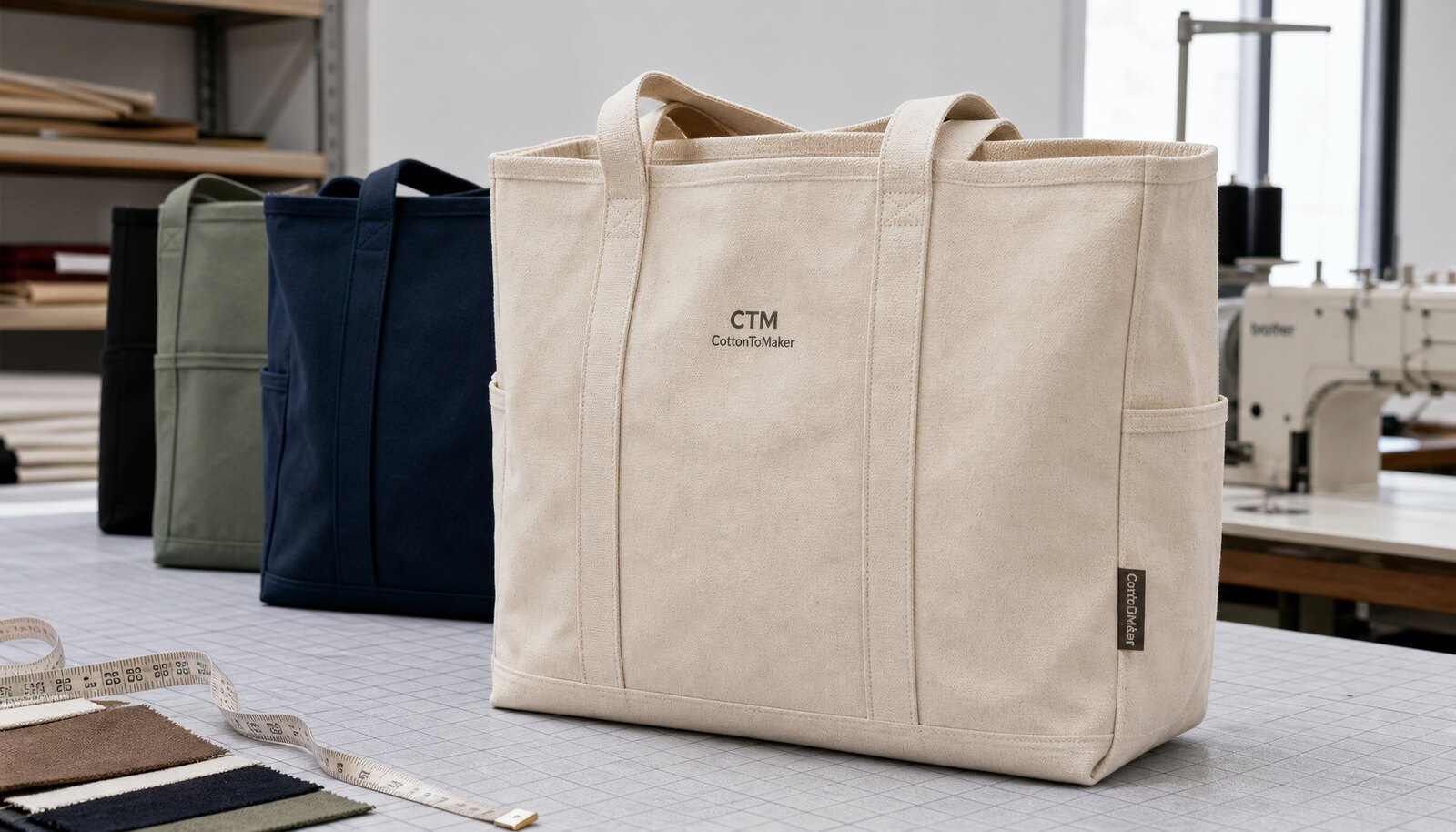
Why retail chain buyers need a procurement view, not a design view
Printed canvas shopping bags for retail chains are not a simple decoration job. They are a repeat SKU, a store-handling item, and sometimes a paid merchandise line. That changes the sourcing logic. A buyer is not only approving artwork; they are deciding how the bag will be produced, packed, replenished, and reordered without causing friction at the distribution center or the store level.
The first sourcing mistake is to start with the logo and leave the structure for later. A clean print cannot rescue a bag that sags, twists, or arrives in cartons that are awkward to receive. If the chain wants consistency across stores, the purchase order needs to define the bag spec as a controlled product, not a one-off promotional item.
For chains, the procurement question is always the same: can this bag be repeated at the same quality, at the same pack configuration, and within a predictable lead time? If the answer is unclear, the first shipment may look acceptable while the second order turns into a re-approval exercise.
- Treat the bag as a repeatable SKU, not only as printed collateral.
- Separate the decision about store use from the decision about artwork.
- Assume reorder stability matters as much as first-order price.
Lock the spec before asking for price
The quote becomes useful only after the spec is fixed. For printed canvas shopping bags, the cost drivers are the ones that change material consumption and sewing time: fabric weight, bag dimensions, gusset depth, handle style, and print coverage. A small change in handle reinforcement or bag width can move the quote more than a buyer expects.
A practical starting point for many retail programs is 12 oz or 14 oz cotton canvas. Twelve-ounce canvas is usually the better cost-to-structure balance when the bag is meant for everyday store carry or paid retail use. Fourteen-ounce canvas is better when the retailer wants a firmer shape, more shelf presence, or a bag that feels more premium in hand. If the spec is meant to sit next to other branded merchandise, heavier canvas often supports the merchandising story better.
Do not leave bag dimensions vague. State the finished size, not just the flat cut size, and say whether the bag must fold flat for warehouse intake or stand upright for shelf display. Handle length is just as important as the body size. Long handles are convenient for shoppers, but if the reinforcement is weak, the bag fails under normal retail use.
- Use finished dimensions in the RFQ, not only a generic tote description.
- Specify finished fabric weight in ounces or GSM and keep one unit standard internally.
- Define handle width, handle length, and whether reinforcement is bar-tacked or double-stitched.
- State whether the bag needs a gusset and how much volume it must carry.
- Confirm whether the print needs to cover one panel, both panels, or a wrap-around area.
Printed canvas shopping bags for retail chains: MOQ and lead time review
MOQ and lead time should be read together, not as separate supplier promises. A low MOQ for a simple one-color tote may be realistic because the factory can run standard canvas, reuse existing screens, and pack the goods in a familiar way. The same supplier can quote a higher MOQ for dyed fabric, multi-color printing, or retail-ready packing because those steps increase setup time and reduce efficiency.
For planning purposes, many retail buyers work with the following logic: pilot runs may fall in the 300 to 1,000 piece range, standard repeat programs often sit around 1,000 to 3,000 pieces, and more customized programs can move into 3,000 to 5,000 pieces or higher. The right number depends on the exact build. The important part is to know what drives the threshold. If the factory says the MOQ is low but the lead time stretches or the unit cost jumps sharply, the buyer is still paying for complexity, just in a different place.
Lead time should also be split into stages. Artwork proofing, sample production, bulk cutting and sewing, printing, packing, and export handling do not all move at the same speed. A repeat order with a frozen spec can often be completed in 20 to 35 days after approval, while a first order with new art, new labels, or a new fabric color may need 30 to 60 days. If the supplier cannot break the schedule into milestones, the quote is not ready for procurement review.
- First orders are slower because proofing and sample approval add steps.
- Repeat orders are faster only if the factory keeps the approved spec on file.
- Custom dye, multi-color print, and retail-ready packing all increase schedule risk.
- A low MOQ with a long lead time is not a bargain if the roll-out date is fixed.
What the comparison table should tell you
A useful sourcing comparison has to show more than preferred fabric or print style. It needs to explain how each option changes MOQ, schedule, cost, QC risk, and reorder behavior. If those five variables are not visible side by side, procurement teams are forced to compare apples with oranges and the lowest headline price often wins by mistake.
The table above is structured around sourcing scenarios rather than abstract material preferences because that is how retail chain programs actually fail or succeed. A pilot run should never be benchmarked against a national replenishment program. Likewise, a retail-ready pack should not be compared with a bulk-shipped sample order unless the buyer is willing to absorb the extra labor and carton space. The right comparison is a program comparison, not a unit-price comparison.
When a supplier offers a lower unit price, ask what they removed to get there. It may be a smaller carton count, thinner canvas, a simpler label package, or looser inspection. If the answer is not visible in the quote, the savings are probably artificial.
- Compare programs by total landed cost, not just factory unit price.
- Ask whether the lower price depends on a larger MOQ or longer lead time.
- Check if a lower quote assumes bulk packing instead of retail-ready packing.
- Require the supplier to say which variables are fixed and which can change on reorder.
How print method and artwork complexity change the quote
Screen print remains the default method for most printed canvas shopping bags for retail chains because it is efficient, durable, and cost-effective for simple logos. One-color and two-color artwork usually give the best balance of visibility and process control. The print stays consistent across a run, the screen setup is manageable, and the factory can repeat the method on reorder without rebuilding the program from scratch.
Complex art changes the picture quickly. Fine line work, gradients, photographic effects, or large solid ink areas all add risk. The more detail the artwork has, the more sensitive it becomes to mesh selection, ink viscosity, and registration control. That is why procurement should not accept the statement that the art is easy without seeing the actual print build. A design that looks simple on screen can be difficult to reproduce on textured canvas.
For buyers, the practical question is not whether the print looks attractive in a mockup. It is whether the same print can be produced consistently across thousands of bags and repeated later without color drift or smudging. If the artwork requires a special effect or a dense ink layer, the quote should show that clearly so the buyer can see the cost of the design choice.
- One- or two-color screen print is the most stable option for repeat retail programs.
- Large solid areas need extra attention for ink coverage and cracking risk.
- Front-and-back printing should be quoted as a separate production condition.
- If the design includes fine detail, ask for a physical print proof, not only a PDF.
- Do not assume digital print is automatically cheaper or better for canvas tote programs.
How to read a supplier quote line by line
A retail buyer should never receive a single all-in number and stop there. A usable quote for canvas shopping bags separates the base bag cost, print setup, print cost by color count, handle construction, labels, packing material, cartonization, and export terms. Once those pieces are broken out, procurement can compare suppliers on the same basis and see which offer actually supports the program.
Hidden cost often appears in packing and logistics, not in the bag body. A supplier may look competitive on the unit price but then charge extra for barcode labels, individual polybags, carton markings, inner packs, or special carton sizing. Those charges matter because they affect both freight and warehouse handling. A slightly higher factory price can still be cheaper if the cartons are smaller, the pack counts are cleaner, and the goods receive faster at the DC.
The quote should also state the commercial terms clearly. If one supplier is quoting FOB and another is effectively building freight into the piece price, the comparison is not valid. Make the supplier name the terms, the carton count, the estimated gross weight, and any setup charges. If a quote hides screens, artwork revisions, or sample fees, ask for them in writing before the comparison.
- Request separate lines for fabric body, handles, print setup, print run, labels, and packing.
- Ask for carton dimensions, gross weight, and pack count before approving the order.
- Separate FOB, EXW, and DDP quotes so freight is not mixed into the bag price.
- Confirm whether screen fees are one-time charges or repeat-order charges.
- Ask whether sample fees are refundable or credited against production.
Supplier qualification: prove capacity before you place the order
Price alone does not qualify a supplier for retail chain work. The buyer needs evidence that the factory can manage repeatability, not just a one-time run. Ask for recent production photos, inspection records, and a short description of how the supplier controls cutting, sewing, printing, and packing. If the factory outsources one of those stages, identify where that handoff happens and who owns quality at each step.
Capacity is especially important when the chain needs repeated replenishment. A factory that can make 5,000 bags once may not be the best choice if it cannot reliably repeat the same order next quarter. Buyers should ask what else is running on the same line, how the factory handles peak season congestion, and whether the canvas bag program has reserved screens, fabric, or packing materials. If the supplier cannot answer those questions clearly, the lead-time promise is weak.
If your retailer has vendor onboarding rules, add compliance proof to the supplier check. That may include factory registration, social compliance documents, and any third-party audit material your chain requires. Even when the bag is technically simple, the vendor approval trail can become the critical path. Procurement should ask for those documents early so they do not block the first shipment.
- Ask who owns each production stage: fabric, printing, sewing, packing, and export.
- Request recent order photos that show the same or similar canvas construction.
- Verify whether screens, trims, or labels can be retained for repeat orders.
- Check whether the factory has the capacity to support your reorder window.
- Collect vendor compliance documents before final commercial approval if your chain requires them.
Sample approval and pre-production control
A sample is only useful if it reflects the bulk order. That means production fabric, production ink, the intended handle construction, and the same packing method you expect in shipment. A pretty prototype made from substitute materials does not reduce risk; it creates a false sense of control. For retail buyers, the sample should prove that the program can be repeated, not just that the artwork looks correct once.
The sample review should include measurements, visual print placement, seam finish, and pack-out behavior. Check the bag against the approved spec sheet, not against memory. If the chain needs a barcode label or hangtag, that element belongs in the sample. If the bag is meant to fold flat in a carton, test that exact fold. If the pack order matters to the DC, test it in the same sequence the factory will use for bulk goods.
Keep one approved sample on the buyer side and one on the supplier side. That creates a practical reference point if a reorder comes back with a different handle length, looser stitch quality, or shifted print location. Reorders drift when nobody can point to the exact approved version.
- Reject substitute-material samples for final approval unless they match the bulk build.
- Check print placement, seam finish, handle attachment, and fold pattern together.
- Retain a golden sample and a matching photo record with the spec sheet.
- Approve barcode position and label size before production starts.
- Do not sign off artwork alone if the bag structure or packing method is still unresolved.
QC standards that hold up in a retail environment
QC needs measurable criteria, not general statements like good stitching or decent print. A practical retail standard starts with defect categories: critical, major, and minor. Critical issues block shipment or create safety risk. Major issues affect function, retail presentation, or counts. Minor issues are cosmetic and should still be tracked because they can pile up across a program.
For canvas totes, the key measurable points are easy to define. Many buyers use a stitch-count expectation of about 6 to 8 stitches per inch on load-bearing seams, plus reinforcement at handle anchors. Handle and seam pull checks should be written into the spec in a way the factory can repeat and record. A simple benchmark for a standard shopping tote is a static load or pull test that matches the bag's intended retail use with a safety margin, rather than an undefined test like strong enough.
Print quality also needs a test method. Ask for a dry rub check and a wet rub check with a white cloth on the approved sample, then require the bulk run to match that result. The inspection plan should also include AQL targets. A practical starting point for many retail programs is AQL 2.5 for major defects and 4.0 for minor defects, unless the chain's internal standard is stricter. Count accuracy, carton marking, and barcode readability should be treated as release criteria, not optional checks.
- Define critical, major, and minor defects in the PO or QA sheet.
- Set stitch-count expectations for load-bearing seams and handle anchors.
- Require a documented pull test or load test at the agreed program level.
- Check dry rub and wet rub resistance on the approved sample before bulk release.
- Use AQL targets and count verification to control shipment risk.
- Reject off-center print, seam opening, missing labels, and carton count errors as defined defects.
Packing, cartonization, and reorder planning
Packing affects cost, damage, and DC speed more than many buyers expect. Bulk packing is the lowest-labor route and may work if the retailer repacks goods internally. Retail-ready packing adds polybag, insert, barcode label, and sometimes hangtag, but it reduces handling at the warehouse and gives the store a cleaner presentation. The right answer depends on where your labor sits in the chain, not on preference alone.
Carton strategy should be practical. For many flat-fold canvas tote programs, retail-ready packs often sit in a 25 to 50 piece per carton range, while bulk-packed cartons can be larger if the bag compresses cleanly and the carton still stays within the warehouse handling limit. The supplier should tell you the carton dimensions, gross weight, and stack pattern so you can check freight and receiving fit before you approve the order.
Reorder planning should be explicit from the beginning. If the chain expects replenishment, ask the factory what data they will hold for repeat orders: screen count, print reference, fabric source, trim source, carton format, and the approved golden sample. The fastest reorder is the one that does not require the buyer to re-explain the product. If a supplier cannot tell you how they will protect the repeat spec, the order is still at pilot stage.
- Choose bulk packing only if the DC has a defined repack process.
- Use retail-ready packing when speed at intake matters more than unit cost.
- Confirm carton size and gross weight against warehouse limits before shipment.
- Keep a repeat-order file with spec, artwork, pack format, and inspection notes.
- Set a reorder trigger point so store stock does not run out while approvals restart.
Specification comparison for buyers
| Sourcing scenario | Typical MOQ planning range | Typical lead time after sample approval | Unit cost impact | QC risk |
|---|---|---|---|---|
| Standard natural canvas, one-size tote, one-color front print | 1,000 to 3,000 pcs | 30 to 45 days | Baseline cost for this category | Low to medium because there are fewer process variables |
| Two-color print or front-and-back print | 2,000 to 5,000 pcs | 35 to 50 days | Higher due to extra setup, slower print speed, and more inspection time | Medium because registration and ink coverage are harder to keep stable |
| Dyed or custom-color canvas | 3,000 to 5,000+ pcs | 45 to 60 days | Higher because dyeing adds process cost and shade control work | Medium to high because lot-to-lot shade drift is a real risk |
| Retail-ready packed with polybag, barcode label, insert card, or hangtag | 2,000 to 5,000 pcs | 35 to 55 days | Higher because of extra labor, packing material, and cartonization | Medium because label position, scan quality, and pack counts can drift |
| Pilot run for a new SKU or store test | 300 to 1,000 pcs | 25 to 40 days | Highest unit cost because setup is spread across a smaller run | High because short runs hide process weakness and limit yield data |
| Repeat reorder with locked spec, retained screens, and stable trims | 1,000 to 3,000 pcs or the original program MOQ | 20 to 35 days | Usually lower or stable if the factory already has the process assets | Low if the golden sample, inspection records, and pack standard are kept on file |
Buyer checklist before sampling
- Confirm the bag size, finished fabric weight, handle length, and gusset before you request pricing.
- State the use case clearly: store carry bag, paid retail merchandise, seasonal promotion, or internal shopper bag.
- Specify print coverage, print colors, and whether decoration is on one side or both sides.
- Ask the supplier to quote the same sample path you want for bulk goods: production fabric, production ink, and production packing.
- Request carton pack count, carton dimensions, gross weight, and barcode label format in the quote.
- Ask whether the MOQ is driven by fabric color, print color count, size, or total order value.
- Clarify the reorder target before approval so the first run does not create a dead-end spec.
- Keep one version-controlled file with the approved spec sheet, artwork, sample photo, and carton standard.
Factory quote questions to send
- What exact fabric weight do you quote, and is that finished canvas weight or pre-shrink weight?
- Is the MOQ driven by size, print color count, fabric color, packing method, or total order value?
- Can you quote the same bag as bulk packed and as retail-ready packed, line by line, so we can compare landed cost?
- Will the pre-production sample use production fabric, production ink, and the same handle construction as bulk goods?
- What is your standard lead time after sample approval, and what events will extend it?
- How many production days do you need for the actual printing stage, separate from cutting and sewing?
- Do you have recent production photos, in-line inspection records, or a finished sample from a similar canvas tote order?
- What inspection standard do you use for major and minor defects, and what AQL target can you support?
- What is your expected seam and handle pull-test method for this bag style, and can you document the result?
- What carton pack count, carton size, and pallet pattern do you recommend for our distribution center intake?
Quality-control points to confirm
- Approve one sealed golden sample and use it as the reference for bulk comparison.
- Set measurement tolerance for body length, body width, gusset depth, and handle length before production starts.
- Require load-bearing seams to show a consistent stitch pattern, with no skipped stitches, loose thread nests, or open seam starts.
- As a practical buyer benchmark, ask for reinforced seams around handle anchors and a documented pull test at the agreed load for the program, such as a standard shopping load plus margin.
- Use a simple stitch-count expectation in the spec, such as 6 to 8 stitches per inch on load-bearing seams if that matches the construction method.
- Define print acceptance by placement, registration, ink coverage, and visible rub resistance, not by appearance alone.
- Run a dry rub check and a wet rub check with a white cloth on the approved sample, then require the bulk goods to match that result within your agreed standard.
- Use a clear defect classification: critical for safety or shipment-blocking issues, major for function or appearance failures, minor for cosmetic variation within tolerance.
- Set an AQL target in writing, with 2.5 for major defects and 4.0 for minor defects as a practical starting point unless your retail QA policy is stricter.
- Verify carton count, barcode scan readability, carton marking, and pack-out consistency before shipment release.