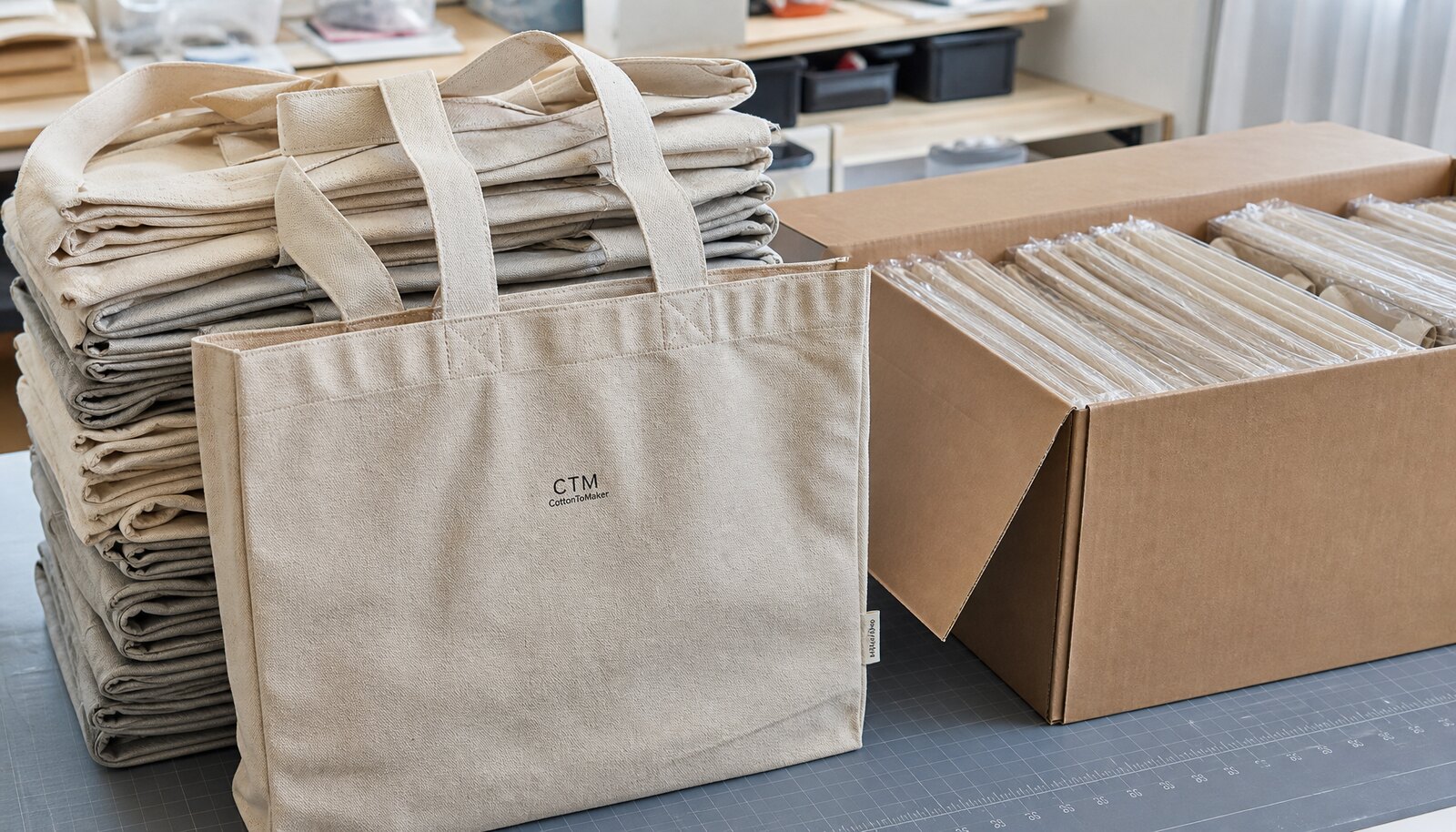
Why carton planning matters as much as the bag spec
For printed canvas shopping bags in retail chains, the bag spec is only half the job. The other half is how many pieces fit in each carton, how much each carton weighs, and whether the store or DC can receive it without repacking. A good-looking quote can still become a bad landed cost if the cartons are too heavy, the cube is wasted, or the packing method crushes the print.
Retail buyers usually feel carton problems in three places: freight cost, warehouse handling, and store replenishment. If the supplier leaves carton planning vague, the same order can arrive as 24 pcs/carton from one factory and 60 pcs/carton from another, which changes ocean cube, receiving labor, and pallet planning. Build the order around the shipper carton from day one, not as a final packing note.
- Treat carton count as a cost driver, not a packing detail.
- Set a max gross carton weight that your DC team can lift safely.
- Ask for carton dimensions before sample approval so freight math is visible early.
Choose the fabric weight from the retail use case, not from habit
For standard retail shopping use, 10–12 oz canvas is the most practical range. It gives enough body for screen printing, keeps the bag upright on shelf, and usually avoids the flimsy look that hurts brand perception. If the bag is mainly for lightweight apparel, cosmetics, or small gift items, 8 oz can work, but the buyer should accept a softer hand feel and a higher chance of wrinkling in transit.
Heavier canvas is not always a better answer. Once you move too far up in weight, carton gross weight rises quickly, and the freight cost can erase the value of a stronger bag. Ask the supplier to quote both fabric weight and finished carton weight so you can compare actual landed cost, not just unit price.
- 8 oz: light promo use, lower cost, more wrinkle risk.
- 10 oz: common retail baseline for general shopping bags.
- 12 oz: stronger body and better print presentation, but higher freight and material cost.
- If the bag carries bottles or boxed goods, increase the base weight or reinforce the handles and seam.
Print method decisions affect both shelf appeal and production risk
Most retail chains do best with screen print when the logo is simple and the color count is low. It is predictable, repeatable, and easier to control across multiple replenishment lots. For detailed illustrations, fine text, or gradient artwork, heat transfer can reproduce more detail, but the buyer should test abrasion, wash behavior, and how the print looks on the texture of canvas rather than on smooth paper.
The risk is not only visual quality. Some artwork looks acceptable on a flat sample but breaks once the fabric is folded, packed, and shipped. On a woven canvas surface, thin lines can disappear into the grain, and dark ink can show slight haloing at the edges. For retail chains, a slightly simpler artwork often performs better in mass production than a complex print that needs constant manual correction.
- Use screen print for flat logos, store names, and clear spot colors.
- Use heat transfer only when artwork complexity justifies the risk and the run size is small.
- Confirm Pantone targets in writing, not just by visual approval.
- Request a rubbed sample or at least a print adhesion note if the bag will be handled heavily in stores.
Use a product-specific comparison to choose the right sourcing route
The supplier route changes more than price. It changes packing discipline, response time, and who owns carton accuracy. A direct factory is usually the best fit when the order repeats, carton counts matter, and the buyer wants to control fabric, print, and packing in one workflow. A trading company can be useful when artwork changes often or when the buyer needs sourcing flexibility across several bag constructions, but the carton logic should still be written into the purchase order.
For retail chains, the practical question is not who has the lowest unit quote on paper, but who can deliver a quote that already includes the right carton configuration. The table below compares the sourcing routes a buyer is most likely to face.
Sourcing route comparison for printed canvas shopping bags
The right route depends on how much control your team needs over spec, lead time, and carton pack. Use this comparison to narrow the RFQ before you start negotiating.
The sample record for printed canvas shopping bags for retail chains shipping carton planning should include front, back, side, seam, logo, label, inside, and packed-carton photos. For important programs, keep one signed physical sample and record the sample version in the approval file.
- Write decisions in measurable language, not only descriptive wording.
- Ask for sample photos plus one physical approval sample for important orders.
- Keep quotation, sample approval, and inspection notes tied to the same spec version.
How MOQ logic changes when you plan by carton
MOQ is often quoted by bag style or print color, but carton planning changes the real order economics. If a factory’s efficient carton pack is 50 pcs and your stores need 48 pcs per case, the supplier may still push for 500 or 1,000 pcs because screen setup, cutting loss, and packing labor are tied to the full run. That does not mean the MOQ is unreasonable; it means the buyer should compare MOQ against the planned store demand and the pallet count, not against a random unit target.
The cleanest way to manage MOQ is to standardize three things: one bag body, one handle color, and one print layout for the first production run. Every extra variant adds setup time and may break the carton plan into awkward mixes. If your chain needs different regions or departments to share the same base bag, keep the body unchanged and vary only the print panel or side label where possible.
- Ask whether MOQ is driven by fabric dye lot, print screen setup, or carton pack efficiency.
- Separate one-time artwork setup from recurring unit cost in the quote.
- Avoid mixing too many sizes in the first order unless the warehouse has a clear receiving plan.
Packing format: the hidden source of damage and cost
Printed canvas bags are usually shipped flat, folded, and bundled inside the outer carton. That sounds simple, but the exact fold direction, bundle count, and interleaf paper choice matter. If the print sits against the same print on the next bag without separation, you can get ink rub or slight gloss transfer, especially on darker or heavier print layers. If the bag is folded too tightly, the first store presentation may show a crease directly across the printed panel.
Retail buyers should decide whether the bag must arrive store-ready or warehouse-ready. Store-ready packing usually means fewer repacking steps but higher carton volume and more labor in production. Warehouse-ready packing saves cube but can require extra folding or sorting at destination. The right answer depends on who opens the carton first and how quickly the bags go from DC to shelf.
- Specify flat pack, folded pack, or banded bundle before quoting.
- Use interleaf paper when print rub risk exists.
- Keep bundle counts easy to verify: 10, 20, or 25 pcs are easier than odd numbers.
- Mark cartons by SKU and color so mixed deliveries can be received without opening every case.
Sample approval should include the carton, not only the bag
A pre-production sample that looks good in hand can still fail the order if the packing method changes later. For this reason, approval should cover the finished bag, the print, the handle stitch, and the shipping carton format together. The carton sample or carton proof should show dimensions, label placement, and the same piece count you expect in mass production. If the factory sends a hand sample without the final carton plan, the buyer has not really approved the order.
The most useful sample check is practical. Load the sample bag with a realistic retail weight, inspect how the handle pulls, and see whether the base hangs straight or twists. Then place a few bags into the proposed carton format and note whether the folded stack remains neat or spreads out and wastes cube. That small test often prevents bigger surprises later.
- Approve one color standard, one print placement, one handle construction, and one carton pack method.
- Test the bag with product weight that reflects actual store use.
- Check whether the folded bag springs open and breaks the carton count tolerance.
- Keep a signed sample or sealed reference bag for production comparison.
QC thresholds that protect store presentation and freight efficiency
For printed canvas shopping bags, quality control should focus on the defects that customers notice first and the ones that create rework at receiving. A small fabric slub may be acceptable on natural canvas, but misaligned print, weak handle stitches, and incorrect carton counts are not. Buyers should define what is acceptable versus rejectable before mass production starts, because a factory will usually build to the written tolerance, not the buyer’s unstated expectation.
The packing and carton side also needs measurable acceptance points. Check whether carton size matches the approved spec, whether the gross weight stays within the DC limit, and whether the outer carton survives normal handling. If a carton is too soft, it may collapse during stacking and damage the bag edges even when the bags themselves are well made.
- Print registration should stay consistent across the lot and within a practical visual tolerance.
- Seams should not skip, pucker, or leave loose thread at stress points.
- Handle length should match the approved spec so bag balance stays even.
- Carton labels must match SKU, color, quantity, and PO details exactly.
Lead time planning: where retail chains lose weeks
The fastest quote is not always the fastest shipment. Lead time for printed canvas shopping bags usually has three parts: fabric procurement or reservation, print setup and sample approval, and sewing plus packing. If the supplier has to source a special fabric weight or a custom handle color, the schedule can slip even when sewing capacity is available. That is why a buyer should always ask whether lead time is quoted from artwork approval, sample approval, or deposit receipt.
Retail chains also need a practical buffer for carton review and shipping documents. If the shipment must match a retail launch date, leave time for one correction cycle. One mistake in carton count or print placement can force a rework that is far more expensive than waiting an extra few days for proper approval.
- Clarify the clock start date: order confirmation, deposit, or sample approval.
- Build in time for carton label review and final packing photo review.
- Avoid adding new colors or handle variations after the sample stage if launch timing is fixed.
Specification comparison for buyers
| Spec decision | Recommended option | When it fits | Buyer risk to check |
|---|---|---|---|
| Fabric weight | 10–12 oz canvas for standard retail carry; 8 oz only for light merchandise | General apparel, beauty, gift, and bookstore chains needing a balance of print quality and cost | Too light a fabric can distort under load and crease print; too heavy raises carton weight and freight cost |
| Print method | Screen print for simple logos and bold spot colors; heat transfer only for short runs or detailed gradients | Chains with repeat logos, stable artwork, and consistent seasonless branding | Fine detail may break on thick weave; confirm Pantone tolerance and abrasion resistance |
| Handle construction | Cross-stitch or box-X reinforcement with 2.5–3 cm webbing handles | Stores where bags carry mixed SKUs or heavier purchases | Weak handle stitching causes returns and store complaints before fabric failure |
| Bag size | One core size plus one oversized promo size instead of too many SKUs | Retail chains planning replenishment across many locations | Too many sizes complicate carton mix, MOQ, and warehouse slotting |
| Carton pack | Flat-packed, same orientation, 50–100 pcs per outer carton depending on bag thickness | High-volume importers optimizing cube and store replenishment | Overstuffed cartons crush print and seams; underfilled cartons waste freight cube |
| Inner packing | Bundle by 10–25 pcs with paper interleaf if print rub risk exists | Printed bags with dark ink, coated print, or delicate surface finish | Ink transfer and scuffing during sea shipment if bags rub without separation |
| Supplier route | Direct factory with carton-optimized packing notes and pre-production sample approval | Brands and distributors managing repeat orders and tighter landed-cost control | Trading layers can hide carton variance, longer lead times, and less packing accountability |
| Compliance evidence | BOM, fabric test data, photo QC report, and packed carton dimension sheet | Retail chains needing internal sign-off and import documentation | Missing packing evidence makes it hard to audit actual cube, weight, and store-ready packout |
| MOQ strategy | Use one standard print plate/screen setup across regions to keep MOQ efficient | Chains rolling out to multiple banners or territories | Artwork changes, multiple handle colors, or mixed lining specs can multiply setup cost and delay approval |
Buyer checklist before sampling
- Confirm final bag size, gusset, handle drop, and usable loading weight.
- Specify fabric type, GSM/oz weight, color tolerance, and shrinkage expectations.
- Send vector artwork and define logo size, print position, and Pantone references.
- Ask for sample photos plus one physical pre-production sample before bulk approval.
- Agree carton packing, barcode or hangtag needs, and shipment marks before production.
- Record inspection checkpoints for stitching, print adhesion, stains, and quantity count.
Factory quote questions to send
- What is your standard fabric construction for this bag size, and what finished GSM or oz weight will you quote?
- How many pieces per carton do you recommend at this bag thickness, and what carton dimensions and gross weight will you use?
- Which print method are you pricing, how many colors are included, and what setup or screen charges apply?
- Can you provide a pre-production sample with the final fabric, print, handle construction, and packing format?
- What is the realistic lead time for sample approval, production, and carton-ready shipment for this order size?
- Please share any carton drop test, seam test, or pull test data you can provide for this construction.
Quality-control points to confirm
- Finished size tolerance should stay within a practical range, typically around +/- 0.5 cm for small bags and tighter only if your pattern supports it.
- Print placement should remain centered and repeatable, with no visible ghosting, banding, or ink bleed on the weave peaks.
- Handle reinforcement should survive normal retail loading without popped stitches, twisted webbing, or unequal handle length.
- Carton pack count must match the approved packing list, with no mixed size cartons unless specifically requested.
- Carton compression should not leave permanent fold marks or transfer print color onto adjacent bags.
- Outer cartons should show clear SKU, color, size, quantity, and country-of-origin markings aligned with importer requirements.