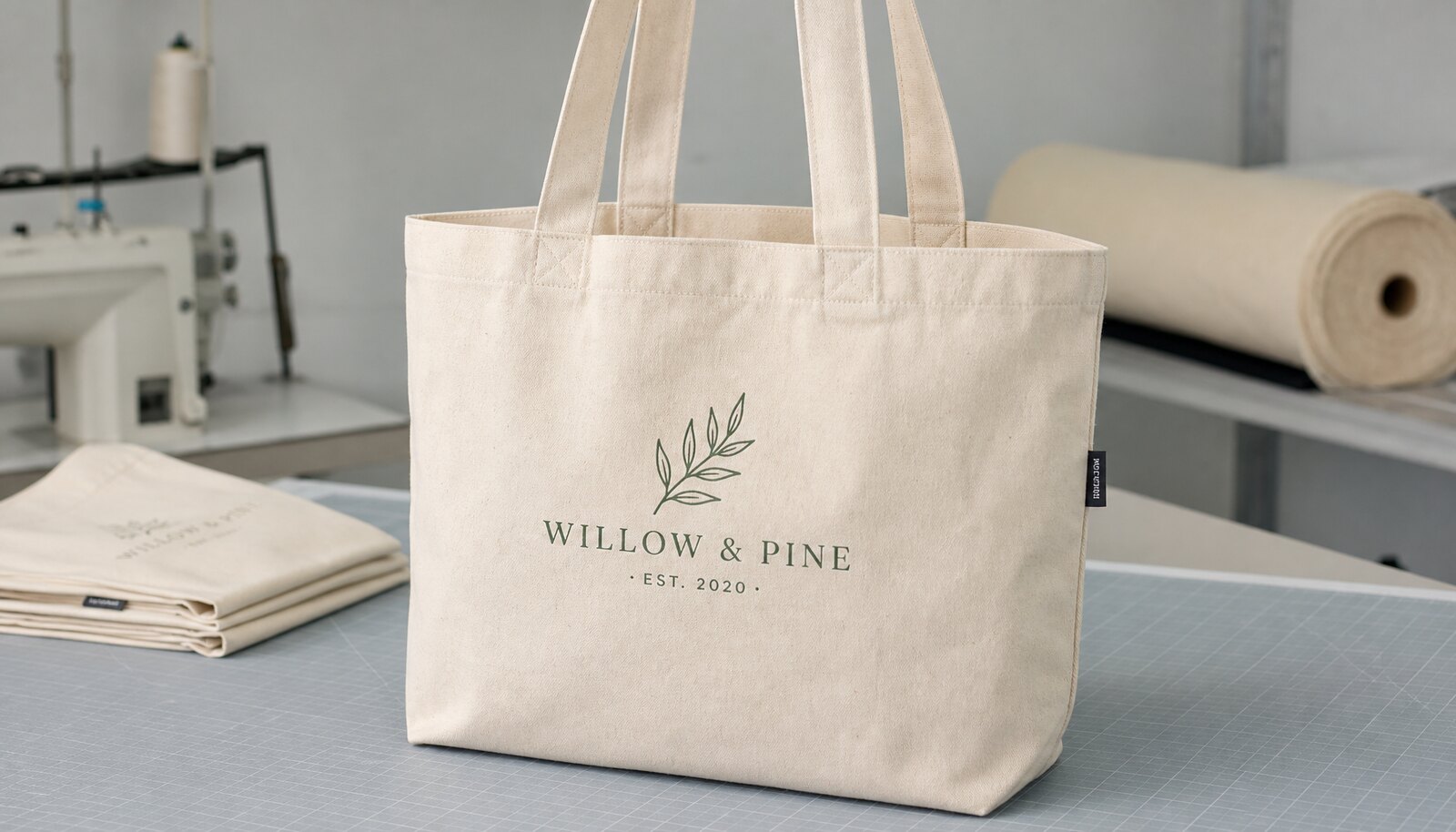
Start With The Exact Product You Plan To Reorder
Printed canvas shopping bags for retail chains should be priced as a repeatable buying program, not as a generic tote. The commercial unit is the finished, approved bag: fabric weight, dimensions, gusset, handles, reinforcement, print method, packing, and carton format. If any of those elements are vague, suppliers will fill the gap with their own defaults, and the quotes will look comparable when they are not. That is the first sourcing problem to solve because it affects every later number, from tooling to freight to replacement rate.
Retail-chain buyers should think in terms of a program rather than a one-off order. A launch order may need store branding, ticketing, and DC labeling, but the real savings usually come from repeatability. If the first shipment is built one way and the reorder is built another way, the chain absorbs inconsistency in customer perception and receiving labor. That is why the RFQ should describe the bag you plan to keep buying, not the promotional version that is easiest for the factory to quote.
The simplest safeguard is to create one spec family per SKU and then decide how many artwork variants can ride on that same body. If the chain needs a black version, a natural version, and a holiday version, keep the base bag identical unless there is a clear commercial reason to change the construction. That makes quote comparison easier and keeps the supplier from re-pricing every small variation as a new project.
- Define one finished spec before you request pricing.
- Treat launch, replenishment, and seasonal graphics as one program if the body spec is unchanged.
- Do not compare offers until the sample, carton pack, and Incoterm are aligned.
- Lock the bag construction in writing before asking for a volume ladder.
Write A Buyer-Grade Spec Sheet That Removes Guesswork
A retail-chain RFQ should contain enough detail that two factories can quote the same item with minimal interpretation. At a minimum, include finished width, height, gusset depth, handle length, handle width, seam construction, top hem construction, reinforcement points, fabric weight, print size, print position, and pack style. If the bag must fit a shelf tray, vending display, or DC bin, include the folded size as well. The more the supplier has to assume, the less useful the quote becomes.
It also helps to state what is not acceptable. For example, if the chain wants a natural canvas look but does not want heavy slub, put that in the spec. If the bag must be suitable for retail sale, say whether inner loose threads are allowed, whether label stitching can show on the inside, and whether the print must remain visible when the bag is folded flat. These details stop suppliers from arguing after sample approval because the acceptance criteria were already part of the commercial request.
For large retail programs, the spec should connect product quality to operational use. If store staff will hand out the bag at checkout, the handle length must be comfortable for short carry and the print should be legible at arm's length. If the bag will be sold as reusable merchandise, then structure, finish, and stitch density matter more because the customer is paying for perceived value as well as utility. The same bag body can often serve both purposes, but only if the buying team defines the requirement clearly at the start.
- Include both product dimensions and folded dimensions if DC packing depends on it.
- State handle attachment style, bartack requirement, and top hem finish.
- Add visual exclusions such as no heavy slub, no visible oil marks, or no crooked print.
- Tie the bag's use case to the approval criteria: checkout giveaway, retail merchandise, or promotional resale.
Choose Canvas Weight Based On Use Case And Landed Cost
The commonly used 10 oz to 12 oz range is a practical starting point for many retail-chain programs, but it is not a universal answer. Ten-ounce canvas can be the better commercial choice when the bag is meant for lighter carry, high volumes, or lower ticket pricing. Twelve-ounce canvas often makes more sense when the bag is sold as an accessory, needs more structure on shelf, or has to feel substantial in the customer's hand. The right weight is a balance of look, load performance, sewing efficiency, and freight cost, not just fabric price.
A stronger comparison asks what the weight change does to the whole landed cost. Heavier canvas usually increases fabric cost and carton weight, but it can also reduce complaints about limp bags, print strike-through, and poor shelf presence. Lighter canvas may save money, but if it increases damage, returns, or customer dissatisfaction, the savings disappear in the background cost of the program. That is why buyers should compare bag weight alongside reinforcement, finishing, and packing efficiency rather than in isolation.
Canvas weight should also be considered by market. A flagship store network selling premium accessories may tolerate higher fabric cost if the bag supports the brand image. A discount chain or seasonal promotion may prioritize cost per unit and accept a lighter hand feel, as long as the bag still passes load and stitch requirements. If the supplier only offers a blanket recommendation, ask for a side-by-side quote at two weights using the same size, same print, and same packing so you can see the real delta.
- Ask for two weight options with the same bag dimensions to compare the landed delta.
- Request the supplier's measured GSM or oz method and note how it is tested.
- Check whether the canvas is pre-shrunk or whether final dimensions are set after finishing.
- Do not approve weight without checking load, shape retention, and print appearance.
Pick The Print Method By Volume, Artwork, And Durability Requirement
For retail-chain canvas bags, screen print is often the most economical and durable baseline when the artwork is simple and the order repeats. It usually handles solid logos and sharp lines well, and the cost structure makes sense when the same print file runs across a large program. That said, it is not automatically the right answer. If the design uses gradients, photographic elements, or frequent campaign changes, digital or heat-transfer methods may be the better commercial fit even if the unit cost is higher.
The buyer should compare print methods on more than price. Ask how the print will feel in hand, whether the ink sits on top of the weave or penetrates it, and what happens after abrasion during store handling and consumer use. On darker canvas, the need for an underbase can change both cost and appearance. On textured canvas, fine detail can disappear if the line weight is too thin. A good quote should say how the factory will manage registration, cure temperature, and color control, not just list the decoration method.
If the bags are for retail sale rather than a giveaway, durability expectations should be stated in the PO. That may mean rub resistance, wash exposure, or a minimum appearance standard after normal handling. For buyer clarity, ask for a decorated sample under the same process planned for mass production. A photo proof is useful for artwork sign-off, but it does not prove durability, ink laydown, or registration control in bulk manufacturing.
- Screen print suits simple logos and repeat orders, but it should still be validated on the actual fabric.
- Ask whether dark fabric requires underbase or additional print steps.
- Require measured print placement, not a visual-only approval.
- If durability matters, ask for rub or wash test evidence appropriate to the print method.
Compare Supplier Routes On Cost, Control, And Reorder Stability
Direct factory sourcing is usually the strongest route when the program will repeat and the buyer wants tight control over fabric, sewing, and print consistency. It gives the procurement team the clearest view of where the cost sits, and it often supports better repeatability if the same factory keeps the approved fabric and print setup on file. The tradeoff is that the buyer must provide a stronger RFQ and more disciplined sample approval because the factory will follow the spec literally.
Trading companies and sourcing agents can add value when a retail chain has limited internal bandwidth, multiple product lines, or a need for coordination across suppliers. They can simplify communication, handle document flow, and help manage sample logistics. But the buyer should insist on transparent pricing. If the intermediary does not break out factory cost, service margin, packaging, and freight assumptions, then the quote cannot be normalized against direct-factory offers. That is a commercial problem, not just a reporting issue.
Stock blank plus local print is a legitimate route for rush programs or test markets, especially when the chain wants to move quickly before committing to a national roll-out. The main risk is variability in blank stock quality and color lot consistency. Regional cut-and-sew with in-house print can be a good middle ground for shorter transit and simpler replenishment, but it often has fewer fabric choices and less leverage on raw material price. The right route depends on whether the chain values speed, control, documentation, or low unit cost most for that program.
- Use one comparison sheet across all sourcing routes.
- Ask for factory-level documentation even when buying through an agent.
- Confirm whether the supplier will hold approved fabric and print settings for reorder.
- Choose the route based on program type: launch, refill, or seasonal test.
Normalize Quotes To Landed Cost Before You Judge The Price
A bulk pricing plan should normalize every supplier quote to the same basis before any decision is made. That means the same bag spec, same print method, same pack method, same Incoterm, same destination, and the same quality standard. If one factory quotes FOB and another quotes delivered, or one includes polybags while the other does not, the difference is not a real price difference. It is an incomplete comparison. Procurement teams save time later by forcing the normalization step early.
The best way to compare offers is to convert them into landed cost per sellable unit. That means production cost, setup and sampling, freight, duty if applicable, inspection, receiving, repacking, and any known defect allowance. For example, a quote that is $0.10 higher per unit at the factory may still be cheaper if it cuts reject rate or DC repacking labor. Likewise, a lower quote can be false economy if it creates higher carton damage or more inbound exceptions. The buyer should compare all suppliers on the same spreadsheet structure so the result is a decision, not a debate.
Here is a simple model the buying team can use: if one supplier quotes $1.20 FOB for 20,000 bags and another quotes $1.08 FOB but adds a higher setup fee, more expensive packing, and weaker carton QC, the cheaper headline number may disappear once freight and receiving are added. If freight, duty, and receiving total $0.32 per unit for the first supplier and $0.40 for the second due to heavier cartons or more damage, the landed gap narrows or reverses. The point is not that one route is always best, but that the unit price alone is not enough for a retail-chain buying decision.
- Convert every supplier offer to landed cost per sellable bag.
- Add expected defect and repack cost before choosing the low price.
- Do not accept mixed quote bases when comparing vendors.
- Use the same spreadsheet columns for every bid.
Set MOQ, Volume Tiers, And Reorder Rules Around Store Reality
MOQ should be tied to production economics, but the buyer should pressure-test whether it is aligned to real store demand. A factory may quote one MOQ per artwork, one MOQ per color, and another MOQ per packing format. If a retail chain intends to launch with several store groups or seasonal graphics, those thresholds matter more than the headline unit price. The practical question is whether the first order can be repeated efficiently or whether the program will be expensive every time the artwork changes.
A useful procurement method is to ask for three quantities: launch quantity, normal replenishment quantity, and low-volume seasonal quantity. Each tier should be quoted on the same spec so the price curve is meaningful. If a factory gives a steep reduction only at a quantity the chain cannot actually use, the quote is not actionable. Ask whether setup costs are one-time or repeated on each reorder, and whether a second run keeps the same print screens, fabric lot, and carton format. Reorder stability is often more valuable than shaving a few cents off the initial launch.
For retail chains with multiple stores, it is also worth asking whether mixed SKU cartons are allowed or whether each carton must contain one style only. Mixed cartons can reduce internal handling but increase picking risk and complicate receiving. The decision should be based on DC process, not supplier preference. If the supplier offers a lower MOQ by combining styles, the buyer should still calculate whether the chain can handle the added complexity without raising labor or error rates.
- Request launch, replenishment, and seasonal price tiers.
- Ask whether MOQ applies per artwork, per color, per style, or per carton pack.
- Confirm whether setup fees are repeated on every reorder.
- Decide mixed cartons based on DC workflow, not supplier convenience.
Approve Samples As A Production Test, Not A Sales Presentation
Sample approval should answer one question: can the factory make the approved bag in bulk, repeatedly, at the stated price? A sample that is prettier than the bulk output is a problem, not an asset. Ask for a pre-production sample made from the same canvas weight, thread, print method, and packing plan that will be used in mass production. If the supplier cannot match the bulk process on the sample, the buyer should treat the approval as provisional until the process is confirmed.
Measurements should be taken after pressing or finishing, not from a loose unfinished sample. Measure finished width, height, and gusset; check handle symmetry; confirm top hem consistency; and inspect the print position against a marked template. Also check how the bag folds into the intended carton format, because an attractive sample that is too bulky to pack efficiently will increase freight and DC handling cost. If the bag is sold as merchandise, the sample should also be reviewed under store lighting so the brand team can judge the finish in the actual retail environment.
Keep one signed master sample per spec family and note any exceptions in writing. If fabric lot, ink formulation, label type, or packing method changes, require a new sample or at least a written approval to avoid unapproved drift. This is especially important for retail chains because one store group may receive the launch batch while another receives the reorder. Without sample discipline, the chain can end up with two versions of what was supposed to be one product.
- Use a production-matched pre-production sample.
- Measure finished dimensions after pressing or final finishing.
- Approve print placement with a marked template and photo record.
- Restart or re-approve if fabric, ink, label, or packing changes.
Define QC Standards And Inspection Levels Before Production Starts
The most useful QC plan is measurable. For printed canvas shopping bags, the buyer should define acceptable variation for dimensions, stitching, print, carton counts, and packing marks before bulk production begins. If the factory is asked to inspect only for general appearance, the result will be subjective and hard to enforce. If the buyer specifies the criteria in advance, the supplier can sort defects consistently and the receiving team can reject shipments with confidence.
A practical inspection framework for retail-chain buyers is to classify defects as critical, major, and minor, then align the inspection method with the order size. Many buyers use an AQL-based inspection plan for bulk production, but the exact level should be stated in the PO or quality agreement rather than assumed. For example, handle failure, missing print, wrong artwork, or incorrect country-of-origin labeling should be treated as major or critical, while a small loose thread on a hidden seam may be minor if it does not affect function or appearance. The key is consistency across suppliers and orders.
Measurable acceptance criteria help prevent arguments at the dock. A useful list would include stitch density or seam strength expectation, acceptable print misregistration range, carton count tolerance, and allowed variance in fabric GSM or oz. If the buyer expects the same bag to be reordered months later, the QC standard should also reference the signed master sample and the same loading test method. That gives the retailer a repeatable benchmark instead of a subjective judgment based on whoever inspects the lot.
- State defect categories before bulk production starts.
- Tie QC to the approved master sample and the PO.
- Require inspection records or photos for disputed shipments.
- Set the same acceptance criteria across all bids.
Write Packing, Marking, And Logistics Rules That Reduce Hidden Cost
Packing can change the economics of a canvas bag program more than buyers expect. Flat-packed bags usually give the best freight efficiency and the simplest distribution-center handling, but only if the bag can be folded consistently without deforming the print or handles. Retail-ready packaging may be needed if the bag is sold as a merchandised item or displayed near checkout, but that should be a deliberate choice because each layer of packaging adds cost, labor, and possible plastic compliance issues. The buyer should ask what the pack method does to cubic volume before approving it.
Carton marking needs the same level of discipline as the product spec. At minimum, the carton should show style, color, size if relevant, quantity, PO number, country of origin, carton number, and gross and net weight. If the chain uses a warehouse management system, add barcode requirements and make sure the code is tested on receipt. If store groups or regions need separated cartons, say so upfront. A supplier who guesses at carton logic can create receiving delays that are much more expensive than the bag itself.
In some programs, humidity or odor matters because the bags sit in store backrooms before display. If the chain has those concerns, include packaging restrictions and any ventilation or storage expectations in the RFQ. That is particularly important when bags are shipped long distances or packed with inks, adhesives, or inserts. The more operational the packing instruction is, the fewer surprises the buyer sees at the DC.
- Choose flat pack or retail-ready pack based on DC and store workflow.
- Specify carton marks, barcode format, and carton count.
- State whether polybags or inserts are required, optional, or prohibited.
- Add any odor, moisture, or compliance restrictions that affect inbound acceptance.
Specification comparison for buyers
| Sourcing route | Best use case | Landedd-cost profile | Compliance and risk control | Repeatability / reorder control |
|---|---|---|---|---|
| Direct factory sourcing | Stable chain replenishment with one locked bag spec and recurring artwork | Often lowest factory price, but freight, duty, inspection, and rework exposure must be added explicitly | Best when the buyer can enforce fabric, stitching, print, and carton specs directly | High if the factory keeps approved fabric, print settings, and master sample on file |
| Trading company or sourcing agent | Programs with limited internal bandwidth or multiple product lines | Can simplify quoting, but service margin and hidden consolidation fees may raise the landed cost | Useful for document flow and supplier coordination, but cost transparency must be written into the quote | Moderate; repeatability depends on how well the agent controls factory changes and substitutions |
| Stock blank plus local print | Urgent launches, test markets, or short promotional runs | Fastest path to receipt, but blank bag price, local print setup, and inbound freight can be uneven | Higher blank lot variation risk; ask for incoming inspection and blank lot traceability | Low to moderate; blank availability and color variation can change between runs |
| Regional cut-and-sew with in-house print | Replenishment where shorter transit and easier communication matter | Usually higher sewing cost than offshore, but often lower logistics volatility | Good for tighter language, faster issue resolution, and simpler claims handling | Moderate to high if the maker holds fabric and print controls consistently |
| One-color screen print | Simple brand marks, evergreen retail logos, and repeat orders | Lowest decoration cost at scale, but screens, setup, and color changes add cost when SKUs multiply | Durable if ink, cure, and registration are controlled; ask for rub and placement tolerances | High when artwork stays stable and the same screens can be reused |
| Digital or heat-transfer print | Complex graphics, gradients, small seasonal runs, or frequent artwork updates | Higher decoration cost per unit; may add pretreatment or transfer material expense | Needs explicit durability expectations for rub, wash, and edge lift or peeling | Moderate; artwork is flexible, but repeat consistency must be proven sample by sample |
| 10 oz canvas | Lighter carry, value programs, promotional retail bags | Lower fabric and freight weight, but lower structure can affect shelf presence | Good if the bag still passes load, seam, and print appearance checks | High if the same fabric lot and finishing method are locked |
| 12 oz canvas | Premium retail resale, more structure, better hand feel | Higher fabric cost and shipment weight, but can reduce complaints about limp bags | Better for resale perception; confirm handle stress and carton cube impact | High if the same construction and finish are held across runs |
Buyer checklist before sampling
- Prepare vector artwork, Pantone targets, and one visual color reference approved by the brand team.
- Lock one spec family per SKU: finished size, gusset depth, handle length and width, fabric weight, reinforcement method, and print size.
- Ask for a tiered price ladder at realistic quantities, not a single headline unit price.
- Require the quote to separate sample cost, setup cost, unit price, packing cost, and freight basis.
- Confirm the Incoterm, destination port or warehouse, and who pays inland freight, duty, customs brokerage, and receiving fees.
- Approve one master sample for each spec family and retain a signed reference sample with dimensions, print placement, and pack method noted.
- Define packing format: bulk flat pack, retail-ready pack, or DC-specific pack with barcode and carton marks.
- State carton quantity, carton count tolerance, overrun and underrun tolerance, and palletization rules if needed.
- Require an inspection standard, defect categories, and escalation steps for rework or replacement.
- Build a reorder plan so the supplier can reserve fabric, screens, ink, and sewing capacity for replenishment.
Factory quote questions to send
- Please quote the same bag spec at each volume tier and state the unit price, setup charge, and any change in price by artwork, color count, or packing method.
- What is the exact fabric specification: oz, GSM if available, weave density, and whether the cloth is pre-shrunk or finished after cutting?
- What is included in the print price: number of colors, screen count, registration tolerance, curing method, and whether there is an underbase for dark canvas?
- Is the sample made from the same fabric, thread, print method, and packing method that will be used in bulk production?
- What are the MOQ rules per artwork, per color, per fabric weight, and per packing configuration?
- What carton pack format do you quote, and are polybags, inserts, barcode labels, and carton marks included or extra?
- What inspection standard do you use before shipment, and can you share sample defect photos or an inspection report format?
- What are your under-run and over-run tolerances, and how do you handle defective units found during inspection or receiving?
- Can you confirm lead time by stage: sample, bulk fabric booking, production, inspection, and shipment?
- If we reorder the same approved spec, what changes, if any, can affect repeatability or price?
Quality-control points to confirm
- Finished dimensions must match the signed master sample within an agreed tolerance, typically ±0.5 cm for small bags or a buyer-approved equivalent on the PO.
- Fabric weight should match the agreed oz or GSM with a stated lot variance limit in writing; the buyer should ask for the supplier's test method if weight is critical.
- Print placement should be measured from fixed points, with a defined tolerance for centering, top-edge distance, and side-to-side alignment.
- Print color should match the approved visual standard or Pantone target within an agreed tolerance, acknowledging that natural canvas texture can shift perceived color.
- Stitching should be checked for skipped stitches, seam slippage, loose threads, and bartack coverage at handle stress points.
- Handles should be equal length within tolerance, attached symmetrically, and capable of passing the agreed loaded lift test without seam failure.
- Needle holes, puckering, oil stains, holes, dirty marks, and frayed edges should be absent from visible surfaces beyond the agreed acceptable defect level.
- Carton count, style mix, barcode labels, country of origin marks, and carton number sequence must match the packing instruction exactly.
- For larger orders, inspect using a stated AQL level or buyer-defined equivalent, and confirm the same sampling plan is used across all suppliers being compared.
- Ask the supplier to classify defects as critical, major, and minor before shipment so the buyer can align reject, rework, or accept decisions consistently.