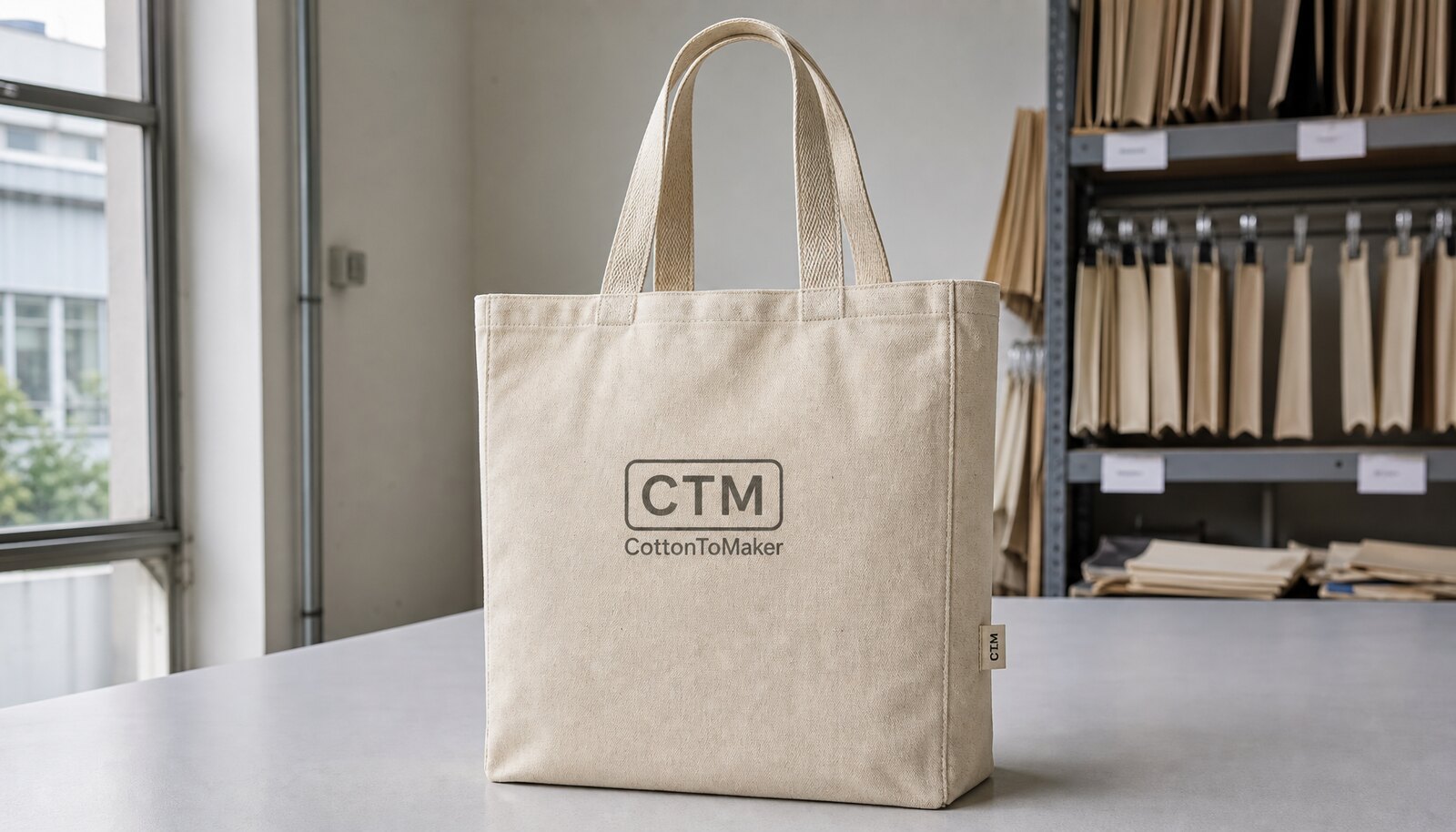
Why museum buyers need a different canvas tote spec
Museum bags are not the same as a generic event giveaway. In the shop, the bag has to hold catalogs, postcards, notebooks, and the occasional hardcover without looking flimsy. At the same time, the museum buyer often needs the unit cost to stay low enough to leave margin for retail markup. That means the spec has to sit in the middle: durable enough for resale, simple enough for repeat production, and visually clean enough to carry a museum logo or exhibition identity without distortion.
The biggest sourcing mistake is treating the bag like a promotional freebie. Once the bag is sold at retail, the buyer needs more consistent seams, better print alignment, and more controlled packing than a giveaway order would require. For a museum program, the best quote is usually the one that balances fabric weight, print method, and shipment timing instead of chasing the cheapest blank canvas price.
- Retail use case: gift shop sales, exhibition merch, membership gifts, or event retail.
- Expected loading: books, posters, stationery, small boxed souvenirs.
- Buyer priority: stable quality across reorders, not just a low first-order price.
Fabric weight and structure: where the value really changes
For printed canvas shopping bags for museums, the usual practical range is 10–12 oz canvas, roughly 280–340 GSM. Below that, the bag may feel too soft or too thin for retail sales. Above that, it begins to look heavy and can increase sewing difficulty, shipping weight, and print wear at fold lines. If the museum sells premium merchandise, a slightly heavier body often supports a better shelf impression and a higher sell-through price.
The structure should stay simple unless the bag is carrying unusually heavy products. An unlined tote with reinforced handles and a reinforced bottom seam covers most museum use cases. Gussets help with display and packing volume, but they also add fabric consumption and sewing labor. If you need the bag to stand more upright in the shop display, a gusset is useful; if you need the best cost-per-unit, a flat tote can be the better route.
- 10 oz / about 280 GSM: lighter retail tote, best for postcards, small gifts, and lower price points.
- 12 oz / about 340 GSM: stronger hand feel, more suitable for books and premium museum merchandising.
- Reinforced handle stitching: important when the bag will be sold rather than handed out once.
Print method choice: what works on canvas and what creates risk
Most museum graphics are logo-led or artwork-led, which makes screen printing the most reliable option for one to three solid colors. It gives good opacity on natural canvas and keeps the print costs manageable on mid-sized orders. If the design includes fine detail, gradients, or a full-color exhibition illustration, transfer printing can work for short runs, but the buyer should treat it as a tradeoff: higher decoration flexibility, but more sensitivity to rub resistance and washing behavior.
For small museum brand marks, woven labels or embroidery can be useful, but they are usually better as a secondary branding element than as the main image area. Direct embroidery on canvas is durable, yet it adds needle distortion and can make the bag feel more premium than the rest of the construction. If the museum wants a clean retail look with controlled cost, screen print on the body plus a woven side label is often the most balanced combination.
- Screen print: best for simple museum logos, dates, and short exhibition titles.
- Heat transfer: best for complex art or short-run seasonal graphics, but needs rub testing.
- Embroidery or woven label: good as a brand detail, not always ideal for large artwork.
MOQ logic: what actually drives the minimum order
MOQ is rarely a single number set by habit. For canvas bags, it usually changes with fabric order, print setup, screen count, label application, and packing labor. A plain one-color tote may fit a lower MOQ because the factory can run a straightforward production line. Add multiple colors, a custom woven label, a special wash effect, or retail hangtag assembly, and the factory has to recover more setup labor per unit, so the minimum often rises.
For museum buyers, MOQ should be reviewed against the shop calendar, not against a generic supplier claim. A single exhibition launch may not justify a very high minimum unless the bag is also intended as a permanent range item. If the bag can be reused for future exhibitions with the same base format and only a changed printed title, a buyer can negotiate a more sensible total plan by keeping the body spec constant and varying only the print plate or artwork insert.
- Lower MOQ usually comes from fewer print colors, fewer decoration positions, and simpler packing.
- A custom woven label or retail hangtag can shift the production plan and raise the MOQ.
- Reorder-friendly designs should keep body spec identical across exhibitions.
Comparison of sourcing routes for museum tote programs
Museum procurement teams usually choose between factory-direct sourcing, a trading company, or a local decorator with overseas blank supply. Each route changes how MOQ, quote transparency, and lead time behave. The cheapest unit price is not always the lowest landed cost once sampling, compliance checks, and freight coordination are added. A buyer comparing routes should look at total control, not just quote headline price.
The table below is most useful when the museum needs both retail appearance and reliable delivery. If the order is small and urgent, a local decorator may be easier. If the order is repeatable and needs strict spec control, factory-direct often performs better. For mixed programs with multiple SKUs, a trading company can consolidate, but the buyer should be careful about who is actually responsible for material control and final inspection.
Sample approval: the stage that prevents most expensive mistakes
A proper sample for printed canvas shopping bags should match the final fabric weight, sewing method, print process, thread color, and label location. A blank sample is only useful for hand feel and dimensions. It does not prove that the print sits correctly on the panel or that the handle stitch line can survive retail use. For museums, the sample should also be checked in the same color environment used to approve artwork, because natural canvas can shift the visual impact of the ink more than expected.
The easiest way to control risk is to separate sample types in the RFQ. First, a blank reference for structure. Then a printed pre-production sample that uses the final artwork and full finishing details. Only after that should the bulk run be authorized. If the museum shop opening date is fixed, it is safer to protect the sample window early than to rush straight into production and discover the logo sits too low or the bag appears thinner than planned.
- Check finished size after sewing, not only cut size.
- Confirm print placement relative to seam and handle top edge.
- Approve the sample under neutral light and compare against the brand color reference.
Packing details that affect landed cost and shop readiness
Packing often looks minor on a quote, but it affects both cost and resale condition. Flat packing in bulk polybags is usually enough for wholesale museum orders, especially when the bags will be unpacked into a stockroom. If the product goes straight to a gift shop display, the buyer may need individual polybags, belly bands, or hangtags. That adds labor, packaging material, and more opportunities for label misplacement, so the requirement should be stated clearly before quoting.
Carton loading is another practical point. Overstuffed cartons crease printed canvas; loose cartons waste freight space and increase damage risk during handling. A good export carton plan keeps the bags flat, dry, and easy to count. For imported museum retail programs, carton marks should identify the style, color, quantity, and purchase order in a format that warehouse teams can receive without opening every box.
- Use flat packing for bulk imports unless retail display packaging is part of the buying plan.
- Keep carton fill consistent to avoid print creases and corner compression.
- Request outer marks that match the museum’s warehouse receiving system.
Lead time review: what a realistic schedule looks like
For a standard printed canvas tote with confirmed artwork, the schedule is usually sample in 5–10 days and bulk production in about 20–35 days after sample approval and deposit. That range assumes normal sewing capacity, standard inks, and no special finishing bottlenecks. If the order includes a new label tool, multiple print positions, or a busy season such as major retail holidays or exhibition launches, the lead time can stretch quickly. A buyer should always separate sample lead time, bulk lead time, and shipping lead time instead of treating them as one number.
Museum procurement is especially vulnerable to delay because shop launch dates are often fixed by exhibition opening calendars. The practical way to reduce schedule risk is to freeze artwork early, avoid late changes to handle length or label format, and keep the first order focused on one body spec with one decoration method. If the museum wants a future reorder option, the factory can usually hold the same base spec and change only the artwork plate, which is faster than re-engineering the whole bag.
- Sample stage: allow time for corrections, not just first approval.
- Bulk stage: confirm that raw material is already available or reserved.
- Shipping stage: book freight before production ends if the launch date is fixed.
How to compare quotes line by line
A useful quote should separate the bag body, print setup, sampling, packing, and any special finishing. If the factory gives only one unit price, it becomes difficult to compare alternatives, especially when one supplier includes a woven label and another excludes it. The quote should also state the canvas weight, finished size, handle length, print method, and carton quantity so the buyer can compare like for like.
Watch for price gaps that come from hidden assumptions. A low quote may be based on lighter fabric, smaller handle reinforcement, or simpler packing. Another supplier may look higher but include pre-production sampling and export cartons sized for easier warehouse intake. For museum buyers, the landed cost should include not only freight but also the cost of rework risk if the first printed batch is rejected.
- Compare the same fabric weight, same print colors, same packaging, and same sample scope.
- Ask whether screen setup or plate cost is one-time or recurring on reorders.
- Separate EXW, FOB, and landed cost before choosing the supplier.
A practical buyer checklist before issuing the PO
Before converting the quote into a purchase order, the buyer should have the product spec tight enough that the factory can produce without interpretation. The museum logo file should be final, the approval contact should be named, and the packaging format should be fixed. This avoids the common problem where procurement, marketing, and the shop team each assume a different version of the bag.
The final order should also reflect actual retail use. If the bag is intended for books and catalog bundles, the handle stitch and bottom seam deserve more attention than decorative extras. If the bag will be sold as a premium souvenir, print consistency and neat edge finishing matter more than shaving a small amount off the fabric weight. The right spec is the one that fits the store shelf and the warehouse pallet at the same time.
- Artwork finalized and approved by all stakeholders.
- Bag dimensions, fabric weight, print method, and label details locked.
- Packing format and carton count confirmed.
- Lead time aligned with exhibition or store launch date.
- Inspection standard agreed before bulk production starts.
Specification comparison for buyers
| Spec decision | Recommended option | When it fits | Buyer risk to check |
|---|---|---|---|
| Fabric weight | 10–12 oz canvas, or about 280–340 GSM | Museum retail shops need a bag that feels substantial, holds books and catalogs, and supports a higher ticket price | Too light looks promotional; too heavy increases cost, stiffness, and print cracking if artwork sits on a hard fold |
| Print method | Screen print for 1–3 solid colors; heat transfer only for short-run complex art; woven label or embroidery only for small brand marks | Most museum graphics are logo-led, text-led, or simplified exhibition artwork | Fine detail, gradients, and thin lines can disappear on textured canvas; CMYK transfers can rub if packing is tight |
| Bag construction | Unlined tote with reinforced handles and bottom seam reinforcement | Retail buyers want a durable, price-efficient bag with repeat sales potential | If the museum sells books or gift sets, weak handles or single-needle seams cause returns and shop complaints |
| Handle length | 60–70 cm total handle drop for shoulder carry | Useful for visitors carrying catalogs, maps, and folded merchandise | Short handles reduce usability; overly long handles can twist and create uneven sewing tension |
| MOQ route | Factory-direct minimum based on print color count and fabric width, often 500–3,000 pcs per design | Best for planned museum launches, exhibition stores, and seasonal retail programs | MOQ may rise if artwork has multiple print positions, custom labels, or special packaging |
| Sample type | Pre-production sample using final fabric, print, label, and thread color | Needed when the museum wants color control and retail-grade finishing | A plain blank sample is not enough to approve print placement, handle length, or shade match |
| Packing format | Flat pack with bulk polybag protection and export carton marks; retail insert only if required | Works for wholesale shipments and distribution to multiple museum shops | Retail-ready belly bands or hangtags add labor and can delay production if artwork approval is late |
| Carton plan | Standard export carton sized to keep canvas flat, dry, and easy to palletize | Suited to importers and distributors managing warehouse intake | Overfilled cartons crease print areas; underfilled cartons raise freight cost per unit |
| Lead time structure | Sample 5–10 days, bulk 20–35 days after approval and deposit for standard specs | Fits most seasonal replenishment cycles and new exhibition launches | Add time for special inks, custom labels, peak-season capacity, and shipment booking delays |
Buyer checklist before sampling
- Confirm final artwork in vector format with Pantone or clearly defined color references before sampling.
- Lock fabric weight, handle length, gusset depth, and seam reinforcement before requesting a final quote.
- Require a pre-production sample that matches the actual fabric, print method, and label construction.
- Define carton quantity, polybag rules, and retail insert requirements in the RFQ.
- Ask the factory to separate unit price, plate/screen cost, sampling fee, and packaging charges.
- Build in time for sample approval, minor revisions, and shipment booking before the museum launch date.
Factory quote questions to send
- What canvas weight and weave count are you quoting, and can you show the finished bag dimensions after sewing?
- What is the MOQ by print color count, and does adding a woven side label or hangtag change that MOQ?
- Which print method are you recommending for this artwork, and what print tolerance do you allow for placement and color variation?
- Can you quote separately for blank sample, printed sample, pre-production sample, and bulk production?
- What is your standard bulk lead time after sample approval, and how does it change during peak season?
- How many bags per carton, what carton size, and what outer mark format do you use for export packing?
- What quality checks do you perform on seams, handles, print adhesion, and fabric stains before shipment?
Quality-control points to confirm
- Fabric weight must match the approved range within a practical production tolerance, and hand feel should be consistent across all cartons.
- Print registration should keep logos and text centered within agreed placement limits and avoid obvious smudging, pinholes, or cracking.
- Handle stitching should be straight, evenly back-tacked, and able to carry typical retail loads without seam pull.
- Seams and stress points must not open when the bag is filled with sample books or a realistic retail weight load.
- Color should be checked under neutral light against the approved reference, especially for museum identity colors and dark ink on natural canvas.
- Cartons should be dry, clean, and properly taped, with flat packing to reduce crease marks in printed areas.
- Any side label, woven label, or care label should be attached in the correct position and orientation across the whole order.