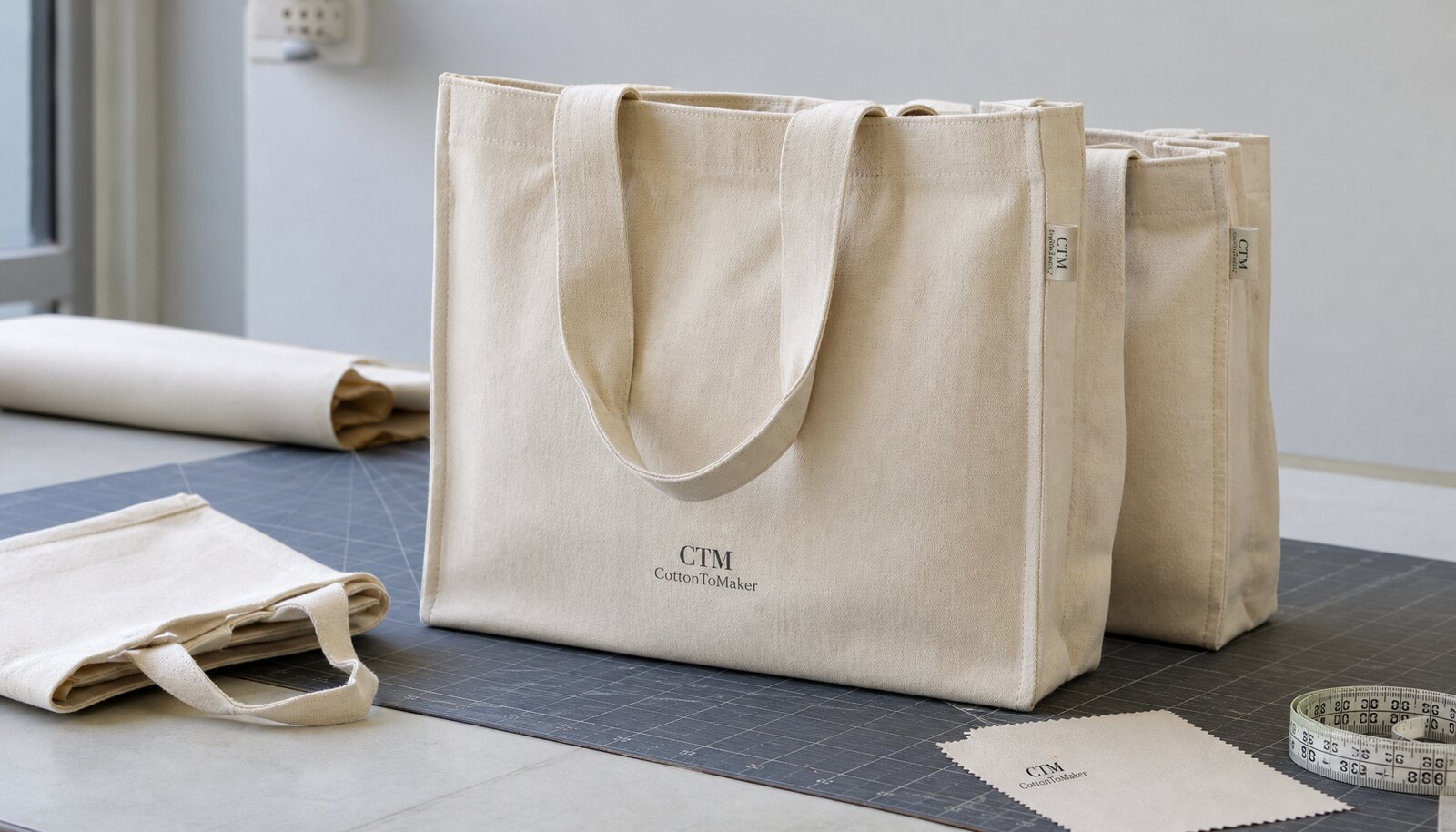
Why museum buyers need a tighter brief than a standard tote RFQ
Museum shops do not buy canvas bags the way a trade-show buyer does. A visitor may use the bag once to carry a catalog home, but the retail team needs it to function as a branded product, a shelf item, and a repeat-use carry bag. That means the bag has to look deliberate, not just durable. The weave, handle length, print edge, and folded presentation all affect how the product reads in a gift shop next to books, stationery, and higher-margin merchandise.
A loose request such as "cotton tote, printed logo, good quality" invites comparison problems. One supplier may quote a light cloth with simple sewing, another may include heavier canvas, stronger handles, and more controlled packing. Those are not equivalent offers. For museum retail procurement, the first job is not to collect prices. It is to define the same bag in enough detail that every quotation reflects the same production job.
- Museum bags need retail shelf appeal, not only carrying capacity.
- A quote without size, fabric weight, print method, and packing detail is not comparable.
- The cheapest bid often wins by leaving out setup, carton, or compliance costs.
Start with the bag architecture: size, gusset, handle, and use case
For most museum retail programs, a practical starting point is 10 oz / about 340 GSM canvas in a natural or bleached finish. That gives enough body for books, postcards, small framed items, and bundled purchases without pushing the price into premium-bag territory. If the bag is expected to carry hardbacks, exhibition catalogs, or mixed merchandise, 12 oz / about 400 GSM is safer because it resists sagging and seam stretch better over repeated use.
Size decisions should follow the shop basket, not a generic tote standard. A flat bag can look neat on the shelf, but a museum shop usually sells objects with awkward dimensions: posters, catalog bundles, boxed gifts, and event merchandise. A gusset in the 8-12 cm range often makes the bag more usable without turning it into a bulky promo tote. Handles should be long enough for shoulder carry if you want the bag to function beyond the purchase moment. For many museum programs, a 58-65 cm handle drop is more versatile than short hand-carry loops.
- Use finished dimensions, not only cut size, in the RFQ.
- Specify gusset depth if the bag will carry boxed or irregular merchandise.
- Ask for handle reinforcement at the first quotation stage, not after sample review.
Fabric weight, finish, and shrinkage are cost drivers, not cosmetic details
Canvas sourcing is often oversimplified as an oz or GSM decision, but the finish matters just as much. A bag that starts at the right weight can still arrive too soft, too rough, or too small if the cloth is not controlled through finishing and sewing. Buyers should ask whether the fabric is pre-shrunk, whether the quoted GSM is finished weight, and how much dimensional change the factory expects after sewing and pressing. That is especially important if the museum wants the bag to stack neatly or fit a display fixture.
Natural, bleached, and dyed canvas behave differently in production. Natural cloth is usually the most straightforward, but it can vary more in shade and flecking. Bleached fabric gives a cleaner retail look, yet may show dirt or print register issues more easily. Dyed fabric can support a stronger visual identity, but it introduces more variables around shade consistency and wash or rub performance. If the bag will be sold as a premium retail item rather than a giveaway, it is worth asking for the fabric source, finishing process, and any agreed shrinkage allowance in writing.
- Ask whether the GSM is measured on finished fabric, not raw cloth.
- Lock shrinkage allowance and measurement method before sample approval.
- Treat natural, bleached, and dyed fabric as different commercial options, not just color choices.
Printing choices should follow artwork complexity and reorder intent
Screen print is usually the strongest default for printed canvas shopping bags for museums when the artwork is a logo, exhibition mark, or one to three flat colors. It gives good opacity, predictable repeatability, and a finish that usually holds up better than a rushed transfer job. On rough canvas, however, even screen print needs a realistic approval process. Small text, thin lines, and tightly spaced type can fill in or break apart if the artwork is too detailed for the fabric texture.
Transfer and digital methods can be useful for low-volume runs or graphics that need more color variation, but they should be selected because they solve a production problem, not because they sound modern. If the bag is likely to reorder, the buyer should ask how color consistency will be controlled, whether the ink or transfer layer will crack under flexing, and what happens when the same artwork is rerun on a new fabric batch. For museum buyers, the question is really about shelf consistency across seasons. A technically impressive sample is not enough if the second production batch looks different.
- Match the print method to the artwork, the fabric texture, and the likely reorder pattern.
- Ask for the actual print area and seam clearance in millimeters.
- Request a durability check on the approved fabric, not only a paper proof.
Quote comparison only works when setup, tooling, and sampling are visible
A useful factory quote should read like a production sheet. If it only gives a unit price and a lead time, the buyer still does not know what is included. For a museum tote program, the quote needs to separate fabric, sewing, print, sample fee, screen setup, carton packing, and any export carton or labeling charge. That structure makes it possible to compare suppliers on the same basis and spot when a low price is really just a stripped-down specification.
This is where many procurement teams lose time. One supplier quotes a low unit price but charges extra for artwork conversion, another includes the setup but uses a smaller carton count, and a third gives a single number without saying whether the inner packing is included. Those differences change the landed cost and the operational burden. If you are buying for a museum shop, you also need to know how the order will be replenished later. A quote that looks inexpensive on day one can be hard to repeat if the supplier never documented the exact spec, tooling ownership, or packing pattern.
- Ask for sample fee and tooling fee separately.
- Confirm whether screens or plates are reusable on reorder.
- Compare carton count, carton size, and gross weight alongside unit price.
Compliance and testing should be market-specific, not generic
Museum retail buyers should not ask for random certificates. They should ask for the documents their destination market actually needs. For some programs, that may be a basic material declaration and color-fastness or rub-test data. For others, especially where imported retail goods are reviewed by compliance teams, the factory may need to provide test reports for the fabric, ink, or packaging components. If the bag is intended for a licensed exhibit or a branded retail line, artwork approval may also need to be documented separately.
It is also worth separating product compliance from children’s product rules. A standard museum shopping bag is usually a general retail item, but if the design is being sold to children or positioned as a youth accessory, the compliance path can change. The buyer should ask the factory which tests they can support, which ones require a third-party lab, and how long that documentation takes. That prevents last-minute delays when the bag is otherwise ready to ship. Compliance is not a premium feature here; it is a schedule control issue.
- Ask for market-specific documentation instead of a generic certificate bundle.
- Separate general retail bags from any product that could trigger children's-product rules.
- Confirm who pays for outside testing and how long the reports remain valid for reorders.
Sampling is the best place to catch shrinkage, print drift, and bad assumptions
A sample should be treated as a production control point, not a souvenir. The goal is to prove that the bag can be built consistently at scale. That means measuring the finished dimensions after pressing, checking the print position against the artwork file, and looking at the handle stitching under real load rather than just by eye. If the museum shop will carry books or heavier merchandise, fill the sample with a realistic weight before approval so the buyer can see whether the body sags or the handles cut into the fabric.
The sample approval package should define what is acceptable and what is not. A logo shift of 1 to 2 mm may be fine on some artwork and unacceptable on others. A slightly softer cloth may be acceptable if the bag is meant to feel natural and relaxed, but not if the product is supposed to stand upright on a retail shelf. Keep one signed gold sample with the approved fabric, print, handle build, and folding method. That sample becomes the reference if the factory changes a detail later or if a reorder is questioned.
- Approve the sample with a load test, not only a visual check.
- Measure after pressing because canvas can move during sewing and finishing.
- Keep one signed reference sample tied to the exact quote version.
Packing, carton loading, and freight are part of the product economics
Packing decisions affect both damage risk and landed cost. Flat bulk packing in export cartons is usually the most efficient route for canvas shopping bags if the print is sturdy enough to handle normal rubbing. If the print surface is delicate or the bag is a white retail item that scuffs easily, then individual polybags or interleaving may be justified. But that decision should be made deliberately, because each extra layer of protection adds labor, materials, and carton volume.
Museum buyers should ask for carton dimensions, bag count per carton, and gross weight early in the process, not after the quote is accepted. Storage is a real constraint in back-of-house retail areas, and oversized cartons can create a hidden handling problem even when the unit price looks right. Freight also changes quickly when carton volume grows. A quote that saves a few cents per bag but adds bulky packing may cost more once export shipping and warehouse handling are included. This is why landed cost matters more than ex-factory price.
- Request bag count, carton dimensions, and gross weight in every quote.
- Use polybags only when the bag needs scuff protection or higher retail presentation control.
- Check carton labels and barcode format against the museum SKU system before production.
How to choose between direct factory sourcing and an intermediary
Direct factory sourcing usually gives the best control when the bag is a recurring museum retail item. It makes it easier to lock the spec, repeat the color, and correct sewing or packing details on the next order. That matters if the bag is part of the museum's permanent retail range rather than a one-off event item. A factory can also be more transparent about the actual cloth, handle construction, and packing line if the buyer asks for a proper technical brief.
A trader or sourcing partner can still make sense when the museum is buying a broader mix of products, needs help coordinating artwork across several SKUs, or lacks internal bandwidth to manage sampling and shipment follow-up. The tradeoff is visibility. Intermediaries can be useful, but only if they supply the same production detail you would request from a factory directly. If they cannot name the fabric source, the inspection method, or the packing spec, then the lower-touch buying route is really just a less transparent one. For a repeat retail program, transparency usually beats convenience.
- Go direct when repeatability and spec control matter most.
- Use an intermediary only if it adds real coordination value.
- Never compare suppliers unless they are quoting the same production sheet.
Reorder discipline: the part that keeps the next shipment from drifting
The first order is not the finish line. For museum buyers, the real value is whether the supplier can repeat the same bag six months later without silent changes. That means the purchase record should keep the artwork file, approved sample photo, fabric weight, handle length, print method, packing spec, and inspection notes together. If that information is scattered across emails, the reorder becomes a fresh sourcing project even when it should be a simple repeat order.
A good reorder process starts with a written comparison against the gold sample. The buyer should ask what, if anything, has changed in raw material source, ink batch, sewing line, or carton packing since the last production run. If the answer is that nothing changed, the factory should still be able to show how they verified it. That level of discipline is especially useful for museum shops that sell seasonal lines or exhibition-specific graphics, because the bag must match the previous retail standard while the artwork changes. Consistency is the commercial asset, not just the bag itself.
- Store the approved sample data with the PO, not only in an email thread.
- Ask for a change log on every reorder.
- Use the same inspection standard for every production batch, even if the artwork changes.
Specification comparison for buyers
| Spec decision | Recommended starting point | When it fits | Quote field to ask for | Buyer risk to check |
|---|---|---|---|---|
| Fabric weight and weave | 10 oz / about 340 GSM plain-weave canvas; 12 oz / about 400 GSM for heavier retail loads | Standard museum-shop bags for books, gifts, and daily carry-out use | Finished GSM, weave count, and whether the weight is measured before or after finishing | A quote based on raw fabric weight can hide a thinner finished bag after dyeing or sewing shrinkage |
| Shrinkage allowance and finish | Pre-shrunk or tightly controlled finish; confirm allowed dimensional variance after pressing | Programs that need repeatable size and shelf presentation | Allowed shrinkage %, measurement method, and inspection point after pressing | Uncontrolled shrinkage can make a reorder look different even when the cut spec is unchanged |
| Print method | Screen print for 1-3 solid colors; transfer or digital only when artwork complexity justifies it | Retail logos, exhibit branding, and seasonal shop graphics | Ink type, screen count, curing method, and color tolerance | A cheap process can blur small text, crack under flexing, or look uneven on rough canvas |
| Artwork placement | Single front placement with clear seam-safe margins and a defined print window | Shelf-facing retail bags where clean presentation matters | Exact print area, seam clearance in mm, and allowed registration shift | Artwork that crosses seams or sits too close to stitching is harder to control in production |
| Handle construction | Wide handles with box-X or bar-tack reinforcement; shoulder length if the bag carries books | Museum shops with heavier merchandise or higher repeat use | Handle width, stitch pattern, stitch count, and handle drop | A weaker handle spec usually fails before the canvas body does |
| Sampling and tooling | Separate sample fee and setup fee on the quote; no bundled mystery charges | First orders, new artwork, or special fabric colors | Sample fee, screen/tooling fee, and whether tooling is reusable on reorders | A low unit price may hide a large one-time charge that changes the landed cost |
| MOQ and carton count | MOQ by artwork and size, plus cartons per 1,000 pcs and gross carton weight | Seasonal launches and replenishment planning | MOQ per SKU, carton count, carton size, and palletization if relevant | MOQ without carton math can look cheap until freight or warehouse handling is added |
| Inspection standard | Factory AQL or buyer-defined inspection with critical defects listed in writing | Higher-volume retail programs and repeat orders | Inspection level, defect classification, and photo report format | A vague 'QC by experience' promise does not define acceptable misprint, stitching, or stain limits |
| Compliance documents | Material declarations and test reports only where the destination market or artwork requires them | EU, US, or branded retail programs with formal compliance review | Requested documents, test standard, and who pays for testing | Missing documents can delay approval, customs clearance, or internal buyer sign-off |
Buyer checklist before sampling
- Define the retail use case first: shelf merch bag, member gift, exhibition product bag, or heavy book-carry bag.
- Lock the finished size, gusset depth, handle drop, and whether the bag must stand upright on the shelf.
- State the fabric spec in finished GSM and note whether the canvas is natural, bleached, dyed, or pre-shrunk.
- Confirm print method, number of ink colors, Pantone targets, and the exact artwork placement window.
- Set acceptable seam details: seam allowance, reinforcement at handle points, and thread color.
- Ask the factory to price sample fee, screen/setup fee, tooling, and any art conversion charge separately.
- Request a physical pre-production sample and keep one signed gold sample for bulk comparison.
- Specify packing count, carton dimensions, carton strength, and whether each bag needs an individual polybag.
- Ask how the lead time is counted: from deposit, artwork approval, sample sign-off, or PO release.
- Request carton marks, barcode format, and SKU labels in the same specification package as the bag artwork.
Factory quote questions to send
- What is the exact finished fabric weight, and is it measured before or after dyeing and sewing?
- Is the canvas pre-shrunk, and what dimensional change should we expect after production or pressing?
- What is included in the unit price: fabric, sewing, print, screen setup, inner packaging, and export cartons?
- What is the sample fee, and is it deductible from the bulk order if we proceed?
- What is the MOQ by artwork, by size, and by color if we change the ink or bag body?
- How many print screens, plates, or setup steps are required for this artwork?
- What is the exact handle construction, handle width, and reinforcement method at the stress point?
- What is your standard tolerance for bag dimensions, print position, and stitch variation?
- Which inspection standard do you use, and how do you classify critical, major, and minor defects?
- How many bags per carton, what is the gross carton weight, and what carton size will you ship?
Quality-control points to confirm
- Finished dimensions should fall within the agreed tolerance after pressing and before packing.
- Fabric hand feel and thickness should match the approved sample; do not accept a visibly lighter cloth.
- Print registration should stay within the agreed shift tolerance and keep small text readable.
- Ink should not crack, flake, or smear after a basic flex check on the approved canvas color.
- Handle stitching should be even, with reinforcement at the base and no skipped stitches at stress points.
- Seams should be straight, secure, and free of loose threads, open corners, or puckering.
- Gussets should fold cleanly without twisting the bag body or causing uneven stand-up behavior.
- Carton counts, carton marks, and barcode labels should match the PO and SKU list exactly.
- Polybag use should be checked against the approved packing spec so the supplier does not swap packaging to save labor.
- A signed production sample or gold sample should be retained and referenced during final inspection.