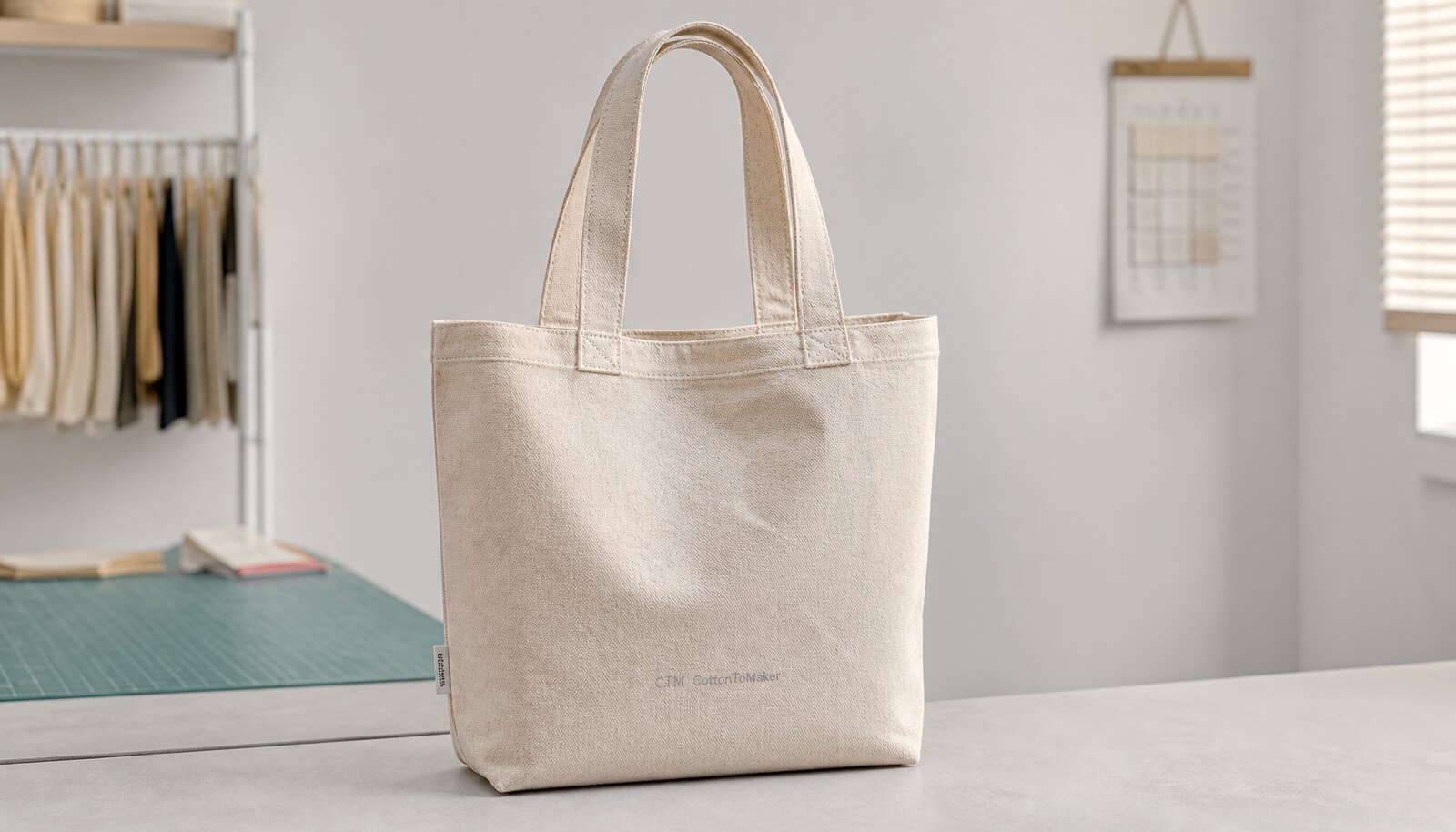
Why museum retail bags fail or sell out
Museum retail bags have to do three jobs at once: sit well in the gift shop, carry the brand or exhibition artwork clearly, and survive being used all day after the sale. If the canvas is too light, the bag looks temporary and the print can distort near seams. If it is too heavy or overbuilt, the bag may feel premium but it can push the retail price above the impulse-buy range and make sell-through harder. A good launch spec balances visual appeal, durability, and a price point that fits the store's merchandise mix.
Start with the use case, not the decoration. A counter item near the exit needs different construction from a premium souvenir that will sit in open stock for months. If the bag is part of a ticket bundle, you may care more about unit cost and quick packing. If it is meant to be a core gift-shop SKU, the finish, hand feel, and handle strength matter more. A vague brief such as printed canvas shopping bag gives the factory too much freedom to quote the cheapest cloth and the fastest process instead of the right product.
- Counter-sale souvenir: prioritize a strong first visual read and low defect rate.
- Gift-shop staple: prioritize handle strength, seam quality, and repeat order consistency.
- Premium art-led item: prioritize print accuracy, heavier canvas, and cleaner finishing.
Set the base spec before you talk about decoration
Most museum retail programs work best with two or three bag sizes rather than a wide assortment. A medium tote around 35 x 40 cm or 38 x 42 cm is a safe workhorse because it fits books, catalogues, and everyday merchandise without feeling oversized. For fabric, 10 oz canvas, roughly 340 gsm, is the low end if you want the bag to feel like a product instead of a promo giveaway. 12 oz, around 407 gsm, is often the safer launch point for museums that care about perceived quality and durability.
Handle construction should be part of the spec, not an afterthought. Self-fabric handles are acceptable on lighter bags, but webbing handles or folded-and-stitched straps hold their shape better on heavier canvas. If the bag needs to carry books, specify bar-tack reinforcement at the handle joints and make sure the factory quotes that work explicitly. If the quote only mentions fabric weight and print, the supplier is leaving out the parts that usually cause field failures.
- Common launch spec: 12 oz canvas, 38 x 42 cm body, 60-70 cm shoulder handles.
- Budget line: 10 oz canvas, minimal lining, single-color screen print.
- Premium line: 12-14 oz canvas, reinforced handles, inside clean finish, woven side label.
Choose the print method for the artwork, not the catalog
Screen printing is still the default for museum bags when the design uses one to three spot colors, especially for logos, exhibit names, and bold graphics that need opacity on natural canvas. It usually gives the cleanest edge control and the best unit economics once the quantity moves beyond sampling and into production. Digital print is useful when the artwork includes gradients, fine lines, or photographic detail, but the buyer should expect a different look on textured canvas and should confirm whether the fabric is pretreated or printed raw.
The wrong print method can make a good design look cheap. Thin lines can disappear into the weave, dark inks can crack at fold points, and small type may close up after sewing. Museum graphics often include detailed illustration, so the supplier should provide a strike-off at actual size rather than a reduced image on screen. If the design has more than a few colors or depends on tonal shading, make the quote state the exact method, the number of screens or plates, and any setup charge per color.
- Use screen print for bold logos, one-off exhibit marks, and reusable stock.
- Use digital print for complex artwork, short runs, or design testing.
- Require actual placement specs: print width, distance from the top seam, and registration tolerance.
- Keep the logo away from seam lines and handle stitches unless the supplier can prove alignment control.
Pick the supplier route that fits the launch risk
For a museum launch, the cheapest quote is often the one with the most hidden coordination risk. A direct factory with in-house sewing and printing gives the cleanest control over fabric, seams, and artwork placement, which matters when the bag is part of the retail story. A trading company can work well if you need multiple product types in one purchase order, but you should expect another layer between your brief and the production floor. That can be acceptable for procurement simplicity, but it usually reduces visibility when problems appear.
Local decorators and blank-bag printers can be fast for tests, yet they often rely on imported blanks with limited control over fabric color, handle construction, and stitch quality. That is workable for a short launch pilot, but less reliable for a long retail season. The right sourcing route depends on whether you are buying a one-time souvenir or building a replenishable SKU with exact repeatability. If your museum gift shop depends on the bag as a core item, repeatability is usually worth more than a small first-run savings.
- Direct factory: best when artwork placement and bag construction must match every reorder.
- Trading company: useful when you need assortment breadth or multi-item consolidation.
- Local decorator: useful for short testing cycles and very low initial quantity.
- Nearshore supplier: useful when launch dates are tight and freight exposure matters.
How to read MOQ and quote logic
MOQ on printed canvas bags is usually driven by three things: fabric roll efficiency, print setup, and packing labor. The bag itself may be simple to sew, but if the print requires multiple screens or a special color match, the supplier wants enough units to spread those setup costs. That is why two quotes for the same bag size can have very different minimums. If your launch is uncertain, it is often better to buy one or two core styles at a realistic quantity than to split volume across too many sizes and end up with weak inventory depth.
Read the quote line by line, not just the unit price. One supplier may quote the body, print, and packing separately while another bundles everything into a higher per-piece rate. Ask how the MOQ changes if you move from one-color to two-color print, if you add an inner seam finish, or if you want individual polybags. The useful answer is not the smallest possible minimum. It is the minimum that still gives you stable color, consistent sewing, and a production line worth setting up.
- Low MOQ works well for launch tests, but it usually raises unit cost and setup risk.
- Multi-color art often increases both minimum quantity and make-ready waste.
- Extra packaging, hang tags, and barcode stickers should be quoted separately or clearly bundled.
Sample approval should be a production rehearsal
The first sample is not there to impress anyone. It is there to expose weak instructions. Measure the finished bag after sewing, not the cut panel, because a few millimeters in seam allowance or print placement can become obvious once the bag is filled. Verify color on the actual fabric weight you plan to use. A design that looks correct on a smooth proof can appear darker, softer, or less legible on rough canvas, especially when the ink sits inside the weave rather than on top of it.
Build the sample review around use, not just appearance. Load the bag with a realistic retail set, carry it, set it down, and look at the shape after stress. If there is a lining, open the bag and inspect loose threads, stitch back-off, and how the top hem sits. For museum retail, the first impression matters, but so does how the product behaves after a customer has put books, postcards, or a water bottle inside it. A good sample should survive that basic rehearsal without changing shape or exposing weak stitching.
- Measure body size, handle drop, and print placement on the sewn sample.
- Rub the print lightly to see whether pigment sheds or marks the fingers.
- Inspect seam density and bar-tacks at the handle joints.
- Approve the sample only after a loaded carry test, not just a tabletop review.
Build packing for shelf display and e-commerce transfer
Retail bags fail in the warehouse more often than on the sales floor. If the bags are packed too tightly, the canvas takes a permanent crease; if they are packed too loosely, the carton void causes scuffing and mixed counts. For museum stores, a neat folded presentation often matters more than a fully compressed bulk pack because the product is sold in a gift environment and may sit visible behind the counter. Decide whether the bag ships folded flat, inserted with a card, or individually polybagged based on how it will actually be displayed.
The packing spec should also protect barcodes, origin labels, and any hangtag. If you are using a side woven label, make sure it sits consistently on every unit and does not interfere with the fold line. Carton labeling should show SKU, color, size, and count per carton. For launch programs, a mismatch between warehouse label logic and store planogram is a common source of opening-day friction because the receiving team cannot tell which carton contains the premium design versus the test design.
- Specify fold direction, insert card size, and whether a silica packet is required.
- Confirm whether each inner pack is the same count or mixed by size and color.
- Make sure carton marks match your receiving system, not just the supplier's template.
- If bags are gift-ready, require crease control and a clean final fold.
Lead time risk starts with artwork approval
Museum launch timelines are often tighter than they look because artwork approval, color correction, and purchase order release happen in sequence. A supplier may quote a short sewing lead time, but if the artwork is still moving or the sample rounds are not closed, the calendar slips before production starts. The safest schedule is the one that assumes at least one round of corrections after the first proof, then leaves time for final inspection and freight booking. If the launch date is fixed, schedule backward from the retail floor, not forward from the purchase order.
Build the schedule around the slowest step, not the easiest one. Print setup is usually quick once files are clean, but fabric sourcing and color matching can take longer, especially if you need a specific natural shade or dyed canvas. Ask the supplier which steps can overlap: fabric reservation, print plate preparation, and carton artwork approval. That tells you whether the factory understands real production sequencing or is just quoting optimistic calendar days. A realistic timeline is usually a sign of a better operator.
- Freeze artwork before you request final lead time.
- Allow extra time for color approval on natural and dyed canvas.
- Separate sample time from mass production time in the schedule.
- Book freight after production status is confirmed, not before.
Compare landed cost, not just ex-works price
The quote that wins on paper can lose after freight, packing, and rework. Canvas tote bags are light, but they take volume, and a bag with a thick gusset or stiff board insert can consume more carton space than expected. If one supplier bundles 12 oz canvas with individual polybags and another offers loose pack in a smaller carton, the freight difference can change the real unit cost enough to flip the decision. This is especially important for museum retail, where margin is protected by sell-through and shelf appeal, not by oversized order quantities.
Ask every supplier to quote the same assumptions so you can compare apples to apples. The request should fix bag size, fabric weight, print method, handle type, packaging format, and final carton count. If you are comparing regions, include origin country, inland move, export packing, and any test documentation the store or distributor requires. The best launch plan is not the lowest piece price. It is the combination that gives you acceptable retail price, stable quality, and a reorder path that does not force a new product development cycle.
- Compare ex-works, freight, duty, and receiving labor together.
- Standardize carton count and inner pack assumptions before comparing quotes.
- Include a reorder scenario so you know whether the price holds at the second run.
- Watch for hidden charges on artwork changes, color matching, and label application.
What evidence proves the supplier can repeat the launch
A museum bag is a repeat-order item, so the supplier needs to show more than a polished product photo. Ask for photos or a short video of the actual production line, the fabric roll or bale they plan to use, and a previous print example on similar weight canvas. You do not need marketing polish. You need proof that the factory understands the same fabric class, the same print density, and the same finishing method. If the supplier cannot show consistent seam work or clear packing discipline, that risk usually lands on your receiving team later.
Supplier evidence is only useful when it matches your spec. A photo of a tote is not proof if the handle width, print coverage, and bag weight are different from your order. Give the supplier one file that includes finished dimensions, artwork placement, packing format, and carton count, then ask them to mark up anything they cannot hold. The best vendors respond with exception notes before production starts. That is a stronger signal than a supplier who agrees to everything and sorts out the problems after goods are already in cartons.
- Request a recent sample photo of a similar bag, not just a generic catalog image.
- Ask for a short line photo or production video if the order is not from a known factory.
- Require written exceptions if the supplier cannot hold one of your dimensions or packing rules.
- Keep one approved golden sample in the file for reorder comparisons.
Specification comparison for buyers
| Spec decision | Recommended option | When it fits | Buyer risk to check |
|---|---|---|---|
| Direct factory with in-house sewing and printing | Best for repeatable museum SKUs with one approved spec | When artwork placement, seam quality, and reorder consistency matter more than the lowest first quote | Verify the factory is not outsourcing printing or changing fabric between sample and bulk |
| Trading company bundling multiple factories | Useful when you need tote bags plus related retail packaging in one PO | When procurement values one contact and consolidated logistics | Check which factory actually makes the bags and whether each run can be repeated |
| Local decorator using imported blanks | Good for short launch tests or emergency replenishment | When speed matters and you can accept limited control over body fabric and stitching | Confirm blank stock source, fabric weight, and whether the bag will match reorders |
| Nearshore factory | Good compromise for mid-size launches with tighter transit windows | When freight time or duty exposure is more important than the absolute lowest piece price | Check whether the supplier can hold the same canvas shade and pack format across runs |
| Low-MOQ digital printer | Best for artwork pilots, seasonal designs, or complex graphics | When the museum wants to test sell-through before committing to volume | Ask for proof of print durability on the exact fabric weight and weave |
| Screen-print specialist | Best for bold logos and one to three spot colors | When the design must look sharp on natural canvas and stay cost-effective at scale | Make sure extra colors, screens, and color matching are itemized |
| Full-package vendor with labels and retail packing | Best for shelf-ready gift-shop inventory | When cartons, hangtags, barcodes, and fold standards are already set | Confirm who owns barcode generation and whether pack labor is included |
| Broker quoting multiple mills | Useful only for price discovery or hard-to-source materials | When you need market comparison before locking a factory | Watch for hidden markups and ask for the manufacturing site on every line |
Buyer checklist before sampling
- Final bag size in cm and inches, with an agreed tolerance
- Target fabric weight in oz and GSM, plus whether the figure is raw or finished fabric
- Print method, number of colors, and exact artwork placement
- Handle construction, reinforcement points, and strap length
- Packing format, carton count, inner pack count, and barcode rules
- Launch date, sample due date, and mass-production due date
- Approved sample reference, color standard, and acceptable deviations
- Reorder assumption for the second run so the supplier can hold the same spec
Factory quote questions to send
- Which fabric weight do you quote, and is it raw or finished GSM?
- Is printing screen, digital, heat transfer, or mixed, and what setup costs apply?
- What is your MOQ by color, print count, and packaging option?
- What is included in the unit price: body, print, sewing, labels, polybag, carton?
- Can you show a similar bag sample or recent line photo from the same process?
- What are the approval steps, and how many sample rounds are included in the quote?
- What carton count and pack method did you assume for this quotation?
- What lead time applies after final artwork and deposit, not after the initial inquiry?
Quality-control points to confirm
- Finished body size stays within the agreed tolerance and the bag hangs square
- Canvas weight matches the approved spec and no thin spots show through the weave
- Print placement matches the artwork sheet and stays clear of seam lines
- Ink coverage is even, with no pinholes, set-off, cracking, or weak edges
- Handle length is even on both sides and reinforcement stitches are secure
- Top hem, side seams, and gusset stitching are consistent with no puckering
- Loose threads are trimmed and there are no oil marks, stains, or broken stitches
- Fold, inner pack count, and carton count match the packing instruction
- Carton marks, SKU labels, and barcode stickers match the purchase order