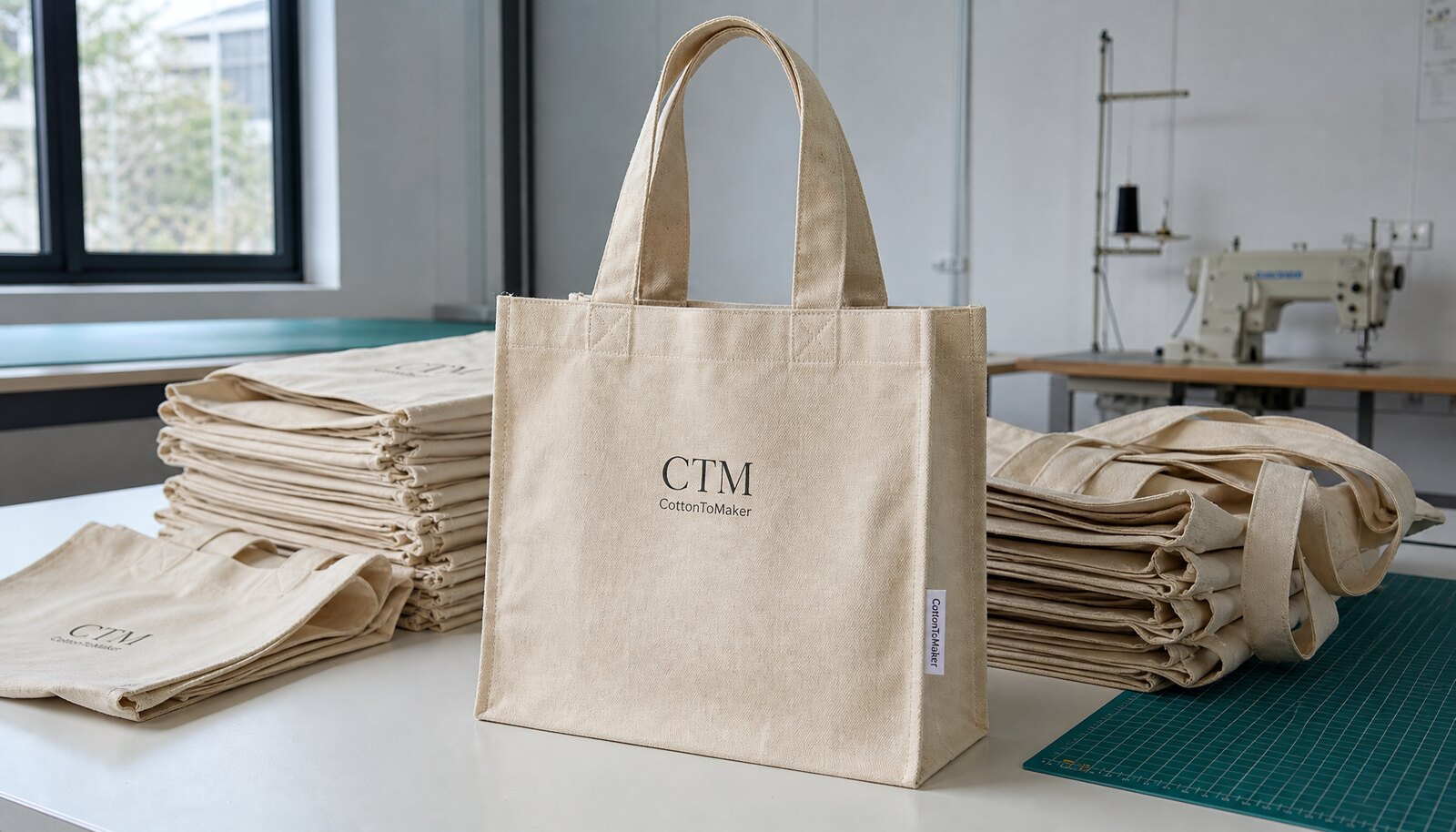
Why hotel buyers need to plan cartons before approving print
For printed canvas shopping bags for hotels, the carton plan is not a packaging afterthought. It affects freight chargeable weight, receiving labor, damage rate, and whether your bags arrive usable for immediate property distribution. Hotels often move bags through a chain of departments: procurement, brand, warehouse, property receiving, and guest-facing retail. A carton that looks efficient at the factory can still create problems if the pack count is awkward, the carton is too tall for pallet stacking, or the printed surface rubs during transit.
The right way to buy these bags is to treat print, structure, and carton loading as one decision. A logo that looks clean on a flat pre-production sample may behave differently after folding, polybagging, and compressing into export cartons. When you issue the RFQ, the supplier should quote not only the bag but the full packing state: how many pieces per inner pack, how many inner packs per carton, what the gross weight is, and whether the outer carton is built for sea freight or mixed courier movement.
- Carton planning changes landed cost, not just warehouse convenience.
- Print durability can drop if the bag is folded too tightly or packed against rough carton surfaces.
- A hotel program often needs repeatable packaging more than the lowest unit FOB.
- Ask for a packing drawing before sample approval if multiple properties will receive the order.
Choose the canvas spec based on how the bag will be used in property
Most hotel shopping bags do well in the 10 oz to 12 oz range, roughly 280-360 GSM depending on weave and finish. If the bag is mainly for boutique retail, room amenities, or light guest carry, 10 oz can work and keeps the bag soft and affordable. If it is meant for retail merchandise, welcome gifts, or repeated use outside the property, 12 oz gives better body, cleaner print appearance, and less collapse at the bottom seam.
For buyers, the key question is not only the fabric weight but also the handling behavior. A loosely woven canvas may show more texture and ink absorption, which can slightly mute fine artwork. A tighter weave improves print clarity but can increase material cost. If the hotel brand wants a premium look, ask the supplier for the same artwork on two fabric weights and compare print edge sharpness, body, and fold recovery.
- 10 oz / 280-300 GSM: lower cost, softer hand feel, suitable for light hotel retail use.
- 12 oz / 340-360 GSM: better structure, stronger appearance, safer for heavier shopping use.
- Natural cotton color shows print well but may vary in shade between fabric lots.
- If the bag needs a bottom gusset, confirm the gusset dimension before artwork layout.
Print method choice changes quote structure and carton risk
For hotel logos and simple branding, screen printing is usually the most practical option. It works well for one to three spot colors, has good opacity on natural canvas, and supports repeat orders with consistent results. It is also easier to inspect against an approved sample because the factory can control registration and ink deposit in a repeatable way. If your artwork includes gradients, tiny serif text, or photographic detail, screen print may be the wrong starting point unless you simplify the design.
Heat transfer and digital methods can make sense for short runs, multicolor art, or seasonal hotel campaigns, but buyers should watch the tradeoff. Transfer films can crack or scuff if they are folded tightly or packed against rough carton walls. Digital output can be visually strong, but color matching across multiple reorder batches may be less stable unless the supplier controls the same fabric base and print environment. For export cartons, the risk is not only print quality at factory release; it is surface abrasion during packing, palletizing, and transit.
- Screen print is usually the best cost-to-durability option for hotel logos.
- Complex artwork should be simplified before quoting, not after sample failure.
- Ask whether the supplier prints before or after sewing; that affects placement tolerance.
- If the bag folds over the print area, require an anti-scuff packing method.
How to read MOQ logic without overpaying for the wrong setup
MOQ for printed canvas shopping bags is often driven by more than finished bag quantity. A supplier may quote a low piece minimum but attach separate minimums for fabric color, print color count, woven label, carton print, and inner pack configuration. For hotel buyers, that means a bag order that seems acceptable on paper can still become expensive if the project requires custom natural-dyed fabric, special side labels, or a branded shipping carton.
The cleanest way to compare quotes is to split them into setup-heavy and variable-cost items. Setup-heavy items include screen preparation, artwork adjustment, label plates, carton artwork, and any special sewing template. Variable items include fabric, labor, print ink, polybags, and carton material. Once you see which part of the price is setup and which is scalable, you can judge whether the MOQ is fair or inflated. This matters most when the hotel is testing a pilot property or a limited retail collection.
- Low MOQ may hide high setup fees on artwork, screens, or labels.
- Ask for price breaks at 500, 1,000, 3,000, and 5,000 pieces if a reorder is likely.
- Separate the cost of bag production from the cost of export carton packing.
- For repeat hotel programs, a higher MOQ can still be cheaper if the print setup is stable.
Use a supplier comparison that reflects real sourcing routes
Hotel buyers often compare three routes: direct factory, trading company, and local converter or decorator. Direct factory sourcing usually gives the best control over stitching, printing, and packing, especially when the order includes custom carton marks or multi-property distribution. Trading companies can be useful when you need broader sourcing support or mixed products, but the buyer should verify who actually owns the printing and carton packing process. A local converter may be faster for sample changes, yet unit cost can be higher and fabric sourcing less transparent.
The right route depends on how much control you need over print consistency and carton accuracy. If the hotel chain requires the same bag across multiple regions, direct factory sourcing with a documented pack method usually reduces variability. If the launch is small and the lead time is tight, a local route can help with speed, but the buyer should treat carton dimensions, count, and artwork files as locked items once the sample is approved.
- Direct factory: strongest control, best for repeat programs and structured packing.
- Trading company: useful for bundled sourcing, but verify the actual factory and process owner.
- Local converter: faster revisions, but higher risk of cost drift and limited material options.
- For hotels with multiple delivery points, carton labeling discipline matters as much as price.
Supplier route comparison for hotel shopping bag programs
A supplier comparison should help procurement teams decide where risk sits, not just who is cheapest. For printed canvas shopping bags for hotels shipping carton planning, the important differences are artwork control, packing reliability, lead time discipline, and the supplier’s ability to reproduce the same carton count every time. Use the table below as a quoting filter, not a marketing comparison.
The best route is usually the one that can prove the process. Ask for sample photos of bag folding, carton loading, carton close-up, and shipping mark placement. If a supplier cannot show how they pack, they usually cannot control it consistently on an export order.
- Compare suppliers on process proof, not only on price.
- Request carton photos from actual shipments or line packing records.
- Use the same packing spec across all quotes so the landed-cost comparison is fair.
Sample approval should cover more than print color
A hotel bag sample needs to prove size, structure, print, and packing logic. Buyers sometimes approve a pretty sample and later discover that the production version is folded differently, packed tighter, or missing reinforcement stitching. That creates a mismatch between what the brand approved and what the warehouse receives. The sample should therefore be treated as a production reference, not a display piece.
A strong sample review covers the bag after one fold cycle, after handling, and after placement in a small carton mock-up. Check whether the logo stays centered, whether the canvas wrinkles in a way that breaks the design, and whether the handles lie flat without twisting. If the bag is meant to be opened and repacked by hotel staff, the carton sample should reflect that exact pack count and pack orientation.
- Approve actual print size and exact placement on the sewn bag, not on a flat art sheet.
- Test one bag from the sample by loading typical hotel-use items.
- Open and re-close the carton to judge whether the pack method slows receiving.
- Retain a sealed reference sample for production comparison.
Packing rules that reduce scuffing, moisture, and receiving errors
Canvas bags are easy to damage when they are packed too aggressively. The fold line can crease the print, and rough carton edges can mark the surface if the bag is not protected. For hotel orders, a simple inner polybag is often enough if the supply chain is dry and the bag is not coated. If the route is humid, mixed with other goods, or exposed to long ocean transit, add moisture protection and define the carton lining clearly. Do not rely on the factory to choose pack style casually; define it in the PO.
Carton count should be selected to match the bag size and the handling environment. Overfilling a carton to save freight can deform seams and make receiving staff fight the pack. Underfilling wastes freight and raises carton count. For many hotel programs, a balanced master carton that keeps gross weight manageable and dimensions pallet-friendly is better than squeezing the last few bags into the box. The right carton is the one that preserves print and makes warehouse handling predictable.
- Use one approved fold method across the whole order.
- Keep carton gross weight practical for hand lifting at receiving.
- Avoid mixed SKUs inside the same master carton unless the buyer explicitly needs kitting.
- Specify whether outer cartons need shipping marks, barcode labels, or property codes.
Lead time, production stages, and where delays usually start
A realistic lead time for printed canvas shopping bags for hotels is usually driven by artwork approval, fabric reservation, print setup, sewing capacity, and carton material lead time. If the design is simple and the supplier has the fabric in stock, sample lead time may be short. But once you add special labels, custom carton print, or a new fabric weight, the project timeline expands. Buyers should plan around the slowest process, not the sewing line alone.
The common failure point is approval lag. A supplier may reserve fabric and prepare screens, but if the buyer changes logo placement or carton labeling after sample review, the clock resets. For hotel projects with opening dates or seasonal occupancy targets, the RFQ should state the expected approval window. That allows the factory to sequence fabric, print, and packing materials in a realistic order.
- Sample development usually takes longer than buyers expect when carton print is custom.
- Screen setup and carton artwork approval often sit on the critical path.
- Reserve time for a second sample if the first sample is only for size review.
- Build a buffer for peak season factory congestion before the hotel opening date.
Build the quote so landed cost is visible, not hidden
A useful quote for hotel procurement should separate the bag cost from each packaging and export component. If the supplier gives only a single unit price, it becomes difficult to compare against alternate sourcing routes. Ask for a breakdown that shows fabric, sewing, print, trims, inner bag or tissue, master carton, carton print, and export handling. If duty or inland freight varies by destination, keep those outside the ex-factory quote but note them in the comparison sheet.
For printed canvas shopping bags for hotels shipping carton planning, the best commercial decision is often not the lowest bag price. A slightly higher factory quote can still win if it delivers tighter carton counts, lower damage, less labor at receiving, and fewer replacement shipments. Procurement teams should compare total landed cost per usable bag, not only FOB per piece. That is the metric that matters when the bags are distributed to hotel properties or sold in a retail channel.
- Compare quote lines using the same carton count and same print method.
- Include replacement risk for print scuffing and crushed corners.
- Track per-usable-bag cost, not just per-piece factory price.
- If multiple properties receive stock, include relabeling and split shipment labor.
Specification comparison for buyers
| Spec decision | Recommended option | When it fits | Buyer risk to check |
|---|---|---|---|
| Fabric weight | 12 oz / 340-360 GSM canvas | Most hotel shopping bags that need structure, decent print hold, and repeat use | Too light will wrinkle and telegraph print; too heavy raises FOB and carton weight |
| Print method | Screen print for 1-3 spot colors; heat transfer or digital only for short runs or complex art | Simple hotel logos, room-service retail, gift shop, or amenity bag programs | Fine lines can fill in on rough canvas; confirm under base color and line thickness |
| Bag construction | Reinforced stress points, bar-tack on handles, folded top edge | Bags carrying retail items, brochures, or in-room purchases | Single-stitch handle attachment can fail in transit or after a few guest uses |
| Handle length | 26-30 cm hand carry or 60-65 cm shoulder carry depending on use | Hotel boutiques, welcome bags, and shopping bags with mixed carry behavior | Short handles may look neat but are awkward with heavier contents |
| Closure style | Open top for retail use; zipper only if item retention matters | General shopping, gift retail, or amenity packaging | Adding a zipper changes cost, carton thickness, and sample approval criteria |
| Pack method | Flat pack with inner polybag and master carton compression control | Export orders where carton efficiency and moisture protection matter | Over-compressed packing can crease print and distort shoulder straps |
| Supplier route | Direct factory with print and packing in-house | Brands and distributors with repeat volume and custom packaging needs | Outsourced print or packing can cause color mismatch and inconsistent carton counts |
| MOQ logic | Base MOQ by fabric color and print setup, not only by bag quantity | When custom logo, custom label, or special carton print is required | Low bag MOQ may hide high setup costs and expensive replenishment |
| Carton planning | Standardize to a pallet-friendly master carton with count by size and weight limit | Hotel programs shipping to multiple properties or distribution points | Mixed SKUs per carton increase pick errors and raise receiving time |
Buyer checklist before sampling
- Confirm final bag size, canvas GSM, handle length, print areas, and whether the bag must carry retail product, brochures, or guest welcome items.
- Define the print method in the RFQ and include artwork count, Pantone target, and whether both sides must be printed.
- Set carton rules early: inner pack count, master carton limit, pallet pattern, moisture protection, and whether outer cartons need shipping marks.
- Request a pre-production sample with actual print, stitching, label, and carton pack method before mass production release.
- Ask for a quotation that separates fabric, printing, trims, labor, packaging, carton, and inland export handling so landed cost can be compared correctly.
- Approve a QC threshold for size tolerance, stitch quality, print registration, and carton count accuracy before booking production.
Factory quote questions to send
- What fabric weight are you quoting, and is the GSM measured before or after finishing?
- Which print method will you use for this artwork, and what is the setup charge per color or per placement?
- What is the MOQ by fabric color, print color count, and carton specification?
- Can you provide a packing plan showing inner pack quantity, master carton dimension, net weight, and gross weight?
- What is the sample lead time for a pre-production sample with real print and final packing?
- Which stitching details are included: handle bar-tacks, side seam reinforcement, and top hem turnback?
- Are cartons labeled by SKU, hotel property, or shipping mark, and is outer carton print included in the quote?
- What inspection method do you apply before shipment, and what defect level triggers rework or replacement?
Quality-control points to confirm
- Fabric GSM tolerance should stay within an agreed range, typically within 5-8% of the approved spec for a commercial canvas bag program.
- Printing must match approved artwork placement and Pantone target; a small shade shift may be acceptable for natural canvas, but heavy washout or bleeding is not.
- Handle attachments must be reinforced with bar-tacks or equivalent stitching; loose threads and skipped stitches should be trimmed and rejected if structural.
- Bag size tolerance should be controlled on width, height, and gusset so carton loading remains stable across the full order.
- Carton count must match packing list exactly; one carton short can create receiving delays and property-level shortages.
- Master cartons should survive normal export handling with clean corners, no bursting seams, and no visible moisture damage or print scuffing.