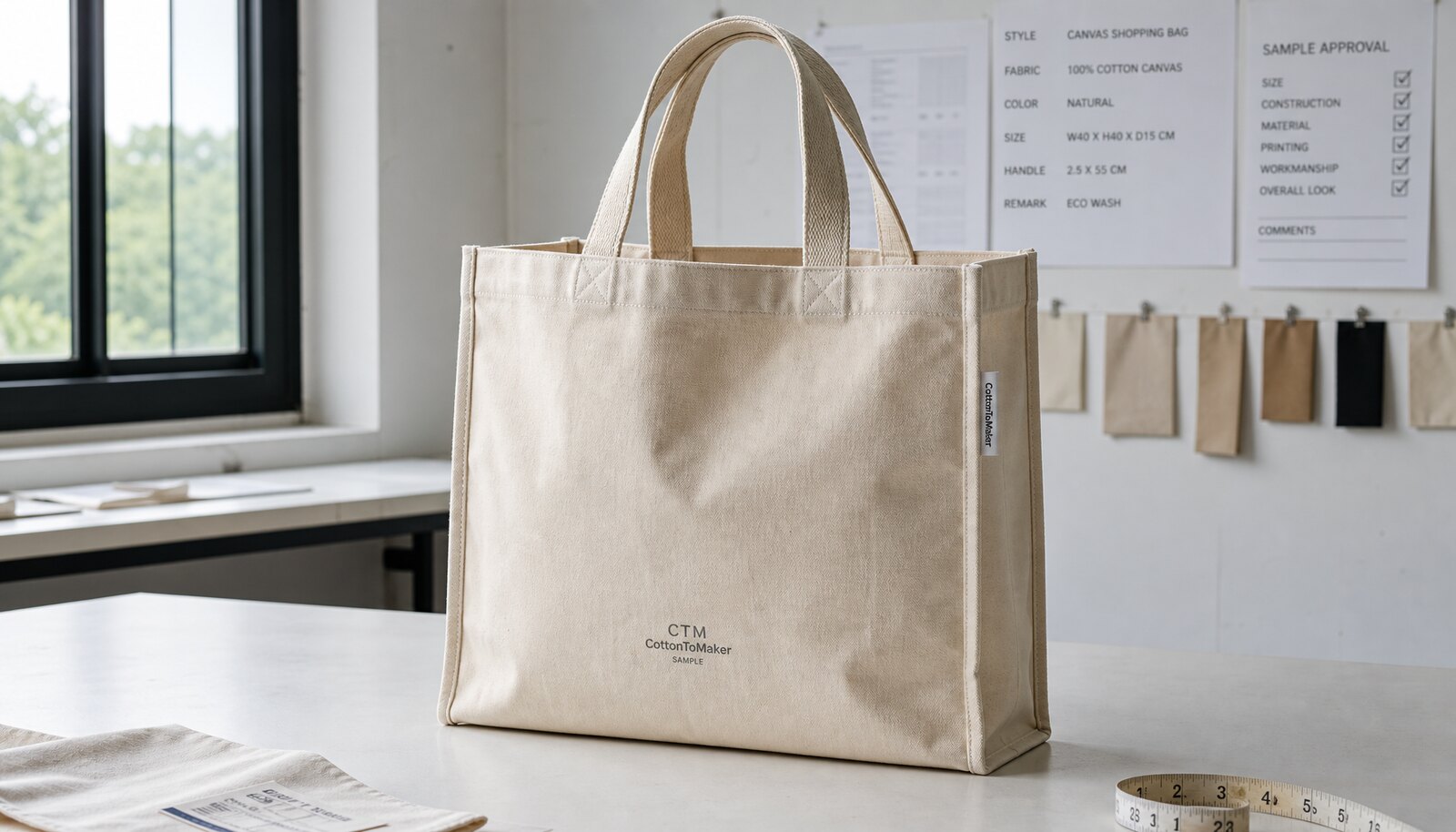
What the hotel buyer is actually approving
Printed canvas shopping bags for hotels are not one product. The same tote can be sold at the front desk, handed out as a conference giveaway, or used as a guest amenity bag for welcome kits, spa items, or local shopping. Each use case changes the approval target. A retail bag needs shelf appeal and repeatability. A guest amenity bag needs reliable packing and clean presentation. A conference giveaway needs cost control and enough strength that the bag survives the event without looking cheap after the first hour.
That is why the sample review should start with the operating context, not the artwork. A logo can be correct and still fail the hotel program if the canvas feels too thin, the handles pull out of alignment, or the fold looks sloppy when stacked behind the front desk. Procurement should treat the tote as a stock item with service expectations, not as a print proof with handles added later.
- Define the program as front-desk resale, guest amenity, conference giveaway, or gift packaging before comparing quotes.
- Match the approval standard to the use case: retail needs stricter appearance control, while giveaways can accept simpler construction if the price is right.
- Approve the bag in the condition the hotel will receive it, including fold, label, carton, and insert card if one is used.
Freeze the specification before you ask for pricing
The fastest way to get misleading quotes is to send a logo and a rough size. Different suppliers will silently assume different canvas weights, handle styles, print methods, and packing formats, then present the results as if they are like-for-like. They are not. One factory may quote an 8 oz body with simple print and bulk folding. Another may quote 10 oz canvas, reinforced handles, and retail-ready packing. The price gap looks like a bargain comparison, but it is really a spec mismatch.
The RFQ should name the finished dimensions, gusset depth, handle length and drop, artwork size, print colors, and packing format before sampling starts. If the bag is expected to feel premium, 10 oz / 340 gsm is a sensible baseline for most hotel applications. If the bag will carry heavier retail purchases or needs a more substantial hand feel, 12 oz / 400 gsm is safer. For giveaway programs, 8 oz / 280 gsm can work if the buyer accepts a lighter body and a more casual finish.
- Send vector artwork and the exact brand color reference, not a screenshot of the logo.
- Specify finished dimensions, not just cut size or a broad size range.
- State whether the fabric should be natural, bleached, pre-shrunk, washed, or steam-set before sewing.
Use case differences that change the bag design
A front-desk resale tote should look like a product, not a souvenir. The customer will compare it against other retail items in the hotel shop or nearby. That means the shape needs to stay square, the print needs to be clean at arm's length, and the pack format should allow tidy stacking. The buyer should pay more attention to color consistency, label placement, and how the bag looks after folding and refolding during merchandising.
A guest amenity bag has different priorities. It may be filled with brochures, water, spa items, or local gifts, so the opening, gusset, and inner finish matter more than retail shelf appeal. A conference giveaway usually has the tightest budget and the least time for customization, but it is exposed to immediate use and repeated handling. In that case, the buyer should push for strong handles, clear logo placement, and simple packing that the event team can distribute quickly.
- For front-desk resale, prioritize presentation, repeatability, and consistent fold quality.
- For guest amenity use, check opening width, gusset shape, and whether the bag stands or collapses the way the hotel needs.
- For conference giveaways, compare unit cost against the risk of handle failure or printing that looks washed out under event lighting.
Fabric weight and construction drive the real cost
Canvas is simple only at a distance. In practice, the fabric weight changes print behavior, hand feel, folding behavior, and perceived value. Lighter canvas reduces unit cost and freight weight, but it shows weave movement, seam twist, and ink saturation faster. Heavier canvas feels more substantial and tends to read as premium, but it also takes more room in storage and can make the artwork look softer if the weave is coarse. A good buyer does not ask which weight is best in general. The better question is which weight fits the bag's job in the hotel operation.
Construction has just as much influence on quality. The sample should show exactly how the seams are formed, where the reinforcements sit, and whether the handle attachment is designed for load or only appearance. A bag can look neat in a photo and still fail at the handle base if the reinforcement is partial or if the stitching pattern does not cover the stress point. Buyers do not need every supplier to build the bag the same way, but they do need the structure to be explicit and repeatable.
- Ask for the exact seam construction and reinforcement method at the handle base, side seams, and bottom seam.
- Verify that both handles are matched in length and aligned at the same attachment height.
- If the fabric is untreated, check whether lint, surface fuzz, or shrinkage could affect the logo after handling or pressing.
Choose the print route the artwork can support
Screen printing is still the most reliable route for most hotel tote programs because it handles flat logos, clean edges, and limited color counts efficiently. It also repeats predictably once the screens are set. The limitation is that screen print exposes weak artwork quickly. Thin lettering, tiny reverse text, tight registration, and complicated gradients often look acceptable on a screen but lose clarity once they hit woven canvas. The approval should therefore test legibility at normal viewing distance, not only at close range.
When the artwork is too detailed for clean print, the right move is often to simplify the artwork rather than force it through a fragile production method. A one-color print with a woven label, embroidery, or a stitched patch can preserve the brand better than a crowded multicolor mark. This is especially relevant for hotel brands that use formal crests, fine-line typography, or artwork that would be unreadable if reduced to tote size. The goal is brand clarity, not maximum decoration.
- Use screen print for one to three spot colors and simple shapes.
- Use a woven label, embroidery, or a patch when the logo has fine detail or the hotel wants a more tactile finish.
- Reject any sample that only reads clearly in a close-up photo but not when viewed at normal arm's length.
Treat sampling as a controlled process, not a single event
A buyer should expect more than one sample stage when the spec is not yet stable. A proto sample is useful for checking shape, proportion, handle length, and whether the artwork placement makes sense on the bag. A pre-production sample should be used for final sign-off once the supplier has locked the fabric, print method, trims, and packing. For recurring hotel programs, the best practice is to retain a sealed approval sample so later production can be checked against a fixed reference instead of memory or screenshots.
This matters because many problems appear only after the first sample has already been approved informally. A factory might change the body fabric, substitute thread color, adjust the handle webbing, or alter the fold to make packing easier. Each change sounds minor until the hotel receives a batch that no longer matches the approved version. A disciplined sample path separates design validation from production validation, which is the simplest way to prevent scope creep.
- Use the proto sample to confirm shape and artwork placement, not to approve final quality.
- Use the pre-production sample to approve the actual bulk build.
- Keep one dated physical reference sample and one photo record of the approved version.
Write tolerances into the approval record
Quote comparison gets difficult when each supplier uses a different idea of acceptable variation. The approval sheet should state the tolerance band before the PO is released, so there is no argument later about what counts as acceptable. For a standard hotel tote, a working target is +/-5 mm on length, width, and gusset, with +/-5 mm on handle drop, if the supplier can hold that consistently. Larger formats may justify a wider band, but the range should be written down, not implied.
Color deserves the same treatment. Canvas has texture, so the printed logo will never look identical to a flat proof or a digital mockup. The buyer should approve under normal indoor light against the selected physical reference sample and document what level of variation is acceptable between bags and between batches. If the hotel is placing the tote alongside other branded goods, the issue is visual harmony as much as exact color math.
- Record dimension tolerances on the approval sheet and in the purchase order.
- Use one named physical sample as the visual benchmark for bulk inspection.
- State in writing whether a miss triggers hold, rework, or rejection.
Compare suppliers by process control, not just headline price
The cheapest quote is often the one with the least control behind it. A direct factory with in-house sewing and printing can usually give better control over the bill of materials, screen setup, sample corrections, and packing consistency. A trading company can still be useful when the order is small, urgent, or part of a broader sourcing bundle, but the buyer should know where the actual production happens and who signs off each stage. That is especially important if the hotel expects repeat orders over time.
When quotes differ, separate the true cost drivers. Fabric weight, print method, reinforcement, packaging, and freight assumptions can all change the final number. Two offers can look similar on paper while being materially different products. If one quote is much lower, ask which element was simplified or omitted. If one quote is much higher, ask which quality step or pack format is driving the increase. The point is not to chase the cheapest line. It is to understand the tradeoff before it becomes a receiving problem.
- Ask who sews the bag, who prints it, and who performs the final carton check.
- Require the supplier to confirm that bulk production will match the approved BOM.
- Treat unusually fast lead times as a risk flag until the factory explains capacity and change control clearly.
Use the hotel operation to test the bag
A useful sample test should reflect how the tote will actually be used by the hotel. For a guest amenity program, load the bag with the items it will carry and inspect how the base behaves, whether the handles stay comfortable, and whether the body collapses too easily when set down. For a resale item, place the sample next to other retail products and judge whether it feels like something a guest would pay for rather than take as a freebie. For a conference giveaway, test whether the bag survives quick packing and repeated handing without the print or seams looking tired.
This is where many samples fail in practice even if the spec looks correct. A bag that is technically within size tolerance may still be awkward to stack behind the front desk. A bag with acceptable print density may still look muddy under warm lobby lighting. A bag with adequate handle stitching may still twist uncomfortably when filled. The approval should therefore include functional observation, not just measurement. That is the part most RFQs miss, and it is the part hotel staff will notice first.
- Load the sample with a realistic carry weight for the intended use.
- Check whether the bag stacks neatly, stands as expected, or folds into the storage format the hotel uses.
- Review the bag under the same lighting conditions where guests will see it if possible.
Packing, carton marking, and receiving are part of the product
For hotel programs, packing is not a back-end detail. It affects storage space, stock rotation, receiving speed, and the condition in which the first bag reaches the guest. A sample that looks good loose on a worktable may arrive creased or over-compressed if the fold method was never approved. The buyer should therefore review folding, inner count, and carton size alongside the bag itself. If the bag is going to be sold, retail-ready packing may be worth the extra cost. If it is going to be distributed internally, flat and efficient packing may be the better choice.
Carton marks should be readable and useful. At minimum, they should identify the style, color, quantity, PO number, and carton sequence if traceability matters. If the hotel uses SKUs or barcode receiving, that should be built into the pack spec. For sea freight or humid storage, ask for cartons that protect the bag shape and print area, not just the cheapest box the factory can source. A damaged carton can turn a compliant bag into a receiving complaint.
- Approve the fold method and pack count together with the bag sample.
- Confirm carton dimensions so the bags are not crushed to fit a too-small export box.
- Use SKU or barcode labels if the bags will be sold through hotel retail or tracked in inventory.
Specification comparison for buyers
| Decision point | Options to compare | Best use case | Buyer check / cost tradeoff |
|---|---|---|---|
| Supplier model | Direct factory with in-house sewing and print; trading company; sourcing agent | Direct factory is usually best for repeat hotel programs; trading companies can help with small tests or complex coordination | Ask who actually makes the bag, who prints it, and who owns final QC. Lower quotes from intermediaries can hide markups or unclear accountability. |
| Sample stage | Proto sample; pre-production sample; sealed approval sample | Proto sample for shape and layout; pre-production sample for final sign-off; sealed sample for bulk reference | Do not approve bulk from a proto sample alone. The later sample stages cost more, but they reduce rework risk when artwork, packing, or trims are still changing. |
| Base fabric weight | 8 oz / 280 gsm; 10 oz / 340 gsm; 12 oz / 400 gsm | 8 oz for giveaways, 10 oz for most hotel programs, 12 oz for premium retail or heavier carry | Heavier canvas raises unit cost and shipping weight, but lighter fabric can show weave distortion and print show-through faster. |
| Print route | Screen print; woven label plus simple print; embroidery or patch application | Screen print for simple hotel logos; label or patch when the logo is detailed or the finish must feel more premium | More complex decoration increases setup and sampling time. It can also improve legibility when the logo is too detailed for canvas ink. |
| Packing format | Flat-fold bulk carton; individual polybag; retail-ready insert card | Flat-fold for back-of-house distribution; polybag or insert card for front-desk resale | Retail-ready packing improves shelf presentation but adds labor, materials, and carton volume. Ask what is included before comparing unit price. |
| QA control point | Visual-only check; measured dimensional check; loading and rub test | Measured checks for all programs; loading and rub testing for guest-use or retail | A cheap visual-only quote may look attractive, but it shifts risk to receiving and the hotel front line if the sample is not controlled. |
| Artwork complexity | One-color logo; two to three spot colors; detailed multi-element artwork | One-color or two-color logos for reliable production; simplified artwork for cleaner canvas print | Simplifying artwork often saves more than just print cost. It can improve consistency, readability, and sample approval speed. |
| Reorder risk | Single event order; seasonal repeat order; ongoing retail SKU | Ongoing retail or amenity programs need the tightest spec and the most durable sample control | If the bag will be reordered, spend more time on sealed sample approval and BOM control. That reduces drift across later batches. |
Buyer checklist before sampling
- Start with the use case: front-desk resale, guest amenity, conference giveaway, or in-room gift packaging. Each one has a different tolerance for weight, finish, and packing.
- Lock the finished size, gusset depth, handle length, handle drop, and print area before requesting samples.
- Send vector artwork and the exact color reference, then state what should happen if the factory cannot hit the original color exactly.
- Choose the fabric weight in gsm or oz and state whether the canvas should be natural, bleached, pre-shrunk, washed, or steam-set.
- Ask for the proto sample first if the design is still moving, but do not release bulk until a pre-production sample matches the approved spec.
- Approve the full bag, not only the printed panel. Measure the finished sample, check the fold, and review the carton format before sign-off.
- Write the acceptance tolerance into the approval record, including dimensions, handle drop, and logo placement.
- Use a buyer-defined rub test only as an acceptance check, and state the method and acceptable result in writing rather than assuming the supplier's internal test is enough.
- Load the bag with a realistic weight for the intended use and inspect seams, handle stretch, and body distortion.
- Confirm pack count, carton marks, SKU labels, and whether the bulk shipment will match the approved sample in body fabric, thread color, label, and folding method.
Factory quote questions to send
- Which company actually makes the bag body, and where is the sewing, printing, and packing done?
- Which sample stage are you quoting: proto sample, pre-production sample, or sealed approval sample?
- What exact fabric weight will be used, and how do you control roll-to-roll variation before cutting?
- Will the fabric be pre-shrunk, washed, or steam-set, and how will you confirm size stability after production?
- What print method will be used for the bulk order, and is it the same method used for the approved sample?
- What is included in the quoted unit price: body, print, label, packing, inserts, cartons, and freight assumptions?
- What dimensional tolerances do you commit to for length, width, gusset, and handle drop, and where are they written?
- What reinforcement do you use at the handle base and side seams, and is it structural or decorative only?
- How do you control logo placement and color consistency across the first run and any repeat orders?
- What is the lead time after sample approval, and what events would change it, such as fabric sourcing, artwork revision, or peak-season capacity?
Quality-control points to confirm
- Use buyer-defined acceptance tolerances, not vague 'commercial tolerance' language. For a standard tote, +/-5 mm on length, width, and gusset is a reasonable working target if the supplier can hold it consistently; larger formats may need a wider band if agreed in writing.
- Handle drop should be measured on the finished bag, left to right, and should not visibly tilt or vary enough to affect carrying balance.
- Stitching should be even and continuous, with no skipped stitches, broken threads, exposed raw edges, or uneven reinforcement at the handle attachment points.
- Reinforcement at stress points should be functional. Bar-tacks, boxed stitching, or equivalent reinforcement should fully cover the load-bearing area; decorative stitching alone is not enough.
- Print placement should match the approved sample and stay centered enough that the logo does not appear to drift toward the seam or base fold.
- Because canvas is textured, color match should be judged under normal indoor light against the approved reference sample, not against a single phone photo.
- Use a simple buyer rub check as an acceptance screen, but treat it as a house test rather than a universal standard. Agree the method in advance, record the result, and escalate to lab testing if the application needs formal colorfastness proof.
- If the bag is intended for repeated guest use or retail sale, load it with a realistic weight and check handle stretch, seam opening, and panel distortion before approval.
- Folded bags should pack cleanly without crushing the print, twisting the handles, or creating count errors at packing.
- Cartons should be legible on at least two sides and should match the agreed style, color, quantity, and PO reference.