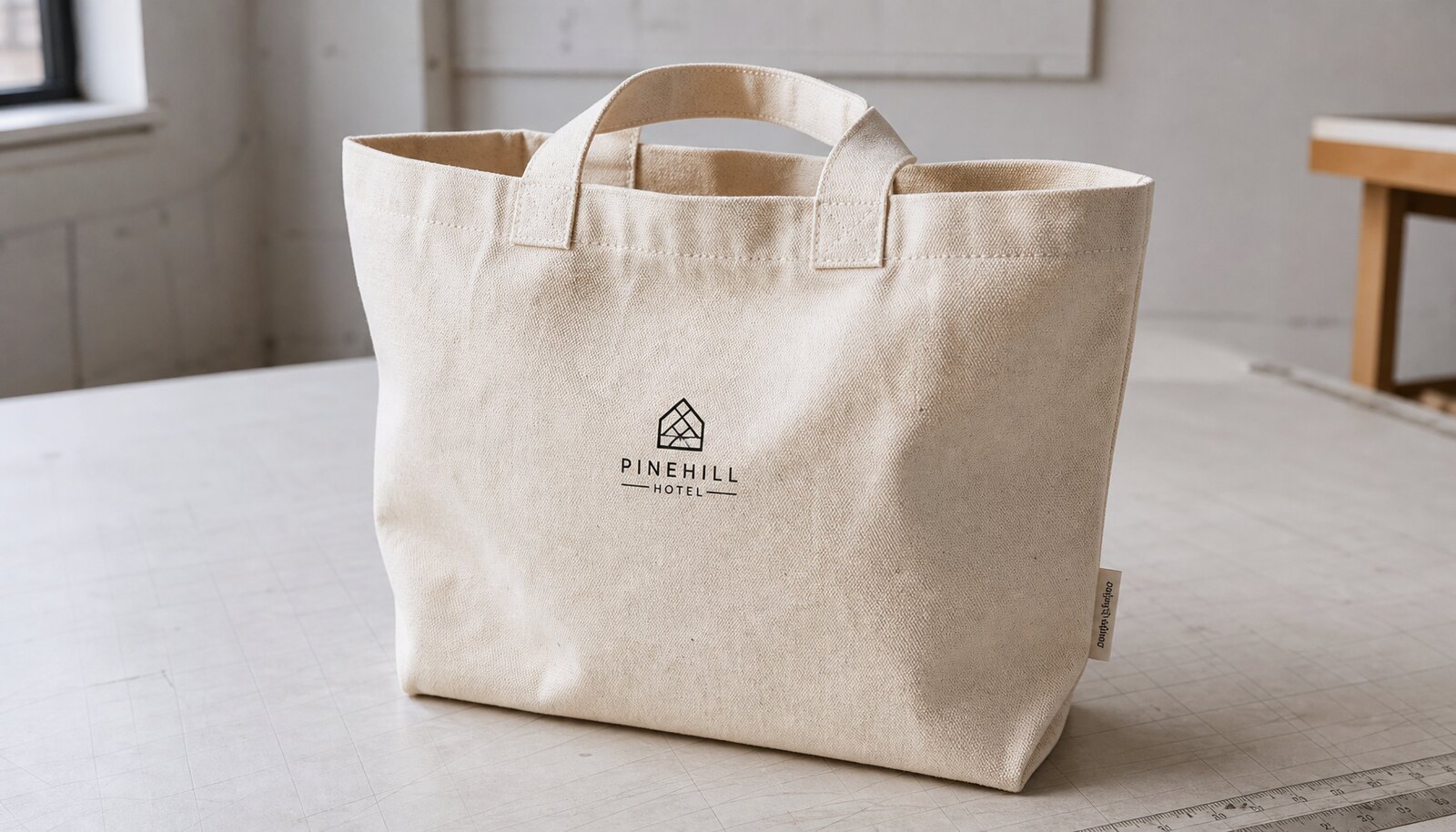
Start With the Buying Problem, Not the Logo
For hotel programs, the real question is rarely whether a canvas bag can be printed. The practical problem is whether the bag can be bought at a usable MOQ, produced on time, and repeated without re-approving every small detail. A welcome bag for a conference, a retail tote in the gift shop, and a premium guest amenity bag all look similar at first glance, but they do not behave the same in sourcing. The best RFQ starts with the end use, because that determines the right fabric weight, print method, packing style, and acceptable lead time.
Buyers often over-focus on the artwork file and under-specify the structure. That creates quote noise. One supplier may price a 10 oz bag with a loose weave and a simple screen print, while another quotes a denser 12 oz body, stronger handles, and better packing. Both answers can be technically correct and commercially useless if the buyer does not define the job. For hotel sourcing, the correct comparison is not just unit price; it is the cost of getting the same guest-facing result across the first shipment and the reorder.
- Define the bag use case first: retail, amenity, conference, or gift-with-purchase.
- Separate the first order from the reorder plan, because MOQ and lead time usually change after the first run.
- Treat artwork as one input, not the entire spec.
Set the Bag Spec Before You Price It
Canvas shopping bags for hotels usually land in the 10 to 16 oz range, or roughly 340 to 540 GSM depending on how the mill and supplier report weight. For a standard hotel retail tote, 10 to 12 oz is often the best balance of hand feel, print clarity, and freight cost. Move to 14 to 16 oz when the bag must stand upright, carry heavier merchandise, or project a more premium look. If the fabric is too light, the bag collapses and the print can look weak. If it is too heavy, the unit cost rises and the sewing line slows down.
The rest of the construction matters as much as the fabric. A plain open-top bag with self-fabric handles is easier to quote than a lined tote with a base board, webbing handles, and an inner pocket. For hotel buyers, the point is to keep the spec honest. A tote that looks simple on a mood board may turn into a different sewing operation once you add gussets, long shoulder handles, reinforced top hems, or a branded side label. Each change affects MOQ and lead time because it touches cutting, sewing, and sometimes printing sequence.
- Choose the fabric weight first, then match the construction to the intended load.
- Lock the finished size, gusset depth, and handle drop before you compare quotes.
- If the bag will be used in a gift shop, avoid overbuilding the structure unless the product needs shelf presence.
Print Method Is the Main MOQ Lever
For printed canvas shopping bags, screen print is still the most practical method for many hotel buyers. It handles simple logos well, produces solid coverage, and usually keeps setup cost more manageable than complex full-color work. If the artwork is one logo, one location, and one or two spot colors, screen print often gives the best balance of durability and pricing. It also suits repeat orders, because the factory can hold the screens and reproduce the same placement with less risk once the process is stable.
Digital print makes sense when the artwork is detailed, color-heavy, or being tested in a small run. It can lower the barrier to entry for a first order, but the buyer should not assume that smaller MOQ automatically means better value. The tradeoff is usually higher unit cost, more sensitivity to fabric finish, and more variance in rub resistance. For hotels, that matters because bags are handled, folded, and carried in public spaces. If the print will be touched often, the ink system and curing process deserve as much attention as the artwork proof.
- Use screen print for solid logos and repeatable hotel retail programs.
- Use digital print only when the artwork complexity justifies the tradeoff.
- Define the print position and maximum color count before requesting MOQ.
Read MOQ the Right Way Across Supplier Routes
MOQ is not a single number. A factory may quote one minimum for the bag body, another for the print color, and a third for the reorder. A trading company may simplify the answer but hide where the real limit sits. A local printer using imported blanks may offer a lower starting point, yet the blank itself can cap your size options and make it harder to standardize the hotel range later. That is why procurement teams should ask for MOQ by design, color, and material, not just by SKU.
The lowest MOQ route is not always the safest route. If you buy a stock blank and overprint it, you may win on speed but lose on hand feel or size precision. If you buy direct from a factory, you may need a cleaner spec and a longer approval cycle, but you usually gain better control over repeatability. For hotel buyers, repeatability matters because the second order often goes to a different property, a different season, or a different duty-free channel. A bag that is close but not identical can create a merchandising problem even when the price looks right.
- Separate MOQ for first order and reorder.
- Ask whether the MOQ changes when the logo changes color count.
- Treat stock blanks as a speed option, not a universal solution.
How to Compare Supplier Options Without Getting Misled
The comparison table below is the simplest way to separate sourcing routes. Direct factories usually win on control and repeatability when the spec is clear. Trading companies can help if you are combining several hotel items in one shipment or need a broader fallback plan. Local decorators are useful when timing is tight, but they often depend on whatever blank inventory they already have. The commercial task is to match the supplier route to the actual buying problem instead of picking the lowest headline quote.
When you review bids, do not compare a factory custom quote against a local print price without adjusting for spec differences. A quote that includes denser canvas, tighter seams, better carton packing, and a reliable sample approval process may be the better number even if the unit price is higher. For hotel buyers, the hidden cost of a weak quote is usually not the unit price itself. It is the rework, the replacement stock, or the repeat order that cannot match the first run.
- Compare like for like: same size, same fabric weight, same print method, same packing.
- Use a route-based comparison, not just a unit-price comparison.
- If the supplier cannot explain the MOQ logic, the quote is incomplete.
Build a Quote That Exposes Hidden Cost
A usable quote for printed canvas shopping bags should break out the main cost drivers clearly. Those drivers are fabric weight, cut size, number of print colors, handle construction, extra finishing, packaging, and any special label or insert work. If the supplier only gives one number, you have no way to judge which change caused the price to move. That is how procurement teams lose time during negotiation. The better approach is to request the same quote at multiple volume points so you can see whether the cost curve is real or just a placeholder.
For hotel programs, quote structure matters because the product often goes through more than one channel. The gift shop may want retail-ready individual packing, while the conference team may want bulk packs for easy distribution. A quote should make those differences visible. If the factory can hold the same spec but switch from retail folding to bulk carton packing, that is useful. If the packaging changes the carton count or the freight class, the landed cost changes even when the unit price does not.
- Request pricing at 3,000, 5,000, and 10,000 pcs for the same spec.
- Make setup fees visible, including screens, plates, labels, and special packing.
- Ask for carton size and packed weight so freight can be compared accurately.
Sample Approval Is Where Most Mistakes Show Up
The sample is not a marketing object. It is the control point for size, print placement, stitching, and packing. For printed canvas shopping bags for hotels, a pre-production sample should reflect the final fabric weight, the final handle length, the final print method, and the final carton pack. If the sample uses a lighter blank or a different thread color, the bulk order will drift even if the artwork is approved. That drift is often subtle, which makes it expensive to catch after production has started.
A strong approval process sets tolerance rather than vague approval language. For example, the buyer can allow a small size variance, define the exact location of the logo, and require the print color to match the approved sample under daylight. The sample should also be handled like the real bag: folded, packed, and shipped in the same way as bulk. Many issues show up only after compression in cartons, where a weak print surface can scuff or a handle fold can crease the logo area.
- Approve the pre-production sample against the final spec, not against a mood board.
- Inspect print position, seam strength, thread trimming, and fold marks.
- Hold the supplier to the same sample standard on every reorder.
Packing Choices Affect Presentation and Damage
Packing is not an afterthought for hotel buyers, especially when the bag is sold in a gift shop or handed to guests as part of a premium program. A simple bulk pack may be fine for back-of-house distribution, but retail-facing bags often need individual folding, a polybag, or a clean carton layout that prevents scuffing on the printed face. The bag should arrive ready to place on shelf, not require a second pass of repacking by hotel staff or the distributor.
The packing spec also changes freight economics. Too much individual wrapping can increase carton volume and add labor cost. Too little protection can result in corner crush, print rub, or dirt marks during transit. The right balance depends on the route, the season, and the sales channel. If the bags are moving through multiple hands before they reach the guest, the carton and inner pack need enough protection to survive that chain without adding unnecessary material cost.
- Define whether the bag is retail-ready, amenity-ready, or bulk-distribution-ready.
- Set the carton pack and outer carton dimensions before booking freight.
- Protect printed surfaces from rub marks if the product will be folded tightly.
Lead Time Planning Should Be Broken Into Real Steps
Lead time is usually where hotel projects lose their calendar. A supplier may quote a single number, but that number often hides separate steps: artwork approval, sample making, fabric booking, printing, sewing, packing, and outbound handoff. If the buyer needs the bags for a property opening, a seasonal launch, or a conference date, the schedule must be split into milestones. Otherwise the team discovers too late that the artwork was approved on time but the fabric was not booked, or the sample was ready but the carton spec changed and delayed packing.
For standard printed canvas bags, a straightforward run may be fast enough once the sample is approved and the material is in hand. More complex specs take longer because the sewing line has to change over, the print setup may need extra alignment, and the packing team may need additional inspection time. The biggest schedule risk is not always the sewing time itself. It is the gap between approval and actual production start. Buyers should ask for a calendar that shows what happens before bulk sewing, not just the final completion date.
- Ask for a lead time split: sample, material booking, production, packing, dispatch.
- Treat peak season and fabric sourcing delays as part of the schedule, not exceptions.
- Do not release the PO until the approval path and ship date logic are clear.
Use Landed Cost, Not Ex-Works, to Make the Decision
For imported hotel bags, the lowest ex-works price can still produce the highest landed cost. The reasons are usually simple: heavier fabric, larger cartons, extra packing, or a supplier route that saves labor but increases freight volume. If the buyer only compares factory quotes without looking at carton count, packed weight, and route timing, the final cost to the hotel can move in the wrong direction. A cheap quote that creates a bad packing pattern is not a savings; it is a deferred cost.
The right buying decision is usually the one that balances MOQ, lead time, and repeatability. A direct factory quote may be better for a permanent hotel retail line. A stock blank route may be better for a time-sensitive conference run. A trading company may work when the buying team needs one source for multiple items. The point is to choose the route that fits the commercial need, then press the supplier to prove the spec with a sample and a clear quote structure.
- Compare ex-works price, packing cost, carton volume, and freight together.
- Factor in re-order stability, not just first-order speed.
- Use a pilot order when the program is new and repeatability matters.
Specification comparison for buyers
| Spec decision | Recommended option | When it fits | Buyer risk to check |
|---|---|---|---|
| Direct factory sourcing | Best for repeat hotel programs, custom size, and tighter control over fabric and stitching | You want a stable spec and can manage a clear RFQ and approval flow | Communication gaps can hide small spec changes unless you lock the sample and tolerance sheet |
| Trading company sourcing | Useful when you need mixed products, backup capacity, or one point of contact | You are buying bags with other hotel collateral or shipping to several markets | Markup can blur the real factory cost and limit visibility into the actual production line |
| Stock blank bag plus local overprint | Good for urgent launches or low MOQ orders with a simple logo | Your size and color can stay within a standard blank inventory | Blank fabric weight, handle length, and seam quality are often fixed and may not match the brand standard |
| Fully custom cut-and-sew with print | Best for premium hotel retail or a long-running branded program | You need a unique silhouette, lining, or reinforced base | MOQ and lead time are usually higher because fabric cutting, sewing, and print all need coordination |
| Screen print | Preferred for one to three spot colors and solid logos | The artwork is simple and the bag will be used repeatedly by guests | Fine text, halftones, and strict color matching need a tighter proof and print tolerance |
| Digital print | Best for small runs with complex artwork or multiple colors | You want to test demand before scaling up a hotel retail SKU | Ink hand feel, rub resistance, and wash durability can vary by ink system and fabric finish |
| 10 to 12 oz canvas | A practical middle ground for hotel gift shops and amenity retail | You need a bag that feels substantial without driving freight weight too high | If the weave is loose or the finishing is weak, the bag can still look cheap despite the weight |
| 14 to 16 oz canvas | Better for premium retail, heavier merchandise, or a more structured look | The bag needs a thicker hand and better standing shape on shelf | Higher fabric cost and slower sewing can push MOQ and lead time up more than expected |
Buyer checklist before sampling
- Lock the bag size, gusset depth, handle length, and seam allowance before requesting prices.
- State the fabric weight in oz or GSM and confirm whether the quoted weight is finished canvas or raw fabric.
- Specify print method, artwork colors, print position, and acceptable color tolerance against the approved sample.
- Ask for MOQ by design, by color, and by reorder, not just a single headline number.
- Confirm whether sample charges, screen fees, plates, labels, and carton marks are included in the quote.
- Require a pre-production sample or photo approval before bulk sewing starts.
- Define the packing method, carton pack, and outer carton dimensions so freight can be compared fairly.
- Get the full lead time split into sampling, material booking, production, packing, and handoff to shipper.
- Ask for inspection standard, rejection process, and who pays for rework if the bulk does not match the approved sample.
- Compare at least two sourcing routes so the lowest ex-works number does not hide the highest landed cost.
Factory quote questions to send
- What is the MOQ for this bag by size, color, and print method?
- Is the quoted canvas weight measured in raw fabric state or after finishing?
- How many print colors are included before setup fees increase?
- What artwork file format do you need for an accurate quote and proof?
- Can you quote the same spec at 3,000, 5,000, and 10,000 pcs so I can see the price curve?
- What is the sample lead time and is the sample charge refundable against bulk?
- What exact packing method is included, and how many pieces per carton?
- What is the production lead time after artwork and sample approval?
- Which tolerances do you hold for size, handle length, print position, and stitch quality?
- What re-order lead time can you support if we repeat the same spec next season?
Quality-control points to confirm
- Fabric weight matches the approved spec and the body panel does not feel thinner than the sealed sample.
- Bag width, height, and gusset stay within the agreed tolerance and the tote stands square enough for retail display.
- Print position is centered or placed to spec, with no smudge, pinholes, ghosting, or visible misregistration.
- Ink coverage is even and the color sits close to the approved sample under daylight and store lighting.
- Handle attachment uses a reinforced stitch pattern and the bag carries the intended load without seam creep.
- Seams are straight, thread ends are trimmed, and there are no skipped stitches at stress points.
- No oil stain, dirty mark, broken yarn, or fabric hole appears on the front panel or visible edge.
- Carton count, SKU label, and packing list match, and the cartons arrive dry with no compression damage.
- The folded size and packing method protect the print surface from scuffing during transport.
- The sample passes the buyer's load test and any pull test agreed in the PO or spec sheet.