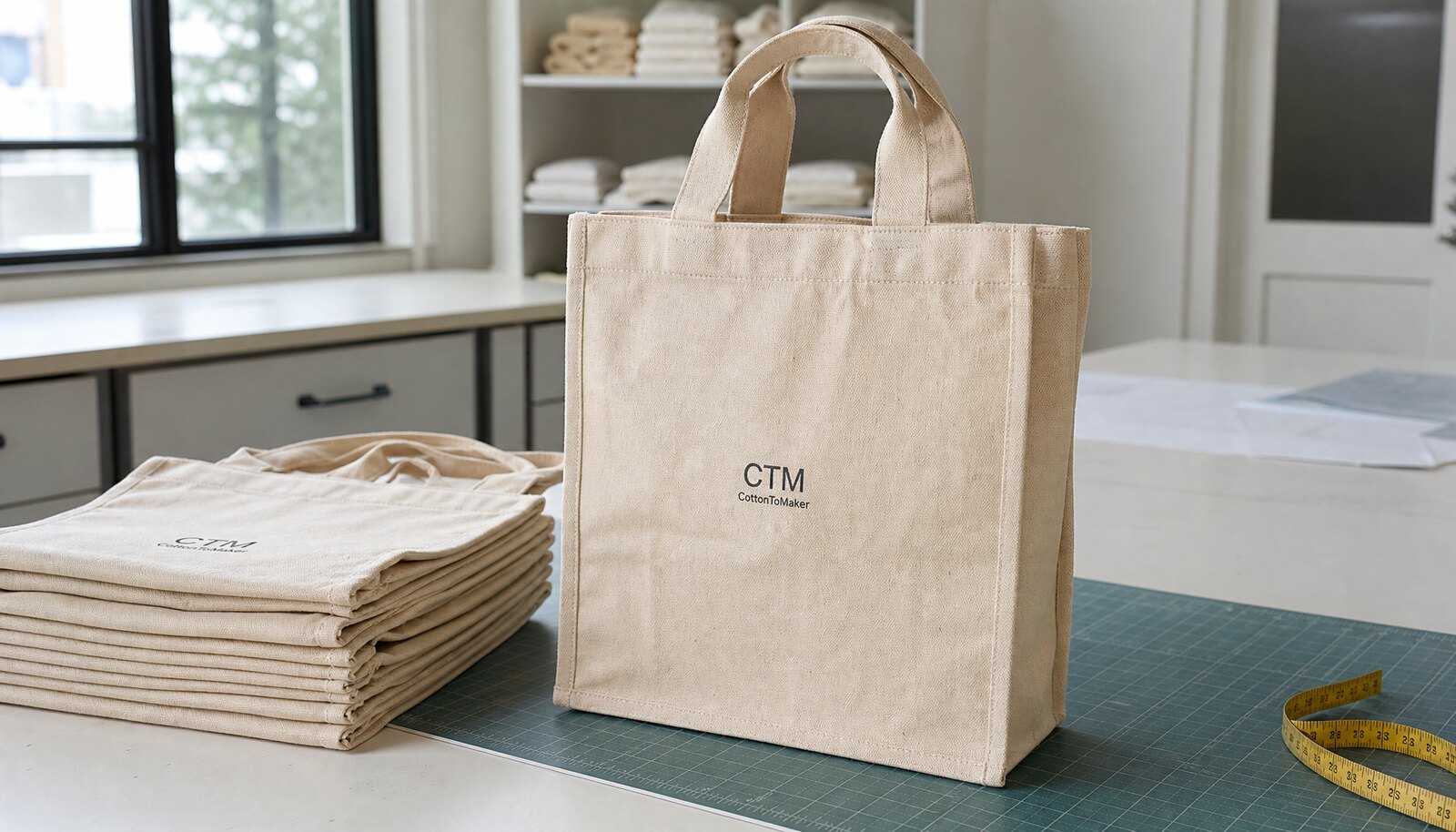
1. Start With The Bag's Job
Gift shop tote sourcing starts with the job, not the logo. A bag that carries boxed ornaments needs a different bottom shape, handle load, and carton plan than a low-cost checkout carrier or a souvenir item sold from a hook. Define the heaviest common purchase, the way the bag will be displayed, and whether it must survive daily carry after sale.
The reorder memo should freeze what stays constant across runs: body size, gusset, handle drop, fabric finish, print area, and pack count. Rotate the artwork only after the base construction is stable enough to repeat without retraining the factory or reworking the packing line.
If the program spans more than one store, plan for the worst receiving condition, not the best design mockup. A tote that looks premium on a table can still fail if the gusset is too shallow for boxed merchandise or if the carton is too heavy for a stockroom to move by hand.
- Define the heaviest item the bag must carry, not just the average basket.
- Decide whether the bag is checkout packaging, gift wrap, or retail resale.
- Set the shelf role up front: souvenir, practical carrier, or premium add-on.
2. Lock The Base Spec Before Artwork
Fabric weight is the first cost and feel decision. For most gift shop programs, 12oz-14oz finished canvas, or about 340-475 GSM, is the useful planning band. Below 12oz only makes sense for light merchandise or low-price promo use. At 14oz and above, the bag starts to feel more premium and carries heavier souvenirs with less collapse on the shelf.
Quote the finished weight, not just the nominal fabric number. Greige weight, washed weight, and finished weight are not interchangeable, and reorder drift usually shows up when those definitions change between sample and bulk. Ask the supplier to state the measurement basis and the tolerance they will hold in production.
Pre-shrunk or controlled-wash fabric matters whenever the bag must fit a display cube, a counter organizer, or a defined carton count. If shrinkage is not controlled, the same tote can come back slightly shorter or narrower on the next run even when the print and sewing look identical.
- Use finished weight as the spec, not a casual oz reference from the sample room.
- Ask for the shrinkage test method and the result after the agreed finish.
- Measure the approved sample after finishing so the factory is comparing like with like.
3. Pick Print For Reorders, Not For Novelty
Screen print is still the best default for most reorder programs. It handles one to three solid colors cleanly, keeps setup understandable, and makes it easier to match the next run to the last one. That matters for destination names, seasonal phrases, simple line art, and logos that need to look the same every time they are reprinted.
Transfers or embroidery can work, but they should solve a specific retail problem. Use them only when the artwork truly needs fine detail, texture, or a premium look that the store can price for. If the bag is a low-margin handout, more complex decoration often creates cost and consistency problems without improving sell-through.
The quote should spell out print count, ink type, cure method, placement, and the allowed registration tolerance. For small front logos, even a few millimeters can change how the bag looks at retail. For larger artwork blocks, write the tolerance down anyway instead of leaving it to the factory's normal practice.
- Default to screen print for repeatable 1-3 color artwork.
- Move to a more complex method only when the retail price supports it.
- Send vector art, not screenshots, and approve one physical proof before bulk.
4. Compare Supplier Routes Before You Compare Price
Compare the route, not just the unit price. A direct factory that cuts, sews, prints, and packs in-house is usually easier to control on reorder runs than a quote that depends on multiple handoffs. The more steps the factory owns, the easier it is to keep sample, bulk, and repeat production aligned.
If any step is outsourced, ask for the subcontractor name, the handoff point, and the QC check before the next stage begins. Reorders go wrong when the sample was made on one line and the bulk run moves to another line with a different stitch setting, screen, or packing team.
The real question is change control. If the supplier cannot tell you where the fabric is cut, where the print is applied, and where the bags are packed, you do not yet have a production plan. You have a quote sheet.
- Prefer in-house production for repeatability and faster issue resolution.
- Require a process map if any step is outsourced.
- Treat unlisted handoffs as a risk until the supplier documents them.
5. Plan MOQ Around Variants, Not Around Hope
MOQ is a matrix, not one number. It changes with body color, artwork, handle style, and pack format. A quote that looks acceptable on the surface can still force too much stock if each seasonal design has its own minimum and its own setup charge.
Keep the base bag stable and vary only the print where possible. For example, one tote body can carry spring, summer, and holiday art while the handle, carton spec, and inner pack count stay the same. That gives the buyer one reusable base spec and lowers the chance of slow-moving inventory.
Use reorder scenarios, not annual averages. If the shop sells slowly between holidays, a low-looking MOQ may still be too high if the factory needs separate screens, separate labels, and separate carton builds for each design. Ask for price breaks at 500, 1,000, and 3,000 units so setup cost is visible instead of buried in the first quote.
- Ask for MOQ by body color, print colorway, handle style, and packing format.
- Standardize the base construction across seasonal programs.
- Build the forecast by season so dead stock does not hide inside a yearly total.
6. Approve Samples As A Production Tool
A sample is only useful if it answers the questions that matter in bulk. Measure body width, height, gusset depth, handle drop, opening width, and folded pack size. A tote can look right on the table and still fail on the hook if the opening is too narrow or the bottom does not sit flat when empty.
Test the bag with a realistic load. If the tote is meant to carry books, mugs, or boxed gifts, use those items or an equivalent weight during approval. Separate cosmetic variance from functional failure: a loose thread may be acceptable if the bag still passes the carry test, but handle creep, seam opening, or print drift are not cosmetic on a premium gift item.
Keep one signed golden sample and one signed spec sheet per SKU. If the supplier wants to change material, packing, or process route later, that change should trigger fresh approval rather than a quiet substitution. That is the easiest way to keep reorders aligned.
- Measure and photograph the approved sample before it leaves the review stage.
- Test the tote with a real load, not just with air inside it.
- Tie the approval to one named sample and one named spec sheet.
7. Write QC Thresholds Into The PO
Acceptance rules belong in the order, not in a follow-up email. For finished canvas, a practical starting point is to hold fabric weight within +/-5% of spec, critical dimensions within about +/-1 cm / 0.5 in, and print placement within the mm tolerance written on the proof. If the bag has to fit a particular shelf bin or retail cube, tighten the dimensional band before booking production.
Use zero tolerance for major defects: open seams, mixed SKUs, wrong size, missing handles, unreadable logo, stains, contamination, or broken reinforcement at the carry points. For minor defects, set a capped allowance in writing instead of leaving the factory to define what is acceptable on the day of inspection.
Ask for a static hang test on the approved load profile. For a standard medium tote, 10 kg for 60 seconds without seam opening, handle slippage, or visible separation is a practical baseline. If the program is heavier or more premium, raise the target and state it in the spec so the supplier cannot argue about intent after the fact.
Color and print need physical comparison, not just photo approval. Check the bag against the signed sample under daylight, then confirm there is no smudge, bleeding, ghosting, or broken line work after the ink is fully cured. If the supplier cannot define the pass/fail line in writing, the quote is not ready.
- Set major and minor defect definitions before production starts.
- Use a physical comparison for color, placement, and finish.
- Require the factory to state how rework, replacement, or chargeback is handled.
8. Put Packing And Carton Specs In The Quote
Packing is part of the spec, not a warehouse afterthought. A useful starting point for gift shop totes is 25-50 pieces per inner pack, with master cartons labeled by SKU, design, colorway, and count. That keeps counting manageable and makes store replenishment easier when the shipment is split between locations.
Keep cartons easy to handle. Unless the order is palletized, aim to keep hand-lift cartons under about 15-18 kg gross. If the lane is humid, long, or stacked, ask for stronger corrugate and a clear stacking assumption. A carton that crushes in transit can erase any savings from a lower bag price.
Write the carton rules directly into the quote: exact carton dimensions, gross weight, inner pack count, barcode format, moisture protection, and whether the outer carton is single-wall or double-wall. If the receiving team scans inbound cartons, align the label format before goods leave the factory.
- Use single-SKU cartons whenever possible.
- Match the label format to the receiving system before shipment.
- Confirm stack limit, board grade, and whether palletization is required.
9. Normalize Quotes To Landed Cost
The cheapest ex-works price is not the best buy if the rest of the route is unstable. Compare quotes on the same basis: bag price, print setup amortized across the order, inner packs, cartons, inland freight, export handling, duty, and receiving costs. If one supplier included two-color print and another quoted one-color, reprice both before judging the unit cost.
An illustrative model looks like this: unit price plus print setup spread across the order plus packing plus cartons plus inland freight plus export handling plus duty. On paper, Supplier A may look cheaper at the factory gate and still finish higher once packing and freight are added. If the lead time slips and forces air freight, the gap can widen quickly.
Separate one-time charges from recurring charges. Screen fees, artwork setup, and carton tooling can distort a small reorder and make the first batch look more expensive than the next one. Ask for a price break table at the volumes you actually reorder so you can tell whether the supplier is discounting the tote or just hiding setup in the initial run.
- Normalize every quote to the same fabric, print, handle, pack, and freight basis.
- Treat setup charges as separate from repeat unit cost.
- Compare landed cost, not just factory price.
10. Work Backward From The Shelf Date
Reorder risk is usually a schedule problem before it becomes a factory problem. Back-plan from the shelf date or seasonal launch date, not from the PO date. Leave time for sample sign-off, bulk production, packing proof, transit, customs, and receiving, because the quote timeline often starts later than the buyer thinks.
For many canvas tote reorders, 35-55 days after final approval is a practical planning window before freight and destination handling. If the supplier promises faster, ask what inventory, screens, fabric, and packing materials are already in place. Speed only matters if the route is already frozen and the proof is already signed.
Use release gates. Do not book production until the spec sheet, golden sample, carton spec, and landed-cost basis are all signed. If any two of those are still open, the order is not ready. That pause is usually cheaper than correcting a bad run after the bags are in transit.
- Back-plan from the shelf date, not from the PO date.
- Add buffer for approval, freight, customs, and receiving.
- Pause the order if the route, spec, packing, or cost basis is still open.
Specification comparison for buyers
| Spec decision | Recommended starting point | Why it fits gift shops | What to confirm in the quote |
|---|---|---|---|
| Fabric weight | 12oz-14oz finished canvas, about 340-475 GSM | Gives enough body for retail display and everyday carry without feeling flimsy | Confirm finished weight, sample weight, and tolerance; go below 12oz only for light promo use, above 14oz for premium or heavier items |
| Fabric finish | Pre-shrunk or controlled-wash canvas for reorder programs | Helps the bag keep the same size and hand feel across repeats | Ask for the test method, shrinkage result after finish, and whether shade variation is expected between rolls |
| Print method | 1-3 color screen print for most reorder runs | Best balance of repeatability, cost control, and clean artwork for simple logos or destination graphics | State the print count, ink type, cure method, and the placement tolerance in mm; if artwork is more complex, confirm the alternate method before pricing |
| Handle construction | Self-fabric or webbing handles with reinforcement at the load points | Works for souvenir books, mugs, apparel, and everyday store carry | Confirm handle width, drop, attachment method, and whether the anchors use bartacks, box-X stitching, or both |
| Seam construction | Overlock plus topstitch or bound seams on stress points | Reduces fraying and improves durability on repeated use | Ask for seam allowance, stitch density, and which edges are reinforced; reject raw load-bearing edges on premium bags |
| Bag size | Medium retail tote around 14 x 16 x 4 in / 35 x 40 x 10 cm | Fits postcards, books, mugs, and small boxed gifts without looking oversized | Confirm opening width, gusset depth, and whether the bag stands and folds as expected when empty |
| MOQ structure | Keep the base bag stable and vary only the artwork where possible | Limits dead stock and makes seasonal reorder planning easier | Ask for MOQ by body color, print colorway, handle style, and packing format, not just by SKU |
| Supplier route | Direct factory with in-house cutting, sewing, printing, and packing | Usually gives better control over sample consistency and reorder repeatability | If any step is outsourced, ask for the subcontractor name, the handoff point, and the QC check before the next step |
| Packing format | 25-50 pcs per inner pack, master carton labeled by SKU | Fits most store replenishment and DC receiving workflows | Confirm inner pack count, carton dimensions, gross weight, barcode format, moisture protection, and whether the carton needs to be hand-liftable or palletized |
Buyer checklist before sampling
- Define the use case first: checkout carrier, gift packaging, or resale item.
- Lock the heaviest common item, bag size, gusset depth, and handle drop before requesting quotes.
- Specify finished fabric weight, finish, and shrinkage limit, not just a nominal oz or GSM figure.
- Send vector artwork and define logo size, print count, placement, and Pantone references.
- Ask for a physical pre-production sample and keep one signed golden sample on file.
- Require a quote that separates unit price, setup charges, packing, freight assumption, and duty assumption.
- Set acceptance rules for fabric weight, dimensions, stitch quality, print placement, and defect count.
- Require a written packing spec with inner pack count, carton dimensions, gross weight, and label data.
- Compare suppliers on landed cost, not only on ex-works unit price.
- Back-plan from the shelf date and include sample approval, production, freight, customs, and receiving time.
Factory quote questions to send
- What is the exact finished fabric weight, weave type, and shrinkage result you are quoting, and is the fabric greige, washed, or pre-shrunk?
- What is the print method, how many colors are included, what is the setup charge per color, and what placement tolerance in mm will you hold?
- What is the MOQ by bag size, body color, print colorway, handle material, and packing format?
- What handle width, handle drop, attachment method, and reinforcement method are included in the quote?
- What seam construction, edge finishing, and stitch density are included on load-bearing areas?
- What packing format, inner pack count, carton dimensions, gross weight, and label format are included?
- What is the lead time from artwork approval to finished goods, and which steps are excluded from that timeline?
- What inspection standard do you use, and how do you classify major versus minor defects?
- Will the sample and bulk run use the same production line and process route, or will any step change between runs?
- What freight term, currency, and surcharge assumptions are included so we can compare landed cost on the same basis?
Quality-control points to confirm
- Hold finished fabric weight within an agreed tolerance band, with +/-5% as a practical starting point for many tote programs.
- Hold critical dimensions within about +/-1 cm / 0.5 in where fit matters, especially on body width, height, gusset depth, and handle drop.
- Hold print placement within the mm tolerance written on the proof; do not rely on a sample photo alone.
- Compare color against the signed physical sample or approved Pantone reference under daylight, not only on a screen.
- Use a static hang test for the approved load profile; 10 kg for 60 seconds is a practical baseline for a standard medium tote, with a higher target for heavier retail programs.
- Reject open seams, missing handles, frayed load points, broken bartacks, loose reinforcement, and visible edge failure as major defects.
- Inspect print adhesion after full cure with a low-tack tape pull or rub test; reject flaking, peeling, ghosting, or bare-fabric exposure that affects sellability.
- Set a written minor-defect cap instead of leaving the factory to decide; if your QA team uses AQL, write the code into the PO and align it with the product value.
- Verify inner pack counts, carton count, and SKU labels before dispatch so mixed lots do not reach receiving.
- Check packed goods for moisture, staining, odor, and crease damage, especially on long transit routes or humid lanes.