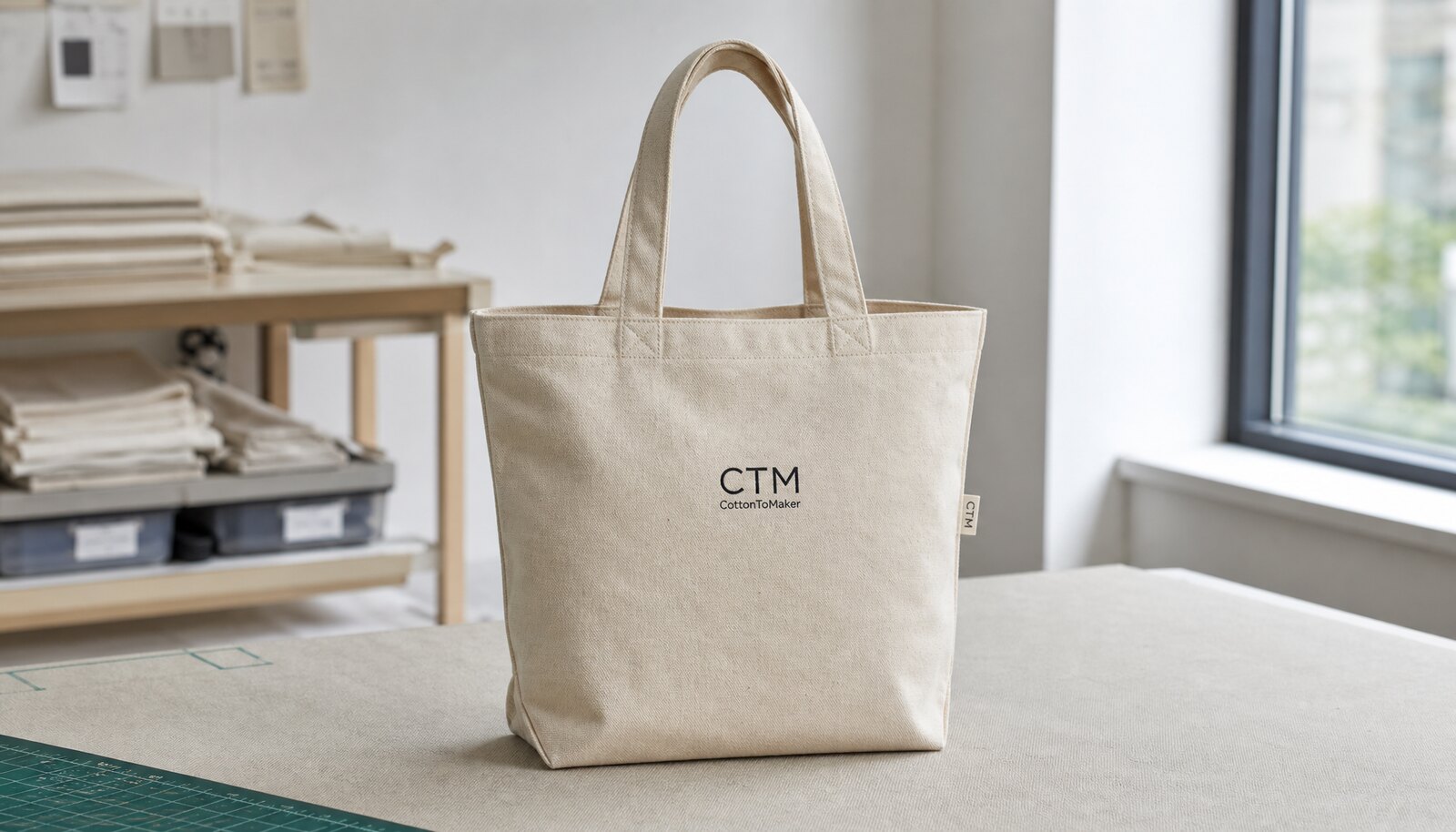
Start With The Retail Spec, Not The Artwork
For printed canvas shopping bags for gift shops, the decoration method only makes sense after the bag spec is stable. A logo can look perfect in a digital proof and still fail in retail if the canvas is too light, the handles distort the body, or the weave is too open for fine type. The first buying decision is not the artwork. It is the blank bag: size, GSM, handle length, seam construction, and how the bag will be displayed, folded, and carried in the store.
A practical starting range for this category is usually 280 to 420 GSM cotton canvas or a cotton-rich canvas. Lighter fabric lowers cost and freight, but it can feel floppy, crease badly in packing, and show print-through on the reverse side. Heavier fabric improves shelf presence and gives the print a more premium base, but it raises material, sewing, and shipping cost. For gift shops, the best point is usually in the middle: substantial enough to feel retail-ready, but not so heavy that the bag becomes bulky in cartons or awkward for replenishment.
- Use heavier canvas if the bag will carry books, souvenirs, or heavier gift items.
- Use a cleaner weave if the artwork contains small type, thin lines, or fine logo detail.
- Keep the print away from seams and fold lines unless the artwork was designed for that disruption.
Choose The Print Method By Artwork Complexity And Volume
Screen printing remains the default for most gift shop canvas bags because it is repeatable, economical, and easy to reorder when the design is stable. A one-color logo, a two-color destination mark, or a simple retail graphic usually prints cleanly and holds up well under handling. Once the supplier has screens and an approved ink formula, the process becomes predictable. That matters for gift shops, where the same design often needs to come back in a new season or for a different location.
DTF and heat transfer become more relevant when the artwork has gradients, photo detail, or multiple colors that would be expensive to separate into screens. They also help when the order is small and the buyer wants to reduce setup cost before a market test. The tradeoff is that the risk moves from screen setup to finish quality: edge lift, a stiffer hand feel, and abrasion at folds or corners. If the bag is going to be handled by shoppers and staff every day, the method must survive that abuse, not just look good in a mockup.
- Screen print fits simple logos, destination names, and bold retail art.
- Transfer methods fit short runs, fast design changes, and complex color artwork.
- If the hand feel matters, ask for a packed sample, not only a flat print swatch.
Use A Method Comparison That Shows Real Buying Breakpoints
A useful comparison does more than name the print process. It shows where the method starts to make commercial sense, what adds cost, and what can fail in production. For screen printing, each added color creates more setup and more registration risk. For transfer methods, the setup can be lighter, but the per-piece labor and finish risk become more important. For gift shop buying, the practical question is whether the design supports the setup. That is why MOQ and artwork complexity matter as much as unit price.
The best RFQ format forces every supplier to quote the same variables: blank bag price, print setup, per-color or per-pass charge, packing cost, carton cost, and any rush or special-placement fee. Without that structure, the lowest quote can hide the most expensive assumptions. Buyers should also ask where the price breaks. A quote that looks expensive at 300 pcs may become the best offer at 1,000 pcs if screen charges are diluted properly. The right decision is the one that fits the target volume and the reorder plan, not just the first shipment.
- Separate blank bag cost from decoration cost.
- Ask the supplier to show the unit price at 300, 500, 1,000, and 3,000 pcs.
- If one supplier quotes a single all-in price, ask for a line-item breakdown before comparing it to others.
Screen Print: Best For Repeat Orders And Clean Retail Branding
Screen print is usually the best choice when the gift shop needs a clean logo, a stable reorder path, and a low decoration cost at volume. It works especially well for one-color or two-color artwork with solid shapes and clear type. On canvas, the ink can sit slightly into the weave and still look crisp if the mesh, ink density, and cure are correct. That is why screen print is still the standard choice for many printed canvas shopping bags for gift shops: it balances appearance, durability, and cost better than most alternatives.
The limitations are predictable. Every extra color adds screens, alignment work, and the possibility of misregistration. Fine gradients and tiny reversed text are more likely to break up on open weave fabric. Buyers should also watch for over-inking, which can make the bag feel stiff or create cracking at the fold line. If the artwork is meant to be reused across seasons, the supplier should archive the approved file, screens, and ink formula so the next run matches the first one.
- Best for simple logos, destination branding, and repeat reorder programs.
- Less suited to photo detail, gradients, and very small reversed text.
- Ask for the screen count, setup cost per color, and whether the factory retains screens for reorders.
Transfer And DTF: Better For Small Runs And Complex Art
Transfer methods are useful when the design is too detailed for a practical screen build or when the buyer wants to launch a small collection without paying for multiple screens. They are often the fastest way to turn artwork into a sellable sample run. For seasonal gift programs, that flexibility matters. A buyer can test a design, evaluate sell-through, and then decide whether to reorder, simplify, or switch to screen print once the winners are clear.
The risk is finish quality. A transfer can look sharp on approval but still fail in use if the film edge starts lifting, the print becomes glossy in an unwanted way, or the surface scuffs where the bag folds. The buyer should pay attention to how the print behaves on the exact fabric and at the exact placement. A design that sits well in the middle of the bag can behave very differently near a seam, a side gusset, or a fold line. If the bag needs premium shelf presentation, the transfer finish has to survive close inspection, not just remote viewing.
- Good for small orders, changing artwork, and full-color illustration.
- Less forgiving around seams, folds, and repeated handling.
- Always approve the final blank, not just the graphic layer.
How Artwork Complexity Changes Quote Structure
Artwork complexity is where many gift shop RFQs go wrong. Buyers often send a logo file and ask for a price without clarifying whether the art is one color, two colors, or a layered illustration. The supplier then prices based on assumptions, and the comparison becomes misleading. A one-color logo with thick lines is a different job from a two-color logo with small type, and both are different again from a gradient illustration. The buyer should separate the file into spot colors, small text, solid fills, and any artwork that must be soft-edged or photo-like.
There are also practical print limits worth specifying. If the logo includes fine lines, ask the supplier what minimum line width they can hold on the chosen canvas. If it includes small text, ask for the minimum readable text height after curing and packing. On natural canvas, halftones and subtle gradients can disappear into the weave if the fabric is too open or the ink deposit is too light. These are not design preferences. They are procurement constraints. The RFQ should make them explicit so there is no argument after the sample arrives.
- Tell the supplier whether the art is spot-color, gradient, photo-like, or mixed.
- Ask for the minimum text size and minimum line width they can hold on the actual fabric.
- Avoid approving tiny reversed type on open-weave canvas unless the factory has already proven it.
Build The RFQ So You Can Compare Landed Cost
A good quote matrix is the difference between a buying decision and a guess. For printed canvas shopping bags for gift shops, landed cost should include the blank bag, decoration, packing, carton cost, inland handling, export handling, freight, duties, and the cost of rejects or rework. A factory can make a quote look attractive by hiding setup, assuming loose packing, or ignoring a special label requirement. That is why the buyer needs a structured comparison, not a single line price.
The most useful matrix has a few fixed columns: blank bag cost, print setup, color count, packing method, carton count, sample cost, lead time, and defect tolerance. Then compare every supplier on the same order size. At 300 pcs, transfer may look competitive because setup is low. At 1,000 pcs, screen print may become the better buy because setup is diluted. At 3,000 pcs and above, the cost delta usually depends more on artwork simplicity and fabric choice than on the decoration process alone. The buyer's job is to force the quote to reveal those breakpoints before the PO is issued.
- Ask for blank, decoration, packing, and freight-related charges as separate lines.
- Compare unit prices at multiple quantities, not just one target MOQ.
- Include the cost of sample revisions and reject allowance in the buying math.
QC Thresholds That Hold Up In A Factory Inspection
Quality control for printed canvas bags should be written in numbers wherever possible. Vague terms like good print, clean finish, or stable color create disputes because the factory and the buyer are judging different things. For dimensions, a standard retail tolerance of plus or minus 1 cm is usually workable, but logo placement often needs tighter control. For centered branding, plus or minus 5 mm is a better starting point, and tighter is better if the logo sits near a seam or edge. The key is to state the tolerance before production, not after the first carton arrives.
Ink performance needs explicit thresholds too. A practical dry-rub test is 20 firm passes with a white cloth with no visible staining or flaking. If the bag is intended to be washable, add the wash condition in the spec and require a matching test. For color, either name the Pantone reference and approve it against the actual blank, or approve against a physical master sample and keep that sample as the production reference. For factory acceptance, many buyers use AQL language: AQL 2.5 for major defects and AQL 4.0 for minor defects is a common starting point for this category. If the supplier proposes different limits, make them state those limits in writing before production starts.
- Use plus or minus 5 mm for key logo placement unless the design allows more drift.
- Require 20 dry-rub passes with no visible staining or flaking.
- Use an AQL standard for carton inspection so defect arguments do not become subjective.
Packing And Presentation Matter As Much As The Print
Gift shops are retail environments, so the bag is judged as a shelf object, not only as a print surface. A well-printed canvas bag can still look cheap if it arrives crushed, dusty, or inconsistently folded. Packing needs to be part of the specification. The buyer should state whether each bag is folded flat, inserted with tissue or cardboard, packed in a polybag, or shipped loose in cartons. If the bag is meant to hang on a hook, the fold dimension should support that display. If it is meant to sit on a shelf stack, the fold should be neat and repeatable.
Packing also affects damage rate and freight efficiency. Loose packing reduces material cost but increases the chance of scuffing and dirt marks. Individual polybags protect the print and improve presentation, but they add cost and waste. Some buyers cut packing too aggressively and later pay for labor in the store or for rework at receiving. The better approach is to choose the lowest packing level that still protects the print and fits the retail display plan. Carton markings, inner pack counts, and SKU labels should be simple enough that receiving teams can sort the order without opening every box.
- Define the finished fold size if the bag must fit a particular shelf or hook format.
- State whether tissue, inserts, hang tags, or polybags are part of the shipment.
- Match carton count to the retailer's receiving process, not just freight efficiency.
Lead Time Risk Usually Starts Before Sewing
Many buyers assume the sewing line determines the schedule, but that is usually not the slowest part. Artwork approvals, print setup, sample correction, color matching, and packing sign-off are where time slips. If the buyer keeps changing logo versions or moves the print area after sample approval, the factory has to repeat setup work and the order loses time. For seasonal gift shop programs, that is often the real schedule risk. A clean approval path matters more than shaving a day off the production floor.
A practical timeline should be staged. Sampling comes first, then final art lock, then production, then inspection, then packing and freight booking. If the supplier prints in-house, screen print may move faster than transfer once setup is approved and the run is stable. If the order needs special folding, labeling, or multiple store SKUs, those steps can add more time than the print itself. Buyers should reverse-plan from the retail launch date and leave buffer for freight booking, customs clearance, and any final correction the factory needs to make before shipment.
- Freeze artwork before sample approval.
- Treat every color correction as a schedule risk.
- Leave time for carton labeling, pack changes, and freight booking.
Specification comparison for buyers
| Spec decision | Recommended option | Typical MOQ or price behavior | Lead-time impact | Buyer risk to check |
|---|---|---|---|---|
| 1-color logo on natural canvas | Single-screen spot-color screen print | Best value once setup is spread across roughly 300 to 1,500 pcs; unit cost usually drops sharply after the first few hundred pieces | Usually adds 3 to 5 production days after artwork approval | Check ink opacity on open weave and confirm full cure so retail rubbing does not lift the logo |
| 2 to 4 spot colors | Separated screen printing with Pantone-matched inks | Usually economical from about 500 to 5,000 pcs; each added color increases screen, setup, and registration labor | Usually adds 4 to 7 production days | Confirm the registration tolerance, small-text legibility, and whether each color adds a separate charge |
| Photo, gradient, or illustration artwork | DTF or heat transfer | Works for 100 to 800 pcs when the design would be too expensive to separate into screens | Usually adds 1 to 3 production days after sample approval | Watch for edge lift, glossy hand feel, and abrasion at fold lines or seams |
| Large print area with bold retail art | High-opacity screen print with controlled ink deposit | Usually fits 500 to 3,000 pcs when shelf impact matters more than ultra-fine detail | Usually adds 5 to 8 production days because drying and handling take longer | Check cracking at the fold line, ghosting on the reverse side, and ink build-up that makes the bag feel stiff |
| Seasonal launch or small test order | Transfer printing or a hybrid sample run | Useful when the design may change after sell-through testing and the buyer wants to limit setup cost | Usually the fastest path for a small initial order once the blank is approved | Make sure the sample uses the final bag fabric, same print position, and same packing method as bulk production |
| Repeat reorder with color consistency | Locked screen print with archived ink formula and artwork file | Usually the lowest-risk option for reorder programs and store-group replenishment | Stable once the process is approved; reorders are faster if screens and artwork are retained | Confirm the factory keeps the approved sample, file version, and ink reference to avoid drift between runs |
| Premium retail presentation | Screen print plus woven side label or inside brand tag | Adds visible brand value; decoration cost is still manageable on medium runs | Usually adds 3 to 6 production days because labeling and packing steps increase | Check label placement, seam allowance, and carton presentation so the bag looks intentional on shelf |
| Budget promo or high-volume souvenir use | One-color screen print on standard 280 to 320 GSM canvas | Usually the most economical option once volume is high enough to absorb setup | Fastest after approval if artwork is simple and the fabric is in stock | Check whether the fabric is thin enough to show print-through, fold marks, or poor body shape in retail display |
Buyer checklist before sampling
- Lock the bag size, canvas GSM, handle length, handle width, and seam construction before asking for print pricing.
- Define the actual retail use case: shelf display, hook display, gift packaging, souvenir resale, or carry bag in-store.
- Separate artwork into spot colors, gradients, small text, and large solid areas so the supplier can quote the correct process.
- State the exact print area in centimeters and the minimum safe distance from seams, folds, and top edge stitching.
- Ask for a sample on the final blank, not a print swatch on a different fabric or a different bag size.
- Specify whether Pantone matching is mandatory or whether visual match to an approved sample is acceptable.
- Request the packing method in writing: flat fold, tissue insert, polybag, hangtag, carton count, and master carton markings.
- Compare quotes on landed cost, not just the decoration price, and include freight, packing, rework risk, and duties.
- Ask the supplier to state the overrun and underrun tolerance before production starts.
- Confirm the supplier will archive the approved artwork file, ink formula, and sample reference for reorder consistency.
Factory quote questions to send
- What canvas GSM do you recommend for this bag size and retail use, and what tolerance do you hold on fabric weight and weave density?
- Which print method do you recommend for this artwork, and what are the tradeoffs versus the other methods you can offer?
- How many screens, plates, heat presses, or setup steps are included in the quote, and what happens if the artwork changes after approval?
- Please quote the bag blank, decoration, packing, carton, and any rush fee as separate lines so I can compare landed cost across suppliers.
- What is the minimum order quantity for each print method, and how does the unit price change at 300, 500, 1,000, and 3,000 pcs?
- Can you match Pantone colors on this canvas, and what color variance should I expect after curing on the actual fabric?
- What is the minimum text size and minimum line width you recommend for this weave so the print stays readable after production?
- Will the preproduction sample use the same fabric, same handle construction, same decoration method, and same packing style as bulk production?
- What are your standard overrun and underrun tolerances, and how do you handle shortages on printed units?
- What is the full timeline from artwork approval to shipment, including sampling, printing, drying or curing, inspection, and packing?
Quality-control points to confirm
- Bag dimensions should stay within the agreed tolerance, typically plus or minus 1 cm for standard retail canvas bags unless the buyer specifies tighter control.
- Canvas weight should match the approved GSM and should not fall below the minimum agreed for body structure and print performance.
- Handle stitching should be straight, reinforced, and free of skipped stitches, loose thread tails, or pulled seams at the attachment point.
- Print placement should stay within the approved position tolerance, typically plus or minus 5 mm for standard logo placement and tighter for centered retail marks.
- Print registration between colors should not show obvious shadowing, color offset, or ragged edges that distract at normal shelf viewing distance.
- Dry-rub testing should show no visible ink transfer after 20 firm passes with a white cloth; wet-rub should not smear or stain in a way that would be visible to customers.
- Adhesion should not show flaking or peel at corners, edges, or folds when the print is lightly flexed by hand.
- Color variance should stay within the approved sample or a stated Delta E target; if no instrument target is used, the bulk should visually match the approved physical sample under the agreed lighting.
- Seam distortion should not break letters, crop logos awkwardly, or push artwork across folds unless that effect is explicitly approved in the design.
- Carton-level defects should be controlled to an agreed AQL, commonly AQL 2.5 for major defects and AQL 4.0 for minor defects, with no mixed SKUs unless labeled.