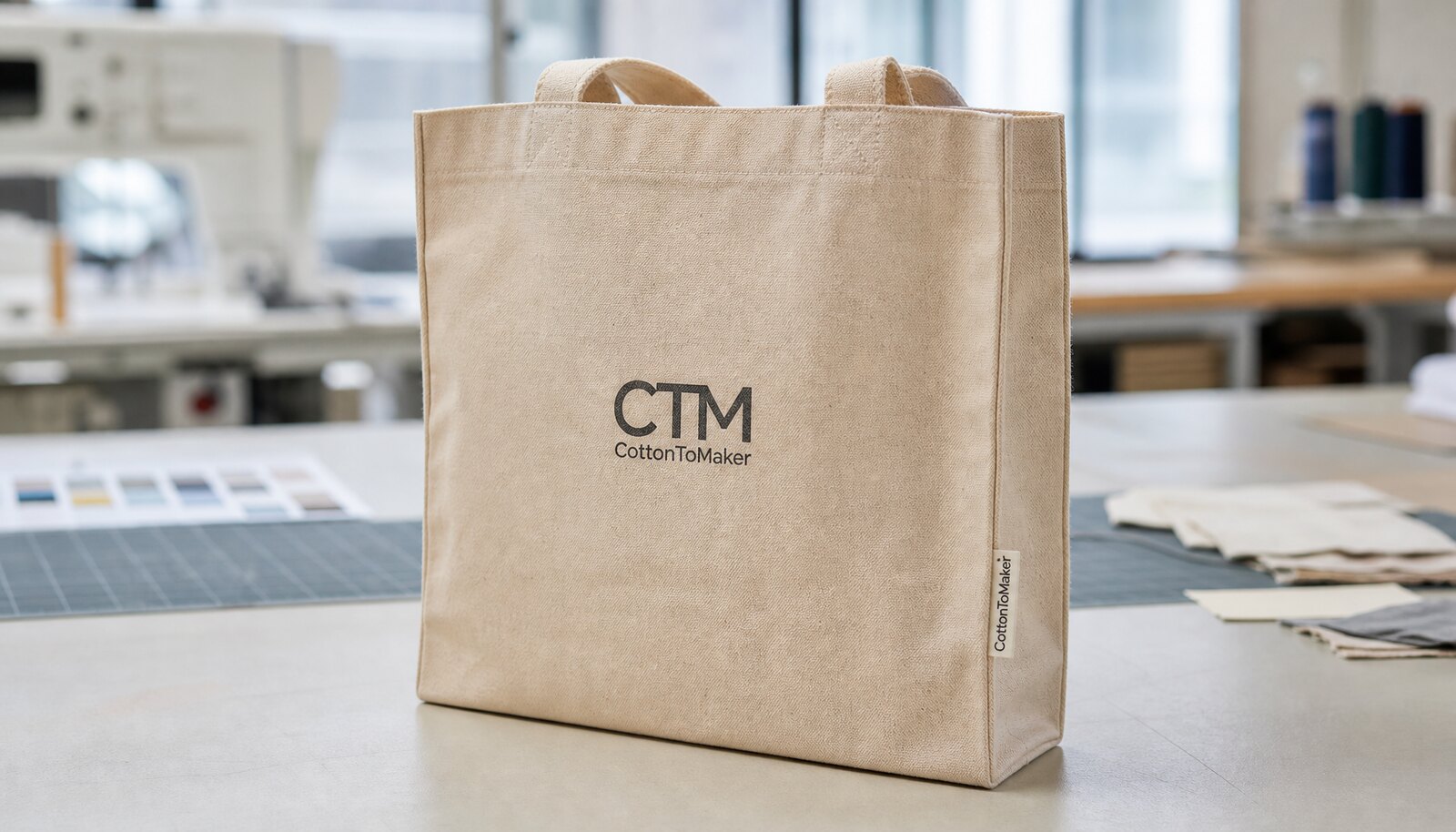
Why gift shops need a different canvas spec than general promo bags
Gift shop bags do more than carry a sale home. They sit at the register, reinforce the store’s brand, and often become part of the customer’s memory of the visit. That changes the buying brief. A promo bag can survive being “good enough.” A gift shop bag has to look intentional on the counter and still hold up when the customer uses it again for errands, travel, or another store visit.
That difference matters because procurement decisions around printed canvas shopping bags for gift shops are not just about unit cost. They are about how the bag feels in hand, how the logo sits on the fabric, how the seams behave when loaded, and whether the finished item fits the store’s price point. A museum store, a resort boutique, a garden center gift shop, and a travel souvenir counter may all want canvas bags, but each one has a different tolerance for fabric weight, print style, and finish.
For that reason, buyers should treat the bag as a retail product spec, not a generic packaging line item. The same design can look premium at 14 oz with a clean one-color screen print, or look weak and forgettable at 10 oz with a crowded multi-color transfer. The right decision starts with end use: what will customers carry, how much weight the bag must support, and how visible the bag will be once it leaves the store.
A practical first question is: what is the bag expected to do after purchase? If it will carry books, candle sets, ceramics, or locally made gift bundles, it needs stronger canvas, stronger handle attachment, and better color stability. If it is mainly a low-cost souvenir bag for light items, a softer spec may be acceptable. The point is to match the bag to the store’s merchandising strategy rather than to a supplier’s default template.
- Gift shop bags need shelf appeal, not just carry strength.
- Judge the bag by hand feel, print clarity, and repeat-use durability.
- The best spec is the one that fits the store’s merchandise mix and price tier.
Start with canvas weight, weave, and finish before you discuss print
Canvas weight is the first variable that changes both perceived value and production cost. For many gift shop programs, 12 oz to 14 oz cotton canvas is the most practical range. At 12 oz, the bag usually feels lighter, folds more easily, and costs less to sew. At 14 oz, the bag gains structure, stands up better on a shelf or checkout counter, and usually gives a more premium impression. If the bag is supposed to feel sturdy and giftable, 14 oz is often worth the incremental cost.
However, heavier is not automatically better. If the canvas becomes too stiff, the bag can feel bulky, create slower sewing operations, and raise freight cost because it packs less efficiently. A 14 oz bag is often the right choice for premium resale, but a 12 oz bag may be a better fit for seasonal programs, lightweight merchandise, or stores where cost control matters more than structure. The right spec depends on the product mix, not on the assumption that thicker always equals better.
Weave structure matters just as much as GSM. A tight plain weave gives a flatter, more stable surface for print and reduces the chance of visible distortion. Loose or uneven weave can create a bag that looks textured in a good way from a distance, but it often makes print edges less sharp and increases panel-to-panel variation. For any logo that needs clean edges, tight weave is the safer option.
Finish is the third decision. Pre-shrunk canvas or enzyme-washed canvas is usually easier to manage for repeat orders because it reduces post-production shrinkage and makes the bag feel less raw. Raw canvas can work, especially for value programs, but it may be more prone to dimensional change after transport or customer use. If a buyer expects future replenishment orders, matching the first production lot with the next lot becomes easier when the finish is stable.
A practical procurement rule: do not let the print decision lead the fabric decision. Pick the canvas first, because the fabric determines the look, the hand feel, the sewing time, and the durability envelope. Once the fabric is set, print method and artwork complexity become easier to compare on a fair basis.
- 12 oz is workable for many value and mid-tier gift shops.
- 14 oz is better when the bag should stand upright, carry heavier items, or feel more upscale.
- Ask for an actual swatch or production sample; a photo is not enough to judge weave or finish.
How to compare weave, finish, and print durability in one buying decision
Procurement teams often compare fabric and print as separate topics, but they interact. A slightly rougher weave can make a simple logo look less polished, while a tighter weave can improve print edges and help a bag read as premium from a distance. In practical terms, the weave count and yarn consistency matter more than broad fabric language like “good quality canvas.” Ask the supplier to name the construction clearly and to send a cut swatch showing the exact surface that will be printed.
If the bag will carry a logo with fine lines, small text, or a geometric border, the fabric surface needs more control. A looser canvas can still be acceptable for rustic or handmade positioning, but it raises the chance of fill-in, edge spread, and uneven ink absorption. The same logo may look acceptable on one fabric lot and less sharp on another if the weave varies. That is why the sample should be taken from production-intent fabric, not from a better showroom stock piece.
Finishing choices change both appearance and risk. Raw canvas tends to feel more natural but can shed lint and show more variation. Pre-shrunk or enzyme-washed canvas usually provides better stability, especially when the bag is expected to be reused and laundered. If the program includes retail resale at multiple stores, finish consistency helps future replenishment orders match the first lot. Buyers do not need to over-specify finish for every program, but they do need to know how the finish affects size, hand feel, and print behavior.
This is also where a sample acceptance rule helps. Instead of approving a sample because it “looks good,” approve it because the fabric surface, color, and print response match the approved master. That keeps the discussion technical enough to protect the reorder, while still letting the bag look attractive in store.
- Request a cut swatch from the same production-intent fabric.
- Check whether the weave supports sharp print edges for your artwork.
- Use finish choices to control shrinkage, lint, and reorder consistency.
Choose the print method based on artwork durability, not on what is easiest for the supplier
Screen print is still the default choice for most gift shop canvas bags because it balances cost, clarity, and repeatability. It performs well on one- or two-color logos, simple store names, seasonal copy, and line art. On canvas, screen print usually looks cleaner than a more complex method because the ink sits well on the fabric and can retain a bold retail look even from a short distance.
The tradeoff is that screen print becomes less attractive as the design gets more complex. Multiple colors increase setup time and registration risk. Fine gradients, photographic artwork, or tiny text can look impressive in a sample but less dependable in production. If the bag will sit beside premium goods, a simpler logo often performs better than a crowded graphic that is hard to print consistently.
Transfer printing can be useful for short runs, tight timelines, or designs with more visual complexity. It can also be a practical bridge when a buyer wants to test a seasonal artwork before committing to a larger run. But transfer is not automatically safer. It needs correct curing, controlled heat, and rub testing. If the print sits on a bag that will be folded, stacked, or carried in humid weather, poor curing can show up as cracking, peeling, or color transfer.
When comparing methods, ask for the same artwork on the same fabric in a side-by-side sample set if possible. Then judge edge sharpness, opacity, surface feel, fold-line behavior, and rub performance. A good supplier should be able to explain why a method was chosen and what they changed in the print process to protect durability. If the answer is simply “this is our standard,” that is not enough for a retail buyer.
One practical way to reduce risk is to use one standard print method for the main bag program and reserve special methods only for limited seasonal drops. That reduces color drift, improves reorder consistency, and gives better leverage on MOQ and pricing. It also keeps the store’s visual identity more consistent from one season to the next.
- Use screen print for most logos and simple retail graphics.
- Use transfer only when artwork complexity or short-run timing justifies the extra risk.
- Require cure details and rub-test results before approving a print method.
Handle construction and seam reinforcement decide whether the bag feels retail-ready
Handles are a functional part of the buying decision, but they are also a visible quality cue. If the handle feels flimsy, twists easily, or sits unevenly, the whole bag looks cheaper than it should. For gift shop canvas bags, a 25–30 mm cotton webbing handle is often the safest all-around choice. It gives a neat retail look, distributes weight well, and tends to be easier to standardize in production. Self-fabric handles can also work, especially when the brand wants a softer, more coordinated appearance.
The more important issue is not simply the handle material but the handle attachment method. X-box stitching and bar tacks are commonly used because they spread load into the bag body more effectively than a basic straight stitch. A buyer should not accept vague phrases like “strong stitching” in a quote. Ask where the reinforcement is placed, how many stitch passes are used, and whether both handles are attached symmetrically. Even a visually attractive bag can fail if the handles were sewn with inconsistent tension or too few reinforcement stitches.
Handle drop also needs to match the bag’s retail use. A short drop may be fine for handheld carry, but it can become uncomfortable when the bag is loaded with books, bottles, or heavier gift sets. A longer drop can make the bag easier to shoulder-carry, but if it is too long the bag may look sloppy or swing awkwardly. This is why handle length should be part of the approved sample, not left to the factory’s default.
Seams deserve the same attention. Side seams, bottom seams, gusset seams, and top hems all contribute to the bag’s carrying performance. A good sample should show clean seam alignment, even tension, and minimal loose thread ends. If a bag is meant to be reused frequently, the buyer should ask for consistent stitch density on stress areas rather than assuming that every factory’s standard is enough. In retail, a bag that survives one purchase but not repeated use does not deliver full value.
For a gift shop, the feel of the handle in hand often influences the customer’s perception of quality more than the bag body itself. That makes handle construction one of the highest-value places to tighten the spec. It is a small detail in the RFQ, but it is a visible detail at the checkout counter.
- Ask for handle width, material, length, and attachment method in the quote.
- Require reinforcement details, not just “double stitched.”
- Test the bag with realistic retail loads before approving the final handle drop.
Use a supplier audit checklist before you compare price
Price comparison is only useful after the supplier can prove they can make the bag you need. For printed canvas shopping bags for gift shops, the audit should start with process control, not sales promises. Ask whether the factory owns cutting, sewing, printing, and packing, and whether the same team handles repeat orders. A factory with integrated control is usually easier to manage on a reorder because the exact process chain is clearer.
For direct factories, the main advantage is control. Fabric booking, print registration, sewing alignment, and packing all sit inside one production chain. That usually lowers the risk of spec drift and helps keep the bulk order close to the approved sample. For traders or converters, the advantage is flexibility: they can sometimes source smaller lots, move faster on communication, or combine multiple product types into one order. The risk is that the actual maker may change between samples and bulk, or between one reorder and the next.
A useful audit question is to ask for the production flow by name: who sources the fabric, who prints, who sews, who inspects, and who packs. Ask for the actual worksite or subcontracted facility if the supplier is not the manufacturer. If they cannot answer directly, the risk is not only quality; it is also traceability when there is a defect or a late shipment.
You should also ask whether the supplier keeps a master sample and master spec sheet for reorders. A good factory will have a clear reference point for fabric, print placement, handle length, and packing format. That is how they prevent drift on seasonal replenishment. If they do not keep a controlled reference, the bag can change quietly on the second or third order even when the artwork file has not changed.
In procurement terms, the audit goal is simple: verify who controls the process, what they measure, and how they keep the bulk order aligned with the approved sample. That is more useful than a polished brochure or a long list of client names.
- Ask who owns fabric sourcing, printing, sewing, inspection, and packing.
- Prefer integrated control for repeat orders and trader flexibility only when it solves a real scheduling or communication problem.
- Request the master sample and master spec that will govern reorders.
How to compare factory sourcing vs trader sourcing without missing the real risk
Direct factory sourcing and trader sourcing can both work, but they fail in different ways. A factory may be better on control, cost transparency, and repeatability, while a trader may be better on speed, communication, and coordination across multiple product types. The problem is that many buyers compare the first quote only. The better approach is to compare risk: where can the order break, and who fixes it fastest?
With factory sourcing, the main risk is usually operational capacity or rigid MOQ rules. A factory can be excellent at producing one clear spec at scale, but less flexible if the order needs many SKUs or frequent artwork changes. With trader sourcing, the main risk is hidden production dependency. The sample can be good because the trader managed development carefully, but the bulk can slip if the actual factory changes fabric lot, print setup, or packing details.
For a procurement team, the best test is to ask for evidence of consistency. Request the name of the actual factory, the process owner, and the QC point at each stage. If you are dealing with a trader, ask whether they can provide production photos from the current line, not only catalog images. If you are dealing with a factory, ask what parts of the process are subcontracted and how they verify subcontractor output. Either route can be acceptable if the control points are clear.
The decision often comes down to order pattern. If the store will reorder the same bag several times a year, a factory relationship may be the cleaner long-term choice. If the buyer needs a small run of seasonal art with rapid communication and bundled sourcing, a trader may be the more practical route. The key is to understand the production chain before the quote is accepted, not after a defect appears.
- Factory sourcing usually gives stronger consistency on repeat orders.
- Trader sourcing may help with speed and coordination, but the actual maker must still be disclosed.
- Compare the real risk path, not only the first invoice price.
MOQ is a production setup question, not a marketing number
Many buyers treat MOQ as a single number, but in production it is usually a combination of fabric, color, artwork, and packing setup. For printed canvas bags, MOQ can change when you change size, print color count, bag color, or finishing method. One supplier may say the MOQ is 1,000 pieces, but that number may apply only to one size in one fabric and one artwork version. If you want three sizes and two print colors, the practical MOQ may be much higher or the setup cost may rise sharply.
The best way to manage MOQ is to reduce variant complexity. Gift shops often need seasonal designs, but the bag body does not need to change every time. Keeping one standard base bag and rotating artwork is usually the lowest-risk approach. If your store team wants multiple versions for merchandising, try to vary the print while keeping the same canvas, handles, and packing format. That gives the factory a simpler workflow and gives procurement a stronger chance of getting a reasonable MOQ.
If a supplier quotes a very low MOQ, ask what they are really doing to achieve it. Sometimes they are using stock fabric, standard sizes, or pre-approved print setups. That can be perfectly acceptable, but it should be clear. A low MOQ is only valuable if the spec still matches your store standard. Otherwise, the order may be easy for the supplier but unsuitable for retail use.
For repeat programs, the most useful MOQ discussion is not “What is your smallest order?” It is “What is your smallest order at the exact spec I want?” That framing avoids surprises and makes the decision more commercial. It also lets you compare whether a slightly higher MOQ gives you better consistency, better color control, or lower landed cost over time.
- Check MOQ by size, color, and artwork version separately.
- Ask which elements drive setup cost: cutting, screen count, dyeing, or packing changes.
- Standardizing the base bag usually lowers total complexity across seasonal programs.
Use landed-cost logic, not unit price, when comparing printed canvas bags
A factory quote is only one part of the real cost. The actual procurement cost includes fabric, printing, sewing, reinforcement, packing, cartonization, quality control, freight, duty, and any rework done at destination. If a quote excludes inner packing or assumes a different carton count, the cheapest-looking number can quickly become the least attractive option once warehouse labor is counted.
This matters especially for gift shops because the bag often needs to arrive in a retail-friendly condition. If it is wrinkled, poorly folded, or packed in a way that slows receiving, the hidden labor cost goes up. Buyers should think about whether they are purchasing a simple carry bag or a retail-ready item. Retail-ready packaging can cost more at the factory, but it may reduce receiving labor, shrinkage, and damage on arrival.
It also helps to compare the quote against your likely reorder pattern. A supplier with a slightly higher unit price but a stable spec and clean repeatability can reduce total cost over the year. That is especially true for seasonal programs where missed timing or a failed sample means the store loses sales opportunity. A lower price that comes with poor timeline reliability is often not lower in business terms.
A practical landed-cost comparison should include a simple side-by-side view: product cost, sample cost, inland freight to port or warehouse, international freight assumption, duties, and destination handling. If you do not have all numbers yet, at least separate fixed setup charges from recurring unit costs. That shows whether the quote is favorable because the unit price is truly better or only because setup has been hidden elsewhere.
For procurement teams, the right question is not “Which supplier is cheapest?” It is “Which supplier gives the lowest acceptable delivered cost for the exact retail standard we need?” That phrasing is more useful because it includes quality, timing, and handling, not just invoice price.
- Compare the complete landed cost, not just the factory unit price.
- Separate one-time setup fees from recurring production cost.
- Include warehouse labor and packing condition if the bags are sold as retail-ready goods.
Sample approval should be built around the failure points that matter in bulk
A sample is supposed to remove uncertainty, but only if you inspect the right things. A polished-looking sample can still hide production risk if it uses a different canvas lot, a different print cure, or hand sewing that won’t match bulk pace. Before approving any bulk order, buyers should confirm the exact sample type: blank sample, printed strike-off, or pre-production sample. Each serves a different purpose. A blank sample checks fabric and construction. A strike-off checks print. A pre-production sample checks the full package.
The most useful sample review starts with dimensions and hand feel. Measure the finished bag length, width, and gusset. Confirm the handle drop, the fold, and how the bag sits when loaded with a realistic retail load. For gift shops, it is worth using the kind of merchandise the store actually sells—books, candles, mugs in protective packaging, or bundled souvenirs—because a bag that looks fine empty may collapse or deform under the real load.
Then move to visual alignment. Check whether the print sits centered, whether the logo is too close to a seam, and whether there is enough margin around the artwork. On canvas, the fabric texture can affect how a design reads from arm’s length. If the store sells a premium product, that visual balance matters. Small print placement errors can make the bag look less deliberate even if the artwork itself is technically correct.
Finally, test the stress areas. Fold and unfold the sample several times, rub the print, check the handle anchors, and inspect the seam tails. If the bag is intended to be reused, ask whether the supplier has any wash or shrink testing available. Even a basic test that checks for size change, seam distortion, and print lifting after washing is better than relying on appearance alone.
A good sample sign-off is not only “approved” or “not approved.” It should note exactly what was approved: fabric weight, color, print position, handle length, packing style, and any exception. That record becomes the reference for future reorders and helps avoid spec drift later.
- Use blank, strike-off, and pre-production samples for different checks.
- Measure the sample with a real retail load, not just empty on the table.
- Record what was approved so later reorders can match the same standard.
Specification comparison for buyers
| Spec decision | Best-fit option | Procurement tradeoff | Buyer risk to check |
|---|---|---|---|
| Fabric weight / GSM | 12 oz to 14 oz cotton canvas, roughly 340–475 GSM | 12 oz is easier to sew, lighter to ship, and usually more cost-efficient; 14 oz improves structure, print stability, and shelf presence | If the actual fabric is lighter than quoted, bags may sag, seams may skew, and the print can look less crisp on a loose weave |
| Weave and yarn finish | Tight plain weave; raw, pre-shrunk, or enzyme-washed depending on retail position | Tighter weave supports cleaner logo edges; pre-shrunk or washed fabric reduces post-delivery size drift but can raise cost and slightly change hand feel | Loose weave can cause ink spread, panel skew, and visible lot variation; confirm an actual swatch and production sample, not a showroom photo |
| Print method | 1–2 color screen print for most gift shop SKUs; transfer only for short runs or complex art | Screen print usually gives better rub resistance and lower unit cost on simple graphics; transfer handles gradients and many colors but needs stricter heat and fold control | Ask for cure method, dry-rub and wet-rub results, and whether the printer is in-house or subcontracted |
| Supplier route | Direct factory with sewing and printing in-house for repeatable programs; trader or local converter for small, urgent, or multi-source programs | Direct factory usually gives stronger control over spec consistency and reorder stability; traders may improve communication or flexibility but can hide the real production source | If the quote comes from a trader, ask who actually prints, sews, inspects, and packs the bags |
| MOQ structure | MOQ defined by size + fabric color + print version + packing format | This matches the way production is set up and prevents hidden setup charges from appearing later | A single headline MOQ can hide extra charges for each artwork, size, or dye lot |
| Handle construction | 25–30 mm cotton webbing or self-fabric handles with X-box or bar tack reinforcement | Webbing usually looks cleaner and carries better; self-fabric handles can feel softer and more coordinated with premium branding | Weak reinforcement, short handle drop, or uneven attachment can fail with books, boxed gifts, or bottle sets |
| Packing format | Flat packed, cartonized by clear count, with SKU label and master carton mark | Cleaner receiving, less repacking, lower damage risk, and easier warehouse control | Loose bulk packing can increase wrinkling, miscounts, and destination labor |
| Sample approval focus | Finished size, print placement, handle length, seam balance, folded size, and retail hand feel | A good sample should match the exact bulk spec, not just the artwork | If the sample uses a different fabric lot, print setup, or finishing method, the bulk may drift |
| Lead time profile | Often 30–45 days after sample approval for standard natural canvas programs; longer for custom dyeing, washing, or multi-round approvals | Short lead times only work when fabric is ready and artwork is frozen early | Late artwork changes, fabric booking delays, and resampling commonly add 1–3 weeks |
Buyer checklist before sampling
- Confirm the fabric weight in GSM or oz, the weave type, and whether the canvas is raw, pre-shrunk, or enzyme-washed.
- Lock the artwork file format, Pantone references, print size, print placement, and whether the printer will send a strike-off or digital proof first.
- Define exact bag dimensions, gusset depth if any, handle drop, handle width, handle attachment method, and target carry load.
- Specify seam reinforcement, stitch density, thread type, and whether stress points use bar tacks, X-box stitching, or double stitching.
- State packing style, carton quantity, carton dimensions, and whether individual polybags, belly bands, or tissue inserts are needed.
- Request a blank sample and a printed pre-production sample before bulk release, and verify both against the same master spec sheet.
- Compare supplier quotes on a like-for-like basis: fabric weight, weave, finish, print colors, bag size, handle spec, packing, MOQ, and lead time.
- Ask for inspection checkpoints and the supplier’s rejection thresholds for size, print defects, stitching defects, and packing errors.
- Check landed-cost drivers separately: factory price, sample cost, internal QC, freight, duties, destination handling, and retail finishing.
- Keep one approved master spec sheet so future reorders do not drift on fabric, print, or packing details.
Factory quote questions to send
- What exact fabric weight, weave construction, and finish are included in your quote, and can you share a real swatch or swatch card?
- Is the quoted price based on one bag size, one print location, and how many print colors or print passes?
- What is the MOQ by size, color, and artwork version, and what setup charges apply to each variant?
- Are sewing and printing both done in-house, or do you outsource either process? If outsourced, how do you control spec consistency?
- Can you show the handle construction, reinforcement method, and stitch density you plan to use on the production line?
- What sample types are included first: digital proof, blank sample, printed strike-off, or pre-production sample?
- What are the exact packing details, including carton count, master carton dimensions, and whether inner polybags are required?
- What size tolerance, print tolerance, and seam defect thresholds do you inspect before shipment?
- What lead time applies after sample approval, and which events most often delay shipment?
- Can you quote the landed-cost split separately for product cost, packing, freight assumptions, and any special finishing or labeling?
Quality-control points to confirm
- Measure finished length, width, and gusset against the approved spec sheet. A practical control point for retail bags is typically ±5 mm on smaller dimensions and ±8 mm on larger dimensions unless your internal standard is tighter.
- Check fabric GSM or ounce weight on incoming fabric lots. If the supplier cannot provide a test reference, inspect hand feel, opacity, slub count, and panel-to-panel consistency across the lot.
- Inspect weave tightness and edge stability. Reject obvious thin spots, broken yarns, misweave lines, or panels that skew after cutting.
- Check print adhesion after cure and after folding. Rub the print with a dry cloth and then with a damp cloth for 20–30 strokes each; flag smudging, cracking, peeling, or strong color transfer.
- Require print alignment control at the panel center and near seams. Define a maximum positional drift before production starts; do not leave “centered” to interpretation.
- Inspect handle attachment points for symmetry, reinforcement placement, and stitch density. For retail use, ask for consistent reinforcement and no loose thread ends at the stress points.
- Verify stitch length consistency on reinforcement areas. Uneven long stitches or skipped stitches usually indicate weak sewing control.
- Confirm carton count accuracy and master carton labeling. If your warehouse receives by SKU, mislabeling can create more cost than a minor cosmetic defect.
- Test a filled bag with realistic retail loads: books, candles, boxed gift sets, or mixed merchandise. Check whether handles cut into the hand, seams strain, or the bag tips over.
- If the bag is marketed as reusable and washable, request a wash or shrink test on a sample lot. Review post-wash size change, seam distortion, and print stability before releasing bulk.