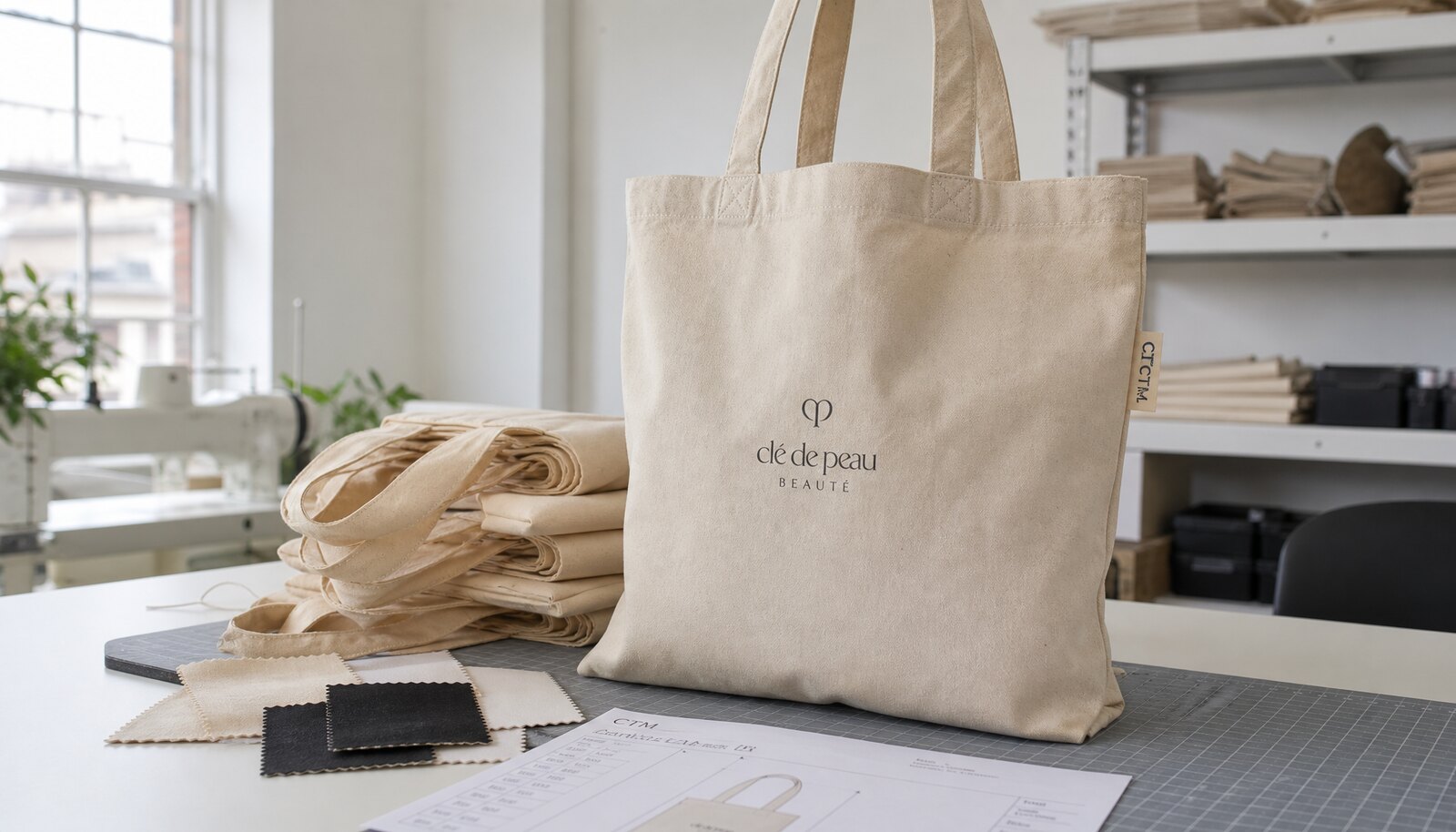
Why cosmetic brands source printed canvas shopping bags differently from generic tote buyers
Printed canvas shopping bags for cosmetic brands do more than hold products. They present the brand at checkout, support the gift experience, and often remain in use after the purchase. That makes the purchase more than a simple tote buy. Procurement has to protect retail appearance, carry performance, and repeatability in reorder, because a canvas bag can quietly affect how the customer remembers the entire cosmetic line.
The common sourcing mistake is to treat the bag as generic promotional merchandise. That approach under-specs the visual details that matter in beauty retail: logo placement, print crispness, handle feel, seam neatness, and the way the bag sits next to the product box. A second mistake is overspecifying every detail, then paying premium pricing for features that do not improve the customer experience. A good buying brief ties the bag to the channel: checkout, gift-with-purchase, event handout, travel bundle, or retail resale.
Beauty buyers also have a different risk profile. The same tote may be handled by store staff, warehouse teams, and end customers. Each touchpoint can expose a weak seam, a dirty pack, or a print shift. If the bag is used in a launch campaign, a small quality miss can spread quickly across photos and social posts. That is why the spec should read like a production brief, not a marketing concept.
The right procurement mindset is to buy the bag as part of the packaging system. The fabric, structure, print, packing, and carton plan all belong in one brief. If those pieces are separated, the quote comparison becomes unreliable and the factory has room to make assumptions that will later show up as cost, delay, or defect claims.
- Checkout bags need cleaner finishing than event giveaways.
- Gift-with-purchase bags should stand up well enough to look presentable in-store and in photos.
- Distributors need SKU labels and carton counts that match warehouse receiving rules.
- Treat the tote as a branded packaging component, not a generic carry bag.
Set the fabric spec first: GSM, weave, and finish affect both price and appearance
For most cosmetic retail programs, cotton canvas in the 10 oz to 12 oz range, roughly 340-410 GSM, is the most practical starting point. It usually gives enough structure for boxed skincare, makeup kits, and gift sets without pushing the bag into a heavy, expensive build. In many wholesale programs, this range also gives the best balance between retail feel and freight efficiency. Going heavier can make the bag feel more premium, but the buyer should expect higher sewing labor, more material use, and a larger carton footprint.
Fabric finish matters as much as weight. Natural canvas, bleached canvas, dyed canvas, washed canvas, and pre-shrunk canvas behave differently in print and in packing. A quote that just says “canvas” is not enough for procurement. Ask whether the cloth is natural or bleached, whether it has been pre-shrunk, and whether the supplier is quoting finished weight or raw weight. That detail matters because a bag can look right in sample form and then relax, tighten, or crease differently after bulk production and packing.
The cosmetic brand decision is not purely technical; it is visual. Natural canvas often reads as softer, more organic, and closer to a clean beauty story. Bleached or bright white canvas gives a sharper branded surface but also exposes print misalignment and dirt more easily. If the bag is going into premium gifting or retail resale, that tradeoff should be decided early so the factory does not optimize for the wrong look.
If the bag will carry heavier items such as glass jars, boxed palettes, or multiple units, do not rely on fabric weight alone. Ask for handle reinforcement, seam reinforcement, and a structure that supports the real load. A heavier cloth with weak handles still generates claims. For sourcing, the question is not just how thick the canvas feels in hand; it is how the complete bag behaves when loaded, folded, stacked, and packed.
- Treat GSM as one part of the spec, not the entire quality standard.
- Ask whether the weight is finished weight or raw fabric weight.
- Match canvas finish to the brand look: natural, bleached, washed, or dyed.
- Use stronger reinforcement rather than only heavier cloth if the main need is load capacity.
Choose bag size and structure around the product mix, not around the catalog default
A cosmetic tote should be sized to the products it actually carries. Many buyers start from a standard medium tote and then discover that boxed skincare tips over, sample kits slide around, or the handle drop feels awkward at checkout. The result is a bag that may be technically usable but does not present the products well. Finished size should be decided from the actual contents, the display situation, and the receiving carton plan.
Flat totes are usually cheaper and pack more efficiently, but they can look cramped once a product box is inserted. Gusseted totes take more material and sewing time, yet they hold shape better and create a more premium presentation. If the bag is meant to stand upright in-store or during a gifting moment, a modest gusset often improves the customer experience more than a slightly lower unit cost. If the bag is mainly for distribution, a flatter construction may be the right commercial choice.
Handle drop is another detail that changes how the bag functions. Short handles suit hand-carry retail bags and neat presentation. Longer handles are better if the customer is expected to carry the bag on the shoulder or if the contents are heavy. Handle width also matters: narrow self-fabric handles can be fine for light sets, but wider cotton webbing generally feels more robust and is less likely to cut into the hand.
Before you ask for quotes, define whether the bag must stand upright, fold flat, fit inside a specific carton, or sit neatly in a store display. That single decision changes the construction and the packing method. If merchandising, marketing, and procurement are not aligned, the bag can be visually attractive but operationally awkward. In wholesale sourcing, awkward is expensive.
- Specify finished width, height, gusset depth, and handle drop in centimeters or inches.
- Confirm whether the bag should stand upright when empty or when loaded.
- Use a wider gusset for boxed products and gift bundles; use a flatter build for lower freight cost.
- Do not let the supplier choose a “standard” size without checking the actual product mix.
Print method selection: compare visual quality, setup cost, and repeat-order behavior
Print method should be selected from the artwork and reorder pattern, not from habit. Screen printing remains the best default for most cosmetic tote programs because it handles one to three solid colors well, gives strong opacity on canvas, and scales cleanly on repeat orders. It is usually the most cost-efficient route when the logo is simple and brand colors are stable. The key is control: registration, ink laydown, and curing must be managed tightly or the result looks uneven.
Transfer methods such as heat transfer or DTF can be useful when the artwork changes often, when the design has gradients or smaller details, or when the buyer is testing a short campaign run. They reduce setup friction for low-volume orders, but buyers should check how the print behaves after folding, handling, and shipping. A transfer that looks clean on day one can still age differently from screen print. That may be acceptable for a short-lived promotion, but it is not the same thing as a long-life retail tote.
Embroidery and woven labels add a premium signal, but they are usually better as accents than as the main branding method for large print areas. They add cost, slow production, and may not suit broad fills or small typography. A small woven side label, minimal stitched patch, or short embroidered mark can work well for beauty brands that want a softer or more elevated finish while still keeping the main logo readable.
For procurement, the practical rule is simple: match the method to the artwork and the order profile. If a supplier recommends a more expensive method, ask why in operational terms: setup count, color count, durability, or print resolution. Then insist on a real strike-off or decorated sample on the actual canvas. Paper proofs do not reveal how the fabric absorbs ink or how the weave changes the visual edge.
- Screen print is usually the strongest default for simple brand marks.
- Transfer methods are useful for short runs and artwork with gradients or frequent changes.
- Approve a decorated sample on the actual canvas, not just a digital proof.
- Ask for setup cost by color so small design changes do not hide extra expense.
Build the quote around landed cost, not just the factory unit price
The easiest sourcing mistake is to compare prices that are not actually equivalent. One supplier may quote a low unit price but use lighter fabric, weaker handles, or simpler packing. Another may quote a slightly higher factory price but include better reinforcement, cleaner folding, and stronger carton protection. In cosmetic retail, the cheaper quote can become the more expensive program once freight, claims, and rework are included.
A usable quote should split fabric, cutting and sewing, printing, packaging, sample fees, and transport assumptions. Ask whether screen charges, color setup, strike-off costs, carton labels, inner polybags, or export documents are included. If the supplier only gives a single number, ask for a full breakdown before you compare it with other offers. The goal is not to make the supplier do bookkeeping for you; it is to expose where the true cost sits.
Freight assumptions matter because canvas totes are bulky. Even a moderate increase in bag size can affect carton dimensions, carton count, and shipping cost. Ask for carton size, gross weight, and pack count in the quote stage so you can estimate shipping impact early. If a supplier cannot provide this, the quoted unit price is incomplete. The same applies to shipping terms: EXW, FOB, CIF, and DDP are not comparable unless you know exactly what is and is not included.
The best landed-cost comparison also looks at downstream handling. Bulk packing may be the cheapest route if your own warehouse can repack or distribute efficiently. Retail-ready packing costs more but may save handling on the receiving end. For a beauty brand, the right answer depends on where the bag will be opened, who will touch it next, and whether appearance at first use matters.
- Compare only like-for-like quotes: same size, same fabric weight, same print method, same packing.
- Ask for a breakdown of setup fees, sample fees, and packing charges.
- Confirm shipping term and freight assumptions before comparing unit prices.
- Request carton dimensions and gross weight so you can estimate shipping impact early.
Compare factory-direct and trader sourcing routes with a real decision framework
Factory-direct sourcing usually works best when the buyer has a clear spec, stable artwork, and a reorder plan. The advantage is control. You are closer to the production line, which helps when fabric quality, sewing consistency, or print placement need correction. It also makes root-cause analysis easier if the sample and bulk order diverge. For teams that can manage the spec discipline, factory-direct often gives the cleanest balance of price and accountability.
Trader or sourcing-agent routes can be useful when the program is more complex. If the buyer needs multiple packaging items, several SKU families, or coordinated shipments across product lines, a trader can reduce coordination load and become a single point of contact. That convenience has a cost. The buyer must know which factory is actually making the bags, who is responsible for final QC, and how changes are documented. If the supplier cannot identify the production site clearly, that is a risk signal.
The real question is not which route is cheaper on paper. It is which route is cheaper after service, sampling, change control, and defect risk are included. A trader may be the better choice for a small team that needs help managing cartons, inserts, labels, and delivery timing. A factory-direct source may be better when the specification is stable and the buyer wants tighter control over production details. The route should be chosen by operating model, not habit.
Whatever route you use, vet the supplier beyond the quote. Ask for business registration, production photos, sample responsiveness, and a clear explanation of inspection and rework. Look for actual sewing-line photos, print-area photos, and packing-area photos, not only polished marketing shots. Ask how the supplier handles reorder consistency and whether third-party inspection is allowed. Good suppliers answer these questions directly because they already manage this part of the business.
- Factory-direct is strongest for repeatable orders and tighter spec control.
- Trader routes can help when multiple SKUs or packaging items must be coordinated.
- Always identify the real factory and the party responsible for final QC.
- Vet communication, documentation discipline, and sample turnaround, not just price.
MOQ, negotiation, and ordering strategy: how to avoid paying for unnecessary flexibility
MOQ is not just a production minimum; it is a reflection of how the factory plans fabric, printing, cutting, and sewing. When a supplier offers a lower MOQ, the buyer should ask what changed. Is the price higher? Is the fabric choice narrower? Is the print method more expensive? Is the supplier mixing your order into another run? Low MOQ can be useful, but it is usually a tradeoff, not a free benefit.
For cosmetic brands, the cleanest MOQ strategy is often to keep the bag construction fixed and vary only the print artwork or insert card. That allows the factory to run one body spec more efficiently while still supporting campaigns, seasonal launches, or different fragrance lines. If the order is split into too many print versions, each version may create its own setup and QC burden. The consequence is usually higher cost and slower approval.
Negotiation should focus on the flexible elements. If the bag is a long-term program, ask whether the factory can reuse screens, artwork setups, or approved reference files for repeat orders. If the supplier is strong on canvas production but weak on packing, consider keeping packing simple rather than forcing multiple customized pack formats. In other words, do not ask the factory to customize everything when only one or two elements actually matter to the business.
If low MOQ is essential, cost it honestly. Lower minimums often carry higher unit pricing, more setup cost per bag, or longer lead times. That does not make the offer bad. It just means the buyer should understand the premium before committing. The worst outcome is approving a low MOQ order and then discovering that every reorder carries the same premium because the program was never designed for scale.
A useful internal rule is to define which variable is allowed to change and which are frozen. For example: size frozen, fabric frozen, print version variable, packing variable only if necessary. This kind of controlled flexibility is more useful than asking the factory to be flexible in general terms.
- Ask MOQ separately for size, print version, fabric shade, and packing format.
- Consolidate artwork versions where possible to protect pricing.
- Clarify whether setup tools can be reused on reorder.
- Treat low MOQ as a paid service level, not a free benefit.
Sample approval and rejection workflow: the step that prevents bulk disputes
Sampling is not a courtesy; it is the commercial reference. For printed canvas shopping bags, the minimum useful sample set is a fabric swatch, a print strike-off on the actual material, and a pre-production sample with the final size, handle, sewing, and packing spec. If you skip any of those checkpoints, the buyer and supplier may not be working from the same assumptions during bulk production.
The sample should be reviewed the way the customer will see the bag. Check it under neutral lighting, fold and unfold it, inspect it empty and loaded with a realistic product set, and compare it against the approved size drawing. If the bag will hold boxed skincare or jars, place the actual items in the sample. That will reveal whether the gusset, handle drop, and structure are truly right. A tote can look fine in a photo but fail when used as a gift carrier.
The rejection workflow should be written before the sample is sent. If the strike-off is off-center, the color is too weak, the handle length is wrong, or the bag collapses too easily, the supplier needs to know exactly what failed and what must be corrected. The note should say whether the revised sample can proceed or whether the supplier must stop and re-approve first. This avoids argument later and helps protect the production schedule.
Keep the approved sample as the master reference and store it with the buying file. Include the approved artwork file, the signed spec sheet, the color reference, the packing method, and any exceptions agreed during approval. If a reorder is placed by a different buyer next quarter, that master sample prevents silent spec drift. In wholesale procurement, the cost of one controlled sample file is usually far lower than the cost of one disputed batch.
- Never approve bulk from a PDF proof alone.
- Approve fabric, print, and packaging as separate sample checkpoints.
- Use a real product load in the sample evaluation if the bag will carry boxed cosmetics or jars.
- Keep a master approved sample with written notes and photos.
Packing, export, and warehouse receiving details that affect retail condition and claims
Packing has a direct effect on how the bag arrives and how the customer sees it. If a canvas tote is folded too tightly, it can hold deep creases that make it look used before it is sold. If it is packed without dust control, it may arrive with lint, odor, or stain issues. For cosmetic brands, those are not minor defects; they are presentation failures that often become claims.
The packing spec should say whether the bags are bulk packed or individually polybagged, how many units go into each bundle or carton, and what the fold standard should be. If the bags are going to a warehouse or retail chain, carton labels and SKU marks must match the receiving system. A mismatch in labels or quantity marks can delay receiving even when the product itself is fine. That is why carton marking should be treated as a quality item, not just an admin task.
Retail-ready packing is worth asking for only when it is truly needed. It adds labor and packaging cost, but it may save handling at the DC or make the bags shelf-ready. Bulk packing is cheaper and often better when the receiving team will repack the bags, or when the bags are being distributed internally. The right answer depends on where the bag will be opened and who handles it next, not on a general preference for “better packing.”
Also ask about moisture, carton compression, and fold memory. Canvas is durable, but overfilled cartons can cause more visible creasing and flatten the brand presentation. If the tote is part of a premium skincare launch or a gift program, the carton should protect the bag without squeezing it into an unattractive shape. Ask for a packing photo if the appearance on arrival matters.
- Specify bulk packing versus retail-ready packing up front.
- Confirm fold method, inner pack count, carton dimensions, and carton marks.
- Make sure labels and SKU codes match the receiving system.
- Ask for a packing photo when the bag will be shelf-ready or gift-ready.
Quality control criteria: use measurable acceptance points, not broad “premium” language
Quality control needs to be more specific than a general request for premium appearance. Buyers should define what premium means in measurable terms: fabric weight, print position, stitch integrity, color match, odor-free packing, and clean carton labeling. Without those criteria, the factory may think a bag is acceptable while the buyer would reject it. A clear QC sheet protects both sides.
Start with fabric. The production fabric should match the approved sample in feel and weight, and it should not have holes, heavy slubs, oil marks, or inconsistent weave density in the visible print area. Then inspect print quality under the same light used for approval. Misregistration, smudging, weak ink coverage, and uneven opacity should be defined as defects before production begins. If the logo is centered, even moderate shifting is visible at retail distance, so set a numeric placement tolerance in the drawing.
Stitching deserves equal attention. The bag should show even stitch length, secure reinforcement, and no loose thread clusters at handle ends, corners, or top hems. A simple pull test on a few pieces can quickly reveal whether reinforcement is enough. If the tote is meant to carry heavy cosmetic sets, ask for a load test that matches the real filling weight rather than a generic empty-bag test.
Inspection should be planned, not improvised. Many wholesale buyers use a pre-shipment inspection against the approved sample and the written spec sheet. That can be done by the buyer, a third-party inspector, or a sourcing partner. The key is that defect counts and acceptance thresholds are written before goods leave the factory. If the batch fails, require sorting, rework, or replacement before dispatch unless the supply plan explicitly accepts the risk.
For cosmetic packaging, presentation defects matter more than they might in a commodity tote program. Dust, odor, packing creases, and size mismatch all affect the customer's impression. The right QC checklist is therefore both functional and visual. It should tell the factory what can be reworked, what must be sorted, and what must be rejected outright.
- Define acceptance criteria in writing before production.
- Check fabric, print, stitching, packing, and labels as separate QC gates.
- Use a pre-shipment inspection or third-party inspection for bulk orders.
- Set defect thresholds for misprint, stain, odor, seam failure, and label mismatch.
Specification comparison for buyers
| Procurement decision | Best option for cosmetic brands | Target cost / lead-time band | QC or compliance implication | Tradeoff by use case |
|---|---|---|---|---|
| Fabric weight | 10 oz to 12 oz cotton canvas, about 340-410 GSM, for standard retail tote programs | Typical sampling lead time: 5-10 days for swatches and decorated samples; bulk lead time: 20-35 days after approval, depending on fabric availability | Specify finished GSM or oz and confirm whether the supplier measures before or after finishing; ask for fabric shade consistency, weave defects, shrinkage risk, and whether the lot is from one dye lot | Best balance for boxed skincare, gift-with-purchase, and reusable checkout bags; lighter weights reduce cost and freight but look less structured |
| Print method | Screen print for simple logos; transfer/DTF for short runs, gradients, or frequent artwork changes; embroidery or woven label only as secondary branding | Screen print usually has the lowest unit cost at scale after setup; transfer methods lower setup friction but often cost more per bag | Require strike-off on the actual fabric, a color reference, and a written placement drawing; define whether color match is exact, close match, or approved variation | Screen print is strongest for repeat orders; transfer is practical for fast campaigns; embroidery is premium but slower and usually better as an accent |
| Bag structure | Flat tote or modest gusseted tote with reinforced handles; boxy structure only when products must stand upright | More gusset depth and reinforcement generally add material, labor, and carton volume; expect freight to rise with bag volume even if unit price looks stable | Check seam symmetry, top hem flatness, handle anchoring, and load behavior; ask the supplier to show pull-test method or internal test standard | Flat bags pack efficiently; gusseted bags work better for cosmetics sets, boxed products, and premium presentation |
| Handle construction | Cotton webbing or self-fabric handles with X-box or bar-tack reinforcement | Reinforced handles add small cost and a little sewing time, but they reduce claims and breakage risk | Specify handle drop, handle width, stitch pattern, and thread color; request evidence of load testing or sample pull testing | Short event bags can use lighter handles; heavier retail bags or glass-filled kits need stronger reinforcement |
| Closure | Open top for retail convenience; zipper or snap only for premium kits, travel sets, or resale use | Closures add components, sewing steps, and lead time; zipper tape and pulls may create supply risk if not controlled | Confirm zipper color, puller finish, tape alignment, and whether closure affects carton pack efficiency | Open-top suits checkout bags; zippered versions suit travel sets, premium gifting, or protected resale packaging |
| Supplier route | Factory-direct for repeatable programs; trader or sourcing agent for multi-SKU coordination or limited internal bandwidth | Factory-direct usually gives better unit cost and faster spec control; trader routes may reduce workload but often add margin | Clarify who owns QC, which site is producing, and how changes are approved in writing; identify the real factory address | Factory-direct is best when specs are stable; trader route helps when packaging, labels, and several items must be coordinated |
| MOQ strategy | Keep bag construction fixed and vary only print artwork or insert card whenever possible | Higher SKU splits raise unit cost and can stretch lead time; low MOQ usually carries setup premiums | Separate MOQ by size, print version, fabric shade, and packing format; ask whether screen, plate, or setup charges are reusable | Good for launches with several fragrance lines or campaigns; keep variants limited if margin matters |
| Packing method | Bulk packed for internal distribution; retail-ready polybagging only when required by store or DC rules | Retail-ready packing increases labor and packaging cost but can reduce downstream handling | Specify fold method, polybag thickness, inner pack count, moisture control, carton marks, and barcode format | Bulk packing is cheapest; retail-ready packing is better when bags must arrive shelf-ready or dust-protected |
| Sample approval | Pre-production sample after fabric, print strike-off, and packing spec are locked | Sampling adds 1-2 weeks upfront but can prevent expensive rework and delayed shipment | Require a sample rejection workflow, revision notes, and written re-approval before bulk cutting | Mandatory for first orders, new artwork, new supplier, or any change in fabric, print, or packing |
Buyer checklist before sampling
- Define the use case in one sentence: checkout bag, gift-with-purchase, event giveaway, internal packaging, or retail resale bag. The use case drives fabric weight, reinforcement, print durability, and packing.
- Lock the fabric spec in measurable terms: cotton canvas, exact GSM or oz, weave type, finish, color, and whether the weight is measured before or after finishing.
- Set finished dimensions, gusset depth, handle width, handle length, and handle drop before requesting quotes.
- Choose one artwork master with Pantone references or a fixed CMYK intent, plus a dimensioned placement drawing measured from seams and top edge.
- State the print method you will accept and define what is acceptable for color deviation, registration shift, ink coverage, and hand feel.
- Ask for quote splits by fabric, print, sewing, packing, sample fees, and freight assumptions so hidden costs are visible.
- Confirm MOQ by size, print version, fabric shade, and packing format, not just by total order quantity.
- Request a fabric swatch, print strike-off, and pre-production sample; do not approve bulk from a PDF alone.
- Write a sample rejection workflow: what gets corrected, who pays for rework if the sample misses the approved spec, and how approval is documented.
- Set carton count, carton dimensions, inner packing, barcode or SKU label rules, and destination receiving requirements before production starts.
Factory quote questions to send
- What is the exact fabric composition, weave, and finished weight, and is the GSM measured before or after finishing or washing?
- Which print method are you quoting, how many colors are included, and what setup charge applies per color or per screen?
- What is the MOQ per size, per print version, per fabric shade, and per packing method?
- What are your dimensional tolerances for width, height, gusset, handle length, and print placement from the seams?
- Will you provide a fabric swatch, print strike-off, and pre-production sample before bulk cutting starts?
- What reinforcement do you use at handle ends and side seams, and can you show a photo or sample reference?
- How do you control color consistency across runs, and what reference standard do you use on approval and production?
- What are the carton dimensions, gross weight, carton pack count, and any palletization rules?
- Is the quote EXW, FOB, CIF, or DDP, and what is excluded from the price?
- What documents will you provide with shipment: packing list, commercial invoice, carton labels, and origin paperwork if required?
Quality-control points to confirm
- Fabric weight should be checked against the approved spec using a sample cut and a documented test method. For procurement use, set the tolerance band in the purchase spec rather than relying on a vague factory statement; a practical commercial band is often about +/- 5% on finished weight unless the approved sample or brand standard requires tighter control. If the lot feels materially lighter than the approved sample, treat it as a defect even if the paper spec looks close.
- Inspect fabric consistency lot by lot. Reject visible holes, broken yarns, oil stains, heavy slubs that interrupt the print area, or obvious shade variation within the same shipment. If the bag is naturally dyed or bleached, define which level of variation is acceptable before bulk order release.
- Inspect print registration against the approved artwork placement drawing, not against memory. For front-panel logos, set a numeric placement tolerance in the drawing and hold it consistently. As a practical rule, more than 3 mm of drift on a centered logo is usually visible to retail buyers and should trigger review; near-seam or multi-color registration should be tighter if the artwork has fine edges.
- Check print color under neutral daylight or a standardized light source, not under warm warehouse lighting. Require a physical approval reference and state whether the standard is an exact match, a close match, or an approved range. If the brand relies on strict Pantone control, say so before sampling because canvas texture and ink absorption can change the visual result.
- Assess stitch quality at handle ends, side seams, and the top hem. Look for skipped stitches, loose thread ends, broken reverse stitching, puckering, uneven stitch length, and seam twisting. For retail cosmetic bags, visible stitching irregularity matters because the product is often judged from shelf distance or at first unboxing.
- Check handle reinforcement carefully. The handle anchor should not open, fray, or distort when the bag is pulled by hand with moderate force. If the tote is meant to hold boxed skincare, glass jars, or multiple items, ask for a documented load test using a real-world fill weight rather than a generic empty-bag pull.
- Review symmetry and structure. A gusset that twists, a top hem that waves, or side seams that bow can make the bag look poorly made even when the print is correct. Set a visible accept/reject rule in the sample file so the factory is not guessing.
- Check for odor, dust, oil marks, and loose lint before packing. These are common claim drivers for cosmetic brands because the defect is visible immediately when a shopper opens the package or when the bag is inserted into a gift set.
- Confirm that carton labels, SKU codes, inner pack counts, and quantity marks match the final approved spec sheet. Receiving errors often come from label mismatch rather than product defects, so the carton marking should be checked as carefully as the bag itself.
- Inspect packing consistency: fold direction, inner bundle count, carton fill, and whether the bags are compressed so tightly that they arrive heavily creased. If the bag is intended to look premium at first touch, require a packing photo and approve the fold standard before mass packing starts.