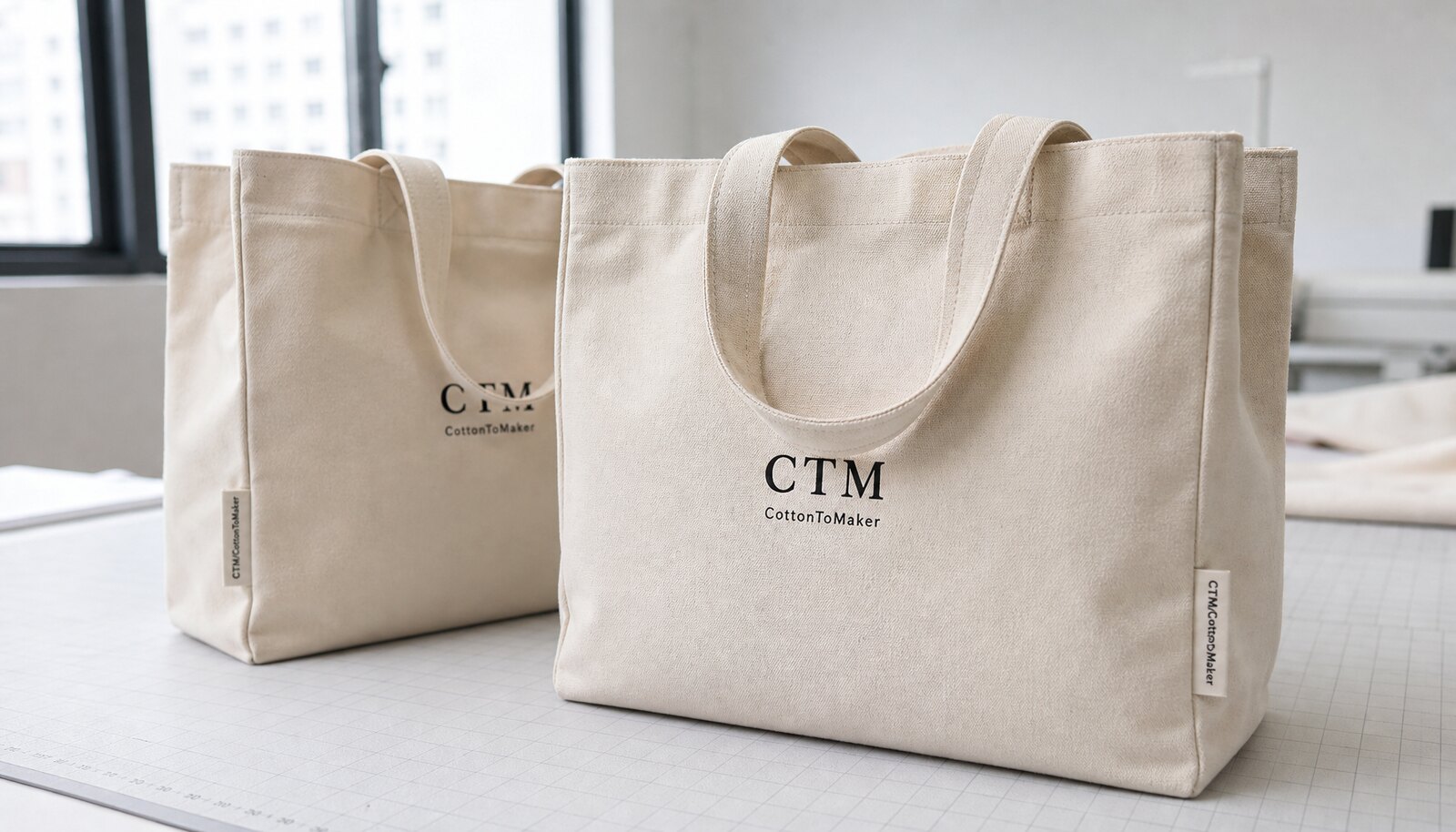
Start With the Use Case, Not the Bag Photo
For cosmetic brands, a printed canvas shopping bag is not just a carrier. It is part of the gift set, the retail display, the influencer mailer, or the in-store purchase experience. That means the bag has to look clean, carry well, and survive handling without turning into a wrinkled afterthought. Before you compare quotes, define how the bag will be used: retail checkout, promo giveaway, bundle pack-in, or premium gift packaging. Each use case changes the right canvas weight, the handle build, and the acceptable print finish.
A good RFQ starts with one sentence on the business need and then turns into measurable specs. If the bag is meant to sit beside skincare boxes or fragrance kits, the fabric should look stable and not too translucent. If it will carry heavier items, the handle and bottom seam matter more than a low unit price. Cosmetic buyers usually lose money when the spec is vague because suppliers fill gaps with their own assumptions. The result is a bag that looks acceptable in sample form but lands poorly in bulk.
- State the bag's role: checkout, gift-with-purchase, event handout, or retail merchandise.
- Define the first impression you want: premium, natural, minimal, eco-looking, or promotional.
- Give the target contents and weight range so the supplier can size the fabric and handles correctly.
Choose Fabric Weight, Finish, and Construction on Purpose
For printed canvas shopping bags, fabric weight drives most of the buyer experience. Around 8 oz to 9 oz works for light promotional use, but cosmetic brands often land better at 10 oz to 12 oz because the bag holds shape and feels more substantial in hand. If the bag is meant to look premium, 10 oz natural canvas is usually the practical middle ground. It prints well, sews cleanly, and avoids the limp look that hurts perceived value. If the product will carry heavier gift sets or several boxed cosmetics, move up in weight before you try to solve strength problems with more stitching alone.
Finish matters almost as much as weight. Natural unbleached canvas gives a softer, more artisanal look, while bleached or dyed canvas makes printed colors read cleaner and more controlled. A tighter weave improves print clarity and reduces the chance that small typography disappears into the texture. Handle material should match the positioning too: self-fabric handles are common for a clean retail look, while cotton tape or webbing can improve durability and reduce sewing complexity. The buyer mistake here is asking for a low-cost canvas bag and then expecting a premium cosmetic shelf presence.
- Use 10 oz to 12 oz canvas for most retail cosmetic shopping bags unless the brief is strictly promotional.
- Confirm whether the fabric is natural, bleached, garment-dyed, or pigment-dyed before sampling.
- Match handle width and reinforcement to the expected load, not just to the printed design.
Compare Print Methods by Artwork Reality, Not Theory
Most cosmetic branding on canvas works best with screen printing when the logo uses solid colors, clean lines, and controlled coverage. Screen print keeps unit cost predictable and handles repeat orders well. It also gives better value when the artwork is simple and the run size is meaningful. If the design has gradients, photo effects, or very small text, screen print can still work in some cases, but the risk of loss in detail rises quickly. Buyers should treat the print method as an engineering choice, not a design preference.
Heat transfer, digital transfer, and other specialty methods can make sense when the artwork changes often or the order is small. They are useful for short campaigns, but they can create a different surface feel and may not age as cleanly on textured canvas. For cosmetic brands, the issue is often not whether the logo is visible on day one, but whether it still looks brand-safe after folding, shipping, and shelf handling. The supplier should show a physical strike-off or print sample on the actual canvas grade you plan to buy, not on a similar-looking substitute.
- Use screen print for simple logos, limited spot colors, and repeatable bulk orders.
- Use transfer methods only when artwork complexity or short-run flexibility justifies the tradeoff.
- Ask for a strike-off on the exact canvas weight and color you plan to approve.
Compare Supplier Routes Before You Compare Price
Two quotes can look close on paper and still produce very different outcomes. A direct factory with in-house sewing and printing usually has better process control, fewer handoffs, and clearer responsibility when something goes wrong. A trading company can still be useful if it manages multiple plants well, but you need to know who is actually making the bag, where the print happens, and who signs off on QC. Cosmetic buyers often lose time when they compare only the unit price and ignore who owns the printing, sampling, and carton packing steps.
The strongest quote is the one that spells out the production route. If the supplier outsources printing, the lead time and color control both become less predictable. If the factory has in-house cutting, sewing, and printing, you can push harder on sample consistency and reorders. That does not automatically mean the direct factory is cheaper overall, but it does make cost drivers easier to see. For a launch order, clarity usually matters more than a few cents of unit price because missed launch windows are more expensive than moderate manufacturing variance.
- Identify who cuts, prints, sews, inspects, and cartons the goods.
- Ask whether the quoted lead time includes material purchase and print setup.
- Compare quotes only after the same spec sheet is sent to every supplier.
Use the Comparison Table to Narrow the Sourcing Route
The right sourcing route depends on what you are trying to control. If the bag is a hero retail item, prioritize direct factory control, physical samples, and tighter QC. If the bag is a fast promotional add-on, a simpler supplier route may be enough as long as the artwork is stable and the packing is clean. Cosmetic brands should also think about how the bag will move through the supply chain. A bag shipped directly to a retailer's distribution center needs better carton labeling than one sent in mixed cartons to a marketing warehouse.
Use the table as a decision filter, not as a spec sheet replacement. The most common mistake is choosing the lowest quote without seeing how the supplier expects to handle print setup, sample approval, and carton packing. That creates hidden costs later, usually in rework, delayed launch, or extra freight. A good comparison route makes the tradeoff visible early: you may pay more for a better production path, but you also reduce the chance of a bad first run.
- Compare supplier options by process control, not just by quoted unit price.
- Treat sample approval and inspection route as part of the sourcing decision.
- Use carton and packing requirements to test whether the supplier understands your channel needs.
Approve the Sample Like a Production Buyer
A cosmetic tote sample should prove three things: the fabric looks right, the print reads right, and the bag can actually be used. Look at the sample under normal indoor light and again near packaging or shelf materials if possible. A logo that feels acceptable on a blank bench can look weak next to a premium carton or fragrance bottle. Check whether the print stays centered after folding, whether the handle length feels balanced in the hand, and whether the fabric has enough body to avoid collapsing into a soft rectangle. That is especially important if the bag will be used for gifting.
The sample process should also confirm hidden production details. Ask for the same stitch pattern, seam allowance, and label placement that will be used in bulk. If the sample is hand-finished in a way that will not be repeated in production, it is not a reliable approval piece. For first orders, a pre-production sample is the best gate before cutting bulk material. If the supplier suggests moving from a photo approval straight to production, the buyer should treat that as a schedule shortcut with quality risk attached.
- Approve the exact canvas weight, color, print position, and handle construction on the sample.
- Compare sample print opacity and logo size against your brand artwork file.
- Reject any sample that uses special handwork that will not be repeated in bulk.
Set QC Thresholds Before the Bags Reach the Carton
A useful inspection checklist for printed canvas shopping bags starts with fabric and moves into sewing, print, and packing. The first reject signals are obvious: holes, dirty marks, broken stitches, uneven handles, or a print that is off-center. After that, the expensive problems are the ones buyers miss until the bags are in use: weak handle anchoring, poor seam balance, color drift across cartons, or print rub-off that smudges on adjacent goods. Cosmetic packaging often sits close to the bag, so an ink issue becomes a brand issue faster than it would in a purely utility item.
Set acceptance criteria in writing before production begins. If you use AQL, align the major and minor defect levels in the PO or quality agreement. If you do not use AQL, define your own limit by defect type and severity. For example, a slightly imperfect stitch line may be acceptable on a promotional run, while a misregistered logo is not acceptable on a retail campaign. The key is consistency: the factory needs to know what stops shipment, what can be repaired, and what must be remade. Without that clarity, inspection becomes negotiation instead of quality control.
- Separate cosmetic defects from functional defects and give each one a clear severity level.
- Test a finished bag with realistic contents before you release bulk shipment.
- Lock the print registration, stitching, and carton count rules in writing.
Pack for Retail Intake, Not Just for Factory Convenience
Packing choices change both labor cost and downstream acceptance. Loose bulk packing can be acceptable for very simple promotional bags, but retail buyers usually need cleaner handling. Individual polybags protect the surface, keep the fold uniform, and make counting easier at the distribution center. The tradeoff is extra material and labor. If the bag has a printed logo, the polybag must not trap moisture or create a pattern impression on fresh ink. For that reason, the factory should confirm ink curing time before sealing or stacking the bags tightly.
Carton logic matters just as much. A carton that is too full causes crushing and sharp fold lines; a carton that is too loose invites movement and corner wear. Ask for carton dimensions, gross weight, pack count, and carton marks in the quote. If your retail customer uses barcode intake, the supplier should place the SKU and PO number where it can be scanned quickly. A clean bag can still fail receiving if cartons are mixed, labels are missing, or the pack count differs from the packing list.
- Define whether each bag needs a polybag, tissue insert, barcode sticker, or hanging tag.
- Match carton pack count to both freight efficiency and retail receiving rules.
- Make sure fresh print has enough cure time before tight stacking or sealing.
Plan Lead Time Around Risk, Not Hope
Printed canvas shopping bags are easy to underestimate on schedule because the bag itself looks simple. In practice, lead time is a chain of smaller steps: fabric sourcing, print setup, sample approval, cutting, sewing, inspection, and carton booking. If any step is vague in the quote, the schedule becomes fragile. Cosmetic launches are especially exposed because the bag often depends on the timing of other packaging or campaign assets. A two-week slip in tote production can hold up a gift set, a retail display, or a pre-launch shipment.
The safest schedule is the one with a clear sample gate and a clear release point for bulk material. If the supplier says bulk production starts before sample approval, that can work only when the artwork and construction are already proven from repeat business. For first orders, you want the sample to expose problems before the factory buys the full fabric lot. Build a small buffer into the plan for print adjustment, carton label changes, or rework. That buffer is usually cheaper than expediting freight after a miss.
- Break the lead time into sample, materials, production, inspection, and freight booking.
- Treat first-order sampling as a gate, not a formality.
- Keep a schedule buffer for artwork corrections and packing label changes.
Build the Quote Around Landed Cost and Repeatability
The best buying decision is not the lowest ex-factory number. It is the quote that tells you what the bag will cost once printing, packing, inland handling, and freight exposure are added together. A supplier can look cheaper by omitting setup charges, understating packing labor, or assuming a lighter fabric than you intended. For cosmetic brands, the landed cost also includes brand risk: a bag that arrives with weak print opacity or poor carton presentation can damage the product line even if the invoice was attractive.
Compare suppliers with a simple sourcing sheet: unit price, sample fee, setup fee, packing cost, carton count, and lead time. Then compare repeat order behavior. Some factories quote aggressively on a first run and become expensive later because they do not have a stable process for the same artwork. Others look more expensive upfront but become reliable on reorders because the print screen, stitch pattern, and carton plan are already locked. That repeatability matters if the bag will stay in the line for multiple seasons or product launches.
- Compare the full quote structure, not only the ex-factory unit price.
- Ask whether setup, screen, and sample charges are one-time or repeated per order.
- Choose the supplier whose repeat-order process is easiest to control.
Specification comparison for buyers
| Spec decision | Recommended option | When it fits | Buyer risk to check |
|---|---|---|---|
| Supplier route | Direct factory with in-house printing | You need tighter control on print color, sample speed, and repeat orders | Outsourced printing can hide extra handling cost and extend lead time |
| Canvas weight | 10 oz to 12 oz natural cotton canvas | Retail cosmetic bags that need a premium hand feel and good structure | Light canvas can look cheap, show contents, and distort after packing |
| Print method | Screen print for simple logos and spot colors | Your artwork is bold, has limited colors, and needs stable unit cost | Fine gradients, tiny text, and strong color matching can fail without a strike-off |
| Artwork approval route | Physical pre-production sample plus photo signoff | The bag is tied to a launch, seasonal campaign, or brand color standard | Photo-only approval misses texture, scale, and print opacity issues |
| Inspection route | Factory inline check plus final AQL inspection | You care about consistency across a large run and carton-level control | Final inspection alone may miss problems already packed into cartons |
| Packing method | Individual polybag with master carton labeling | You ship to retail DCs or need clean shelf-ready handling | Loose packing can create dust, fold marks, and carton mix-ups |
| Handle construction | Cross-stitch or reinforced box stitch at stress points | Bags will carry cosmetic kits, gifts, or heavier sample sets | Weak handle reinforcement causes early returns and image damage |
| MOQ strategy | One production colorway with controlled artwork variants | You want a lower first order without inflating setup cost | Too many artwork versions can push the quote up and complicate QC |
Buyer checklist before sampling
- Lock the finished bag size, including seam allowance and usable interior width.
- Specify canvas weight in GSM or oz and state whether the fabric should be bleached, natural, or dyed.
- Define the print method, print placement, ink color, and acceptable color tolerance.
- State handle length, handle width, and whether handles are self-fabric, webbing, or cotton tape.
- Confirm stitch reinforcement at handle anchors, side seams, and stress points.
- Approve one physical pre-production sample before bulk cutting begins.
- Set packing format, carton pack count, carton markings, and any barcode or SKU label needs.
- Request the supplier's standard QC method and whether they can support AQL inspection.
- Ask for lead time split by sample, material sourcing, production, and carton booking.
- Compare quotes using the same specification sheet so fabric, printing, and packing are priced on equal terms.
Factory quote questions to send
- What exact canvas weight and weave construction are you quoting, and is that before or after washing?
- Is the print included with one color, two colors, or full artwork setup, and what is the surcharge for extra colors?
- What is your MOQ by size and print design, and does MOQ change if I use a different handle or label?
- Will you produce a physical pre-production sample, and what is the sample fee if the order proceeds?
- What is included in the quoted price: fabric, printing, sewing, label, inner packaging, and master carton?
- What is the expected lead time after sample approval, and what part of that time is material purchase versus sewing?
- How do you handle print color matching, and can you reference a Pantone target or physical swatch?
- What inspection standard do you use for sewing and printing defects, and can I nominate a third-party inspector?
- How will the goods be packed per carton, and what is the carton size and gross weight estimate?
- What additional cost should I expect for rush orders, custom labeling, or mixed size cartons?
Quality-control points to confirm
- Fabric weight matches the approved spec within a tight tolerance and feels consistent across the roll.
- Canvas is free from holes, heavy slubs, oil marks, dye streaks, and visible contamination.
- Bag dimensions are within the agreed tolerance for width, height, and gusset after sewing.
- Handle length is even on both sides and the reinforcement stitching is secure with no loose ends.
- Seams are straight, thread tension is balanced, and no skipped stitches appear on load-bearing zones.
- Print is centered, sharp, and aligned to the artwork proof with acceptable color variation only.
- Ink penetration is controlled so the reverse side does not show excessive strike-through unless specified.
- Finished bags pass a basic load test and do not distort badly at the handle base or bottom seam.
- Labels, side tags, or care marks are placed correctly and sewn cleanly without curling or peeling.
- Cartons are packed to the agreed count, marked correctly, and show no crushing, moisture, or mixed SKU errors.