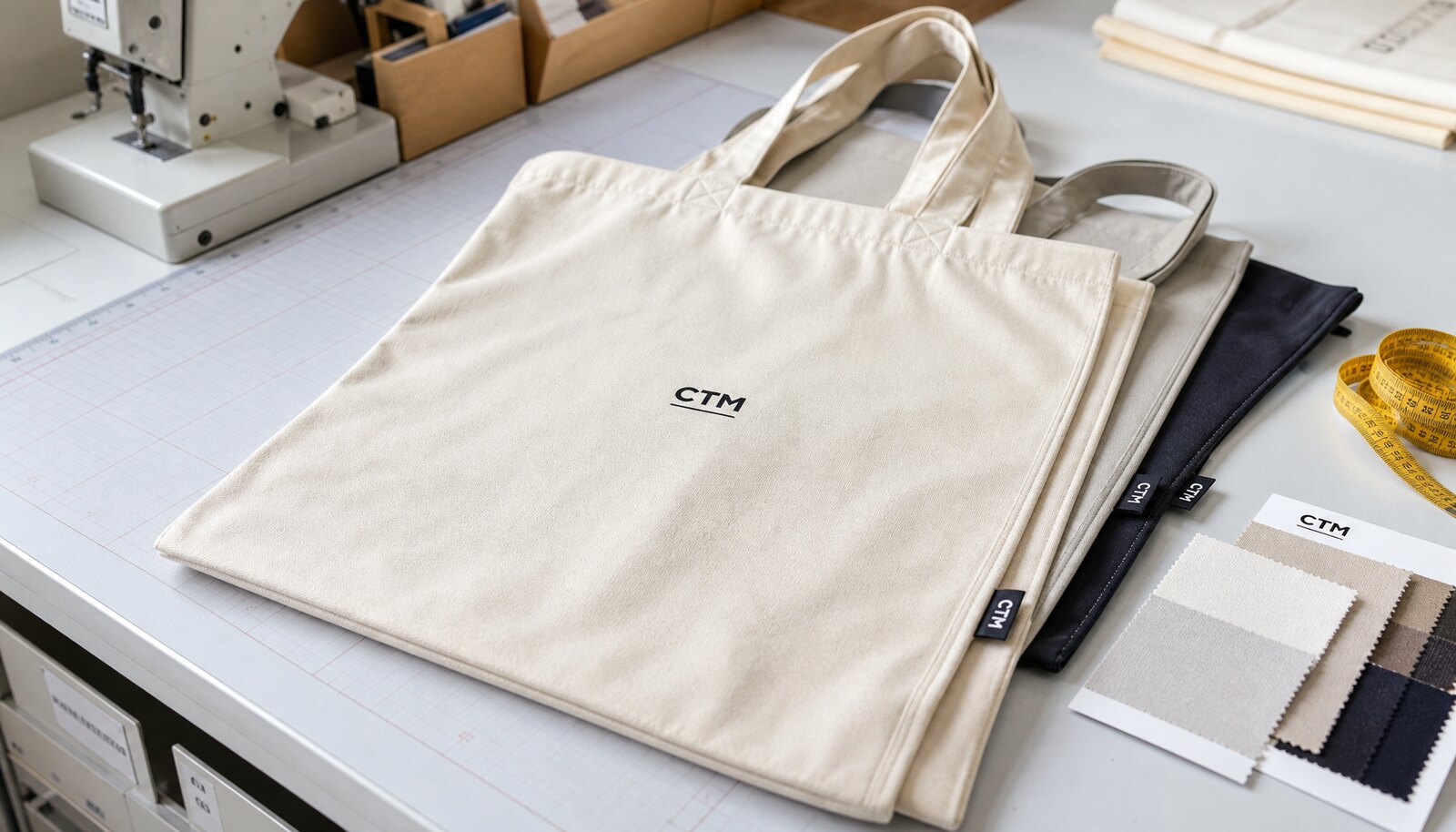
Why material choice matters more than artwork for corporate event tote bags
For corporate events, the tote is judged twice. First, attendees pick it up at registration, at the booth, or near the venue entrance. Second, they decide later whether it is worth reusing. That is why material specification matters as much as the logo. A sharp graphic on weak fabric still feels cheap, while a simple one-color print on the right canvas can look credible, survive the event floor, and keep working after the event ends.
Procurement teams often spend too much time approving artwork and too little time defining the bag itself. That is where many sourcing problems begin. A quote can look competitive until the event load changes. Once brochures, notebooks, samples, a bottle, or a boxed gift are added, the tote may sag, wrinkle, or fail at the handles. For printed canvas shopping bags for corporate events, the real job is controlled carrying, controlled presentation, and predictable reuse.
The most useful buying approach is to define the use case first. Is the bag meant for a lightweight conference kit, a premium welcome pack, a sponsor gift, or a retail-style giveaway that will be reused after the event? Each of those uses changes the material balance. If the tote only needs to hold a notebook and brochure set, a moderate GSM range is enough. If it must carry heavier inserts or stand up visually beside premium merchandise, the construction needs more body and a cleaner sewing standard.
This is also why supplier conversations should start with performance, not decoration. Ask what load the bag is built for, what fabric construction they recommend, and whether the print method will hold up when the tote is folded, stacked, and transported. Those answers tell you more about finished quality than a polished mockup ever will. In procurement terms, the bag is a functional packaging item with brand value attached, not just a canvas surface for graphics.
Start with the fabric: GSM, weave structure, and surface behavior
For most corporate event totes, 280–320 GSM cotton canvas is the practical starting point. It gives enough body to feel like a real product without becoming unnecessarily heavy or expensive. In sourcing terms, this range usually fits brochure packs, conference kits, and branded gifts that need to look presentable in hand and on a table. If the bag must carry a bottle, catalog, or boxed item, or if the event is premium enough that hand-feel matters almost as much as function, 350–400 GSM is usually the stronger choice.
What buyers sometimes miss is that GSM alone does not guarantee a good bag. Weave construction has a major impact on print quality, stitching behavior, and the finished surface appearance. A 300 GSM fabric with a stable, even weave can outperform a heavier canvas with loose yarn variation or uneven thickness. When the weave is too open, logo edges can blur, fine text can break up, and seams can look puckered after sewing. That is why fabric photos, swatches, and a pre-production sample matter more than a catalog description.
For most event programs, natural cotton canvas is the most commercial choice. It accepts screen print well, keeps the look straightforward, and tends to be easier to compare across suppliers. Bleached canvas can give a brighter print base, but it can also show dirt more quickly. Washed canvas has a softer, more relaxed hand-feel, but buyers should inspect the lot carefully because the finish can introduce more surface variation. If the event requires a more premium or lifestyle look, that may be acceptable; if the brand wants clean, repeatable print edges, the fabric should be tested under the lighting and handling conditions the event will create.
A useful sourcing habit is to ask for fabric details in more than one way: GSM, weave count or yarn density if the supplier can provide it, and the expected shade behavior from lot to lot. If the vendor only says “high-quality canvas,” that does not help procurement compare offers. The more precise the fabric description, the easier it is to prevent surprises after the first production run. Buyers should also ask whether the fabric is raw, pre-shrunk, or finished, because dimensional change after printing can affect both size and appearance.
Choose the construction variant that fits the event, not just the sample room
Canvas is not one material in practice; it is a family of construction choices. Two bags with the same nominal GSM can behave differently if one uses a tighter weave, a denser thread count, or a more consistent yarn. Buyers sourcing for events should think in terms of visible performance. Does the fabric lie flat enough for a clean logo? Does it resist seam puckering? Does it keep its shape when packed, stacked, or folded for distribution? Those questions are more useful than chasing the heaviest possible cloth.
If the event team values structure and a tidy silhouette, a tight plain weave cotton canvas usually performs better than a softer or slubbier build. If the event wants a more relaxed, fashion-led look, a washed finish can be acceptable, but only if the buyer is willing to allow some variation in appearance. In either case, ask the supplier to identify any finishing process used on the canvas. Brushing, washing, enzyme treatment, or softening agents can change print coverage and hand-feel enough to matter in bulk.
There is also a practical trade-off between visual purity and manufacturing tolerance. A tighter fabric can improve print sharpness, but if it is too stiff, sewing may leave more pronounced creases at the gusset or corners. A softer bag may fold more easily, but the logo may distort at stress points. The right answer is not a perfect fabric. It is a fabric that matches how the bag will actually be used at the event and afterward.
A common procurement mistake is approving a sample based only on how it looks empty. Event bags are handled in two different states: flat and filled. The approved sample should be checked both ways, because the seam behavior and logo appearance can change once the bag is loaded with the actual insert set. A bag that looks fine on the table but twists under load is not ready for bulk approval.
Match print method to artwork complexity, quantity, and durability risk
For most printed canvas shopping bags for corporate events, screen print remains the default commercial choice. It handles one- or two-color logos efficiently, gives a flatter visual result, and is usually the most cost-effective when quantities are meaningful. For a corporate event with a simple mark, event name, or sponsor logo, it is hard to beat screen print on durability and unit economics. Buyers should not assume the cheapest method is always the most durable, but in many standard tote programs, screen print does both jobs well.
Heat transfer and digital print are useful, but only when the artwork demands them. If you need gradients, photographic detail, tiny sponsor logos, or multi-color visuals that would require too many screens, then transfer or digital may be the right trade-off. The buyer should still ask what the print looks like after folding, stacking, and repeated handling. A transfer that looks sharp on one sample can crack at the fold line or lift at the edges if the bag is packed tightly. Digital print can also show softer edges on textured canvas than it does on a proof file.
Ink and curing matter more than many quote sheets reveal. On canvas, a good print is not just about color; it is about coverage, adhesion, and resistance to rub. Ask what ink system is used, how it is cured or heat-set, and whether the supplier tests for rub-off before packing. If the tote will be bundled with other items, the print must survive pressure and movement inside the carton. If the bag will be distributed individually, the buyer can be a little less strict on packing rub, but not on adhesion.
The safest approach is to align the method with the event use. When the artwork is simple and the run is moderate to large, screen print is usually the most efficient route. When the design is visually complex, push for a sample that shows the actual material, the actual print method, and the actual fold condition. That prevents a polished proof from hiding a production weakness. Buyers should also ask whether the artwork needs underbase printing on dark or dyed canvas, because that can change both opacity and cost.
Use seam and handle construction to separate a promo bag from a reliable event bag
Handle construction is one of the fastest ways to tell whether a tote is built for real use or just for a photo. Self-fabric handles look clean and keep the bag visually unified, while cotton webbing handles usually feel more robust and are often better when the bag needs to carry a heavier load. For corporate events, both can work; the better choice depends on the desired look, the carry weight, and the price ceiling. What matters is not only the handle material but how it is attached.
Reinforcement should be explicit in the spec. Ask whether the factory uses an X-box stitch, a bar-tack, or another reinforcement pattern at the stress point. A weak handle may pass a quick visual check and still fail when the bag is loaded repeatedly. Also confirm the handle length and drop length. If the handles are too short, the bag can sit awkwardly on the shoulder or pull at the opening. If they are too long, the bag can look sloppy and drag during event pickup.
Seam allowance and bottom construction deserve the same attention. Side seams that are too narrow can distort after a few uses. A bottom seam that is not reinforced enough may split at the corners when brochures and boxed items are packed tightly. Buyers should ask how the bag is sewn at the load points and whether the pattern is single-needle, double-needle, or otherwise reinforced. The exact method can vary by factory, but the stress points should be visible and consistent.
A useful judgment rule is simple: if the bag is intended to be reused, stitching is part of the product, not a hidden manufacturing detail. A tote with a weak seam is a short-lived marketing item, no matter how good the logo looks on day one. Buyers should also ask for a light pull test on the handle anchors, because a factory can often catch weak sewing before cartons are sealed.
Build the quote around the real cost drivers, not just unit price
A useful supplier quote should separate fabric, printing, sewing, packing, and export carton preparation. If the quote is only a single landed or ex-factory number, procurement cannot tell whether the supplier is offering the same bag spec or quietly simplifying the build. For printed canvas shopping bags for corporate events, the quote should be itemized enough to reveal what changes when you move from one fabric weight or one print color to another.
The main cost drivers are predictable. Higher GSM raises fabric cost and can also increase cutting waste and freight weight. More print colors add screens, setup, or transfer complexity. Reinforced handles require more labor. Optional retail folding, individual polybagging, insert cards, or label stitching adds packing time. Even carton dimensions can move the final number because they affect freight efficiency. Buyers do not need to eliminate these features; they need to know what they cost so they can decide where premium value actually matters.
There is also a hidden trade-off between unit cost and process control. A very low quote can signal that the supplier is using a lighter fabric, a simpler stitch pattern, smaller print coverage, or minimal QC. That may be acceptable for a low-risk giveaway, but it is not acceptable if the bag will be distributed at a flagship event or paired with expensive merchandise. Procurement teams should compare offers on the complete specification, not only on the displayed unit price.
A practical tactic is to ask for base pricing plus optional upgrades. For example: quote the standard 300 GSM natural canvas bag with one-color print and bulk carton packing, then separately quote heavier canvas, longer handles, extra print color, and retail folding. That structure makes trade-offs visible and keeps the team from arguing over assumptions after the first quote arrives. It also makes it easier to identify whether a supplier is truly competitive or simply quoting a thinner build.
Compare sourcing routes before you compare the quote sheet
A direct factory quote and a trading-company quote can look similar at first glance, but they carry different control points. Direct factory sourcing is usually stronger when the buyer wants repeatability, detailed construction control, and a clear line of responsibility for fabric, print, and sewing. It also makes it easier to lock a known sample and repeat it next season. For recurring corporate event programs, that consistency is often worth more than a small nominal discount.
A trading route can still make sense. If the order mixes several bag styles, if artwork changes frequently, or if the internal team wants one point of contact across multiple products, a trading partner can simplify coordination. The caution is that the quote must still show who is making the bag, who is checking the print, and who signs off the final cartons. Without that visibility, a trading-layer quote can hide differences in fabric source, stitch quality, or packing detail.
The procurement question is not “factory or trader?” in the abstract. It is “which route gives us the production control we need for this specific event?” If the bag is a repeat SKU, direct factory sourcing usually gives better continuity. If the project is a one-off campaign with mixed items and short approval cycles, a capable intermediary may reduce admin load. The key is to avoid paying factory-level pricing for trading-level control, or trading-level pricing for a spec that really requires direct oversight.
For buyers who manage multiple events across the year, it can help to keep a retained master sample and a simple spec sheet that records the exact canvas, print, handle, and packing details. That makes it easier to detect whether a new quote is truly matching the previous build or just resembling it on paper. It also gives the procurement team a better basis for negotiating substitutions when supply is tight.
Use the sample to prove the spec, not to admire the design
The sample stage should answer production questions. Hold the bag under the same sort of light the event will have, because canvas shade and print density can look different under warm indoor light, daylight, or camera flash. Measure finished size, handle drop, print placement, and seam allowance. If the bag must stand upright on a table or hold a boxed item without collapsing, test it with a realistic load rather than just feeling it empty in your hand.
The most valuable sample review is a short comparison between the approved sample and the expected bulk order. Record the finish, the canvas weight if the supplier can provide it, the print color reference, and the exact acceptable tolerance for size and placement. If the supplier changes the fabric mill, screen mesh, ink system, or sewing line after sample approval, that should trigger another check. In procurement terms, a sample is not decoration; it is the reference standard for the bulk run.
It also helps to test the bag in a way that mirrors real event handling. Fold it the way the event team will stack it. Place the expected insert set inside. Run a few carry cycles. Check whether the print cracks at the fold, whether the handles twist, or whether the top edge distorts when loaded. These are the issues that show up in the venue and later become service complaints, even if the sample looked perfect on a table.
A disciplined sample process avoids false confidence. If the first sample looks good but the bag behaves badly when filled or folded, the quote is not yet ready for approval. That discipline saves more time than arguing over a reprint after the goods have shipped. Buyers should also keep the approved sample labeled with the date, artwork version, and packing method so that later reorders do not drift quietly.
Set QC thresholds that catch the failures buyers actually see
The common tote failures are predictable: off-center logos, weak handle stitching, loose threads at the side seams, print that rubs in packing, and fabric that varies too much from carton to carton. QC should focus on those issues first. A bag can look acceptable from a distance and still be a poor production piece if the handle reinforcement is weak or the print was not cured properly. For event buyers, the goal is not perfection for its own sake. It is consistent, presentable output that survives handling.
Acceptance criteria should be concrete enough for a factory to inspect. Logo placement should stay within a practical tolerance from the approved sample. The exact number can vary by factory and bag size, but the key is to define it in writing before production begins. Stitching should show no skipped stitches at load points. Print should not smear, block, or crack when the bag is folded in its packed state. The carton should protect the handles and the front panel from compression damage.
It is also wise to ask how the factory checks quality before packing. Do they inspect print registration? Do they trim threads? Do they do a pull or load check on handles? Do they compare the first and last carton against the approved sample? Those steps may seem basic, but they reveal whether the supplier is managing the process or just sending bags through a line. A detailed QC response is often more useful than a broad promise of “good quality.”
Procurement should also keep one sourcing caveat in mind: not every defect can be solved by a tougher inspection. If the fabric is too loose, the print method is mismatched, or the handle is under-designed, no amount of carton sorting will fix the underlying issue. Good QC catches process drift; good specification prevents the defect in the first place. For that reason, the spec should name the bag’s intended load and expected reuse level before production starts.
Packing and carton planning can change landed cost more than buyers expect
Packing is often treated as a detail, but it affects labor, carton count, freight volume, and perceived quality. Bulk packing in export cartons is normally the lowest-cost option for event bags because it keeps handling simple. If the print is likely to rub, or if the bags need to arrive presentation-ready, then add a protective layer only where it is truly needed. Full individual polybagging is usually unnecessary for standard event distribution and can create more cost and waste than the buyer intended.
Ask for carton dimensions, carton weight, and the number of bags per carton before comparing quotes. Those figures influence air and sea freight, warehouse handling, and sometimes the way the goods will be received by the event team. A lower unit price can disappear once the cartons are too bulky, the pack count is inefficient, or the carton style is too soft for stacking. In other words, packing is part of the product economics.
The best practice is to tie packing to the end use. If the bags will be handed out at a conference desk or booth, bulk carton packing is usually enough. If they will sit on display or be distributed as part of a premium kit, a neater fold and controlled protection may be worth the extra cost. Ask the supplier to quote both versions if you are not sure, so you can compare the delta instead of guessing.
One more sourcing caveat: overpacked cartons can hide problems until opening day, while underpacked cartons can crush print panels and distort handles. A sensible carton spec gives enough protection for transport without turning the bag into an overengineered package inside a package. The carton count should also match the event team’s receiving plan, because awkward pack counts can slow distribution even when the product itself is correct.
Specification comparison for buyers
| Spec decision | Recommended option | When it fits | Buyer risk to check | Procurement takeaway |
|---|---|---|---|---|
| Canvas weight | 280–320 GSM cotton canvas for standard event bags; 350–400 GSM for premium hand-feel, boxed inserts, or bottle carry | Conference kits, sponsor packs, welcome bags, and event giveaways that need a structured look | Too-light fabric can go semi-translucent after printing; too-heavy fabric increases freight and can be overbuilt for a single-day event | Use the middle range unless the load or brand presentation clearly justifies a heavier bag |
| Weave and surface | Tight plain weave cotton canvas with low slub variation and consistent yarn density; washed canvas only when a softer, relaxed look is part of the brief | Brand-led events where logo clarity, flat print edges, and repeatability matter | Loose weave can blur fine text, distort logos, and cause seam puckering; washed finishes can vary more from lot to lot | Ask for weave description, fabric photos, and swatches before accepting a price comparison |
| Print method | 1–2 color screen print for most corporate event orders; heat transfer or digital print only when the artwork is complex or the run is short | Simple logos, event names, and sponsor marks on medium to large quantities | Transfers can crack at fold lines; digital print can look softer on textured canvas than on proof files | Choose print method by artwork and durability, not by whichever option looks cheapest on a quote sheet |
| Handle style | Self-fabric handles for a clean, unified look; 25–30 mm cotton webbing handles when the bag needs more perceived strength | Reusable event bags that may carry catalogs, bottles, or boxed gifts | Short handles, weak stress-point stitching, and inconsistent handle drop are common failure points | Handle design is a fast way to distinguish a presentation tote from a disposable promo bag |
| Reinforcement | X-box stitch or bar-tack reinforcement at handle anchors and high-stress seams | Any bag expected to be reused or to carry a real load | A neat-looking bag can still fail if reinforcement is too light or inconsistent across cartons | Do not treat sewing as a hidden detail; it is a key performance specification |
| Supplier route | Direct factory sourcing for repeat programs and fixed specs; trading company only when styles, artwork, or packing vary often | Buyers with stable volume forecasts and clear QC requirements | A layered quote can hide changes in fabric source, print control, or carton packing | Use the sourcing route that gives the best visibility into the actual production controls |
| MOQ logic | Natural canvas and one-color art usually support lower MOQs; dyed fabric, multiple print colors, and special packing raise MOQs | Single-event programs or annual repeat orders with fixed artwork | Low-MOQ offers may hide setup fees or limit fabric and packing choices | Ask whether MOQ changes by colorway, print method, or pack format |
| Packing format | Bulk export carton packing for standard distribution; limited protection only when print rub or presentation requires it | Conference handout, booth distribution, and retail-style gifting | Overpacking raises labor and freight; underpacking can cause scuffs, crush marks, and distorted handles | Packing belongs in the quote because it changes landed cost |
| Lead time | Sample 5–10 days; production 20–35 days after sample approval for standard builds | Orders with standard canvas, one logo, and frozen artwork | Artwork changes, fabric substitutions, or label revisions can reset the schedule | Treat approval timing as part of the project plan, not only as factory lead time |
Buyer checklist before sampling
- Confirm finished size, canvas GSM, weave type, and target hand-feel before requesting quotations.
- Send vector artwork with exact logo size, color count, placement, and any label, hangtag, or woven trim requirement.
- State whether the bag will hold brochures only or also catalogs, bottles, boxed gifts, or sample products.
- Define handle length, handle drop, reinforcement method, seam allowance, and whether the bag must be folded, flat-packed, or presentation-packed.
- Request sample photos, a pre-production sample, carton count, master carton dimensions, and any packaging tolerance in the quote.
- Ask suppliers to separate fabric, printing, sewing, packing, and freight-ready export costs.
- Ask which QC points are checked before packing: fabric shade, print registration, stitch density, thread trimming, and carton count.
- Confirm whether optional upgrades such as heavier canvas, longer handles, or retail folding can be priced separately for trade-off comparison.
- If the tote will be reused after the event, ask for an approved master sample to lock the construction standard for repeat orders.
Factory quote questions to send
- What canvas GSM, weave density, and fabric finish are included in the quoted price, and what tolerance range do you allow on bulk fabric?
- Is the price based on natural cotton canvas, bleached canvas, or dyed canvas, and how much shade variation should we expect between lots?
- How many print colors are included, what printing method is proposed, and what are the setup, screen, plate, or transfer charges?
- What ink system do you use on canvas, and how do you cure or heat-set it to reduce cracking, rub-off, or wash issues?
- What is the MOQ by colorway, print variant, handle option, and packing style rather than only a single headline number?
- What handle material, handle width, handle length, seam allowance, and reinforcement stitch are included in the quoted build?
- Is the bottom single-stitched, double-stitched, or reinforced at the stress corners, and can you show a sample photo of the seam finish?
- What sample type is included before bulk production, and what design, fabric, or packing changes would trigger a new approval sample?
- How many bags are packed per carton, what are the carton dimensions, and what is the gross weight per carton?
- What QC checkpoints do you perform on fabric GSM, print alignment, stitch strength, thread trimming, and carton handling?
Quality-control points to confirm
- Fabric GSM should match the approved spec within a practical production tolerance, and the weave should be uniform enough that print edges stay clean across the full run.
- Canvas shade should remain consistent enough that the tote does not look visibly different from carton to carton, especially on natural or bleached fabric.
- Logo placement should be centered or positioned within the agreed tolerance, with no obvious tilt, drift, or placement drift across cartons.
- Print opacity should be sufficient on natural canvas so the base fabric does not show through key brand areas, especially around thin strokes and small type.
- Ink coverage should be even, and the print should be fully cured or heat-set so it does not transfer to adjacent bags when packed tightly.
- Stitching at handles, side seams, and bottom corners should be tight, even, and free from skipped stitches, loose threads, or weak backtacks.
- Handle length, drop length, and reinforcement method should match the approved sample and should not vary noticeably across production lots.
- Seam allowance should be consistent enough that the bag shape does not twist, flare, or pucker when loaded with a realistic event kit.
- Carton quantity, carton label data, and inner packing method should match the approved packing spec and the agreed count per carton.
- Random drop, shake, and compression handling should not cause seam failure, major wrinkling, or print cracking beyond the accepted limit.