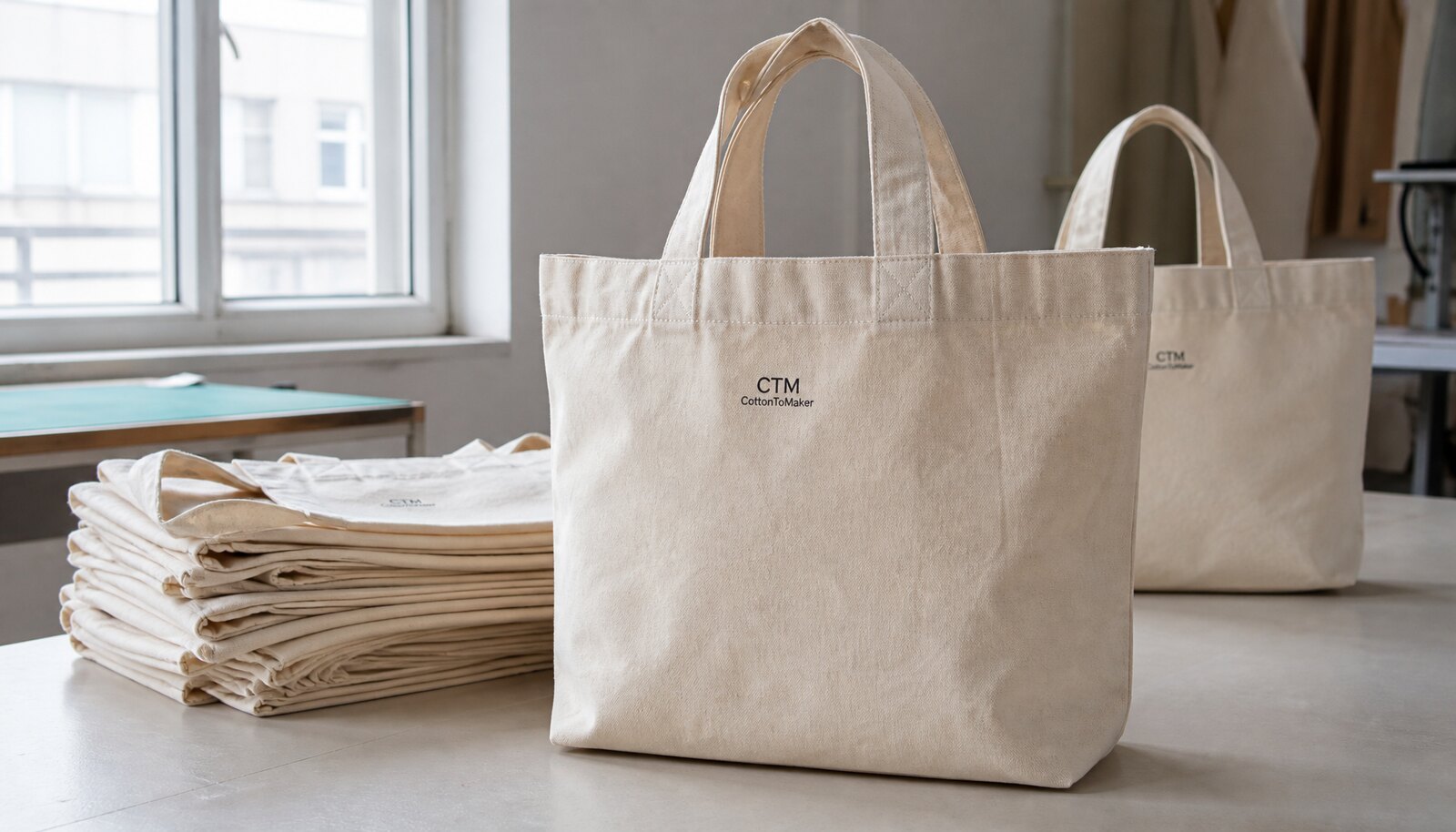
Why corporate event buyers need a tighter QC standard
Printed canvas shopping bags for corporate events look simple, but the buying risk is usually hidden in the details. A bag can look fine in an artwork proof and still arrive with weak handles, thin fabric, crooked logo placement, or packing that creates extra work for the event team. Procurement failures here are rarely dramatic; they are expensive because they show up late, when the event date is fixed and there is no room to restart production.
The right control point is the use case, not the artwork file. Event bags usually need to carry catalogs, notebooks, bottled drinks, sample packs, and branded inserts, so the buyer has to control fabric weight, seam structure, print durability, and carton packing from the start. If those items remain vague, the supplier will fill in the blanks with a default spec, and default is often too light, too loose, or too generic for a branded event program.
- A mockup is not a manufacturing spec.
- The event team cares about fast distribution, not just how the bag looks in one photo.
- If the bag is meant to be reused, handle strength and print durability matter more than decorative details.
Lock the product spec before the logo file
Many RFQs jump straight to artwork, but the fabric defines the bag first. Canvas weight, weave tightness, and finish all affect how the logo prints, how the bag hangs, and whether it keeps its shape after sewing. A 10 oz canvas may be enough for light handouts, but it is easier to distort under print pressure and it tends to feel less controlled in the hand. For most corporate events, 12 oz / about 340 GSM is a practical baseline, while 16 oz / about 450 GSM is better when the bag needs to feel substantial or carry heavier inserts.
The other spec items need the same level of precision. State the finished width, height, gusset, handle length, handle width, seam type, and whether the bag is open top, snap top, or zipper top. If you want a colored canvas, clarify whether the fabric is natural, bleached, dyed, or printed after weaving, because each option changes cost, color stability, and lead time. A clear spec sheet removes a lot of back-and-forth later.
- Document size tolerances before quote comparison, especially for width, height, gusset, and handle symmetry.
- Tie the bag dimensions to the actual event contents so the supplier is not guessing at capacity.
- If the logo must sit close to a seam, set the placement tolerance in millimeters, not in general terms.
Compare suppliers by production path, not just unit price
A quote list with one number per supplier is not enough to buy confidently. You need to know whether the offer is coming from a direct factory, a broker, or a trading company consolidating different products. Those routes can all work, but they do not carry the same level of control. A direct factory usually gives better visibility into fabric sourcing, stitching line control, and final inspection responsibility, while a trading route can be useful for mixed-item programs or small test volumes where speed matters more than deep process control.
The practical way to compare is to normalize the quotes by spec, not by headline price. If one supplier is quoting a lighter canvas with a single-color print and another is quoting heavier canvas with reinforced handles, those are not equivalent offers. The table below is meant to force a like-for-like comparison so the buyer can see where the real tradeoffs sit: price, lead time, inspection rigor, and reorder stability.
- Normalize fabric weight, print method, and handle construction before you compare unit price.
- Ask who owns the final QC decision and whether the factory will send a pre-ship photo set.
- Treat a very low quote as a prompt for more questions, not as a win by default.
Ask for procurement evidence, not just a promise of quality
The strongest supplier files contain evidence that the plant can actually make the product consistently. For printed canvas bags, that evidence may include a factory profile, production photos, prior inspection reports, machine list, calibration records, lot traceability notes, and test reports for fabric or print claims where relevant. If the supplier is making compliance claims, such as recycled content, organic fiber content, or low-impact dye claims, request the underlying certificate and the exact scope instead of relying on a logo on a brochure.
This matters because event buyers often inherit supplier confidence where they should have proof. A supplier may say the fabric is thick, the ink is durable, or the stitch line is reinforced, but procurement should still ask for the material spec, a sample report, and a QC record that shows how the factory checks those claims. Evidence reduces disputes later, especially when the shipment is a one-time event order and there is no long production history to fall back on.
- Request the supplier's spec sheet, not only the sales brochure.
- If compliance or sustainability claims are part of the buying decision, ask for certificate scope and issue dates.
- For critical orders, request a sample of the factory's final inspection record or AQL report format before approving the PO.
Sample approval should prove the real production method
A digital proof can confirm artwork, but it cannot prove the bag. The pre-production sample needs to use the final fabric, final thread, final print method, and final trim details. If the supplier sends a hand-made mockup, a substitute fabric, or a sample without the final reinforcement, the sample is useful for layout only. It should not be treated as final approval for production.
The most reliable sample review is hands-on and simple. Measure the bag against the drawing, compare handle length side to side, check how the logo sits relative to the seam, and rub the print with a dry cloth to see whether it smears or lifts. If the bag will be filled with brochures or sample products, place the actual contents inside the sample and look for distortion, bottom sag, or handle pull. That one step often reveals issues that a flat sample will hide.
- Retain one approved sample with the date, version number, and sign-off names.
- Mark any changes from the initial quote directly on the sample sheet so the factory cannot claim a misunderstanding later.
- If the sample does not use the same fabric lot or print setup, treat it as a prototype rather than approval.
Set measurable QC thresholds before production starts
The fastest way to avoid dispute is to replace vague language with measurable criteria. 'Good quality' does not help anyone at receiving. A buyer should define what is acceptable for print clarity, stitching, size, odor, stains, and packing format. For event bags, the most important defects are usually obvious: wrong print placement, weak handles, seam failure, and pack-out that creates extra labor. Cosmetic imperfections matter too, but they should be ranked behind function and brand legibility.
An AQL framework gives the receiving team something concrete to work with. Many buyers use AQL 2.5 for major defects and AQL 4.0 for minor defects on promotional merchandise, but the point is not the number itself; it is the discipline of using one standard consistently. The PO should name the inspection level, the sample plan, and the defect definitions. When the cartons arrive, the inspector should record carton numbers, sampled pieces, defect types, pass/fail outcomes, and photos for any rejected units.
- Define major defects as items that affect use, safety, brand clarity, or pack-out efficiency.
- Define minor defects as cosmetic issues that do not affect use, but do not leave them unlisted.
- Require a receipt log with carton number, sample count, defect code, and final disposition for each problem found.
Packing and labeling can make or break receiving efficiency
Packing is not an afterthought on event orders. A bag that arrives in the wrong fold pattern, with poor carton labeling, or with no moisture protection can create delay even when the bags themselves are acceptable. Flat-folded packing is usually the most efficient option for corporate events because it keeps freight predictable and makes receiving faster. Inner polybags should be used selectively, mainly when the print is fresh, the destination is humid, or the bags need extra surface protection.
The buyer should also think about the end-user workflow. If the event team needs to hand out bags at a registration desk, then carton quantity, carton markings, and fold consistency matter more than retail presentation. If the bags are going straight to a client-facing gift program, a more finished pack-out may be justified, but it should still be specified. The receiving file should state carton count, gross weight target, carton dimensions, and whether palletization is required.
- Flat-folded cartons usually reduce freight waste and simplify counting.
- Use moisture protection only when the destination climate or packing cycle justifies it.
- Make sure the carton label matches the packing list exactly, including style code and PO reference.
Lead time needs milestones, not vague shipping language
Corporate event schedules are usually fixed, so lead time risk matters as much as unit price. The buyer needs a schedule that separates sample lead time, sample approval time, mass production, packing, and shipment booking. If the factory says 'about one month' without naming the start point, the date is not controlled enough for a time-sensitive order. A good schedule states when the clock begins, what stops it, and what happens if artwork or sample approval changes midstream.
Change control is where a lot of delays are created. If the buyer updates the logo file, changes the handle length, or adds a second print location after the sample is approved, the factory may need new screens, new cutting patterns, or a fresh inspection cycle. That does not make the supplier slow; it means the specification moved. To keep the order on track, freeze the spec at a defined date and keep all changes in a written revision log.
- Separate sample timing from bulk production timing in the PO.
- Make the supplier state whether lead time starts at deposit receipt, art approval, or sample sign-off.
- Use version control for art files, spec sheets, and packing instructions so the factory does not work from mixed documents.
Use landed cost, not ex-factory price, as the decision metric
The cheapest ex-factory quote is not always the best buy. Freight, carton volume, packing labor, sample cost, reinspection cost, and emergency replenishment risk all change the real cost per accepted bag. A lighter bag may save on material, but if it tears, prints weakly, or arrives with handle defects, the actual cost per usable unit goes up. For event programs, procurement should think in terms of accepted units delivered on time, not just cartons shipped.
A good comparison also separates the visible cost from the hidden cost. Visible cost is the unit price on the quote. Hidden cost is the time spent correcting art, chasing samples, reworking labels, arranging last-minute replacements, or handling a disputed inspection result. If one supplier is stronger on evidence, sample discipline, and final QC records, that supplier can be lower risk even when the headline price is slightly higher. That tradeoff is often the right choice for a live event calendar.
- Compare cost per accepted bag, not just invoice price per shipped bag.
- Include freight, inspection, packing, and rework exposure when you evaluate total value.
- A repeat supplier with clean production records can be cheaper across two or three event cycles.
Turn the checklist into a reusable RFQ package
A buyer-ready RFQ should be specific enough that each supplier quotes the same product. That means one page for dimensions, one page for print art and placement, one page for packing, and one page for QC and inspection expectations. Attach the approved sample photos, the color target if relevant, and the sign-off notes for any details that are easy to misunderstand, such as handle length, gusset depth, or whether the bag must be folded a certain way for pack-out. The clearer the RFQ, the fewer assumptions the supplier can make.
For procurement teams that reorder the same style, keeping a clean order file matters as much as the first buy. Save the approved sample photo set, the inspection report, the carton label format, and the final supplier quote with the approved revision number. That way the next event program does not start from scratch. If the bag is working well, the re-order decision becomes a controlled repeat instead of a new sourcing exercise.
- Package the RFQ as a spec sheet, artwork file, packing instruction, and QC requirement set.
- Save the approved sample record so future reorders can be matched against a known baseline.
- If you need multiple suppliers, send the same document set to each one and compare only the responses that match the brief.
Specification comparison for buyers
| Decision area | Budget / fast-turn option | Balanced procurement choice | Higher-control / premium choice | Cost and lead-time impact |
|---|---|---|---|---|
| Fabric weight | 10-12 oz canvas for light handouts and short event use | 12 oz / about 340 GSM for most corporate events | 16 oz / about 450 GSM when the bag must feel substantial and be reused | Heavier fabric raises material cost, cutting waste, and freight weight |
| Print method | Single-color screen print with limited setup | Screen print for 1-3 solid colors and stable repeat orders | Multi-step print or transfer method only when artwork complexity requires it | More colors and special effects increase setup time and reject risk |
| Handle construction | Standard stitched handles with minimal reinforcement | Reinforced self-fabric handles with bartacks or X-box points | Longer handles with reinforced stress points for heavier contents and repeated reuse | Reinforcement adds labor time and a small unit-cost increase |
| Bag dimensions | Small format for flyers and lightweight handouts | About 35-38 cm W x 40-42 cm H with a 10-12 cm gusset | Custom size matched to event kits, sample packs, or bottles | Custom sizing can increase cutting waste and delay first sample approval |
| Closure | Open top for the fastest pack-out | Open top unless the contents need security or privacy | Top zipper, snap, or button closure for travel kits or confidential inserts | Closures increase labor and component cost and can extend lead time |
| Supplier type | Trading route or broker for small mixed orders | Direct factory for repeat event programs | Direct factory with dedicated QC sign-off and traceable production records | Trading routes can hide material substitution but may help when consolidating many items |
| Inspection scope | Visual check only on a few cartons | AQL-style inspection with defect coding and carton sampling | AQL plus retained golden sample, photo record, and lot traceability | More inspection takes time but reduces dispute cost and emergency rework |
| Packing method | Bulk fold in export cartons | Flat-folded, carton-counted, with clear labels and moisture protection as needed | Flat-folded plus palletized shipment for higher-value programs or tight warehouse controls | Better packing raises line time but can lower receiving labor and damage |
| Sample approach | Mockup or digital proof only | Pre-production sample using final fabric and print method | Gold standard sample signed off by procurement, brand, and receiving team | Real samples add one cycle to the schedule but prevent expensive misunderstandings |
Buyer checklist before sampling
- Confirm the finished fabric weight in GSM or oz, plus whether the canvas is natural, bleached, dyed, or recycled.
- Lock bag dimensions, gusset depth, handle length, and the exact handle attachment pattern before comparing quotes.
- Specify the print method, number of colors, print locations, and Pantone targets if brand color control matters.
- Request a pre-production sample made with the same fabric, ink, thread, and trim intended for bulk production.
- Set visible acceptance limits for print registration, seam quality, loose threads, stains, odor, and panel distortion.
- Define the inspection rule in the PO, including the AQL level, sample size, and how major and minor defects will be classified.
- Confirm carton quantity, carton markings, inner protection, palletization if needed, and whether bags are folded flat or stuffed.
- Ask for sample lead time, production lead time, and the exact milestone that starts the clock, such as deposit, art approval, or sample sign-off.
- Require the supplier to state who performs final inspection and whether they can share a photo set or AQL-style report before shipment.
- Keep one approved sample, one annotated photo set, and the final spec sheet in the purchase file for later reorders.
Factory quote questions to send
- What exact canvas weight are you quoting, in GSM or oz, and is that for finished fabric or greige fabric?
- Which print method is included in the quote, and what changes in cost or lead time if we add a second color or a second print side?
- What are the finished dimensions, handle length, gusset depth, and reinforcement details included in this price?
- Does the MOQ change if we switch from natural canvas to dyed canvas, or if we change the print color count?
- Will the pre-production sample use the same fabric lot, same screens or transfer setup, and same stitching line as bulk production?
- What is your standard production lead time after sample approval, and what events extend it?
- How are the bags packed per carton, what is the estimated carton size and gross weight, and can you provide a packing method photo?
- What inspection standard do you use before shipment, and can you share the defect categories and sample report format?
- Can you provide fabric composition evidence, certification references if applicable, and test reports for any compliance claims you make?
- If there is a quality issue on arrival, what is your claims process, and how quickly can you replace affected cartons for an event deadline?
Quality-control points to confirm
- Fabric weight should match the approved range. Verify it from the supplier spec sheet and, for critical orders, check random incoming pieces against the declared weight.
- Major logo defects should be rare and obvious. Reject blurred print, wrong placement, major misregistration, missing print sections, or weak opacity that makes the logo hard to read at normal viewing distance.
- Set a size tolerance before production release. Many buyers use an internal tolerance of about +/- 1 cm on bag height and width and tighter control on logo placement, especially when the print sits close to seams.
- Seams should be even and complete with no skipped stitches, broken thread runs, loose ends at stress points, or visible corner pulling. If the bag will carry heavier inserts, require reinforcement at handle joins and bottom seams.
- Handle length should be symmetrical within the approved tolerance, and the attachment points should match on both sides of the bag. Compare the first, middle, and last cartons, not only the pre-production sample.
- Use an AQL-based receipt inspection for lot control. A common starting point for promotional merchandise is AQL 2.5 for major defects and AQL 4.0 for minor defects, but adjust the limit to the event risk and reorder cost.
- Record inspection results in a way that supports claims. Log the carton number, sample size, defect code, pass/fail decision, and photo evidence for each nonconforming sample or carton.
- Check for contamination and finish issues. Reject oil marks, glue smears, dust, moisture, odor, and visible color transfer on packed bags, especially when the print is fresh or the fabric is light-colored.
- Verify carton condition at receipt. Cartons should arrive dry, intact, and labeled with PO reference, style code, color, and quantity so the receiving team can reconcile the shipment quickly.
- Keep a retained golden sample with the approved spec sheet and sign-off date. That sample becomes the reference point when later production lots drift in size, print density, or packing format.