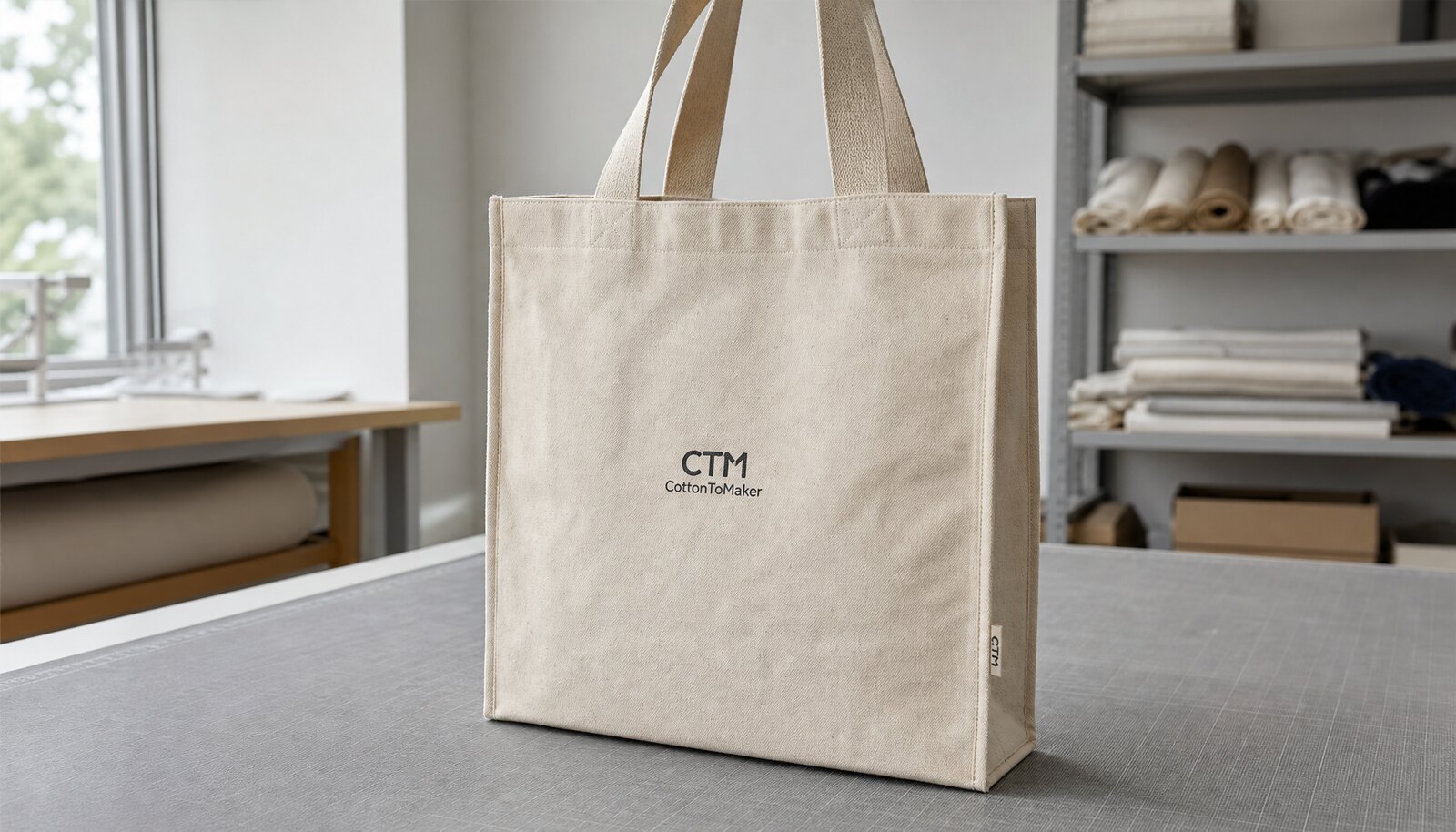
1. Why coffee brands need a sourcing plan, not just a tote quote
Printed canvas shopping bags for coffee brands often sit between merchandise and utility, which is why a simple quote request usually produces messy comparisons. The same tote may be sold at a café counter, added to a subscription box, bundled with beans, or shipped as wholesale stock to a distributor. Each use case changes the spec in a different way. A retail merch bag needs shelf presence and a clean logo face. A subscription insert needs low weight and predictable folding. A wholesale replenishment program needs carton efficiency and consistent reorders.
That is why a private label sourcing plan is more useful than a design approval. It gives the supplier enough information to quote the actual production job: canvas weight, handle type, logo method, fold style, pack-out, and inspection standard. Without those details, suppliers fill the gaps with assumptions. One may quote a lighter fabric, another may exclude setup charges, and a third may assume bulk packing even when the buyer expects retail-ready presentation.
For B2B procurement, the main goal is not to find the lowest unit price. The goal is to remove quote ambiguity before the first sample is made. If the RFQ clearly states the use case, suppliers can price the same construction, the same decoration method, and the same packing format. That is what makes landed-cost comparisons meaningful. It also reduces the chance of late-stage changes, such as discovering that a bag approved for merch is too soft for store display or too heavy for subscription shipping.
Coffee brands usually buy these bags for one of four reasons, and each reason should point to a different spec approach. Retail merch can justify a heavier canvas and more polished packing. Subscription inserts typically need lower weight and simpler decoration. Café resale often needs a mid-range canvas with dependable print durability. Wholesale replenishment usually benefits from repeatable packing and strong carton control more than from premium add-ons. If the sourcing plan does not identify the commercial route, the quote will not reflect the real job.
- Write the use case before you ask for pricing.
- Compare quotes only after the supplier has confirmed the same bag structure and packing method.
- Treat the tote as part of the brand program, not only as a printed accessory.
2. Match canvas weight to the actual job: GSM, oz, feel, and failure risk
The most useful canvas decision is not “thick or thin.” It is which weight range matches the bag’s job, price point, and durability expectations. For coffee brands, 8 oz to 10 oz cotton canvas is usually the commercial sweet spot. In gsm terms, that is often about 280 to 340 gsm, depending on how the supplier measures and finishes the fabric. This range gives a decent body without making the tote excessively expensive or stiff. It also tends to print well with standard screen printing.
Use 8 oz / roughly 280 gsm when the bag is a lighter promotional item, a subscription add-on, or a café impulse buy where the product value must stay low. The risk profile is simple: the bag may fold nicely and keep freight down, but it can look less premium on shelf and may show more wrinkling. Use 10 oz / around 340 gsm for the most common private label coffee tote programs. That weight usually gives a better hand feel, less translucency, and a more stable panel for print placement. Use 12 oz / roughly 400 gsm when the bag is expected to carry heavier items, hold shape for retail display, or support a higher selling price.
The buyer should always ask whether the quoted weight is finished fabric weight or greige weight. This is not a small detail. A supplier can talk about the same number while meaning different measurement points. Finishing, washing, or dyeing can all change how the bag feels and performs. If your brand cares about handfeel, ask for a physical swatch and compare it against the approved sample. If your brand sells into retail, also ask for shrinkage or dimensional stability data after finishing if the supplier has it. Even if you do not request a formal test report, the supplier should be able to explain what variation has been observed in previous production.
For procurement buyers, a practical way to think about failure risk is this: lighter canvas reduces cost but increases the chance of visible collapse, edge curl, and lower perceived value. Heavier canvas improves structure but increases sew time, carton weight, and shipping cost. If the order is for cafe resale or store merch, 10 oz is often the safest default. If the buyer is launching a premium line, 12 oz may be justified. If the order is a free insert or event item, 8 oz may be the right commercial choice.
The fabric choice should also be tied to print behavior. A coarse surface can make fine typography look weaker than the proof image suggests. Dark inks on light natural canvas are usually reliable, while very light inks on medium-toned or dyed fabric require more control over opacity and ink load. Buyers should not assume the same logo will look equally sharp across all weights. The heavier the texture and the looser the weave, the more important it is to simplify the art.
- 8 oz / ~280 gsm: best for giveaway, insert, or low-cost merchandise with lighter carry loads.
- 10 oz / ~340 gsm: best all-around choice for most coffee brand retail programs.
- 12 oz / ~400 gsm: best for premium retail feel, shape retention, and heavier contents.
- Ask whether the weight is finished or greige; do not accept a quote that avoids the measurement point.
- Request a fabric swatch when the order is brand-facing and the handfeel matters.
3. Choose handles, seams, and reinforcement based on load, not just appearance
Handle design is where many tote quotes quietly diverge. Two bags can look nearly identical in a photo while performing very differently in use. The lowest-cost option is usually a self-fabric handle, where the handle is cut from the same canvas as the body. That approach keeps the BOM simple and can support lower MOQ. It works well for light-to-medium carry loads, but the handles can feel harder in the hand and may twist more than webbing. A cotton webbing handle costs more but usually feels better, sits flatter on the shoulder, and can improve the perceived retail value of the bag.
The handle drop should be specified in centimeters, not described vaguely as “long” or “shoulder-length.” For procurement purposes, the buyer should also define the acceptable tolerance. A practical commercial band is often ±0.5 cm to ±1 cm on handle length, depending on the program. If the bag is going to be carried by customers, uneven handle length is not a cosmetic issue only; it changes comfort and may trigger retail complaints. The same applies to seam alignment and handle symmetry.
Reinforcement matters more than many first-time buyers expect. Ask for the exact reinforcement method at the handle point: bar-tack, cross-stitch, box stitch, or double stitching. For a coffee tote that is meant to hold beans, bottles, or packaged goods, the buyer should ask the factory how they test the attachment point. Even if they do not have a formal lab test, they should be able to describe the pull method they use in production or sample development. If the program is retail-facing, the buyer should also ask whether the top hem is folded with a clean edge or left raw inside, because that affects both appearance and stress distribution.
The side seams and bottom corners are another common failure point. A visually clean seam is not enough. The buyer should specify a minimum stitch density or at least ask the supplier to standardize it across the run. For example, a commercial tote may use close, even stitching without skipped stitches or open gaps; any obvious seam gap in the load-bearing area should be rejected. If the bag has a gusset, the gusset corners need special attention because they take extra stress when the tote is full. Buyers should request seam close-up photos in the sample stage and again during pre-shipment inspection.
If the bag will be sold as retail merch rather than as a free insert, the construction should match the brand’s target price. A premium coffee brand can justify cotton webbing, reinforced corners, and a more structured top hem. A lower-priced promo bag may be better served by a simpler build that keeps costs under control. The key is consistency: the handle, seam, and reinforcement should support the actual contents and the way the customer will use the tote.
- Specify handle drop and tolerance in centimeters.
- Ask for the reinforcement method at the handle attachment points.
- Request seam close-ups and a loaded sample check before bulk approval.
- Use webbing for comfort and premium feel; use self-fabric for lower cost and simpler sourcing.
4. Printing choices that work on canvas and where they fail in production
For coffee-brand artwork, the most reliable decoration method is usually screen print. It offers the best balance of cost, repeatability, and visual clarity for simple logos. If the design is one solid color, screen printing is typically the easiest route to control. Two-color printing is still practical, but the buyer must watch registration closely. When the design includes small text, thin outlines, or fine borders, the art often needs to be simplified for canvas. The fabric texture is not a smooth paper board; it can break up detail and change how the ink sits.
A helpful commercial rule is to design for the material, not for the branding deck. On rough canvas, bold type and strong negative space tend to print better than thin lines. If the logo includes a lot of detail, the supplier should be asked to provide a strike-off or at least a print reference showing how the art will be adjusted. Heat transfer can work for short runs or seasonal launches, but it is generally more sensitive to fabric texture and wear. It may be acceptable for a limited campaign, yet less ideal for a bag that needs to survive repeat customer use and repeated washing.
The buyer should define print placement in millimeters or centimeters, not only with a design mockup. Say where the top edge of the print should begin, how far it should sit from the side seam, and whether it must be centered over the front panel or aligned to the logo area of the bag after folding. This is especially important if the bag has a gusset or a structured fold, because the visible face can shift when the tote is packed or displayed. If the order is for a retail shelf, ask for photos of the print on a folded bag as well as on an open sample.
Ink durability and coverage should also be part of the discussion. The factory should explain how they control opacity, drying, and cure. A logo that looks fine immediately after printing may crack or transfer if the ink layer is too heavy or under-cured. Buyers do not need to run a lab, but they do need a practical evidence request: ask for a sample that has been folded, carried, and handled in a way that reflects the intended use. If the brand intends the bag to be washed, ask the supplier how they expect the print to behave after washing, even if no formal wash-test standard is being contracted.
Finally, ask how the factory handles multi-color reorders. A supplier that can repeat the same screen positions and ink mix consistently is much easier to work with than a supplier that treats each order like a fresh art job. For coffee brands with ongoing retail programs, print repeatability matters as much as the first sample image.
- Use screen print for most one-color and two-color coffee logos.
- Require print placement in measurable terms, not only in artwork language.
- Ask for a strike-off or approved printed sample when artwork detail is important.
- Check how the ink behaves after folding, handling, and optional washing if the bag is meant for repeated use.
5. MOQ, artwork variants, and real cost drivers in the quote
MOQ is often misunderstood as a single number, but in tote sourcing it usually comes from several different constraints: fabric stock, cutting efficiency, print setup, and packing labor. A factory may accept a 3,000-piece total order and still require 1,000 pieces per artwork, or 500 pieces per colorway, because the printing setup is the limiting factor. For coffee brands with multiple roasts, store locations, or seasonal art, the buyer should separate the MOQ for the body bag from the MOQ for each decoration version.
This matters because a quote can look low when the supplier prices only the fabric and sewing, but the real cost spikes once artwork changes or extra colors are added. Ask the supplier to quote the base bag, the print setup fee, and any color-change surcharge separately. If the supplier offers stock canvas, the MOQ may drop, but the buyer usually gives up some control over exact fabric shade or texture. Stock materials are useful when speed matters, but procurement should verify that the stock actually matches the brand’s retail expectations.
There is also a decision point between one SKU and several small variants. Coffee brands often want different tote messages for different blends or channels. That can be smart from a marketing standpoint, but it multiplies setup work. If the goal is a single evergreen merch item, keep the design stable and use one SKU. If the brand needs channel-specific bags, price them as separate SKUs and compare the incremental cost of each variant. The hidden cost is not only in print; it can also show up in warehousing, carton labeling, and receiving errors at distribution centers.
To make quotes comparable, ask for these line items in writing: bag body price, handle price if separate, print setup fee, per-color surcharge, woven label or hangtag price, retail packing fee, and carton cost. The seller should also state whether the MOQ includes a full print run or whether the first run is a sample or pilot quantity. If they are offering a “small trial order,” ask what changes if the buyer converts that trial into a reorder. Too many buyers lose time by treating trial and production pricing as the same thing.
A good private label sourcing plan also includes a simple decision rule. If the brand is focused on repeatability and long-term retail use, pay for a lower-risk spec with cleaner setup. If the brand is testing the market, prioritize lower MOQ and a simpler print. Don’t ask the supplier for every possible option; ask for the option that matches the launch strategy. That makes the final quote easier to approve and easier to repeat.
- Ask for MOQ by artwork version, not just by total order quantity.
- Require separate pricing for setup fees, print colors, and packing extras.
- Use stock fabric only when the brand can accept limited shade and texture variation.
- Price channel-specific art as separate SKUs so warehousing and replenishment stay clean.
6. Comparison table for spec alternatives, not just supplier routes
When buyers compare tote quotes, they often look at supplier type first. That is useful, but procurement decisions are actually driven by spec alternatives: 8 oz versus 10 oz, self-fabric versus webbing handles, single-color versus two-color print, and bulk pack versus retail-ready pack. Those choices affect cost, MOQ, lead time, and QC burden more directly than the sourcing channel alone. The table below is meant to help a buyer make those product decisions before opening the RFQ to multiple suppliers.
Use it as a spec screen. If the program is for café resale, the 10 oz or 12 oz options may justify the added cost. If the program is for a subscription insert, the lower-weight and bulk-packed options may be better. If the buyer is managing a retail chain, retail-ready packing may be worth the extra labor because it lowers receiving work and presentation errors at store level.
- Compare spec alternatives before comparing vendor names.
- Track cost, MOQ, lead time, and QC burden together.
- Choose the construction that matches the sales channel, not only the design mood.
7. Sample approval should prove the bag can survive use, packing, and reorders
A sample is useful only if it answers the production questions. For a coffee-brand tote, the sample should be checked as a working product, not a display object. That means the buyer should inspect the bag body, the print, the handle, and the fold pattern together. A sample that looks correct on a table may fail once it is loaded with product or stacked in a carton. The approval step should therefore include a physical test: put actual coffee bags or a realistic weight in the tote, lift it by the handles, and check whether the shape remains acceptable.
The first sample should answer five questions. Does the size match the approved dimensions? Does the canvas feel right for the brand tier? Does the print sit where the artwork requires? Do the handles feel comfortable and stable? Does the folded bag pack the way the warehouse or store team expects? If any of these are not right, fix them before bulk production. A lot of quote gaps show up only at this stage because the factory’s sales sample and production line are not using the same assumptions.
For art-heavy bags, ask for a strike-off or print proof that isolates the decoration result before the entire bag is made. This is especially helpful when the artwork has fine text, a border, or a second color. The buyer should verify ink density, edge sharpness, and placement on the actual canvas, not only on a digital render. If the logo is critical to the brand, the approval should be tied to a physical signed sample with a version number and date. Keep that sample file with the PO so the supplier has one frozen reference.
If the bag is intended to ship retail-ready, review the packing sample too. Ask the supplier to show how they fold the tote, whether it goes into a polybag, whether the insert card stays visible, and whether the carton count is correct. A retail-ready bag that looks good but is packed inconsistently creates downstream labor for the warehouse and store team. For wholesale replenishment, the sample should still show the final carton logic so the buyer can assess cube efficiency and count accuracy.
The most important sample rule is simple: never approve a bag by mockup alone. A mockup shows intent. A sample shows production behavior. Coffee brands that sell private label totes should treat the sample as a mini production rehearsal, not just a design checkpoint.
- Load the sample with realistic weight before approving it.
- Check handle comfort, print placement, fold behavior, and carton fit together.
- Tie the approval to a dated, signed, version-controlled physical sample.
8. QC thresholds buyers should write into the RFQ
Quality control works best when the buyer writes measurable acceptance criteria before production starts. Vague terms like “good quality” or “no major defects” are not enough for canvas totes. The supplier needs to know exactly what counts as acceptable variation. For size, a practical commercial tolerance is often ±0.5 cm to ±1.0 cm on key dimensions such as width, height, and gusset depth, but the buyer should choose the exact band based on the final use case. A tight retail program will usually need tighter control than a giveaway batch.
Stitching needs measurable rules too. Ask for a minimum stitch density and a clear seam defect threshold. Even if the supplier does not quote the density in lab language, they should be able to state the stitch style and the quality rule used on the line. For example: no skipped stitches, no open seam gaps, no broken thread in the load-bearing area, and no loose thread tails longer than 1 cm on the visible face. If the bag has a gusset or a reinforced top hem, add a separate rule for those points.
Print quality should include registration limits. For a simple one-color logo, any major shift may be unacceptable if the brand face is centered or the logo sits close to an edge. For two-color work, a practical maximum registration shift is often around 2 mm to 3 mm for simple graphics, but the buyer can tighten that if the logo has fine outlines or small type. Also define what counts as a print defect: ink smearing, pinholes, voids, ghosting, overspray, or uneven opacity in the visible logo area. Do not leave this to a subjective review after shipment.
Fabric defect rules are equally important because canvas often shows imperfections more clearly than synthetic materials. In the front logo panel, reject oil stains, dirty marks, holes, broken yarns, and conspicuous slubs. In non-visible zones, you can allow only defects that do not affect use or retail appearance. If the coffee brand sells premium merchandise, ask the supplier to use a stricter visible-zone rule than they would for promo stock. It is better to define the defect threshold by zone than to inspect every bag with the same standard.
Carton rules matter as much as bag rules. Mixed SKUs in the same carton, missing labels, wrong carton count, crushed cartons, or unreadable carton marks create real receiving issues. If the bags are retail-ready, the buyer should require fold consistency, polybag integrity if used, and barcode placement that can be scanned without opening the carton. If the bags are bulk packed, define how many units per inner bundle and whether any mixed-color pack-out is allowed. The rule should be written in the PO, not negotiated after the shipment is already moving.
- Use measurable tolerance bands for size, print placement, and stitch quality.
- Reject loose thread tails, open seam gaps, visible stains, and crooked logo placement in the retail face area.
- Write defect rules separately for visible zones, non-visible zones, and cartons.
- Lock carton count, SKU separation, and label placement before production starts.
9. Packing, retail readiness, compliance, and documentation requests
Packing decisions directly affect cost, warehouse work, and store presentation. A bulk-packed tote is usually cheaper to produce and ship, but it creates more labor at receiving and may crease more heavily. A retail-ready tote with an insert card and polybag can look cleaner on shelf and reduce store handling time, but it adds material cost and carton volume. For coffee brands, the right answer depends on where the bag will be sold. A café counter display may justify retail-ready packaging. A distributor replenishment order may not.
Buyers should ask the supplier to quote packing as a separate choice whenever possible. That allows the commercial team to compare the difference between bulk pack and retail-ready pack instead of guessing. Ask for inner pack count, carton dimensions, gross weight, and a photo of the final carton pack. These are not small details; they affect freight, warehouse fit, and shelf-ready receiving. If the supplier is quoting for e-commerce fulfillment, ask whether the pack method protects print quality during transit and whether the insert card or barcode label will stay in place.
For compliance and documentation, procurement should request only what is relevant to the destination market, but it should request it early. At minimum, confirm fiber content wording, country of origin marking, care label requirements if the bag will be resold as a retail good, and any packaging restrictions that apply in the destination market. If the buyer needs environmental or recycled-content claims, ask for documentation that supports the claim rather than verbal assurance. If the supplier says the bag is recycled cotton or another specialty material, ask for traceability or material declaration evidence that can be filed with the purchase record.
This is also where local decorator tradeoffs become clearer. A local printer or decorator may be useful for speed, but the buyer should still ask the same questions about packing, labeling, and defect rules. Local production does not automatically mean retail-ready production. If the job is a rush replenishment, the buyer should check who owns the decoration process, who handles the final QC, and who is responsible if the packing count is wrong. Domestic convenience is valuable, but it should not replace documented acceptance standards.
If the tote is part of a larger private label program, the documentation checklist should include the final approved artwork, the signed sample, the PO specification sheet, inspection photos, carton count confirmation, and the shipping mark template. Keep these together. That makes reorders easier and reduces the chance that a supplier works from an old file or a remembered instruction instead of the current spec.
- Quote bulk pack and retail-ready pack separately.
- Request carton dimensions, gross weight, and pack photos before approving freight assumptions.
- Confirm fiber content, origin marking, and any needed label wording early.
- Do not assume a local decorator is automatically retail-ready; verify the same QC and documentation rules.
10. Lead time, reorders, and what changes when the coffee brand scales
Lead time is usually longer than the quote suggests because canvas totes combine fabric, cutting, printing, sewing, inspection, and packing. If the fabric is already in stock and the artwork is simple, the schedule can be manageable. If the bag needs custom dyeing, multiple colors, special labels, or retail-ready packing, the timeline grows quickly. The most common delay is not sewing speed; it is late approval. A buyer who changes artwork after strike-off, or delays sample sign-off, can lose days or weeks without realizing it.
First orders are slower than reorders because the supplier has to set up the spec. Once the factory has approved fabric, screen positions, print colors, handle method, and pack count on file, repeat runs become much easier to manage. That is why the sourcing plan should be built for the second and third order, not only the launch order. If the coffee brand expects growth, the buyer should choose a spec that can be repeated without redesigning the bag each season. Reorders are where a good private label program becomes profitable.
A practical lead-time question is: where is the bottleneck today? Ask whether fabric, printing, sewing, packing, or export booking is the current constraint. Suppliers often know this immediately, and the answer is more useful than a generic number of days. If the bottleneck is fabric, the buyer may need to lock color and weight earlier. If printing is the bottleneck, reduce the number of colors or simplify placement. If packing is the bottleneck, reconsider retail-ready presentation for the first run.
When scaling to wholesale or multi-store distribution, consistent pack-out and carton marks matter more. One mixed carton can disrupt store receiving. One wrong label can slow down a warehouse. At that scale, the buyer should ask for a final production photo set that includes bag front, back, handle close-up, carton exterior, carton interior, and a packed SKU count image. These photos do not replace inspection, but they are useful evidence that the supplier followed the approved pack method before shipment.
For procurement teams, the best lead-time control is to freeze the spec early and avoid moving targets. Change the artwork once, and you may still be fine. Change the artwork, the canvas weight, and the packing format at the same time, and the program becomes much harder to manage. A coffee brand that wants reliable replenishment should optimize for repeatability, not novelty at every reorder.
- First order lead time is usually driven by setup; reorders are driven by repeatability.
- Ask the supplier which step is the current bottleneck instead of only asking for a generic number of days.
- Freeze the spec early if the brand expects multi-store or wholesale expansion.
- Request final production photos that show the bag, the pack, and the carton together.
Specification comparison for buyers
| Supplier option | What to verify | Commercial advantage | Buyer risk to control |
|---|---|---|---|
| Direct sewing factory | fabric swatch, approved sample, seam close-ups, logo test photos, packing pilot, and final inspection evidence | Better sample-to-bulk control and faster production feedback | May be weaker on export paperwork or branded packing unless checked early |
| Trading company | Factory name, production photos, trim-source proof, and who owns QC decisions | Can coordinate small mixed orders and extra services | Markup can hide real factory capability and slow defect decisions |
| Specialized bag workshop | bag size, gusset, handle drop, seam allowance, stitch density, reinforcement patch, and loading expectation | More practical for detailed construction, trims, and repeat programs | Capacity may be limited during peak seasons |
| Low-price general supplier | 8-12 oz cotton canvas, 120-220 gsm cotton, recycled cotton, or blended fabric selected by use case and target price | Useful for simple promotional runs with loose specs | Material downgrades, weak packing, and vague inspection scope can erase savings |
| Retail-ready supplier | fold method, inner bundle, carton count, carton mark, moisture protection, SKU separation, and warehouse receiving needs | Can handle labels, SKU separation, carton marks, and receiving rules | Higher unit cost must be compared against reduced warehouse work |
| Compliance-focused supplier | Fabric records, labeling review, test plan, and production traceability | Safer for retail programs and repeat brand orders | Documentation claims need evidence, not only sales language |
| Local sample room plus bulk factory | Signed sample, bulk factory handoff, first-piece photos, and deviation owner | Good for complex branding before large production | Sample room quality may not match bulk line unless handoff is controlled |
Buyer checklist before sampling
- Define the coffee-brand use case first: retail merch, subscription insert, café resale, wholesale replenishment, or event giveaway. Each one changes the bag spec, packing format, and acceptable cosmetic defects.
- Specify the bag size in finished dimensions, the canvas weight in gsm and oz, and whether the quoted weight is finished fabric weight or greige weight. Ask the supplier to confirm both if there is any doubt.
- State the exact print method allowed, the number of colors, the logo placement in millimeters, and the maximum acceptable print shift. Do not approve artwork based only on a mockup.
- Ask for the handle construction: self-fabric, cotton webbing, folded edge, double-stitched, bar-tacked, or cross-stitched. Define handle drop and target load expectation.
- Request a physical pre-production sample, a print strike-off if needed, and photos of the final packed carton before mass production starts.
- Set measurable QC thresholds in the RFQ: size tolerance, stitch density, seam allowance, print registration, stain limits, loose-thread limits, and carton defect rules.
- Request landed-cost breakdowns: ex-factory price, setup fees, sample fee, packing fee, carton cost, inland transport, export document charges, and freight assumptions.
- Ask for traceability and compliance evidence relevant to the destination market, including fiber content labeling, country of origin marking, and any packaging or chemical-restriction documentation required by the buyer’s market.
Factory quote questions to send
- What canvas weight are you quoting in gsm and oz, and is it finished fabric weight after washing/finishing or greige weight before finishing?
- What exact bag size is included in the price, and what tolerance do you guarantee for width, height, and gusset depth?
- Are the handles self-fabric or cotton webbing, what is the finished handle drop, and what pull-test or reinforcement method do you use?
- What print method is included, how many colors are covered, and what is the surcharge for additional colors, larger print area, or print on both sides?
- What is the MOQ by artwork version, by fabric color, and by packing style? If stock fabric is used, how much can MOQ change?
- What sample stages are included before bulk production, and what approval step freezes the final print position and carton pack?
- What stitch density, seam allowance, and reinforcement method do you use at the handle points and bottom corners?
- What size tolerance, print registration limit, and defect rate do you use for final inspection?
- How are bags packed per inner bundle and per carton, what is the carton size and gross weight, and are cartons drop-tested or ship-tested?
- What documents can you provide for retail or import use, such as fiber content, care label wording, country of origin marking, and packing list details?
Quality-control points to confirm
- Approve the fabric weight, handfeel, and shrinkage behavior before print approval; if the bag changes size after washing or finishing, it must be reflected in the final spec.
- For size checks, accept only the tolerance band written in the PO. A practical commercial band for canvas totes is often ±0.5 cm to ±1.0 cm on key dimensions, but the buyer should set the exact rule per SKU.
- For stitch quality, define a minimum stitch density and a clear defect threshold. Example: no skipped stitches, no open seam gaps, and no loose thread tails longer than 1 cm in the retail face area.
- At handle attachment points, require consistent reinforcement and no broken stitching. Any pull failure at normal use load or obvious stress damage is a reject.
- For print quality, set a maximum registration shift, commonly around 2 mm to 3 mm for simple logos, and tighter if the logo has fine type or a border. No smearing, pinholes, or major ink voids in the visible logo area.
- Define fabric defect limits by zone. In the front logo panel, reject oil stains, holes, slubs, broken yarns, and dirty marks. In non-visible areas, allow only defects that do not affect use or retail appearance.
- For packed goods, require carton count accuracy, correct SKU separation, clean fold direction, and no mixed versions unless pre-approved in writing.
- For retail-ready packing, check that polybags, inserts, barcodes, and carton marks match the order file exactly. Mixed labels, missing inserts, or unreadable barcode placement should fail the lot or trigger rework.