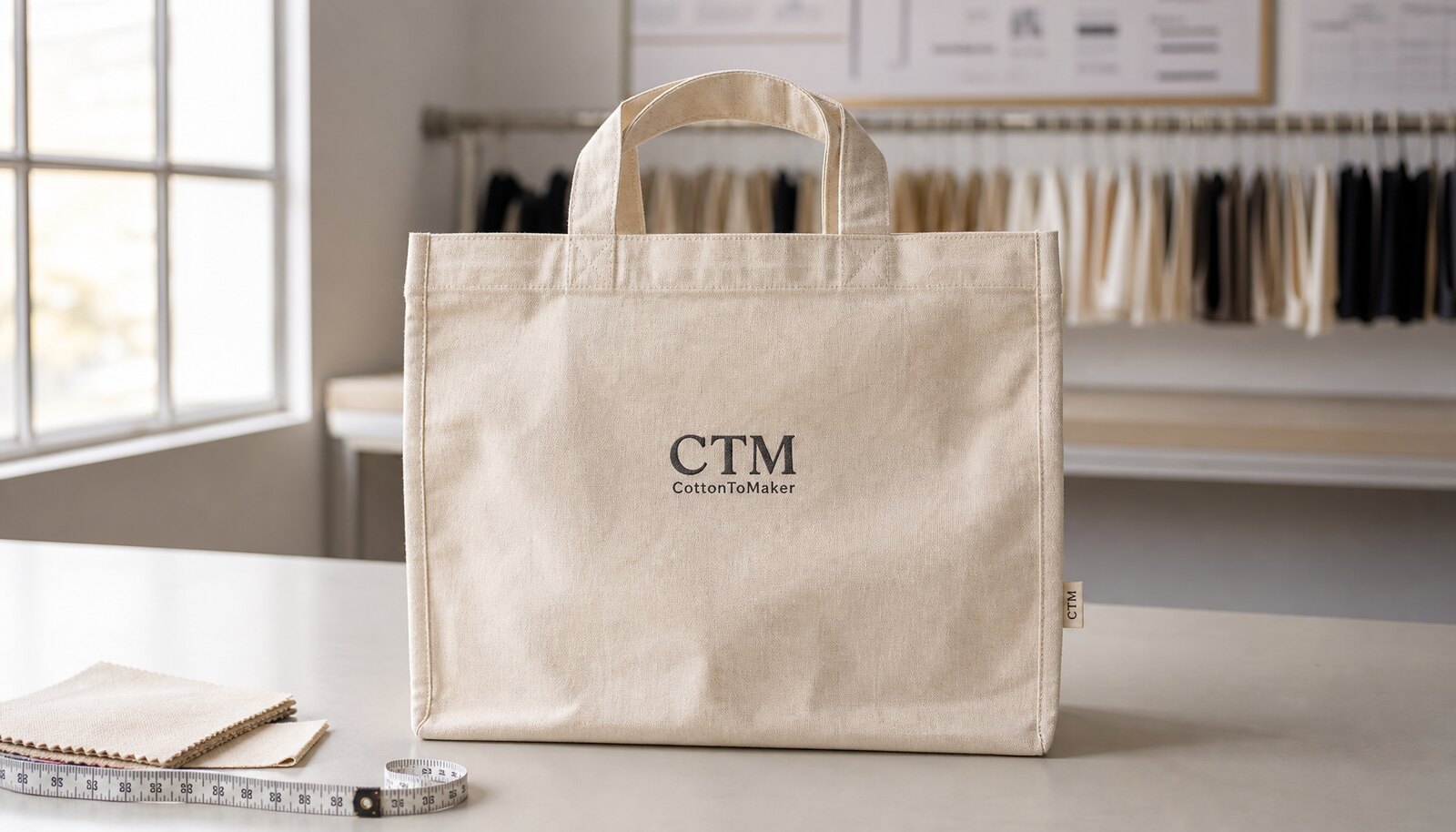
What Coffee Brands Are Actually Buying
For coffee brands, a printed canvas shopping bag is rarely just a giveaway. It is a retail accessory, a reusable carrier, and often a small but visible brand billboard that has to survive stores, sidewalks, and repeat use. That changes the buying standard. A tote that photographs well but feels flimsy will drag down perceived product value, while a bag that is overbuilt can protect quality and destroy margin before it reaches the shelf.
The right bulk pricing plan starts with the job the bag must do. Some brands need a simple one-color natural canvas carrier for roasted beans, tasting kits, or store pickups. Others need a heavier bag that can carry several retail items without seam failure. A procurement team should define the channel before it asks for pricing, because the same factory can quote very different numbers for a gift bag, a shelf-ready retail SKU, or a warehouse pack item.
- Retail-facing bags usually need cleaner stitching, flatter print, and better packing than a one-off promo tote.
- Coffee shoppers often reuse the bag, so handle comfort and seam durability matter more than a low first-cost win.
- If the bag sits near point-of-sale displays, the print must read clearly from a few feet away.
- If the bag ships inside a gift set, the finish standard should include folding quality and carton fit.
Lock the Base Spec Before You Ask for Price
Canvas pricing changes quickly when the base spec is vague. The biggest cost drivers are fabric weight, bag size, handle construction, and whether the bag needs a gusset, lining, or internal pocket. In practice, most coffee brand programs sit in the 10 oz to 12 oz range for standard retail use. That is enough body to feel respectable without pushing material and sewing cost into premium territory too early.
A buyer should not ask for price on "canvas shopping bags" in the abstract. The factory needs a finished size, a fabric weight or GSM target, a bag color, a handle spec, and a print area that can be cut and sewn without guessing. If the order is for heavier product loads, it is worth testing 12 oz or 14 oz canvas and confirming the handle attachment area is reinforced. Small spec changes can move cost more than many teams expect.
- 10 oz canvas works when the bag is light retail carry and the brand wants to protect price.
- 12 oz canvas is a practical middle ground for most coffee brand shopping bags.
- 14 oz or higher is better when the bag must feel premium or support heavier contents.
- A 1 cm change in finished size can affect cutting yield, carton count, and freight efficiency.
Bulk Pricing Bands That Help Buyers Sanity-Check Quotes
A useful quote needs more than a single unit price. Procurement should ask for pricing at several quantity bands so the team can see the real cost curve. For an illustrative planning exercise, a simple 10 oz natural canvas bag with one-color print might land around the following ex-factory bands: 1,000 pieces at roughly $1.20 to $2.40 each, 3,000 pieces at roughly $0.90 to $1.80 each, and 5,000 pieces at roughly $0.70 to $1.40 each. Heavier fabric, two-sided print, multiple colors, labels, or retail packaging can move those bands upward quickly.
Those numbers are not market promises. They are a way to catch quotes that are out of line with the spec. If one supplier is far below the band and another is far above it, the buyer should first check fabric weight, print setup, sewing complexity, packing assumptions, and whether any step is missing from the quote. Most bad comparisons come from mismatched assumptions, not from the factories themselves.
- Ask for quote bands at 1,000, 3,000, 5,000, and 10,000 pieces if the program is repeatable.
- Separate the base bag cost from print setup, packing labor, labels, and cartonization.
- Treat extremely low quotes as a request to verify fabric weight and included work, not as automatic savings.
- Expect the price curve to flatten as quantity rises, but do not assume every extra unit gets cheaper at the same rate.
How the Quote Should Be Structured
A serious quote should break the price into clear blocks: fabric, cutting, sewing, print setup, print run, labels, packing, cartonization, and the shipping term. If the supplier gives one flat unit price with no breakdown, it becomes hard to compare against alternate factories or to understand what changes when the order size moves. Procurement teams should push for price structure, not only a finished number.
This is especially important when the buyer is trying to build a long-term bulk pricing plan. A clean quote shows which elements are variable and which are fixed. Setup charges should be visible. Packing should be visible. If a supplier is hiding cost in an unclear "miscellaneous" line, the quote will be difficult to defend later when the order is amended or repeated.
- Require a line item for print setup or screen charge if the design has multiple colors.
- Ask whether the quote assumes cutting waste, overrun allowance, and thread trimming are already included.
- Request a quotation in the same currency and shipping term across all suppliers so the comparison stays clean.
- If the supplier cannot break out packing, assume the unit price is not yet ready for procurement review.
Print Method Drives Both Cost and Risk
The print method is one of the fastest ways to create quote noise. A one-color screen print is usually the cleanest path for coffee logos, product names, and simple origin graphics. It keeps setup straightforward, helps repeat orders stay stable, and usually gives the best unit economics at scale. When the design is simple and the brand wants a crisp retail look, this is the first method to benchmark.
Transfer printing becomes useful when the art includes gradients, detailed illustration, or several shades that screen printing would flatten. It can help with lower quantities, but the buyer should test adhesion and rub resistance, especially if the bag will be folded, stacked, or carried daily. For dark canvas or complex artwork, a buyer should require a real sample, not just a digital proof, because the final look on woven fabric can shift more than expected.
A buyer should also ask how the factory handles ink cure and color control. Poor curing can lead to tackiness or rub-off. Poor registration can make a crisp logo look sloppy even if the image itself is correct. For a coffee brand, that is not a minor cosmetic defect; it changes how the customer reads the brand on the shelf.
- Screen print usually wins for simple coffee logos and higher reorder volumes.
- Transfer methods are better for detailed art but need durability testing.
- Ask whether the quote includes one-side print only or matching both sides.
- Confirm whether dark bags need an underbase ink layer and how that affects cost.
Compare Supplier Routes Before You Compare Unit Price
For coffee brands, the cheapest quoted bag is not always the lowest-risk supply route. A direct factory can usually give the best cost control, but only if it truly handles the full chain from fabric sourcing to sewing and packing. A trading company can be useful when the brand needs coordination support, but the buyer has to know whether the trading layer is adding value or just another margin point between the factory and the purchase order.
Regional sourcing also matters. Mainland China often offers broad capability, fast sample development, and mature print and sewing capacity, which is useful when the design needs several process steps. Vietnam can be attractive when the buyer wants competitive sewing capacity and a supply base that is already familiar with export programs, though print capability and fabric availability still need to be checked factory by factory. India can be strong for cotton-based programs and fabric depth, but the buyer should verify finish consistency, lead time, and the exact export packing standard. Turkey can work well for shorter transit into Europe and for buyers who value closer communication with regional suppliers, though the cost structure may differ from Asia. Domestic converters are still useful for fast launch programs, short replenishment cycles, or small-market tests, even if the unit cost is higher.
The decision is not abstract. It should be based on lead time pressure, forecast confidence, tolerance for quality variance, and the value of speed versus margin.
- Use direct factory sourcing when the design is stable and the annual volume is meaningful.
- Use a domestic converter when speed, local compliance, or low volume outweigh unit cost.
- Use a trading route only if it adds real coordination or supplier access that the buyer cannot manage directly.
- Ask each supplier whether the fabric is woven, cut, printed, and packed in one site or moved between multiple sites.
Compliance and Testing You Should Ask For
Canvas tote bags are simple products, but procurement still needs a basic compliance file. For coffee brands selling into the US, Europe, or the UK, the buyer should ask for the relevant chemical and factory documents that match the market. That can include REACH-related declarations for EU programs, CPSIA-oriented confirmations when the bag is positioned for children or used in a regulated retail program, California Proposition 65 awareness for US-bound products, and supplier audit evidence such as BSCI, SEDEX, or a factory social compliance program if the buyer requires one.
Chemical and physical tests should be tied to the actual use case. For a printed canvas shopping bag, the practical checks are colorfastness to rubbing, print adhesion, seam strength, dimensional stability after processing, and, when relevant, odor or packaging cleanliness. A buyer does not need a laboratory report for every line item in the world. It does need enough evidence to know the bag will not bleed, split, or arrive with a problem that a store team has to absorb.
Useful test references include ISO 105-X12 or an equivalent crocking test for rub resistance, a seam strength test using a recognized textile method such as ASTM D1683 or an equivalent, and dimensional checks against the approved spec after production and after any wash or finishing process. The supplier should be able to explain which methods they use and what the pass criteria are.
- Ask for rub resistance testing on the printed area, especially for dark bags or high-contrast inks.
- Ask for seam or handle pull testing if the bag is intended to carry heavier coffee products.
- Request a written declaration for restricted substances if the bag will ship into regulated markets.
- Verify that any compliance documents actually match the factory and the product configuration being quoted.
Sample Approval Is Where Most Order Problems Start
A canvas bag sample is not just a visual reference. It is the approval document for fabric hand feel, print density, bag dimensions, stitching, and packing. Buyers should insist on a pre-production sample made from the same fabric weight, ink, thread, and label construction that will be used in mass production. A digital proof is not enough because it cannot reveal fabric texture, print absorption, handle balance, or the way the bag folds into a carton.
The sample should be measured and marked up against the order spec before the bulk PO is released. If the handle length, seam allowance, or print placement looks loose on the sample, those issues should be corrected before production starts. Once cutting begins, the cost of a small error rises quickly because every bag repeats the same mistake across the whole lot. For repeat coffee brand programs, the sample pack should include the approved artwork file, a signed measurement sheet, and the packing format that will be used at shipment.
- Approve a physical pre-production sample, not just artwork renderings.
- Measure bag width, height, gusset, and handle drop against the written spec.
- Reject any sample with obvious print bleed, skewed placement, or weak seam finishing.
- Keep the signed sample, approved art, and spec sheet together as the order baseline.
Packing, Cartons, and Shelf Presentation
Packing is often treated as an afterthought, but for coffee brands it affects both damage rate and presentation. Bulk loose packing is efficient and keeps cost down, which suits distribution centers and secondary packaging operations. Individual polybags, on the other hand, are better when the bag is going straight to retail shelves, customer gift sets, or e-commerce fulfillment. The right format depends on who touches the bag next, not just the factory's convenience.
Carton planning should be specified early. A buyer needs carton count, carton dimensions, gross weight, and any palletization requirement before finalizing the order. If the cartons are too large, bags can shift and crease; if they are too tight, the packing team may deform the print area. For coffee brands that care about a neat opening experience, a folding standard and a pack count should be written into the PO.
- Use bulk loose pack for warehouse receiving and lowest packing cost.
- Use individual polybags when presentation, dust control, or retail handling matters.
- Lock carton count and carton size before production, not after shipping is booked.
- Ask whether cartons can be palletized without crushing the bag shape or print surface.
Lead Time Risk Is Usually a Material or Artwork Problem
A realistic schedule should separate sample approval, fabric allocation, printing, sewing, packing, and shipping. If a supplier gives one total lead time with no stage breakdown, the buyer has no way to see where delay risk sits. For printed canvas bags, the most common delays are fabric color availability, delayed artwork approval, and print correction after the first strike-off. Those problems are avoidable if the buyer closes the spec early.
Coffee brands should also account for seasonal demand spikes. Launching a new packaged coffee line or holiday gift set can create a compressed window where bag production competes with label, carton, and fulfillment scheduling. The right response is to build slack into the PO and insist on a fixed sign-off calendar. A rushed bag order often ends up as a premium freight problem instead of a sourcing win.
If the order is international, lead time should include customs clearance assumptions and the route being used. A sea shipment may reduce freight cost but add calendar risk. A domestic or regional source may cost more but reduce the chance that a marketing launch slips because the tote bags missed the inbound window.
- Break the schedule into sample, bulk, inspection, and dispatch milestones.
- Do not release production before art, size, and packing are all signed off.
- Ask what material or print step is most likely to move the delivery date.
- Build a buffer if the tote must land before a launch, trade show, or holiday promotion.
Specification comparison for buyers
| Spec decision | Recommended option | When it fits | Buyer risk to check |
|---|---|---|---|
| Direct factory with in-house printing | Best for repeat programs and tighter unit cost control | You already know the bag size, art, packing style, and annual forecast | Confirm whether fabric sourcing, cutting, sewing, printing, and packing are actually under one roof |
| Trading company or sourcing agent | Useful for multi-SKU programs and coordination-heavy buys | You need help managing several factories, labels, or packaging inputs | Check who owns quality responsibility and which factory will physically make the bag |
| Domestic converter | Good for small runs, urgent reorders, and local approvals | Launch quantities are low or the deadline is too short for offshore lead time | Expect higher unit cost and verify fabric origin, print repeatability, and color consistency |
| 10 oz to 12 oz canvas | Balanced weight for everyday retail use | You need a practical bag that feels sturdy without overbuilding cost | Check shrinkage, handle comfort, and whether the bag still sits flat when filled |
| 14 oz or heavier canvas | Chosen for premium positioning or heavier loads | The bag must feel substantial and support more weight | Watch sewing quality, handle attachment, and freight cost because weight rises quickly |
| One-color screen print | Strong choice for coffee logos and simple artwork | The design uses clean solids and needs a retail-ready finish | Confirm cure quality, rub resistance, and whether dark bags need an underbase |
| Heat transfer or digital transfer | Better for gradients, detailed art, or smaller quantities | The artwork has fine detail or too many colors for economical screen printing | Test wash, fold, and rub durability before approving bulk production |
| Bulk loose pack | Lowest pack cost and simplest warehouse handling | You are shipping to a DC or plan to rehandle bags later | Confirm stain protection, carton size, and whether the bags can rub during transit |
| Individual polybag with insert | Best for retail shelves or gift presentation | You need cleaner presentation and better dust control | Check added labor, plastic policy requirements, and carton count impact |
Buyer checklist before sampling
- Lock the finished bag size, handle length, and gusset depth before requesting quotes.
- Specify fabric weight in oz or GSM, fabric color, and whether the canvas is natural, bleached, or dyed.
- State print method, number of colors, print area, and whether a second-side print is required.
- Define stitching standard, handle attachment style, and any reinforcement at stress points.
- Decide packing format, carton size target, and whether retail barcode labeling is required.
- Request a pre-production sample with real fabric, real print, and final packing materials.
- Ask for MOQ by fabric, print color, and packing configuration, not only by total order value.
- Confirm acceptable tolerance for size, print registration, and color variation in writing.
- Get lead time split into sample approval, bulk production, inspection, and sailing or trucking window.
- Ask for test methods used for seam strength, colorfastness, and dimensional stability, not just a generic QC promise.
Factory quote questions to send
- What fabric weight, weave count, and shrinkage allowance are included in the quoted price?
- Is the print price based on one side or two sides, and what is the setup charge per color?
- What is the MOQ by colorway, print design, and packing method?
- Does the quote include cutting, sewing, trimming, inspection, and carton packing, or only ex-factory bag cost?
- What are the overrun and underrun tolerances for bulk production?
- Can you send a pre-production sample using the same fabric, ink, thread, and label as mass production?
- What carton pack count, carton dimensions, and gross weight will you use for this order?
- What is the expected production lead time after sample approval, and what can delay it?
- Which tests or QC checks do you perform on print adhesion, seam strength, and measurement accuracy?
- What cost changes if we switch from loose pack to individual polybag or add a side label?
Quality-control points to confirm
- Fabric weight matches the approved spec within the agreed tolerance.
- Bag size, gusset, and handle length are within measured tolerances on random carton samples.
- Print position, color density, and registration match the signed-off strike-off or pre-production sample.
- Seams are straight, reinforced at stress points, and free from skipped stitches or broken thread ends.
- Handles are balanced, securely attached, and do not twist or pull unevenly under load.
- No oil stains, fabric holes, loose lint, or needle damage are present on visible surfaces.
- Carton count, inner packing, and shipping marks match the purchase order and packing list.
- Rub testing, seam pull testing, and measurement checks are recorded before shipment release.
- Packaging materials are dry, clean, and free from odor contamination that could affect retail presentation.