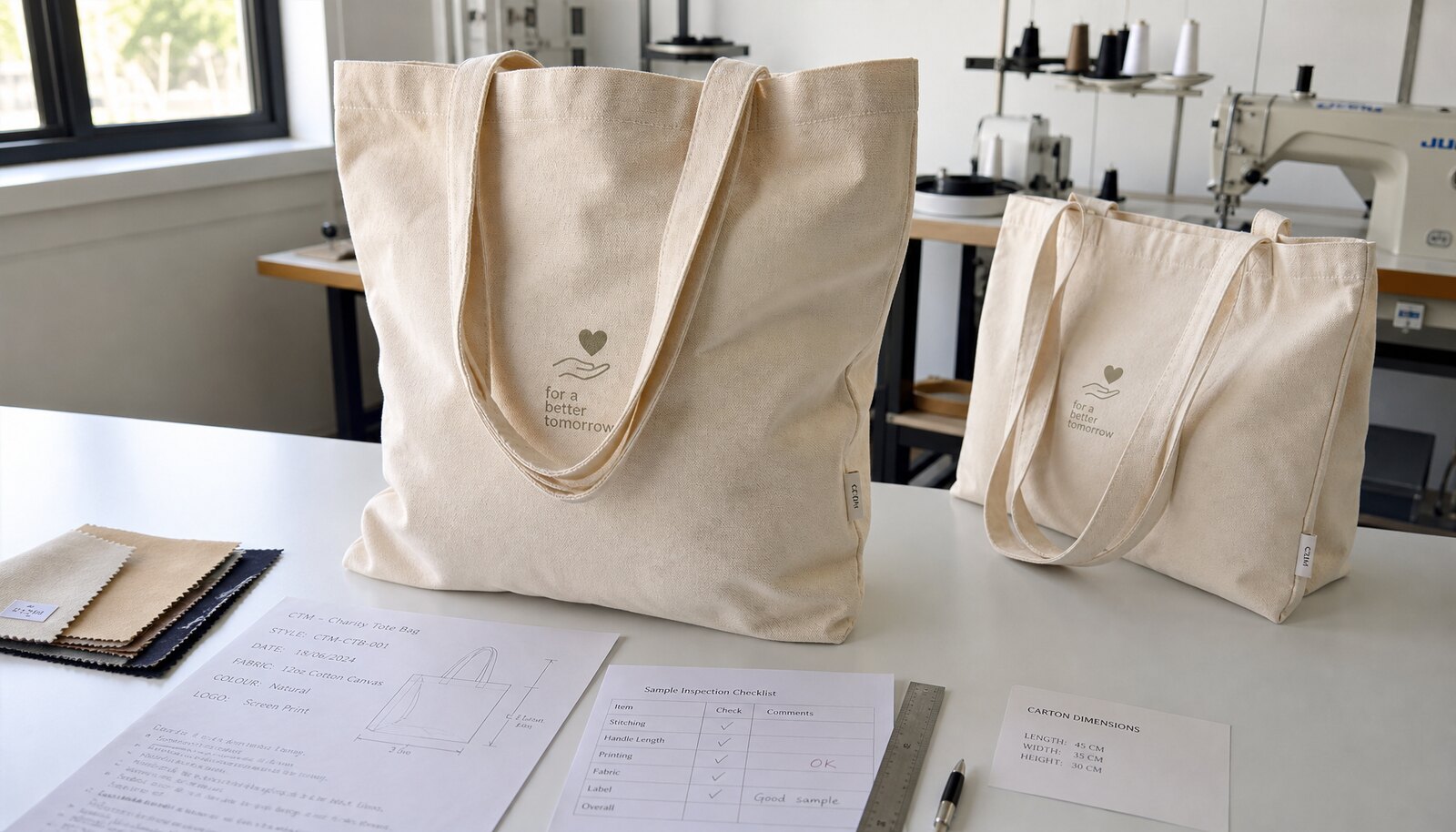
1. Reorder planning starts with the campaign requirement, not the tote itself
For printed canvas shopping bags for charity campaigns, the procurement risk is rarely the first order. The bigger problem is the repeat order that has to match a prior campaign, a donor drive, or a fundraising retail program without enough documentation. If the original spec was only remembered informally, the next buyer has to reconstruct size, fabric, print, and packing from old invoices and photos. That is how lead times slip and unit prices drift.
A useful reorder planning memo should translate a campaign memory into a production-ready requirement. The memo should state what the bag is doing in the campaign: event handout, donation carrier, retail fundraiser item, volunteer kit, or mailer insert. It should also state whether the next order must be identical to the approved lot or whether a controlled revision is acceptable. That single distinction affects MOQ, sample method, print setup, and even freight planning.
For procurement teams, the goal is not only to place another PO. It is to keep the same commercial outcome with less rework. The cleaner the prior record, the easier it is to negotiate a stable quote and the lower the chance that one supplier quotes a bag while another quotes a partially finished item with hidden packing charges.
- Write the campaign use case before quoting the bag.
- Identify the prior order number, sample date, and approved artwork version.
- State whether the order is a true repeat or a revised spec.
- Capture any problems from the last shipment so they are not repeated.
2. Lock the bag specification that controls repeatability
The most repeatable charity tote is the one with the fewest moving parts. Buyers should lock the size, gusset, handle length, print area, and canvas weight before asking for final pricing. If those elements keep changing during procurement, suppliers will re-quote the job as a development order instead of a reorder, and that usually means extra setup charges and more sample rounds. For repeat programs, a stable spec is often worth more than a slightly lower unit price.
A practical starting point for many campaigns is a bag around 38 x 42 cm with an 8-10 cm gusset and long handles. That size is common because it can hold brochures, books, and promotional inserts without feeling oversized. But the right answer depends on what the campaign is distributing. If the tote must fit a specific box, folder, or product bundle, define the internal dimensions the bag must accommodate rather than relying on a standard market size.
Fabric weight matters just as much as dimensions. Buyers often talk about canvas as if all canvas behaves the same, but natural canvas, bleached canvas, and dyed canvas can differ in opacity, surface smoothness, and print response. For a reusable charity bag, 10oz-12oz canvas, or roughly 280-340 GSM, is a practical range. Below that, the bag may feel too promotional. Above that, the freight and sewing cost rise quickly without necessarily improving campaign value.
- Confirm whether the bag must be based on a previous approved sample or only visually similar.
- Define finished size, not cut size, if your supplier is responsible for sewing shrinkage control.
- Specify canvas type, color, and finish so later reorders do not drift in appearance.
- If the bag must stand up on shelves, ask for a fabric and gusset combination that supports structure.
3. Match print method to artwork complexity and repeat frequency
Printing is usually where a charity tote either stays consistent or becomes a production headache. For repeat orders, the safest default is one- or two-color screen printing when the artwork is bold, the logo is simple, and the design will be repeated in later campaigns. Screen print typically gives the strongest opacity on natural canvas and the most predictable cost structure for large runs. The compromise is that fine detail, thin lines, and reversed text may lose clarity if the artwork is too intricate.
If the program needs variable names, seasonal slogans, or a different version for each event location, transfer-based methods or digital processes may make more sense. They can support faster design changes and smaller lots, but buyers should treat them as a trade-off, not an upgrade. On canvas, the print layer can feel more noticeable, and long-term wear may be weaker if the bags are washed, folded heavily, or handled daily. The real decision is whether the campaign values repeatability or variation more.
The artwork approval step should be commercial, not decorative. Ask the supplier to confirm Pantone targets, the minimum line thickness they can hold, the print placement window on the actual bag size, and whether the artwork sits safely away from seams or gussets. If the logo touches a fold line, the bag may pass a photo check but fail in use.
- Use screen print for stable repeat artwork and large campaigns.
- Use transfer or digital methods when artwork changes often or has variable text.
- Ask for the smallest line and text size the printer can reliably hold on canvas.
- Confirm logo placement on the sewn bag, not only on a flat layout drawing.
4. Build a sourcing workflow instead of asking for a simple quote
A strong sourcing process for printed canvas shopping bags for charity campaigns should move in a fixed sequence: requirement capture, supplier screening, quote comparison, sample approval, pilot verification, bulk release, and shipment control. Many buyers skip directly from requirement capture to quote comparison, which makes the decision look efficient but hides risk. The supplier that looks cheapest on day one may later add fees for screens, packing, carton changes, or artwork adjustments.
Start by asking suppliers to quote the same spec sheet and the same artwork version. Then screen the suppliers by production route. Direct factory sourcing is usually the best route for stable repeat orders because it gives clearer visibility into fabric sourcing, sewing, printing, and final inspection. Traders can be useful when the buyer needs mixed product types or urgent changes, but the buyer should ask who actually does the work and which steps are outsourced. The more handoffs in the chain, the more opportunity there is for schedule slippage or spec drift.
When comparing suppliers, do not stop at unit price. Ask for quote validity, sample lead time, production lead time, packing format, overrun policy, and whether the same fabric and print method will be used on the repeat run. A supplier who can describe the production route clearly is usually easier to manage than one who only sells a headline number.
- Use one master RFQ sheet for every supplier.
- Ask each supplier to identify in-house versus subcontracted steps.
- Compare quote validity periods, not just prices.
- Request sample lead time and bulk lead time separately.
5. Compare suppliers with a real procurement matrix, not a yes/no note
A procurement comparison table should help the buyer choose, not merely describe products. For canvas tote reorders, the key comparison factors are process control, spec consistency, sample reliability, packing discipline, and landed cost. A factory quote may be slightly higher than a trader quote, but if the factory owns the print and sewing process, the buyer usually gets better traceability and fewer surprises during the repeat run. That matters most when the campaign has a fixed public launch date.
A useful comparison matrix should include decision nuance. For example, a supplier with a low MOQ may still be unattractive if the quote hides screen fees or if the sample is made on different fabric. Another supplier may have a higher base price but a much better carton configuration that reduces freight and warehouse handling costs. Procurement should score suppliers on more than cost, using criteria such as sample match, communication speed, documentation quality, and ability to hold the same spec on reorders.
For high-intent buyers, the comparison should also include failure risk. Ask which supplier has the clearest defect policy, who will replace goods if the print shifts, who can provide production photos, and who can ship in stages if campaign demand is uncertain. That turns supplier selection into a commercial decision rather than a price-only comparison.
- Score suppliers on price, spec stability, documentation, lead time, and QC transparency.
- Compare sample quality against the approved master sample, not against a product photo.
- Include carton size and gross weight in the comparison because they affect freight cost.
- Ask every supplier to quote on the same Incoterm and the same destination assumptions.
6. Calculate landed cost and timing before the reorder is approved
The real cost of a tote reorder is more than the factory price. Landed cost should include product, printing, packing, export carton, origin handling, freight, duty if applicable, destination receiving, and any repacking the warehouse has to do. If a supplier offers a very low unit price but ships in a carton format that is inefficient for your warehouse, the apparent savings can disappear quickly. Likewise, a slightly higher factory quote can still be better if the supplier reduces damage risk or consolidates packing more efficiently.
Timing is just as important. Charity campaigns often have hard dates tied to events, donor mailouts, or seasonal fundraising peaks. Buyers should not ask for a lead time in general terms. They should ask for a schedule: sample approval window, material booking date, production start, inspection date, packing completion, sailing or dispatch, and arrival buffer. That timeline reveals where the schedule can break. If the supplier cannot commit to a specific sample approval date or production booking date, the buyer should treat the lead time as provisional.
A practical reorder plan includes a risk buffer. For a stable repeat order, keep a small time reserve for sample signoff, freight delay, and one round of corrective action if inspection finds a defect. If the campaign launch cannot move, consider splitting the order into an early shipment and a later replenishment lot. That reduces the chance of a campaign stockout while still allowing the buyer to adjust the final quantity after early distribution data comes in.
- Compare quotes on delivered cost, not only factory price.
- Ask for a dated production timeline with each milestone listed.
- Keep buffer time for sample approval and transit delays.
- If demand is uncertain, use a split shipment or phased release plan.
7. Set MOQ expectations around setup cost and repeatability
MOQ on printed canvas shopping bags is usually driven by fabric sourcing, print setup, and sewing line efficiency. That means MOQ is not a fixed market truth; it changes with the exact spec. If the supplier has the right canvas in stock and the screens already exist, a true reorder may be possible at a lower quantity. If the campaign changes the bag size, handle style, or artwork, the supplier may need fresh cutting markers, new screens, or a new packing line setup, and MOQ will rise accordingly.
This is why buyers should ask for two MOQ figures: one for exact reorder and one for revised-spec reorder. Without that split, suppliers may present an optimistic low MOQ that only applies if the buyer keeps every detail unchanged. The more a campaign expects future reorders, the more valuable it is to preserve a production-friendly spec. Sometimes the first order should be built for repeatability even if it costs slightly more, because the savings show up later when the same bag can be reproduced without retooling.
A good MOQ discussion also tests whether the supplier understands the business use case. Ask how the MOQ changes if the buyer wants cartons labeled for direct warehouse receipt, if a sewn label is added, or if bags must be polybagged individually. These details can materially change labor and packing time, so they belong in the order discussion before the quote is accepted.
- Request MOQ by exact reorder and by revised-spec reorder.
- Ask whether screens, cutting patterns, or dyes already exist from the prior run.
- Do not assume a low MOQ quote includes all setup charges.
- If future reorders matter, favor a spec that is easy to repeat.
8. Treat sample approval as a control gate with written acceptance criteria
A sample should do more than look good. It should prove that the factory can produce the bag to the agreed spec on the same production route that will be used for the bulk order. For that reason, a true pre-production sample should match the approved bag size, fabric weight, print method, and handle construction. If the sample is made from a different fabric or a different print process, the buyer is not approving the actual lot, only a prototype. That is a weak control point for a repeat campaign.
The sample signoff process should be documented. The buyer should keep one sealed master sample and one working reference sample, then record the artwork version, color references, sample date, and any deviations approved in writing. If the supplier proposes a small change, such as a different thread color or a different carton count, get that change recorded before bulk release. Otherwise the next reorder can drift quietly from the standard.
For buyer confidence, the sample review should include both visual and functional checks. Visual checks cover logo position, color tone, stitch neatness, and symmetry. Functional checks cover handle comfort, seam strength, and whether the bag folds or stacks the way the warehouse expects. The aim is not perfection in a showroom sense; it is production control.
- Approve only a sample made on the same or equivalent production route.
- Record artwork version, sample date, and any approved deviations in writing.
- Keep a sealed master sample and a photo record of front, back, inside, and handles.
- Do not release bulk until the sample and quote match line by line.
9. Packing, carton design, and logistics can change the economics of the reorder
Packing is often overlooked until the shipment is almost ready, but it can materially affect cost and damage rates. Canvas bags crease, collect dust, and rub against each other in transit. If the bags are going directly into a warehouse, a bulk carton with a fixed inner count is often the best balance of cost and protection. If the bags are being used in retail, event kits, or donor packs, individual polybags or pre-counted bundles may be justified. The key is to decide early, because packing changes labor and carton dimensions.
Carton planning should be part of the quote comparison. Ask for carton dimensions, gross weight, total cartons per lot, and whether the carton layout allows safe manual handling. If the cartons are too heavy, they can damage corners and slow warehouse receipt. If they are too loose, the bags may shift during transit and mark the printed area. A buyer should also confirm whether moisture protection is required, especially for long sea transit or humid storage. Natural canvas can pick up warehouse odors and show handling marks more easily than many buyers expect.
The best practice is to define a packing acceptance standard in the purchase order. That standard should cover inner count, outer carton count, carton marks, style code, and whether mixed colors are allowed. If the campaign expects a later repack at destination, state that in the RFQ so the supplier does not over-engineer the original pack-out and add unnecessary cost.
- Define inner count, outer count, and whether mixed-style cartons are allowed.
- Ask for carton dimensions and gross weight before approving freight.
- Specify moisture protection if transit or storage conditions are humid.
- Use carton labels that match the buyer’s warehouse receiving process.
10. Use a QC checklist with defect severity, inspection thresholds, and release criteria
QC for printed canvas shopping bags should be specific enough to support a lot decision. Generic statements like “check quality carefully” do not help a buyer manage production. A practical inspection plan starts with a sampling method, then separates defects into critical, major, and minor categories. Buyers commonly use an AQL-style approach for this type of product because it gives a structured way to inspect a lot without checking every unit. The exact acceptance numbers should be agreed in writing before production begins.
Examples help define severity. Critical defects would include a bag that is the wrong size in a way that makes it unusable, a handle that detaches under normal handling, or print content that is wrong enough to cause campaign misuse. Major defects include significant print misregistration, open seams, missing reinforcement, oil stains, or obvious shade mismatch that would be visible to the end user. Minor defects might include small loose threads, slightly uneven fold lines, or light handling marks that do not affect function or brand appearance. Buyers should define which of these are acceptable and which trigger rework.
Inspection should also be tied to a sample comparison step. At least one random piece from each inspected carton set should be compared against the approved master sample for color, print location, and finishing. If the supplier provides production photos, those photos should show the actual lot, not only a perfect finished piece. If the buyer wants tighter control, add a photo review before shipment release and require corrected cartons to be photographed after rework. The acceptance rule should be written clearly enough that the supplier knows what happens if the lot misses spec.
- Use an AQL-style sampling plan with written critical, major, and minor defect limits.
- Treat wrong artwork, failed handles, and unusable size drift as critical or major defects.
- Check at least one random piece per inspected carton set against the approved master sample.
- Hold shipment if the lot shows repeated print drift, seam failure, or carton packing errors.
Specification comparison for buyers
| Decision area | Recommended default for repeat charity campaigns | Trade-off / when to deviate | What to verify before award |
|---|---|---|---|
| Fabric weight | 10oz-12oz cotton canvas, about 280-340 GSM | Go lighter only for single-use handouts; go heavier if the bag is a retail fundraiser item or will carry books and donations often | Ask for actual swatches, finished GSM/oz, and whether the fabric is pre-shrunk or raw; confirm shade and slub level against the approved sample |
| Print method | 1-2 color screen print for stable repeat artwork | Use transfer or digital methods when artwork changes often, includes variable names, or has more colors than a screen print can handle cleanly | Request minimum line thickness, Pantone matching approach, wash/rub expectations, and proof of print placement on the actual bag size |
| Bag size and structure | About 38 x 42 cm with 8-10 cm gusset and long handles | Adjust if the bag must fit specific inserts, retail shelves, or donor pack contents | Confirm printable area away from seams, gusset depth after sewing, and whether the bag can stand upright when filled |
| Handle construction | Reinforced self-fabric or webbing handles with cross-stitch or bar-tack reinforcement | Switch only if the bag will carry heavier loads or needs a premium retail feel | Ask for stitch count, bar-tack length, seam allowance, and pull-test criteria on handle attachments |
| Supplier route | Direct factory for stable repeat orders; trader only if the program needs mixed items or rapid changes | Use a trader if the buyer lacks development capacity or needs consolidation, but expect less process transparency | Ask who prints, who sews, who inspects, and which steps are subcontracted; request factory address and audit documents if available |
| MOQ planning | Base MOQ on the exact reorder spec, then a revised-spec MOQ as a separate scenario | Lower MOQ is sometimes possible if fabric and screens already exist; it rises when size, color, or art changes | Request MOQ by scenario, not one number; ask whether setup charges, screen fees, or dye lot minimums are embedded |
| Sample approval | One pre-production sample matched to the approved master sample before bulk cutting | If the prior order had issues, add a photo approval stage and a pilot batch check | Ask for a signed sample signoff form, sample date, material references, and a photo set of front, back, inside, and handle seams |
| Packing format | Bulk carton pack with fixed inner counts unless retail presentation requires individual polybags | Use individual packing only when presentation or resale justifies the added labor and freight | Confirm carton count, dimensions, gross weight, moisture protection, carton labels, and whether destination repacking is needed |
| Quote basis | Request itemized pricing for bag, print, packing, and export carton cost | A single lump-sum quote can hide setup charges or make supplier comparison misleading | Insist on separate lines for fabric, printing, sewing, packing, carton, and any overrun allowance |
Buyer checklist before sampling
- Define the exact reorder scenario: identical repeat, revised artwork, revised size, or revised pack-out.
- Confirm bag size, gusset, handle length, printable area, and whether the bag must match a prior approved sample.
- Lock fabric weight in GSM/oz and specify natural, bleached, or dyed canvas.
- Provide vector artwork, Pantone references, and the number of print colors, plus minimum line thickness if artwork is detailed.
- State whether the reorder must be identical to the prior lot or whether a controlled revision is acceptable.
- Request itemized pricing for fabric, sewing, print setup, print execution, packing, and export carton cost.
- Ask for MOQ separately for exact reorder and revised-spec reorder.
- Request a pre-production sample made on the same production route as the bulk order.
- Define carton count, gross weight limit, moisture protection, and whether retail polybags are required.
- Set the latest acceptable ship date, not just the order date, and include buffer time for sample approval and transit.
Factory quote questions to send
- What exact fabric weight do you recommend for this bag size and expected carry load, and is the quoted GSM/oz finished or raw?
- Is the quoted print price for one side or both sides, and what setup or screen fee applies per color or artwork version?
- What is the MOQ for an exact reorder using the same fabric, same artwork, and same packing, and what is the MOQ if we revise any one of those items?
- Will the pre-production sample be produced on the same machine, with the same print method, sewing line, and finishing process as bulk production?
- What tolerances do you apply for bag dimensions, print position, color matching, stitch length, and handle reinforcement?
- How many bags are packed per carton, what are the carton dimensions and gross weight, and do you include moisture protection or inner polybags?
- Which steps are done in-house and which are subcontracted, and can you name the facility responsible for printing and final inspection?
- Can you quote the bag, print, packing, and export carton separately so we can compare suppliers on the same basis?
- What documents can you provide with the quote: fabric spec, approved sample photos, QC checklist, and packing diagram?
- If the campaign needs a phased release or split shipment, can you hold finished goods and ship on a schedule without changing the approved lot?
Quality-control points to confirm
- Fabric control: agree a target GSM/oz and accept a narrow lot tolerance only after a swatch comparison to the approved sample. For repeat orders, buyers should check for visible shade banding, thin sections, slubs, stain marks, oil spots, and inconsistent weave density across the roll. If the lot varies noticeably from the approved master sample in hand feel or opacity, hold shipment for review.
- Dimension control: verify finished width, height, and gusset on a measured sample set after pressing. A practical buyer threshold is to inspect enough units to confirm the average is on spec and no obvious outliers are present. Reject if the bag is consistently undersized, the gusset collapses below the approved profile, or the bag twists after sewing.
- Print quality: inspect logo placement against the approved position window, color against the approved reference, and edge clarity under normal room light. Serious defects include smearing, double images, broken lines, poor registration between colors, pinholes in solid fills, and obvious color shift. Minor issues such as slight print texture variation may be acceptable if they do not affect legibility or brand appearance.
- Sewing quality: check seam straightness, stitch density consistency, and reinforcement at handle attachments. Major defects include skipped stitches, open seams, split corners, loose bar tacks, and handles that are visibly uneven or off-center. Minor defects include small loose threads that are trim-able and do not expose a structural weakness.
- Functional strength: apply a reasonable pull check to handle anchors and stress points on sampled bags. The bag should not show seam failure, handle tearing, or immediate stitch opening during normal handling. If the campaign bag is expected to carry books or donation kits, request a higher-load check and keep the acceptance method in writing.
- Packing and carton quality: verify pack count, carton dimensions, gross weight, carton marking, and moisture protection. Inspect for crushed corners, damp cartons, mixed styles in the same carton when not allowed, and missing size/color labels. A practical acceptance rule is that the carton contents must match the packing list exactly and the carton must survive normal warehouse handling without print scuffing.
- Acceptance method: use a documented sampling plan, ideally an AQL-style inspection framework, so the lot decision is not made from a handful of hand-picked pieces. For a production lot, define the sample size, the limit for critical defects, and separate limits for major and minor defects. Keep the approved sample on site during inspection and require photo evidence for any suspect carton before the lot is released.