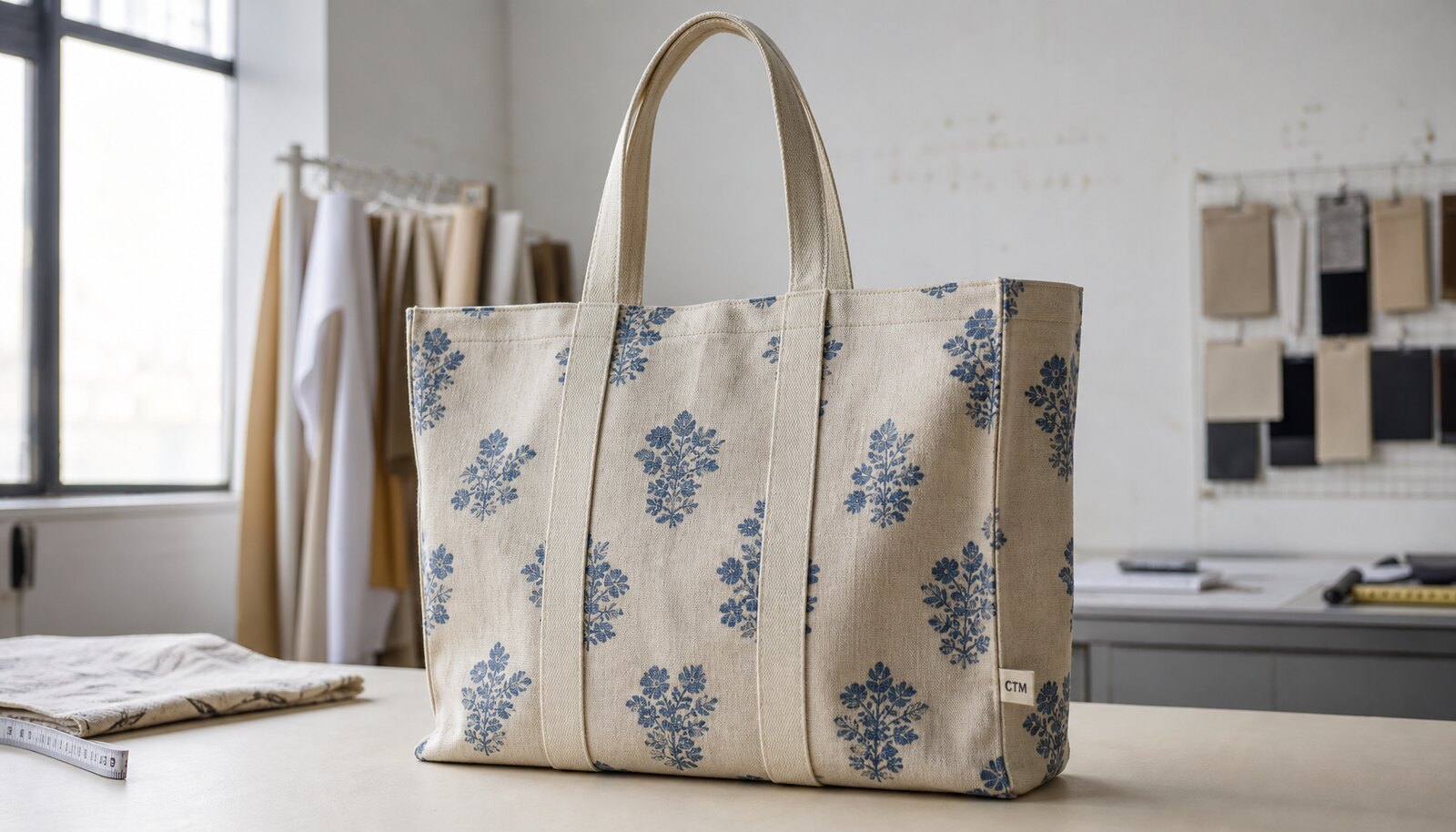
Why the sample is the contract, not just a visual reference
For printed canvas shopping bags for boutiques, the sample is the buyer’s most practical control point. It is the only physical reference that can lock the fabric, print, stitching, handle construction, and packing format before the factory starts mass production. If the sample only shows logo placement, the order is exposed to quiet substitutions later: a lighter canvas, a looser weave, a different ink, or a cheaper carton. Those changes often do not appear in a simple photo review, but they show up immediately when the goods are received, folded, packed, and handled by store staff or warehouse teams.
Treat the sample as a frozen version of the order. That means the approved sample should be tied to one spec sheet, one artwork file, one packing instruction, and one quoted version. The most common sourcing problem is not that the sample is bad; it is that the sample was approved too loosely. The buyer thinks the approval covers a 10 oz pre-shrunk canvas with flat bulk packing, while the factory believes it only covers the printed logo on a similar stock bag. The result is quote drift and quality dispute later.
For boutique programs, the sample also needs to reflect the customer experience. Canvas tote bags are often judged by hand feel, structure, how cleanly they stand, and how premium they look beside apparel, candles, books, or gifting items. A bag can pass a simple visual review and still fail the retail test if the handles twist, the hem waves, or the print looks dull on the chosen canvas. Approval should therefore cover both technical fit and shelf appeal.
The cleanest process is to sign one physical golden sample and keep it with the procurement file. Put a version number and approval date on the sample record, on the spec sheet, and on the PO. If the factory later changes the fabric, print process, or pack format, require a new approval event. That small discipline prevents most of the arguments that otherwise happen during bulk production or receiving.
In practice, a strong sample file does three jobs at once. It protects margin by preventing costly rework. It protects timing by reducing the number of back-and-forth corrections before production. And it protects brand perception by making sure the bag that lands on the boutique floor looks and feels like the product that was originally approved.
- Freeze one physical sample with a versioned spec sheet and artwork file.
- Do not approve a photo alone when the bulk spec is still unclear.
- Treat any later change in fabric, print, handle, or packing as a new approval event.
- Keep the golden sample accessible to QC, receiving, and replenishment teams.
Choose the base bag before you debate the print
Many buyers start with the logo and only later realize that the base bag determines whether the print reads as premium or promotional. The fabric weight, weave tightness, and finish affect how the artwork sits, how the bag stands, and how the customer perceives the product. A soft bag can be perfectly printable and still feel too casual for a boutique shelf. A heavier bag may feel right, but if the weave is too open or the finish is too rough, the decoration can look patchy or uneven. That is why the sample should begin with the body specification, not with the artwork.
There is no single “best” canvas weight for every program. Eight-ounce canvas can work for light retail goods, giveaways, or short-term campaigns where the bag only needs to carry minimal weight. Ten-ounce canvas is often the practical middle point for boutiques because it offers a more structured hand without pushing cost, weight, and freight too high. Twelve-ounce and above makes more sense when the bag needs to hold heavier purchases, when the brand wants a firmer silhouette, or when show-through on natural canvas must be reduced. But even that range depends on construction. A 10 oz canvas with a well-built handle, tighter weave, and clean top hem can outperform a heavier fabric that is poorly sewn or too loose in the body.
Handle construction matters as much as fabric weight. A bag intended for retail carry should be checked for handle width, handle drop, attachment length, and reinforcement pattern. A wide enough handle can improve comfort and reduce stress at the attachment point, especially if the boutique carries books, boxed gifts, denim, or small home accessories. If the handle is narrow or under-reinforced, the bag may still look acceptable in a sample photo but will deform under real use. Ask the factory to state the stitch pattern and reinforcement method clearly, because that is often where a cheaper construction quietly saves cost.
Also ask whether the canvas is pre-shrunk, washed, or finished in a way that affects size stability. Canvas can tighten or distort with moisture and handling, and a sample made from one lot may not behave the same as bulk production. If the bag will be reused by customers, choose a fabric and stitch structure that can better tolerate folding and repeated handling. For boutique buyers, the most useful question is not simply “Is 10 oz enough?” but “Does this exact fabric, with this handle and stitch pattern, support the retail use case and the print quality we need?”
- Judge the bag body before the artwork: fabric weight, weave, finish, and structure drive the retail impression.
- Use 8 oz only for lighter loads or lower-cost programs; 10 oz is a strong default for many boutiques.
- Move to 12 oz+ when the product load is heavier or when a firmer premium shape is required.
- Check handle width, drop, reinforcement, and stitch pattern as part of the base bag approval.
Match print method to artwork complexity, use case, and order volume
The right print method depends on more than the logo artwork. It depends on how many colors are needed, how much opacity the design needs on canvas, whether the bag will be folded often, how premium the finish should feel, and what MOQ the supplier can realistically support. For simple boutique branding, screen print is still the most reliable and scalable option. It typically gives strong opacity on natural canvas, clean edges, and good repeatability when the factory has stable print controls. But it only works well if the screens are aligned, the ink is cured properly, and the bag is positioned consistently across the run.
For short runs or more detailed artwork, transfer-based methods or DTF can be useful. They reduce some setup burden and can reproduce color complexity more easily in the sample phase. But they introduce new checks that buyers should not ignore. A transfer can feel too plastic, can lift at the edges, or can crack when the bag is folded into cartons or placed under pressure in a warehouse. A DTF print can look visually sharp yet still fail a boutique standard if it feels heavy on natural canvas or if the edges become visible at close distance. The sample should be bent, rubbed, and folded—not just photographed under good light.
If you are sourcing a simple logo bag for repeat replenishment, ask whether the print method will remain stable over time. Some suppliers can make a good sales sample using a different process from the one they plan to use in bulk. That is not automatically a problem, but it must be stated. The buyer should know whether the sample is a visual direction sample, a print-method test sample, or a true pre-production sample. Without that distinction, print approval becomes misleading because the factory may switch from one method to another after the order is placed.
Ink or transfer durability should be checked against the real use scenario. A boutique shopping bag often gets bent, stacked, handled by store staff, and reused by the customer. That means the decoration needs more than color accuracy. It needs cure stability, edge integrity, and rub resistance. If the artwork is simple and the order repeats often, screen print usually gives the cleanest commercial result. If the art is complex and the run is short, a transfer method may be acceptable—but only if the buyer is comfortable with the hand-feel and the durability profile.
In RFQ terms, ask suppliers to quote the same bag in the same base canvas with the decoration method separated clearly. That way you can compare screen print against transfer or DTF on the actual total cost, not on a generic quote that hides setup differences. The sample should tell you which method is most appropriate for your art, but the commercial decision still has to balance repeatability, tactile feel, and MOQ.
- Use screen print for simple logos and repeat orders where opacity and consistency matter.
- Use transfer or DTF only when the art complexity or low volume justifies the trade-offs.
- Test rub, fold, and edge lift on any print method that is not screen print.
- Demand clarity on whether the sample method is the same method intended for bulk production.
Compare supplier routes before you compare price
Buyer-side sourcing often gets distorted when all suppliers are treated as though they are making the same product in the same way. They are not. A direct factory, a trading company, and a local decorator each create a different approval risk. The direct factory route is usually the most transparent because the same team quotes, makes the sample, and runs production. That gives the buyer the best chance to see real stitching quality, print control, and packing practice. It is especially useful when the boutique program needs repeat orders, the brand expects stability, or the bag is part of a wider packaging family that must remain consistent across seasons.
A trading company can still be the right choice when the buyer wants one contact for multiple accessory lines or when the supply chain needs coordination across several plants. The issue is not the presence of a trading layer; the issue is whether the real maker is visible and accountable. Buyers should ask who actually cuts, prints, and sews the bag, who signs the pre-production sample, and whether any subcontracting is allowed after approval. If the sample comes from one factory but bulk production moves elsewhere, quality drift becomes much harder to control.
A local decorator using imported blanks can work for store openings, fast seasonal tests, or small promotional campaigns. That route is fast because the blank bag already exists and only the print step is being added. But it is only a partial comparison. The blank may be lighter, the seam build may be different, and the landed cost can be misleading if the buyer later tries to scale the same program through a different supply chain. It is a useful route for speed, not for assuming long-term production parity.
The best RFQ practice is to force each supplier route to quote the same end target: same bag dimensions, same canvas weight, same print method, same packing method, same carton count, same delivery term. Then ask for the hidden ownership details. Who owns the fabric? Who owns the screens or artwork files? Who pays for rework if the bulk sample diverges? Who approves a material change? Those questions make supplier routes comparable in a way unit price alone never can.
For procurement buyers, the practical goal is not just to find the lowest number. It is to identify which route can hold the approved sample through bulk production with the fewest moving parts. That is usually the supplier who can answer the questions directly and document the controls without hesitation.
- Direct factory gives the clearest link between sample and bulk output.
- Trading company is workable only if the real maker is identified and accountable.
- Local decorator plus imported blank is useful for speed, not for comparing full production economics.
- Ask who owns the fabric, the print files, the sample approval, and the subcontracting decision.
Use a sample approval checklist with measurable acceptance criteria
A sample checklist becomes useful only when it is measurable. The buyer should be able to inspect a printed canvas shopping bag for boutiques and answer: does it match the spec, or does it not? Start with dimensions. Measure width, height, and gusset on a flat surface and compare them against the approved drawing. Then check handle drop and symmetry. A boutique bag that is visibly uneven when held by the handles will look unprofessional even if the logo print is clean. If the sample varies outside the agreed tolerance, that should be documented before bulk production starts.
Next, inspect the sewing. Look at the top hem, side seams, bottom seam, and handle attachment. The stitch line should be straight and consistent, with no skipped stitches, loose thread tails, or obvious distortion around reinforcement points. Buyers sometimes say they want a “stronger bag,” but the useful instruction is more specific: require even stitch density, no seam puckering, and reinforcement that is symmetrical on both sides of the handle attachment. If the bag is meant to carry heavier retail items, ask the factory to describe the stitch construction rather than using generic reassurance.
Print placement is another area that should be written in millimeters, not just described as centered. The logo should sit relative to the bottom seam, the side fold, or the top hem according to a clear reference. On natural canvas, some minor surface variation is normal, but the print must still appear intentional and square. Check opacity, edge sharpness, and the absence of visible banding or weak coverage. If the artwork uses more than one color, inspect registration carefully. Misalignment might seem minor on a small sample, but it becomes obvious in a store setting.
Material acceptance should be documented too. Natural canvas often has small flecks or slubs, and that is acceptable only if it falls within the agreed shade band and visual range. Ask the factory to show a hand reference or approved fabric standard, not merely a verbal promise that the cloth is “good quality.” If the canvas is dyed or bleached, define the acceptable shade range; if it is natural, define what level of flecking or tonal variation is acceptable. Otherwise the receiving team will have no basis to distinguish normal texture from poor workmanship.
The most effective approval checklist also includes what happens when the sample fails. For example: if print placement is off by more than the tolerance, the factory must resubmit; if the handle stitching is uneven, the factory must revise before pre-production approval; if the sample uses stock material, it cannot be used for final bulk authorization. Those decision rules reduce subjectivity and stop a sample from becoming an endless negotiation tool.
One more point: do not forget to compare the sample against the golden sample after bulk goods are packed. A good initial sample can still be lost in translation if the production team uses a different fold, a different carton count, or a different packing sequence. The approval checklist should therefore extend from the bag itself into the pack-out condition.
- Measure width, height, gusset, handle drop, and print placement against the drawing.
- Check stitch density, symmetry, reinforcement, and thread tails at every stress point.
- Write print position and acceptable shade band in millimeters or a defined visual reference.
- Define what fails approval so the factory knows when to resubmit before bulk begins.
Turn the sample into a quote baseline and prevent quote drift
A quote is only useful if all suppliers are quoting the same thing. The sample approval stage should lock the commercial baseline so every offer can be compared on equal terms. That means the RFQ needs to reflect the approved sample exactly: fabric weight, size, handle material, handle length, print method, number of colors, label format, packing style, carton count, and delivery term. If one supplier quotes a flat-packed bag with no inner packing and another quotes a bag with a polybag and insert card, the prices are not comparable and the lower number may simply be less complete.
Buyers should also separate one-time setup charges from recurring unit cost. For printed canvas shopping bags, setup can include screen charges, color matching, artwork prep, sample courier, carton artwork, and any revision fees caused by a changed sample. If these are buried in the unit price, it becomes hard to tell whether the supplier is truly competitive or just presenting a low headline number. That problem is especially common in small boutique programs where the MOQ is not large enough to absorb hidden setup waste comfortably.
The quote should also include a clear change-control rule. Ask the factory which changes require a re-quote. A change in canvas weight or weave almost certainly should. A new print color usually should. A small packaging adjustment may or may not. Without that line, suppliers can quietly revise pricing after sample approval under the excuse that the order has “changed.” The buyer can prevent this by attaching the approved sample version number to the RFQ and PO from the start.
Do not compare factory price without considering total landed cost. Freight, duty, carton volume, sample shipping, and the cost of rework can easily change the real economics of the order. A slightly more expensive supplier may be the better commercial choice if they can keep the product stable, reduce rejections, or avoid a second sample cycle. Conversely, a lower unit price is not a bargain if the print quality is weak or the packing causes warehouse damage. The sample is the best way to predict those hidden costs before they hit the budget.
When you are comparing offers across regions, normalize the sample assumptions. Compare the same bag weight, the same packing density, the same carton size, and the same expected delivery route. That gives procurement a realistic landed-cost basis instead of a confusing list of different package shapes and different print assumptions.
- Quote the same sample version across all suppliers before comparing price.
- Separate one-time setup from recurring unit cost in every offer.
- Attach the approved sample version number to the RFQ and PO.
- Compare landed cost, not just factory price, especially where freight and rework can change the result.
Set packing, carton, and warehouse handling rules early
Packing is often treated as a final admin step, but for canvas tote bags it is part of product quality. A good print can be scuffed by poor folding. A neat handle can be bent by overfilled cartons. A premium-looking bag can arrive creased if the fold direction or carton compression was never specified. That is why the sample should be approved in the same pack format the factory plans to use for bulk shipping. If the sample is shown flat and the bulk will be polybagged, say so. If the sample is nested and the bulk will be loose packed, that difference must be visible in the approval file.
Choose the packing format based on how the goods will be received and sold. Flat bulk packing usually works best for import programs because it reduces carton volume and protects the bag shape if done correctly. Polybagging may be appropriate for moisture protection or for retail presentation, but it adds waste and can trap humidity if the route is long or the carton storage conditions are poor. Tissue or insert cards may be useful for display, but they should not be added casually because they change carton density, labor time, and landed cost.
The carton spec needs as much clarity as the bag spec. Define the carton grade, quantity per carton, outer label format, SKU content, barcode rules, and gross weight range. If your warehouse or retailer uses a scan-based receiving system, make sure the carton mark and the bag mark align. If the bags are to be shelf-ready, define how they should be folded, whether they should be inserted face-out, and whether any top protection is needed to keep the print surface clean.
You should also ask for packing controls that reduce transit damage. Cartons should withstand a practical compression and drop check appropriate to the shipping lane. The bags should not deform, the handles should not crease permanently, and the print should not show rub marks after a carton is squeezed or stacked. For humid routes, include moisture protection or desiccant if the route or storage environment warrants it. That is especially important for canvas bags that may be held in inventory before seasonal release.
Good packing is not just about preventing damage; it also keeps receiving simple. When the outer carton marks are clear and the bag count is accurate, warehouse teams can accept the shipment faster. That makes a real difference for boutique programs that are time-sensitive and frequently replenished.
- Approve the bag in the same pack format you will receive in bulk.
- Define carton count, carton grade, carton label content, and SKU/barcode rules in writing.
- Use moisture protection when the route or storage conditions justify it.
- Treat flat packing, folding, and polybagging as quality decisions, not afterthoughts.
Tie lead time to sample approval milestones, not just the quoted date
Quoted lead time is only meaningful if the start point is clear. In practice, suppliers often mean different things when they say a bag can be delivered in a certain number of days. One may be counting from artwork confirmation. Another may be counting from deposit receipt. Another may be counting from pre-production sample approval. For printed canvas shopping bags for boutiques, only the last of these is useful for planning because it reflects the actual production-ready state. If your launch calendar is built on the wrong start point, the order can be late even when the supplier believes they met the promise.
The sample loop is where most schedules slip. The first sample may be quick, but if the logo size changes, the print process needs a new screen, the handle width changes, or the carton mark needs to be revised, the project restarts. That is not a failure; it is a normal sourcing cycle. The issue is whether the buyer allowed time for it. If the bag is for a seasonal launch or a retail reset, build in at least one correction cycle and a buffer for final material booking. Otherwise the team may feel pressured to approve a sample too quickly just to protect the calendar.
Ask the supplier how long each milestone takes: first sample, revised sample, pre-production sample, and bulk run after written approval. Those are different lead times. Ask them to state whether bulk materials are booked after the first sample or after final approval. In well-run programs, the factory should avoid locking the wrong fabric or labels too early. That protects both sides from inventory mistakes if the sample changes.
You should also check whether any critical materials are long-lead items. Canvas, webbing, woven labels, and printed cartons may have separate supply timing. If the factory controls those items internally, ask whether they are already stocked or must be newly made. If they are external, ask what happens if one of them delays the package. Lead time risk usually comes from one part of the product chain, not from the bag body itself.
The practical buyer rule is simple: do not release a PO until the pre-production sample has been signed off on the exact material and pack format that will go to mass production. The date on the quote is not the same as a ready-to-make approval. The approval milestone is the one that should drive the schedule.
- Ask suppliers to state the lead-time start point in writing.
- Build time for at least one revision cycle on new art, new packing, or new materials.
- Do not book final materials too early if the sample may still change.
- Release the PO only after the pre-production sample is approved on the exact bulk spec.
Use QC checks that are specific enough to hold the line in production
Quality control for printed canvas bags should move beyond general impressions. The buyer needs acceptance criteria that can be checked at sample stage, during in-line inspection, and at final carton audit. Start with the fabric. Inspect for broken picks, thin spots, stain marks, odor, oil contamination, or visible weave faults. Then assess whether the canvas weight matches the approved standard closely enough to preserve the hand feel and structure. A premium boutique bag needs enough body to stand and carry merchandise without collapsing, but it also needs a finish that suits the brand position.
Sewing quality deserves concrete criteria too. Use stitch consistency as a visible proxy for workmanship: no skipped stitches, no crooked seam runs, no loose thread tails, no puckering at the top hem, and no asymmetry in handle attachment. For a tote that will be reused, ask the supplier whether they have any internal stitch-length standard and whether reinforcement is applied at the same points on every bag. Buyers do not need to prescribe the machine, but they do need a measurable result.
For print QC, define the expected check in terms of cure, rub resistance, and placement. Screen print should not show smudge, powdering, or color loss after a practical rub test on the approved area. Transfer or DTF should not lift at the edges or crack visibly after repeated folding. If your brand uses a specific color reference, store the approved reference visually and digitally. If the bag uses natural canvas, accept only the flecking and tonal variation that were written into the spec. That prevents normal texture from being confused with defect and also stops the supplier from using “natural variation” as a blanket excuse.
A useful QC file also includes carton-level checks. Cartons should be fit for purpose on the route and should not cause handle creasing, print scuffing, or body deformation under normal handling and compression. Drop and compression tests do not need to be laboratory complex to be useful; they need to reflect the route and packaging level. If the goods are likely to be stacked, moved between docks, or held in a warm warehouse, the pack spec should be robust enough for that reality.
The best practice is to compare production against the golden sample, not just against the PO. If the golden sample and the PO match exactly, then any deviation becomes visible. That is the simplest way to prevent “close enough” production from becoming accepted inventory.
If your procurement process uses third-party inspection, give the inspector a short defect list and a clear pass/fail threshold. A more detailed checklist is better than a generic “good quality” note because it forces the factory to control what actually matters for boutique resale.
- Inspect fabric for stains, weak spots, odor, broken picks, and weave faults.
- Set stitch and seam criteria: no skips, no loose tails, no puckering, no crooked runs.
- Require rub or fold checks for print durability, especially on transfer methods.
- Add carton drop and compression checks suitable to the shipping route and storage conditions.
Close the order with a clean sign-off package
The final approval package should be short, complete, and easy to audit later. At minimum, it should include the signed golden sample, the final spec sheet, the final artwork file, the approved packing instruction, and the PO reference that matches all of those records. If those five items line up, the buyer has a solid source of truth for production, receiving, and replenishment. If they do not line up, disputes start because everyone is looking at a different version.
For repeat boutique programs, version control matters more than polished language. Put the version number on the sample sheet, on the artwork file, and on the PO or line note. If a later order changes the print size, the canvas weight, the carton count, or the pack style, do not treat it as a silent update. Re-approve it. That is especially important when the bag is tied to seasonal display, retail merchandising, or a branded customer experience where consistency matters across stores.
It is also worth deciding how you will compare future production to the approved sample. The receiving team should know where the golden sample is stored, who can authorize a deviation, and what deviations require rework, discount, or rejection. A good procurement process does not leave those decisions until goods arrive. It defines them before purchase. That keeps both supplier and buyer aligned when timing is tight and the bags are needed for a launch or restock.
One final control point: if the supplier changes anything after approval, ask for a written change note that explains what changed and why. This is not bureaucracy for its own sake. It is the simplest way to avoid the common problem where a sales sample is approved by one person, a revised bag is made by another team, and the receiving warehouse is left to guess whether the difference is acceptable. Clear approval records turn a subjective process into a manageable one.
That is the real purpose of the sample approval checklist. It is not merely to confirm that the logo looks right. It is to make the full supply chain accountable to one version of the bag, one version of the pack, and one version of the commercial agreement.
- Keep one signed golden sample with the matching spec sheet and final artwork file.
- Put version numbers on every approved file and change note.
- Re-approve any change to fabric, print, carton count, or packing format.
- Tell receiving who holds the authority to accept deviations and who does not.
Specification comparison for buyers
| Buyer route | What the sample really proves | When it is strongest | Controls that keep quotes comparable | Main risk to verify |
|---|---|---|---|---|
| Direct canvas bag factory | Cuts, prints, sews, and packs under one production system; the sample is closest to bulk reality | Repeat boutique programs, stable designs, and replenishment orders | Ask for the exact bulk fabric, trim, print process, and packing spec; confirm the same plant signs the pre-production sample | Check for hidden subcontracting and whether the factory can truly reproduce the approved sample at scale |
| Trading company with named factory | Coordinates a factory-backed sample but may not control all operations directly | Multi-item sourcing, lower-touch programs, or buyers who need one contact for several accessories | Request the factory name, production location, and who owns the sample approval; require the real maker to sign off on final specs | Verify that later orders will not be moved to another plant without written approval |
| Local decorator using imported blanks | Confirms decoration quality on a ready-made bag shell, not full production control | Fast seasonal tests, local launches, small promotional runs, or urgent retail events | Separate the blank-bag spec from the print spec; compare blank weight, seam quality, and bag dimensions before judging price | Check whether the blank is commercially stable or just a convenient off-the-shelf substitute |
| Sales sample on stock material | Shows artwork placement, logo size, and visual direction only | Early concept review, buyer feedback, or internal merchant sign-off | Label it clearly as a visual sample only; do not use it as the final production reference | Do not approve bulk from a sample that uses different canvas, different print chemistry, or different packing |
| Pre-production sample from bulk materials | Matches the materials and methods intended for mass production | Final approval before PO release and before the factory books main materials | Require exact fabric lot or approved equivalent, final artwork file, final trim, and carton spec | Make sure any last-minute change triggers a new sign-off instead of a verbal update |
| Screen print | Reliable for simple logos, sharp blocks of color, and repeat orders | One- or two-color boutique logos with clear brand marks | Confirm screen count, ink type, cure method, opacity, and registration tolerance | Watch for under-cured ink, edge blur, and cracking after fold and rub testing |
| DTF / heat transfer | Useful for detailed artwork and shorter runs where screen setup is less efficient | Small MOQs, multicolor designs, or fast merchandising tests | Confirm transfer type, press settings, wash/rub performance, and finish feel on canvas | Check for edge lift, plastic hand-feel, and print durability after folding |
| Flat bulk pack | Protects shape, lowers volume, and works well for import programs | Warehouse-received goods, export cartons, and cost-sensitive shipping | Define carton count, fold direction, moisture protection, and outer label format | Inspect compression marks, creasing, and whether the print rubs during transit |
Buyer checklist before sampling
- Freeze one annotated spec sheet before sample approval: size, gusset, handle drop, handle width, print size, logo placement, and carton count.
- Approve the exact canvas construction, not just the appearance: fabric weight, weave tightness, yarn thickness, finish, and whether the canvas is pre-shrunk or washed.
- Match the print method to the art and volume: screen print for simple repeat logos, transfer methods only when the artwork complexity or MOQ justifies them.
- Inspect stitching at the handle attachment, top hem, side seams, and bottom seam; look for symmetry, stitch consistency, and reinforcement at stress points.
- Require the factory to state whether the sample uses bulk fabric, bulk webbing, bulk labels, and the same packing method that will be used for production.
- Set written tolerances for size, print placement, shade, natural flecking, and seam alignment so the sample is not judged subjectively later.
- Keep one signed golden sample with the final artwork file, the approved packing instruction, and a version number that matches the PO.
- Ask for MOQ by size, print color count, fabric color, and packaging format instead of relying on one headline order quantity.
- Require the quote to separate one-time setup charges from recurring unit pricing: screen prep, artwork prep, labels, carton artwork, and courier samples.
- Make the PO reference the approved sample version explicitly so any later change in fabric, print, or packing is traceable.
Factory quote questions to send
- Is the quoted sample made from the exact bulk fabric, webbing, and label material, or only a similar stock substitute?
- What is the exact canvas specification: gsm or ounce weight, weave construction, and expected shrinkage after moisture exposure or handling?
- Which print process is included, how many colors are priced, and what setup fees are one-time versus repeat order charges?
- What is the MOQ for each bag size, each print version, and each packaging version?
- What handle width, handle length, handle drop, and reinforcement stitch pattern are included in the quote?
- What are the packing details per carton, including carton dimensions, gross weight, carton grade, and outer label content?
- Are artwork prep, screens, plates, sample courier, and carton artwork included, or billed as separate line items?
- What is the lead time for the first sample, revision sample, and bulk production after written approval?
- Which in-line checks, final inspections, or third-party tests are included before shipment?
- What changes will trigger a re-quote, and what changes can be absorbed without changing the unit price?
Quality-control points to confirm
- Bag dimensions should match the approved spec within the written tolerance, measured flat at width, height, and gusset depth.
- Handle drop, handle symmetry, and handle width should match the approved sample; measure from the top edge to the lowest point of the handle loop.
- Stitch quality should be consistent with no skipped stitches, broken threads, loose tails, or seam puckering at stress points.
- A practical acceptance benchmark is stitch density that is even along the seam, with no visibly open spacing or irregular reinforcement at the handle attachment.
- Print placement should stay within the approved tolerance in millimeters and should be square to the bag body and seam lines.
- Print appearance should show no bleeding, smudging, pinholes, banding, color skip, or under-coverage on the approved color area.
- If using screen print, check cure by rub test on the approved ink area and confirm the print does not transfer, crack, or powder under normal handling.
- If using transfer or DTF, check edge lift, finish feel, fold-crack behavior, and adhesion after repeated bending of the bag body.
- Shades should fall within the approved shade band; natural canvas variation should be accepted only if it was written into the reference standard.
- Fabric should be free from broken picks, weak spots, oil marks, mildew, odor, contamination, and visible weaving faults that affect presentation or strength.