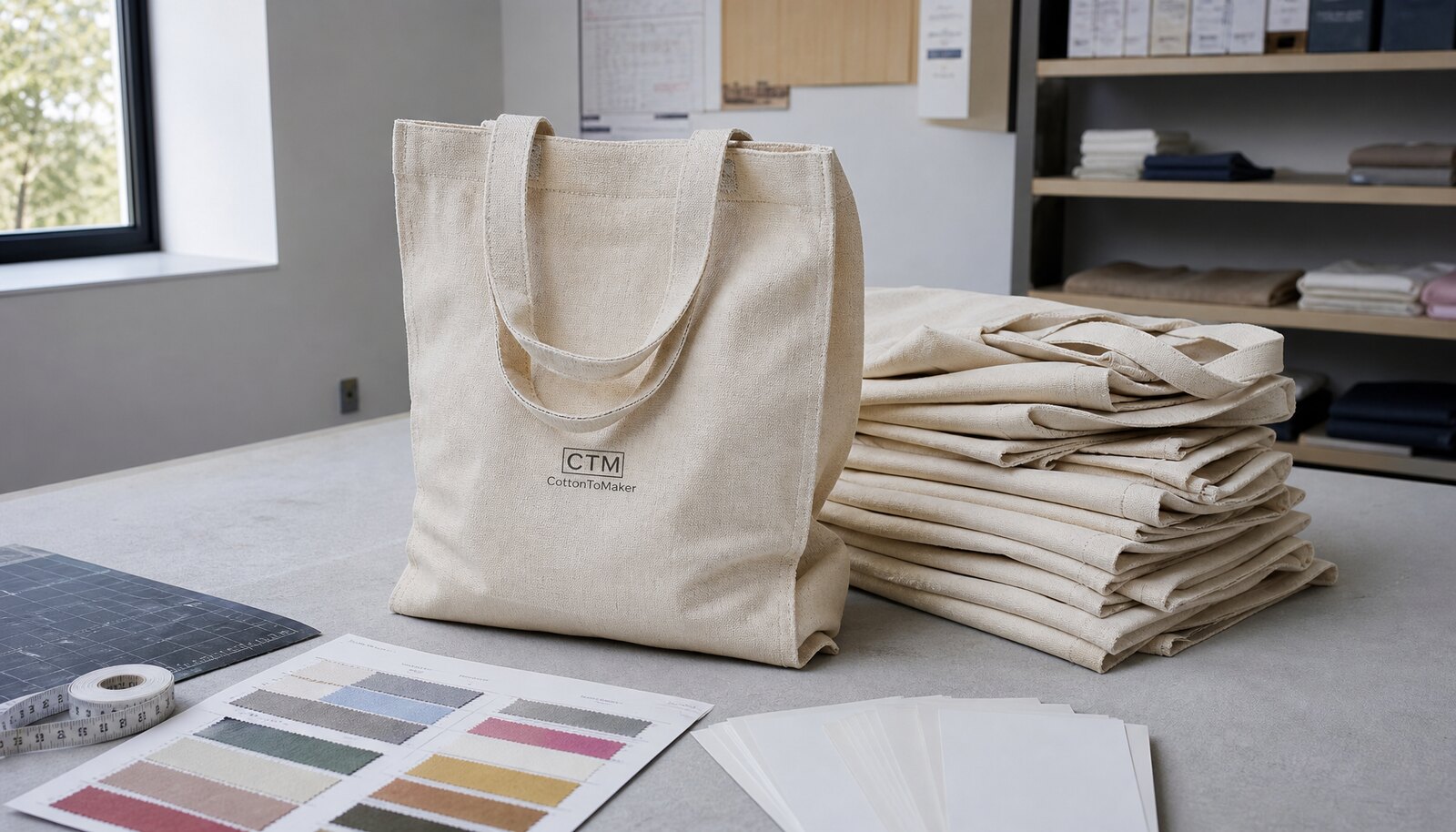
Why boutique buyers get tripped up on canvas bag quotes
Printed canvas shopping bags for boutiques look simple until the quote lands in your inbox. One supplier prices by fabric weight, another bundles print into the unit rate, and a third gives a low headline number that only works at a much larger quantity. If those quotes are compared as if they were identical products, the cheapest option may turn into the most expensive once freight, packing, and rework are counted.
The sourcing challenge is that this bag is both a retail accessory and a brand carrier. It must look clean on shelf or at the point of sale, but it also has to survive everyday customer use. For procurement teams, the real question is not just the price per bag. It is what exact spec is being priced, what MOQ sits behind that number, and how much lead time has already been absorbed by the production route.
The fastest way to create quote confusion is to leave the spec open. If size, canvas weight, print method, handle construction, and packing format are not fixed, suppliers will fill the gaps differently. One may assume stock fabric and bulk pack. Another may assume washed canvas and retail polybagging. Both can be “right” from their own point of view, but only one will match the buying plan.
This is especially important for seasonal launches and gift-with-purchase programs. Those orders often have a hard launch date and a short commercial window. A boutique may only need the bags for six weeks, but during that window the bag must arrive on time, look consistent, and not create dead stock after the promotion ends. If the program is tied to a store opening, trunk show, or holiday event, the buyer should treat the tote like a launch SKU, not a casual promo item.
Reorder control matters just as much as first-run pricing. A buyer may approve a sample that looks premium, then receive a later run that is a little flatter, a little darker, or packed differently because the factory switched fabric lots or adjusted the print line. The procurement fix is simple: freeze the spec, approve one signed reference sample, and ask the supplier to confirm what must stay identical on future runs. That keeps the conversation focused on commercial continuity instead of generic sourcing talk.
- Use one version-controlled spec sheet for every supplier you contact.
- Compare quotes line by line: fabric, print, sewing, packing, cartons, and freight assumptions.
- Write the intended use clearly: retail shopping bag, gift-with-purchase bag, event bag, or premium merchandise bag.
- Ask whether the quote is based on stock canvas or custom-ordered material.
Choose the canvas weight for the real use case, not the catalog photo
Canvas weight is the first choice that changes both feel and cost. For light boutique carry use, seasonal promotions, or soft goods, a 10 oz canvas can be enough if the sewing is neat and the bag size is sensible. A 12 oz canvas usually gives a more stable hand feel, better drape control, and a more premium retail impression. If the bag is expected to hold books, candles, boxed gifts, or heavier apparel, many buyers move to 14 oz so the bag does not look flimsy on the shelf.
Do not rely on the label alone. Two suppliers can both claim 12 oz canvas and still deliver different results if one is using a looser weave, different finishing, or a different measuring method. Buyers should ask for the actual fabric GSM or ounce weight, whether the cloth is pre-shrunk, and whether the bag will be washed after sewing. Pre-shrinking matters because shrinkage changes finished dimensions, print alignment, and repeat order consistency.
The buyer should also confirm whether the canvas is brushed, enzyme-washed, bleached, or left natural. Those finishes affect appearance, print behavior, and hand feel. Natural undyed canvas can be attractive for boutique branding, but the tone can vary slightly between lots. If the brand needs a warmer or more uniform base, it is safer to specify bleached or dyed fabric rather than assuming “natural” will always look the same.
Retail shelf presentation deserves its own decision rule. A canvas tote that stands more cleanly in a display basket, holds a front panel without drooping, and recovers shape after unpacking usually sells the bag better than a softer version that looks casual in a box. That difference is not cosmetic only; it affects how buyers and end customers perceive value. If the bag will sit beside apparel or gift items in-store, ask the factory how the bag behaves after compression in a carton and whether it needs a shaping insert or tighter pack format.
There is also a reorder risk hidden in fabric choice. The more specialized the finish, the more likely the factory needs to match a particular lot on the next run. That does not mean you should avoid custom finishes; it means you should decide in advance whether consistency or lowest unit price matters more. For boutique programs, consistency usually wins once the tote becomes part of the brand experience.
- 10 oz: cost-efficient and suitable for lighter retail loads and promotional use.
- 12 oz: the most balanced option for boutique shopping bags with a premium feel.
- 14 oz: better structure and durability, but higher fabric and sewing cost.
- Pre-shrunk or washed fabric is safer when size consistency matters across reorders.
Print method selection: what changes the MOQ, the look, and the reorder risk
For boutique logo work, screen printing is usually the default because it is stable, scalable, and cost-effective at repeat quantities. A simple one-color logo or slogan prints cleanly on canvas and tends to hold up well when the factory has a disciplined print line. For brands that expect to reorder the same design, screen print is often the better long-term choice because the setup is repeatable and the result is easier to control from batch to batch.
Digital print has a place, but it is not automatically the better answer just because the artwork is more complex. It is useful when the run is small, when the artwork has many colors, or when the buyer wants a quick test order. The tradeoff is that the unit price often stays higher, and the visual result can differ depending on weave and finish. On a coarse bag, digital print may not sit as smoothly as the buyer expects, and tonal results can shift if the process is adjusted on a later reorder.
A useful quote should make clear how many colors are included, whether screen setup is charged separately, and whether the print area is fixed or flexible. Large coverage increases ink usage, drying time, and defect risk such as pinholes or edge blur. A design that looks simple in artwork software can still be expensive if it wraps around seams or sits close to handle attachment points. Boutique buyers should ask for a print placement drawing with seam clearance, not just a flat artwork file.
The print method also affects commercial feel. A clean screen print on thick canvas usually reads as more retail-ready than a crowded digital layout trying to reproduce too many tones on a textured surface. If the bag is a gift-with-purchase item, that matters less. If the bag is intended to sit on a boutique shelf and be carried repeatedly in public, the print needs to look crisp at a glance and survive handling without obvious cracking or rubbing.
Ask the supplier what changes the setup if you revise the art. Screen setup revisions, color reproofing, or a changed print position can add both time and cost. Many delays begin here, not in sewing. A supplier that can explain its screen making, proof approval, and reproof trigger points is usually giving you a more realistic lead-time answer than one that only quotes a single production number.
- One- or two-color screen print usually keeps the production route practical.
- Large artwork increases setup burden, ink usage, and defect risk.
- Ask whether the quote includes screen setup, film output, and color separation.
- Confirm whether the print position is fixed or can be shifted to clear seams and handles.
MOQ logic: why the lowest quote is often not the best buy
MOQ is not just a factory preference; it is usually a production efficiency threshold. The cutter wants enough fabric to nest patterns efficiently, the print room wants enough units to justify screen setup, and the sewing line wants a batch size that does not require constant changeovers. That is why a standard boutique tote often lands around 500 to 1,000 pieces per design or color when the specification is straightforward. Lower numbers are possible, but they usually depend on stock materials, simplified packing, or a less efficient line schedule.
If a supplier offers a very low MOQ, the buyer should identify what was reduced to make it possible. Sometimes the factory is using stock canvas and a basic trim package. In other cases, the fabric is thinner, the print area is smaller, or the order is being held until it can be combined with another job. That may be acceptable for a launch test, but it is not the same as a stable replenishment program. The quote should say clearly what is standard and what is being improvised for the small run.
MOQ should be judged against the product plan. If the boutique expects to sell through quickly and reorder regularly, a higher MOQ may still be cheaper in the long run if it locks in better fabric control and more consistent print quality. If the bag is seasonal, tied to a gift-with-purchase campaign, or used for a store opening, the buyer may accept a smaller quantity and a higher unit cost to reduce dead stock risk. The right answer depends on demand confidence, storage space, and how sensitive the brand is to consistency across reorders.
The hidden cost in low-MOQ purchasing is that the bag may become hard to repeat. Small orders are more likely to use leftover fabric lots or alternate trims. That can be perfectly fine for a one-off event, but for a boutique bag meant to become part of the brand identity, the buyer should ask whether the supplier can reserve material or record a lot reference for future reorders. Without that, the second run may not match the first closely enough for retail use. A good MOQ discussion should therefore include not just quantity, but repeatability, reorder timing, and whether the factory can hold fabric or screens for the next run.
It is also worth asking how MOQ changes across variables. A bag may be achievable at 500 pieces in one color with one logo position, but jump sharply when the buyer adds a second print color, a custom woven label, or retail polybagging. Those changes do not just add material cost; they change line efficiency. When a quote seems unusually low, a procurement buyer should ask what is excluded and whether the quoted quantity is for the full finished product or only for a simplified version of it.
- MOQ can change by artwork complexity, print colors, bag size, and packaging requirements.
- Mixed colors may be possible if the base bag and print setup stay unchanged.
- Custom labels, inserts, or hangtags often raise the practical MOQ even when the base tote is simple.
- A low unit price at high quantity may be better value than a low MOQ with a much higher landed cost.
Compare sourcing routes before you compare unit price
The sourcing route matters almost as much as the bag spec. A direct factory quote usually gives better visibility into fabric, printing, sewing, and packing. That matters when the buyer needs a repeat order and wants control over size tolerance, print alignment, and carton loading. A trading company can be useful when the buyer needs a quick one-stop response, but the buyer should still ask the same production questions and request proof of actual factory control.
A local converter can be helpful when speed matters more than absolute cost. This route often works best for short runs, rush replenishment, or domestic programs where transport time is already a large part of the schedule. The tradeoff is that the customer may have fewer fabric and finish choices, and the per-unit price can be higher because the operation does not have the same scale as a larger factory.
Stock-bag suppliers with custom print are often the fastest route for launch tests. If the base bag already exists in the right size and material, the supplier only needs to handle the print and packing steps. That can compress lead time significantly. The buyer should still check whether the stock base is stable across reorders, because a stock program can change without much notice if the supplier replaces fabric or updates the cut pattern.
The most important procurement principle is to match the sourcing route to the commercial purpose of the bag. A boutique chain launching a signature shopping bag may need direct-factory control and repeatability. A seasonal pop-up may care more about speed and low commitment. A good buyer does not choose the route by habit; they choose it by the business model, the launch date, and the level of reorder risk they are willing to carry.
- Direct factory: best for repeatability, traceability, and spec control.
- Trading company: useful if they can document the real factory and QC flow.
- Local converter: strong for fast turnaround and domestic delivery.
- Stock-bag supplier: best when speed matters and the base bag can stay standard.
Product-specific comparison: which sourcing route fits boutique bags
The table below compares common sourcing routes using buyer-side criteria that actually affect a decision. The goal is not to crown one route as universally best, but to show which route fits which type of boutique program. A retail bag for a seasonal launch has a different risk profile than a long-term branded carrier. The same is true for a gift-with-purchase bag, which may need a lower commitment and a faster release window.
A serious review should also compare what the supplier controls in-house versus what it has to outsource. Outsourced steps are not automatically bad, but they add timing risk because the factory is depending on another vendor’s schedule. The more handoffs there are, the harder it becomes to commit to a reliable ship date. For procurement buyers, that means lead time should be read as a production map, not a single promise.
- Ask which steps are in-house and which are outsourced.
- Do not compare quotes without comparing the production route.
- Require the same spec version to be used in sampling, mass production, and reorder quotes.
How to review sample bags before you approve production
A sample should do more than show the logo. It should prove that the bag size is correct, the fabric weight feels right, the print is readable at retail distance, and the sewing lines do not distort the artwork. If the bag is meant for display, check how it sits after unpacking. A premium bag should recover cleanly, not stay crushed at the bottom seam or twist at the handles. The sample is your chance to catch the factory’s production habit before the full order is cut.
The most useful sample review is based on acceptance criteria, not vague impressions. Measure the finished bag in several places, check the seam allowance, verify the handle drop, and compare print position to the approved artwork drawing. If the supplier says the fabric was pre-shrunk or washed, ask how much shrinkage was measured before cutting. If the supplier used a temporary hand-finished correction on the sample, ask whether that same correction will exist in bulk or whether it was only done to make the sample look better.
For important orders, keep one signed reference sample and label it clearly with the PO number, spec version, date, and supplier name. That matters for reorders. If a later run is even slightly different, the production reference gives the buyer something objective to compare against. It also helps settle disputes about whether the second run matches the first, which is particularly important when the bag is used as a retail identity item rather than a disposable carrier.
A common mistake is approving a sample that looks good in one view but has hidden issues in use. For example, the print may be centered on a flat table but shift after sewing because the panel stretches, or the handle may look fine until weight is added. The buyer should test the bag with a realistic load and inspect it from the angle customers will actually see in store. That simple step catches many issues that a photo-only approval will miss. For boutique programs, this is also where gift-with-purchase or seasonal launch bags can fail: they look right in the sample room, then arrive too soft, too wrinkled, or too compressed for shelf presentation.
If your program includes more than one store format, ask whether the bag needs to meet a display requirement as well as a carry requirement. A tote that lives near the checkout counter may need a firmer body and a flatter fold. One that is handed out at an event may need less structure but better bulk packing efficiency. Those are different commercial uses, and they should not share the same approval standard by default.
- Approve one signed reference sample before bulk cutting.
- Keep photo records of front, back, side seam, bottom gusset, and label placement.
- Check print registration against seam lines and handle attachment points.
- Reject samples that rely on hand-finishing that will not be repeated in mass production.
Packing and carton planning affect receiving speed and damage risk
Packing is often ignored in early quote discussions, but it affects warehouse speed and retail readiness. Bulk-packed canvas bags are efficient for importers who will repack locally. Individual polybagging is useful when bags need to stay clean, folded uniformly, or retail-ready out of the carton. If the order includes inserts, swing tags, or barcode stickers, the buyer should specify whether those are applied at the factory or at destination, because that changes both labor and lead time.
Carton planning matters because canvas bags are bulky. A well-prepared quote should show carton dimensions, gross weight, and quantity per carton so the buyer can estimate freight accurately and plan warehouse receiving. If the carton is too full, the bags may arrive compressed and wrinkled. If it is too empty, freight costs can rise because the load is inefficient. Either way, carton data should be part of the commercial comparison rather than an afterthought.
For boutique programs, packing also affects how quickly the product can be put into service. If cartons are clearly labeled by style, color, and quantity, the warehouse can receive the order faster and avoid manual sorting. If the order includes mixed sizes or mixed print versions, the buyer should ask for a carton map and carton-level labels before shipment. That prevents stock confusion and reduces the chance that the wrong version reaches the store.
If the bags are being sold as merchandise rather than only used as carrier bags, packaging matters even more. In that case, the factory should quote the bag like a retail product: folded size, insert position, label placement, and protection from dust and handling marks. A small packing change can materially affect the commercial impression of the bag when it reaches the boutique. For gift-with-purchase bags, the protection standard can be slightly lower than for shelf merchandise, but it still should not be so loose that the first customer touch makes the bag look used.
One useful control is a pre-carton photo or pack-out approval. Ask the supplier to show a packed bag, a carton label, and one finished carton before mass shipment. That does not replace final inspection, but it catches avoidable packing mistakes such as wrong folding direction, missing stickers, or mismatched SKU labels.
- Bulk pack lowers cost but requires strong SKU labeling and carton control.
- Retail polybagging adds labor and plastic cost, but it protects print and presentation.
- Barcode stickers should match the buyer’s warehouse SKU structure exactly.
- Ask for a test carton photo if the shipment is mixed by size or artwork.
Lead time review: where the calendar usually slips
A realistic lead time review starts by breaking the schedule into stages rather than quoting one broad number. For a standard printed canvas bag, the process usually includes sample approval, fabric readiness, cutting, printing, sewing, packing, quality inspection, and freight booking. If the supplier cannot explain these stages, the ship date is not yet a plan; it is a guess. The most useful quote is one that shows how long each stage normally takes and which steps are under the factory’s direct control.
The quickest orders are the ones that keep the production path simple. If the fabric is stock, the artwork is final, and the packing is basic, the factory can often move from approval to production without much delay. Once the job adds custom washing, special dyeing, lining, zipper hardware, or retail packaging inserts, the calendar gets longer. These steps may be commercially worthwhile, but the buyer should see them as lead-time drivers and budget accordingly.
Factory-controlled time and outsourced time should be separated. Cutting, sewing, and in-house screen printing are usually easier for the factory to control. Fabric dyeing, custom label printing, or third-party carton sourcing may sit outside the factory’s direct schedule. That difference matters because outsourced steps are where delays often start. A factory may still be honest and capable, but if it depends on another vendor for a key input, the buyer needs a buffer. In printed canvas tote production, the most common delays are not dramatic; they are small revisions that compound: screen setup revisions after artwork tweaks, color reproofing when the first strike does not match, or a late decision to change the print position because the seams do not allow the original placement.
Wash or shrink effects can also change the timeline. If the canvas is washed or pre-shrunk, the factory may need to test the shrink behavior before cutting. That is not a problem by itself, but it is a real production step. If the buyer changes the spec after the fabric has already been processed, the factory may need to rework the batch or remake screens because the final size and placement no longer align with the approved sample. Those are the kinds of delays that are easy to miss if the schedule only says “production 10 days.”
Carton compression is another practical issue. Bags packed too tightly may need reworking, refolding, or a short recovery period before final pack-out. This is especially relevant when the bags are intended to look premium on arrival. If the buyer expects shelf presentation or retail use immediately after receipt, the packing standard should be chosen to avoid a last-minute de-compression delay at the warehouse.
The key procurement lesson is that speed is a system outcome, not a single promise. A supplier who can print quickly but cannot source fabric reliably is not necessarily faster overall than a supplier with a slightly longer but more predictable process. Buyers should value reliability, especially when the bags are tied to store openings, seasonal launches, or promotional windows. Ask for the normal-condition lead time, the best-case lead time, and the likely delay points. That is a much more useful answer than one number with no context.
- Standard orders move faster when fabric is stock and artwork is final.
- Special dyeing, washing, or custom labels extend the calendar.
- Screen setup revisions and color reproofing can add time before sewing starts.
- Freight booking and export documents can affect ship date even after production is complete.
A practical stage-by-stage lead time view for buyer planning
Buyers often receive a single lead-time number, but that number is only useful if you know what it includes. For example, a supplier might quote ten days for production, but that may exclude sample sign-off, screen making, fabric procurement, and carton sourcing. Another supplier may include the whole process but only if the buyer approves artwork immediately. Those differences matter more than the headline number.
A stage-by-stage timeline also helps the buyer identify where the supplier is strongest. A factory that controls cutting, sewing, and printing in-house may move fast once approvals are done. A company that outsources printing may still be fine for simple jobs, but the quote should reflect the extra handoff. Buyers should ask for date ranges, not just one date, so they can see the slack built into the promise. For example, ask for earliest start, normal start, and latest ship date under normal conditions.
If the order includes custom fabric or special finishing, buyers should treat the lead time as a mini project plan. Fabric development can take longer than expected if the supplier is matching a custom tone or finish. Print strikes may need adjustment because canvas weave absorbs ink differently than a smoother material. Packaging also adds time if the supplier has to source polybags, inserts, or labels from another vendor. The more the bag resembles a retail product, the more the schedule should be managed like a retail production calendar rather than a simple sewing order.
The practical way to use this is to ask for a date that is attached to a decision, not a date floating in isolation. Sample approval date, screen approval date, cut start date, pack-out date, and booking date should all be visible. When a supplier says they can ship in two weeks, the buyer should know whether that includes artwork reproofing, material procurement, and inspection. That is where real schedule control begins.
- Ask for stage-level dates, not only a single ship-date estimate.
- Separate in-house process time from outsourced material time.
- Request the supplier’s normal-condition lead time and their best-case lead time.
- Add buffer when the order includes custom fabric, labels, or retail packaging.
Specification comparison for buyers
| Sourcing route | Typical MOQ behavior | Lead time profile | Best print method fit | Buyer risk to check |
|---|---|---|---|---|
| Direct factory | Most useful when you need a stable reorder program; common starting points are 500–1,000 pcs per design for a standard boutique tote, but MOQ rises when you add custom lining, zipper, label, or retail-ready packing | Usually the easiest route to control once artwork and spec are frozen; if fabric is stock and printing is in-house, the factory can often move faster and with fewer handoff delays | Best for screen print on repeat brand SKUs; digital can work for small launch tests, but repeated runs usually hold up better with screen print | Ask whether fabric, print, sewing, and packing are all controlled in-house; request a pre-production sample, a lot reference, and a reorder match plan |
| Trading company / agent | May look flexible at quote stage, but the underlying factory often sets the real MOQ; small orders can carry a hidden premium if the agent is aggregating multiple steps | Communication may be convenient, but date certainty is weaker if printing or packing is subcontracted; delays can hide behind the agent’s update cadence | Works for simple artwork if the agent has a proven factory base and the same line is used for repeat orders | Confirm the actual factory name, who owns QC, and how they handle delays in outsourced steps; do not accept a quote without process traceability |
| Local converter / regional supplier | Can support smaller launch quantities, especially for domestic or regional programs, but price per unit is often higher and fabric options can be narrower | Often faster for samples and short replenishment runs, especially when freight lanes are short and customs are not involved | Good for short-run screen print or simple logo work where speed matters more than extensive customization | Check whether the base canvas is stock or custom sourced, and whether the converter controls stitch quality and fabric consistency |
| Stock-bag supplier with custom print | Usually the fastest path for a boutique launch when the base tote already exists in the right size and color; MOQ can be low if only the print changes | Fast when the base bag is in stock, but slower if the supplier must source a different handle, label, or closure before printing | Best for one- or two-color screen print on a standard bag; less suitable for complex art or precise retail presentation requirements | Verify that the stock SKU is reserved for your order and that the same base bag can be matched on reorders; ask for SKU photos and lot control |
| Hybrid / outsourced production chain | MOQ can appear low in the first email but rise once fabric, print, sewing, packing, and cartons are counted across multiple vendors | Most variable route because the schedule depends on handoffs between fabric sourcing, print shop, sewing line, and pack-out | Can work for mixed methods, but only when the workflow and responsibility map are tightly managed | Demand a stage-by-stage timeline and written ownership for each handoff; ask how delays are handled when one subcontractor slips |
| Material | Canvas weight, fiber mix, finish, and any recycled-content or certification claim should be defined before you compare price | Not a lead-time line item by itself, but material choice changes how quickly the bag can move to cutting and sewing | Affects all print methods because weave, absorbency, and surface finish change ink behavior and visual result | Check whether the supplier can prove the specified fabric weight, finish, and lot consistency rather than just naming a catalog grade |
| Construction | Bag size, gusset, handle length, handle width, reinforcement, and seam allowance all change labor time and defect risk | Construction choices affect sewing complexity and therefore the actual production calendar | Simple construction works best for repeat screen-print orders; premium retail bags can justify more complex builds if the calendar allows it | Ask what changed from sample to bulk if the supplier says the lead time is “the same” despite added structure or reinforcements |
| Decoration | Screen print, digital print, embroidery, woven label, hangtag, and heat transfer each change setup effort and repeatability | Artwork approval and screen setup can add time, especially when the buyer revises placement, color count, or print size after sampling | Screen print is the most common fit for canvas; digital print is useful for small runs or highly detailed art; embroidery is more boutique-looking but slower and heavier | Confirm print method suitability for the exact canvas weight, and ask what can cause reproofing or screen remake if the artwork shifts |
Buyer checklist before sampling
- One finished spec sheet for all suppliers, with dimensions in millimeters, fabric weight, handle length, handle width, handle drop, print placement, and packing format
- Final artwork in vector format, with Pantone or CMYK targets and a print area drawing that shows safe margins from seams, handles, and edges
- Confirmed fabric description: canvas weight, weave type, finish, and whether it is natural, bleached, dyed, washed, or pre-shrunk
- Handle specification including width, material, attachment method, reinforcement, and the finished carry height from top edge to grip point
- MOQ request broken out by artwork, color, size, and every add-on such as lining, zipper, snap, label, hangtag, or retail packaging
- Packing specification including bulk pack vs retail polybag, inner count, carton count, barcode format, and carton marking language
- Sample approval standard with measurement tolerance, print acceptance standard, seam requirements, and pack appearance requirements
- Requested delivery plan showing sample lead time, bulk production lead time, and freight booking window
- Reorder requirement notes, including whether future runs must match the first lot in fabric tone, print density, carton count, and pack configuration
Factory quote questions to send
- What is the MOQ per artwork, per color, and per size, and what specifically changes the MOQ if we switch from screen print to digital print or add extra colors?
- Please separate the quote into fabric, printing, sewing, packing, cartons, and optional add-ons so we can compare suppliers on the same basis.
- Which canvas weight do you recommend for this bag size and intended retail use, and is the canvas pre-shrunk or washed before cutting?
- Can you confirm whether the same factory controls fabric sourcing, cutting, printing, sewing, and packing, or are any steps outsourced?
- What is the sample charge, what sample lead time do you need, and is the sample charge refundable against bulk order quantity?
- How many colors are included in the quoted print price, what is the surcharge for extra colors, and what is the maximum print area included in the quote?
- Please give a stage-by-stage production timeline: fabric ready date, cutting date, print date, sewing date, packing date, and estimated ship date.
- What is your default packing standard, and can you quote alternate packing for bulk pack, retail-ready polybagging, or carton-packed mixed sizes?
- What QC points do you inspect before shipment, and can you share your measurement tolerance, stitch standard, acceptable print defects, and carton test method?
- If we reorder the same SKU later, what control do you use to keep fabric tone, print density, and bag dimensions consistent across lots?
Quality-control points to confirm
- Fabric weight should match the agreed specification within a practical tolerance, and the supplier should state whether the control is by GSM, ounce weight, or both. Ask for the actual measurement method used at the factory, not only the catalog label.
- Finished dimensions should be checked after production and after final packing. A workable buyer-side tolerance for boutique tote bags is often ±0.5 cm to ±1.0 cm on height and width, with the tighter end used for premium retail bags; handle drop should stay within a clearly stated band.
- Stitching should be inspected at handle joins, side seams, bottom seams, and gussets. Ask the factory to state stitch density in stitches per inch or stitches per 3 cm, and require reinforcement such as box-x stitching or bar-tacks at stress points.
- Handle attachment should be strong enough for the intended load. Define defect examples in advance: loose threads longer than the agreed limit, skipped stitches, twisted handle alignment, or uneven reinforcement placement.
- Print acceptance should cover registration, edge sharpness, ink opacity, and color match to approved artwork. Define what is unacceptable: visible bleed into the weave, pinholes in coverage, ghosting, off-center placement, or major shade drift from the reference sample.
- For natural or undyed canvas, color variation between lots is normal. Ask for a retained sealed sample and a lot reference so a future reorder can be checked against the first approved run.
- Measure print placement from fixed points, not from the outer edge of the bag alone. Require the centerline distance from top edge and side seam to be recorded so seam variation does not hide a shifted logo.
- If the bag is meant for retail shelving, verify that it can stand and recover shape after unpacking. A boutique bag should not slump heavily, twist at the handle base, or crease so hard that the front panel looks distorted on display.
- Carton quality should be part of QC, not an afterthought. Specify carton dimensions, net and gross weight limits, carton label format, and whether cartons should survive normal handling without opening or crushing the bags inside.
- Define an allowable defect rate before production starts. Ask the factory to state its AQL target or internal defect allowance for major, minor, and carton-level defects, rather than relying on a general promise of quality.