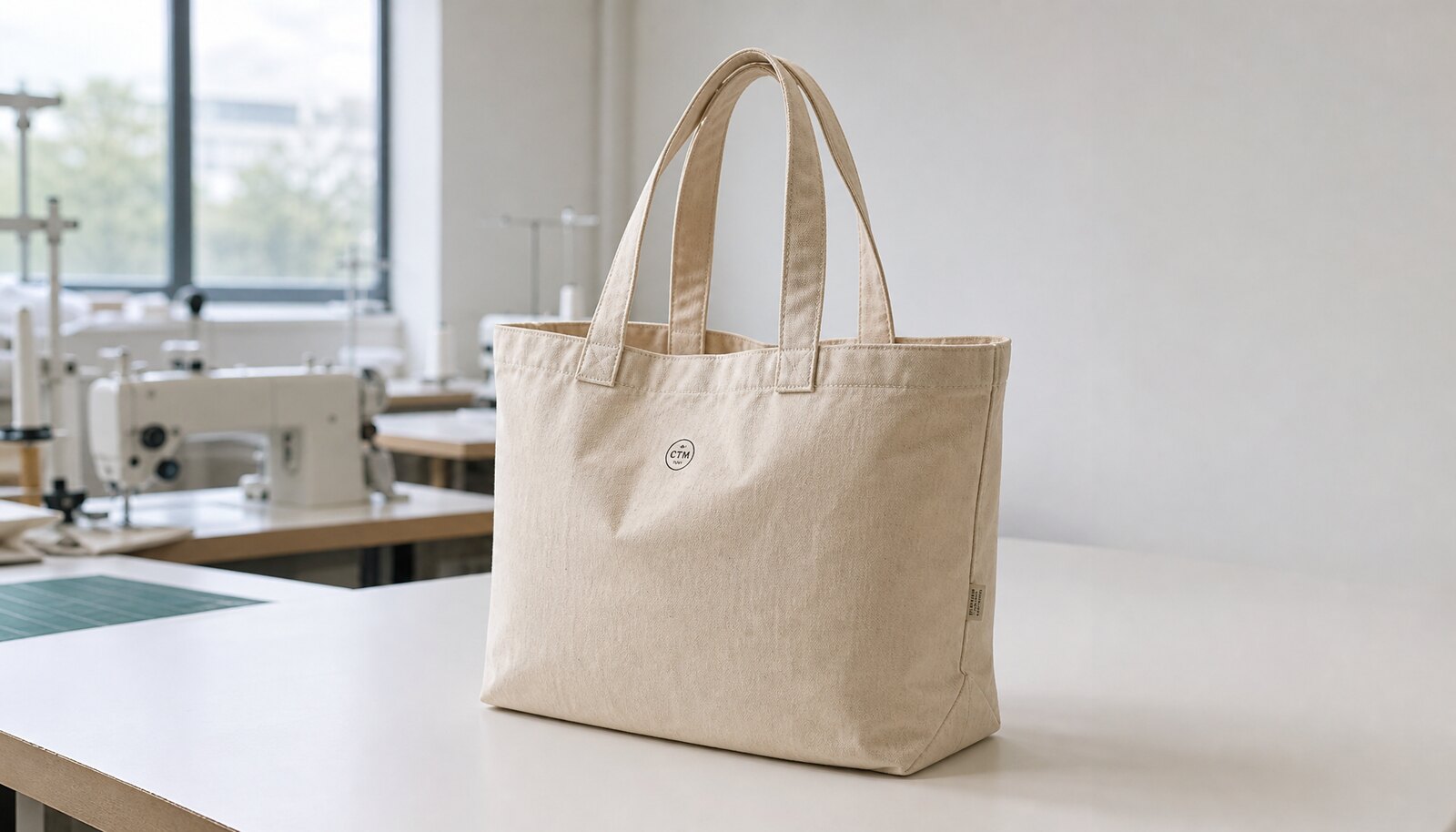
Why bookstore bags need a stricter sample gate than a normal promo tote
Printed canvas shopping bags for bookstores sit between a promo item and a retail product. They are expected to carry hardcovers, notebooks, and mixed purchases, but they also sit on display hooks, counters, and gift tables where appearance matters. That is why the sample is not just a decoration check. It is the point where buyers confirm whether the bag can work in a store environment without looking cheap or failing under routine use.
The most common procurement mistake is to judge the tote from the front panel alone. A sample can look clean on the table and still fail in service if the handle drop is wrong, the seams twist after loading, or the canvas is thinner than the quote implied. For a bookstore program, the approval step needs to answer one question: will this bag still carry well and present cleanly after repeated daily use?
That means the sample must cover appearance, function, packing, and reorder consistency. If the bag is treated as a final production reference, it gives procurement a solid basis for supplier comparison, claims handling, and later reorders. If it is treated as a courtesy sample, the bulk order often becomes the first real quality test, which is the most expensive place to discover a problem.
- Use the sample to test retail appearance and carrying performance together.
- Treat the approved sample as the control for bulk production and reorders.
- Do not approve a bookstore tote without checking load behavior and shelf presentation.
Start with the use case, because the quote only matters after that
The first procurement decision is not the logo artwork. It is the use case. A checkout tote for daily bookstore use needs different performance than a premium resale tote or a one-off launch gift bag. If the bag will carry books every day, body structure, handle reinforcement, and abrasion resistance matter more than a small unit-price difference. If the bag is intended as a retail item, fold quality, handfeel, and visual finish matter more because the customer is buying the bag itself, not just using it.
Write the use case into the RFQ before asking for pricing. Include the likely contents, expected load range, whether the bag is hand-carry only or shoulder-friendly, how often it will be folded, and whether it needs to stand flat on a shelf or pack tightly into cartons. Suppliers can quote more accurately when they know the duty cycle. Without that context, one vendor may price a light promo bag while another quotes a retail-grade reusable tote, and the numbers will not be comparable.
A practical rule: if the bag will routinely carry hardcovers, a notebook, and maybe a drink or small merch item, do not ask suppliers to quote only the cheapest canvas they can find. Ask for the lowest spec they believe will survive the use case, and make them explain the tradeoff in writing. That gives procurement a better basis for price-versus-performance decisions than a bare unit price.
Also define the reorder expectation up front. Some bookstore bags are one-season items. Others are core stock that must match from one replenishment to the next. Those two buying models need different supplier promises, especially on fabric lot control, print repeatability, and packing consistency.
- Define whether the bag is for resale, checkout, gifting, or event distribution.
- State the expected load in plain terms, such as paperbacks only or mixed hardbacks plus merch.
- Clarify whether the bag must look premium on a shelf or simply perform well at a low cost.
A useful supplier comparison matrix: what to compare beyond unit price
Buyers often ask suppliers for a unit quote and stop there. That is not enough for printed canvas shopping bags for bookstores because the quote can hide very different builds. A lower price may come from lighter canvas, narrower handles, fewer stitches, smaller print areas, simpler packing, or a subcontracted print step that increases the risk of drift later. For bookstore programs, the comparison needs to cover both cost and control.
The best comparison is not only direct factory versus trading company. It is a matrix of who controls the fabric, who prints, who inspects, and who can repeat the same spec without renegotiating every detail. Direct factories usually have the strongest process control if they truly cut, print, and pack in-house. Trading companies can be useful when the buying program is broad and the admin load is heavy, but the buyer needs stronger documentation because several steps may sit with different subcontractors. Local decorators using imported blanks can be fast for small runs, yet the blank-bag consistency and reorder match can be weaker.
When you compare suppliers, ask for the same evidence pack from each one: a construction sheet, exact material declaration, current production photos or short videos, lead time by stage, and who owns the final approval before shipment. If one supplier cannot show a real production line or cannot explain where the sample is made, that is a sourcing risk, not just a quotation gap.
The most procurement-useful dimension is sample control. Ask: if we approve this sample today, how exactly will you keep the bulk run matching it next month? A supplier that can point to stored artwork files, retained screens, recorded trim specs, and a signed reference sample is materially lower risk than one that can only promise to “follow the sample.”
- Compare who controls fabric, printing, finishing, and final inspection.
- Ask for the same evidence pack from every supplier so the quotes are comparable.
- Watch for hidden cost shifts in handle width, packing format, label work, and print colors.
Specification choices that matter: fabric weight, weave, handles, and structure
For bookstore totes, 10 oz canvas can work for light use, but 12 oz natural canvas is usually the better starting point for a daily retail bag. At a practical level, many buyers land around 280 gsm to 340 gsm for a balance of structure and cost. That range usually gives enough body to handle books without making the tote feel stiff or overpriced. If the bag must feel more premium or support heavier mixed purchases, 14 oz to 16 oz can be appropriate, but the buyer should expect higher unit cost, more sewing time, and more freight weight.
Handle construction deserves as much attention as fabric weight. A narrow or lightly stitched handle can make the bag feel weak even when the body fabric is acceptable. Webbing around 2.5 cm wide is a common baseline for a bookstore tote, especially when the load may include hardcovers. What matters most is not width alone but the attachment method. Box-X stitching, reinforced bar-tacks, and balanced handle positioning are the details that keep the bag from twisting or cutting into the hand under load.
Structure is the third point. A bottom gusset helps the bag stand and helps books sit flatter. Hemmed top edges usually improve durability and create a cleaner retail look. Raw edges, crooked gussets, or a weak top finish make the sample look unfinished even when the print is good. For buyers, the point is simple: small construction upgrades can change the retail impression more than a slightly bigger logo ever will.
If you are comparing one factory’s 12 oz bag to another’s 12 oz bag, do not assume they are equal. Canvas weave density, yarn quality, and finishing can change the handfeel and the way the bag hangs. Ask for a close-up fabric photo and, where possible, a mill declaration or material sheet instead of relying on a generic ‘12 oz’ statement.
- Treat 12 oz / roughly 340 gsm as a common retail-safe baseline, not a universal rule.
- Use handle reinforcement details as a buying criterion, not a cosmetic note.
- Specify gusset depth, top finish, and seam construction in the RFQ.
Print decisions: what a good bookstore logo sample should prove
For a bookstore logo, one- or two-color screen print is usually the most stable option when the design is simple. Screen print typically gives strong opacity and repeatability on canvas, which helps when the bag is handled, folded, and stacked. The main procurement issue is not whether it looks good in a PDF proof. It is whether the ink sits cleanly on the weave, cures properly, and stays presentable after friction and folding.
If the artwork contains fine text, a detailed line drawing, gradients, or multiple brand elements, digital or transfer methods may be considered. Those methods can work, but they need more scrutiny because durability depends on ink adhesion, cure control, substrate texture, and post-print handling. A buyer should not assume that a visually sharp sample also means good retail durability. Thin strokes can fill in, transfer edges can lift, and a logo that looks good on a fresh sample can age badly after repeated folding.
Set measurable print rules before sample approval. Write the approved position in millimeters from the top edge or seam reference. Define a minimum stroke width for small type. Define whether slight ink variation on natural canvas is acceptable or whether the color target is strict. If the bag is intended for store display, specify the acceptable level of ghosting, edge spread, or registration drift. These details keep the supplier from improvising around a vague logo request.
If the artwork is likely to be reordered often, ask the supplier to keep the print reference on file with the same artwork version, Pantone reference or visual standard, screen count, and cure settings. Repeatability is a procurement control issue, not just a print shop issue.
- Use screen print for simple logos and repeat orders when durability matters.
- Set print position in millimeters from a seam or top edge, not by eye.
- Protect small type with a minimum stroke width and clear-space rule.
What a real approval sample must be made from
A sample should only be approved if it uses final production materials and final production methods. That means final fabric lot, final ink system, final handle material, final reinforcement method, and final packing approach. A sales sample or photo sample can help with early concept discussions, but it cannot control bulk production because it may use substitute materials or a different process path. If the supplier proposes a substitution for any of those items, the sample should be treated as development only until the substitution is documented and accepted.
The approval step should begin with measurements. Check body width, height, gusset depth, handle length, and handle drop against the drawing or tech pack. Then move to workmanship. Look at seam alignment, stitch density, edge finish, thread trimming, and whether the print lands within the allowed area. After that, move to function. Load the bag with actual books or equivalent weight, lift it, carry it, set it down, and refold it. A sample that feels fine empty but twists or digs into the hand under load is not ready.
A useful habit is to keep one approved control sample with the signed spec sheet, artwork file, dated notes, and photos of the accepted front, back, side, and inside views. That becomes the reference if the factory later sends a revised strike-off or a bulk pre-production sample that looks slightly different. Without one control sample, procurement often ends up debating memory instead of evidence.
If the supplier sends a pre-production sample, ask for the exact date, the fabric lot code, the ink batch if available, and the trim source. Those details are valuable when a bulk lot later shows a change that is hard to diagnose from photos alone.
- Approve only a sample made from final fabric, final print, and final trim.
- Measure the sample before visual judgment, not after it.
- Load-test the bag using actual books or realistic substitute weight.
QC depth buyers should ask for: abrasion, seam stress, rub resistance, and carton tests
This is where many tote approvals stay too soft. A bookstore bag is handled, slid, folded, set on counters, and sometimes dragged against shelves or rough surfaces. The sample approval should therefore include a few basic stress checks, even if the supplier does not provide formal lab testing. At minimum, the buyer should ask how the factory checks abrasion, seam security, and print rub resistance, and should receive a written answer that can be repeated on later orders.
For seam stress, the buyer can define a practical internal check: load the bag to the expected use weight, hold it by the handles for 30 to 60 seconds, and inspect the handle join and side seams for opening, puckering, or thread pull. If the supplier has access to lab testing, ask whether they use a seam strength method, a grab test, or an equivalent internal standard. The exact test standard may vary by factory, but the acceptance criterion should not vary: no visible seam failure, no loose reinforcement, and no distortion that changes the bag’s shape.
For print durability, ask for a rub check. A simple dry rub with a white cloth and a light wet rub can reveal whether the ink cures properly and whether it marks adjacent surfaces during normal handling. If the bag will be reused frequently, request evidence that the print remains stable after folding and repeated friction. If the supplier can offer a test report, ask for the method used. If they cannot, record your own internal result and keep the method unchanged on future samples.
Carton performance matters too. Bags can pass the product test and still fail in transit if the cartons crush, open, or miscount. Ask for a carton drop or handling check that reflects the real packing route. You do not need a full certification program for every tote order, but you do need confidence that the master carton will survive normal warehouse handling, not just a gentle factory handover.
Ask for photos or short video clips of the actual checks if the factory says the test is done internally. A short clip showing the loaded bag, the rub check, and the carton close-up is more useful than a verbal assurance that testing happened.
- Ask for seam stress evidence and reject any sample with handle-join opening or seam creep.
- Run a dry rub and a light wet rub check on the print surface before approval.
- Check carton count, carton marks, and pack integrity with the same seriousness as the tote itself.
Color, placement, and retail appearance rules that reduce rework
Canvas is a natural substrate, so the same ink can look slightly different from one fabric lot to another. That is normal, but it needs to be controlled. For a bookstore brand, a physical sample or strike-off is much more useful than a loose color description. If the artwork is simple, a Pantone target or equivalent physical reference helps the factory reproduce the tone more consistently. If the artwork contains more than one color, confirm whether each color is matched separately or whether the supplier is using a visual approximation on natural fabric.
The second rule is placement. Many tote samples are rejected not because the logo is wrong, but because the logo sits awkwardly relative to the seam, top fold, or gusset line. Write the acceptable print position in millimeters and reference the seam, not just the center of the bag. If the logo is small, insist on a maximum positional drift. Small marks are the first to look off when they move even a little. For side labels and woven tags, treat the label position as part of the approved decoration because label placement affects folding and shelf appearance.
Finally, set a visible-appearance check under normal retail light. If the bag will sit near cash wraps or shelves, it should be judged at the distance a customer actually sees it. That is where minor registration errors, uneven ink density, or a slightly crooked label become obvious. The sample should pass from a buyer’s-eye view, not just from a production table view.
For repeat buys, ask the supplier to keep an approved color reference with the order record. A written note like “natural canvas may vary slightly” is not enough on its own; you want a stored standard so the next batch can be checked against something tangible.
- Use a physical sample or strike-off as the approval reference for color.
- Write print placement in millimeters from the seam or top edge.
- Approve label position with the same care as logo placement because it affects folding and shelf display.
MOQ and cost drivers: what actually changes the unit price
MOQ is rarely one number for these bags. It moves with fabric weight, bag size, number of print colors, label work, packing format, and whether the supplier needs new screens or revised cutting markers. A basic one-color tote with no extra trim will almost always price differently from a two-sided bag with a woven label and barcode sticker. For procurement, the important point is that the quote should break those costs apart so the buyer can see what is recurring and what is one-time.
Ask for line-item pricing whenever possible. Separate the bag body from the decoration, the trim from the packing, and the tool or screen charges from the unit price. That makes it easier to compare suppliers and easier to manage a reorder later. It also exposes where a supplier may be hiding margin: for example, in “free” artwork setup that quietly reappears in the next version, or in packing fees that were not obvious in the initial quote.
For bookstore programs, repeatability often matters more than a small first-order discount. If you expect to reorder the same tote through the year, ask whether the supplier retains screens, color references, and trim specs, and whether the next order will match the approved sample without a new round of debate. The cheapest quote can be expensive if the second batch no longer matches the first.
If you are comparing two offers that look similar, check whether one includes a tighter pack count or better flat-folding. A supplier can make the bag price look lower and then recover margin through a less efficient packing format that costs more to receive, count, and shelve.
- Request pricing by size, artwork, print color, and packing spec.
- Separate one-time tooling or screen costs from recurring unit costs.
- Confirm whether MOQ is per SKU, per artwork, or per colorway.
Which supplier route fits which risk profile
Direct factory sourcing usually makes the most sense when the buyer wants control over sample-to-bulk consistency, reorders, and lead time. If the factory cuts the fabric, prints in-house, and packs the carton itself, there are fewer handoffs and fewer places where a detail can drift. That does not make the factory automatically better, but it does make it easier to audit. Ask to see actual production-line evidence: cutting, printing, curing, sewing, and final packing, not just a polished office photo.
Trading companies can be useful when the buying program is broad, the quantities are mixed, or the buyer needs one contact for several SKUs. The tradeoff is that the chain is longer. That means the approval package has to be tighter. Buyers should ask who actually prints the bag, who approves the color, who inspects the final carton count, and who owns the screens or files for reorders. If the trader cannot answer that clearly, the buyer is taking on hidden execution risk.
Local decorators using imported blanks can work for very short runs or emergency replenishment. The advantage is speed and flexibility. The weakness is that the blank bag base may vary from reorder to reorder, and the buyer may not be controlling the original canvas specification. That can be fine for a pilot run, but it is less ideal for a long-term bookstore program where the same tote must look and feel consistent across seasons.
A good procurement habit is to ask every route for the same three things: a current production photo or short video, a written process map showing who does what, and the name of the person who signs off the pre-ship lot. Those three items often reveal the real execution risk faster than a price comparison alone.
- Direct factory is usually the cleanest path for repeat orders and tighter spec control.
- Trading company is useful when admin consolidation matters, but documentation must be stronger.
- Local blank-and-print routes can work for small runs, but base-bag consistency is a real risk.
Specification comparison for buyers
| Buying path / spec choice | Best use case | Pros | Tradeoffs / buyer risk | Typical approval focus |
|---|---|---|---|---|
| 12 oz natural canvas, one-color screen print, direct factory | Core bookstore tote for checkout use and repeat replenishment | Balanced cost, structure, and print durability; easier to keep consistent across reorders | Natural canvas tone can shift how the logo reads; low-cost mills may vary lot to lot | Fabric weight proof, handle reinforcement, print cure, repeat-order match, carton consistency |
| 10 oz canvas, one-color print, trading company | Light promo tote, event giveaway, seasonal traffic driver | Lower first-order cost; easy to quote quickly; acceptable for lighter loads | Higher risk of handle fatigue, seam distortion, and thinner handfeel under books; reorders may change if fabric source changes | Load test, seam security, exact fabric declaration, who prints, who inspects |
| 14–16 oz premium canvas, multi-step decoration, direct factory or specialist decorator | Retail-resale tote, premium gift-with-purchase, launch program | Stronger body, better shelf presence, stronger perceived value | Higher unit cost, heavier freight, longer sewing/print time; over-spec risk if the bag is only for light checkout use | Opacity, abrasion resistance, fold appearance, print placement, packaging finish |
| Imported blank + local print | Small pilots, urgent local programs, short-run seasonal needs | Fast turnaround for small quantities; easy to test art before a larger buy | Blank-bag consistency can vary, and reorder match depends on the blank supplier as much as the printer | Blank dimensions, shrinkage, print adhesion, repeatability of the blank stock |
| Trading company with audited factory chain | Multi-item sourcing, buyers needing one contact across several SKUs | Can consolidate admin, artwork handling, packing, and dispatch | Responsibility can blur across workshops; sample approvals must document the actual maker | Traceability, subcontracted printing, retained screens/files, inspection ownership |
| Pre-production sample from final fabric and trim | Any order that needs a real approval gate before bulk | Best control point for go/no-go, especially when the bag will be sold or used daily | Takes longer up front; may require revision if the spec is incomplete | Measurement check, rub test, load test, carton drop/packing check, label placement |
Buyer checklist before sampling
- Confirm the end use in one sentence: checkout bag, retail-resale tote, event giveaway, or gift-with-purchase. If the use case is still flexible, do not lock a final sample yet.
- Write the target load into the spec. A bookstore tote should be judged against the real contents it will carry: hardcovers, paperbacks, notebooks, and small merch, not an empty-bag visual only.
- Approve the bag against finished dimensions, not approximate size. Record body width, height, gusset depth, handle length, and handle drop with a millimeter tolerance before sampling starts.
- Ask for the actual fabric weight in gsm or oz from a mill sheet, invoice, or supplier declaration. A visual guess is not enough for procurement sign-off.
- Confirm whether the sample uses final production fabric, final print method, final label, final handle material, and final packing format. If any item is substituted, mark the sample as development only.
- Inspect print placement from a fixed reference point, usually the top edge or side seam. Do not approve a tote whose logo is only visually “centered” by eye.
- Check logo clarity under normal store lighting and at arm’s length. Small text should remain readable, and solid areas should not look patchy or washed out.
- Run a realistic carry test with books or equivalent weight. Lift the bag, walk with it, set it down, and repeat several times to see whether the handles twist, stretch, or cut into the hand.
- Inspect handle symmetry, stitch consistency, and reinforcement shape. The bag should hang level when loaded; a slight lean often signals uneven handle length or offset attachment.
- Pull at the seam and handle joins by hand to identify early opening, thread pop, or weak reinforcement before bulk production starts.
Factory quote questions to send
- What exact fabric weight, weave style, and finishing are included in the sample and bulk quote, and what tolerance do you hold on that weight?
- Is the approval sample made from final production fabric, final ink, final label, and final packing format, or is any part substituted? Please identify any substitutions in writing.
- What is the MOQ by size, artwork, and print color, and does the MOQ change if we add woven labels, hangtags, barcode stickers, or inner packing?
- Who performs the printing in your chain, and do you control curing, drying, and post-print inspection in-house or through a subcontractor?
- What is your standard dimensional tolerance for finished width, height, gusset, and handle drop? Please state the tolerance in millimeters.
- What is your standard acceptance criterion for print position, registration, and opacity? If you use internal criteria, please share them.
- Do you keep the screens, artwork files, trim records, and approved reference sample for repeat orders, and how long do you retain them?
- Can you show a current production construction sheet or dated factory photo for a bag with the same seam and handle reinforcement method?
- What carton size, inner pack count, and flat-fold method are included in the quote, and which of those change the unit price?
- What is the sample lead time, the sample revision lead time, and the bulk lead time after final approval?
Quality-control points to confirm
- Fabric weight within agreed tolerance; for a nominal 12 oz / roughly 340 gsm bag, many buyers use a practical acceptance band of about +/- 5% to +/- 8% and reject obvious underweight substitutions.
- Canvas surface even, without oil marks, contamination, broken slub lines, or weak thin streaks on retail-facing panels.
- Finished dimensions, gusset depth, and handle drop within the approved range; treat deviations that affect balance, shelf fit, or carry comfort as defects, not cosmetic variance.
- Print centered or placed to spec within the agreed positional tolerance; for small logos, a common practical limit is within about 3 mm to 5 mm of the approved position.
- Ink fully cured: no tackiness when pressed, no transfer after a dry rub, and no cracking after the bag is flexed and folded several times.
- Rub testing: perform at least 20 firm dry rubs with a white cloth and a light wet rub if the bag may contact moisture; visible color transfer or smearing is a fail unless the buyer has explicitly allowed it.
- Seam and handle stress: load the bag to the target weight and hold or carry it for 30 to 60 seconds; no thread pop, seam opening, or reinforcement distortion should appear.
- Stitching straight and consistent, with no skipped stitches, loose loops, broken threads, or seam puckering that changes the silhouette.
- Handle reinforcement secure, with box-X, bar-tack, or equivalent reinforcement showing full stitch formation and no broken thread ends at the load point.
- Load performance: the bag should remain functional after several lift-and-set cycles with books or equivalent weight, and handles should not elongate enough to change the approved drop noticeably.