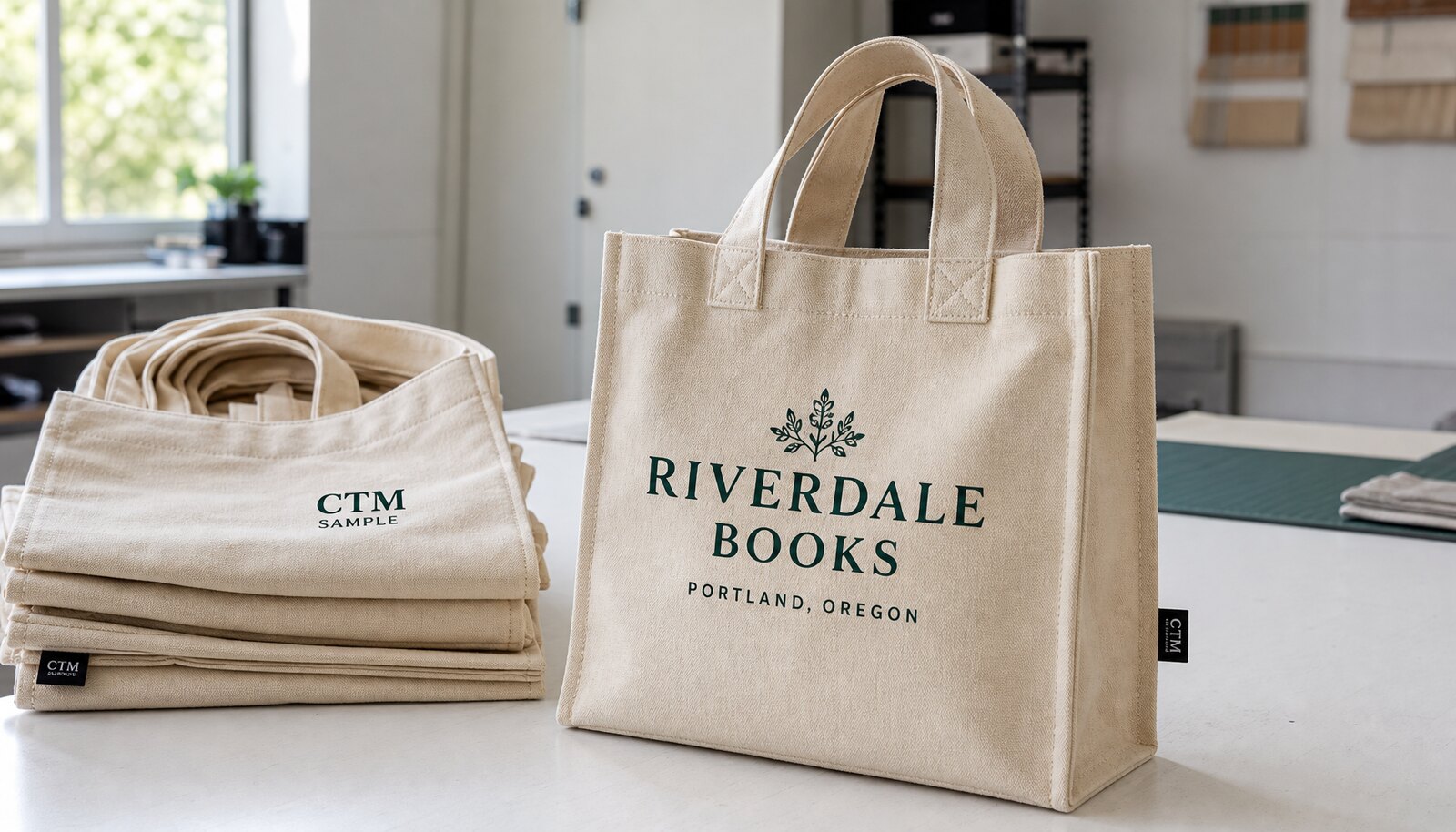
1. Define the bookstore use case before you compare materials
Buyers looking for printed canvas shopping bags for bookstores usually already know the format they want: a reusable tote that feels stronger and more premium than a paper bag. The harder part is defining the business job the bag has to do. A tote used at checkout, sold as merchandise, or handed out with a purchase has different expectations for weight, appearance, carry comfort, and pack-out. If those use cases are mixed together in the RFQ, suppliers will quote different assumptions and the comparison becomes unreliable.
For procurement, the first decision is not fabric weight but usage profile. A checkout tote needs quick packing and a practical carry capacity. A merchandise tote needs to look good on a shelf hook and hold up under repeat customer use. A gift-with-purchase tote may justify a heavier cloth or better finishing because the bag becomes part of the promotion. Independent bookstores often care about perceived quality and lower minimums. Chains usually care more about uniformity, reorder stability, and warehouse-friendly packing.
The best RFQs separate commercial intent from decoration. Instead of asking for a generic tote with a logo, specify what the bag must carry, where it will be sold or handed out, and how long the program must last. Ask whether the bag must fold flat, stand upright, or ship in bulk cartons only. The more clearly you define the use case, the less likely the supplier is to substitute a cheaper construction that looks acceptable in a sample room but fails at the counter.
In practice, the spec should read like a buying decision, not a design note. State the expected contents, frequency of use, channel, and budget sensitivity. That gives suppliers a chance to recommend an honest fabric weight, a realistic handle structure, and the right print method. It also helps procurement compare quotes on the same basis instead of chasing the lowest number in the table.
- Define whether the tote is for checkout, retail sale, gift-with-purchase, or event distribution.
- State the expected load in books, kilograms, or pounds; hardcovers are a better test than paperbacks.
- Confirm whether staff need the tote to fold, stack, hang, or display with other merchandise.
- Ask suppliers to recommend fabric weight only after they understand the use case.
2. Choose canvas weight based on load, shelf presentation, and landed cost
Canvas weight is the main material decision because it affects structure, print opacity, sewing behavior, freight weight, and the customer’s first impression. For most bookstore programs, 10–12 oz cotton canvas is the practical center of gravity. It is substantial enough to hold shape, yet not so heavy that it becomes hard to sew, difficult to fold, or expensive to move in bulk. If the tote is intended to feel premium or will regularly carry hardcovers, 12–14 oz can be justified. That higher range should be chosen because of a real use case, not because “heavier sounds better.”
A lighter canvas may save a little cost, but it can look limp on the rack, show print shadowing, and distort around the bottom seam when customers overpack it. It also tends to feel less giftable. On the other hand, very heavy canvas can improve durability but add cost in fabric, thread, labor, and freight. It can also make the tote feel stiff, which may not match the bookstore’s brand tone if the retailer wants something softer and more casual.
A buyer should compare weights by task, not by label. A tote that carries two paperbacks comfortably may still feel weak once a hardcover, notebook, and small accessory are added. Ask for actual oz or GSM, request the sample in the exact cloth quoted, and test it with representative books. If the supplier gives only a general “good thickness” answer, the quote is too vague to support a procurement decision.
As a rule, the best value is often not the heaviest fabric but the fabric that still prints cleanly, survives repeated carry, and lands at the right shelf value. Weight should be chosen with the full economics in mind: material cost, sewing time, freight cube, and likely customer perception. That is a more reliable method than treating oz as a proxy for quality on its own.
- Ask for both oz and GSM if the supplier works in mixed unit systems.
- Match the fabric weight to the heaviest realistic store load, not the average one.
- If the tote is sold retail, include perceived value and shelf presentation in the weight decision.
- Watch for over-specifying weight, because higher oz usually increases unit cost and can slow production.
3. Inspect weave quality, yarn consistency, and shrinkage before you approve samples
Two bags can both be called 12 oz canvas and still print very differently. That is why weave density and yarn consistency matter. A tighter, more even weave usually gives cleaner print edges, better opacity, and fewer pinholes in the image area. A looser weave can make logo edges look fuzzy, especially on small text or thin lines. If the bookstore artwork includes fine typography, a detailed illustration, or a dark print on natural cloth, the weave can be as important as the total cloth weight.
Yarn quality also affects how the bag behaves in sewing and use. Inconsistent yarn thickness can create slubs, weak points, or uneven density across the same roll of fabric. Those issues may not show in a catalog photo, but they show up in the finished tote as texture variation or uneven ink absorption. Ask the supplier whether the fabric is plain weave cotton canvas, how the yarn is controlled, and whether the production cloth is the same as the sample cloth. A sample made from a cleaner fabric than production cloth is a common source of avoidable disappointment.
Shrinkage deserves a written answer, especially if the tote may be washed, steam-finished, or stored in varied humidity. Uncontrolled shrinkage can move the print, alter the final dimensions, or pull at seams. If the supplier can provide pre-shrunk, sanforized, or otherwise stabilized cloth, that is worth documenting. If not, ask what shrinkage range is typical and how it is measured. For a bookstore buyer, the real question is whether the tote will still sit flat, carry books comfortably, and hold its logo placement after normal handling.
The safest approach is to approve the sample only after checking the cloth under real lighting and handling conditions. Compare the feel, the shade, and the print behavior against the approved target. If the tote needs to match an existing brand program, ask for a physical shade reference or retained sample rather than relying on screen images alone.
- Request a production fabric swatch or cut piece, not just a photo.
- Ask for weave type, yarn control, and the expected shade variation if the fabric is natural.
- Require a shrinkage answer in writing if the tote may be washed or exposed to steam.
- Inspect for slubs, holes, thin patches, and uneven density in the logo area.
4. Match the print method to artwork complexity, order size, and reorder frequency
Print method should be chosen for the artwork and the buying pattern, not for whatever is cheapest on a supplier’s standard line. For most bookstore bags with one to three solid colors, screen print remains the most dependable option. It gives strong coverage on canvas, works well for repeat orders, and usually holds up better than lower-cost methods when the tote is used daily. If the design is simple and the buyer expects reorders, screen print is often the most cost-effective route.
Digital print and heat transfer become more attractive when artwork changes frequently, the run is short, or the design has more detail than screen print can comfortably handle. Seasonal author campaigns, illustrated series art, and limited editions may justify these methods. The tradeoff is that canvas texture can reduce crispness, and adhesion or flex cracking must be verified. A print that looks sharp on a flat mockup may not survive repeated folding, bagging, and handling unless the process is tested on the actual cloth.
The biggest mistake is approving print before checking the art at production scale. A logo that looks clean on a monitor can become crowded or blurry when the strokes are too thin for canvas. Tiny text, hairline rules, and overly detailed shading are common failure points. Ask the supplier for the minimum line thickness and minimum text size they can reproduce consistently on the quoted cloth. Request a print mockup at actual size, not a compressed screen preview.
For procurement, the practical decision is often this: use screen print for repeatable brand marks and solid graphics; use digital or transfer only when the artwork requires it and the buyer is willing to accept more testing. That keeps cost and risk aligned instead of forcing a complex design into a process that was never meant for it.
- Screen print is usually best for simple logos and repeat orders.
- Digital or transfer print can work for short runs and complex artwork, but adhesion and flex testing are essential.
- Reject artwork that depends on very thin lines or tiny text unless the supplier proves it can print cleanly.
- Ask whether print screens, files, or setup costs are retained for reorder efficiency.
5. Compare supplier routes by control, speed, and accountability
A quote from a factory, trading company, or local converter can look similar on paper but behave differently in execution. Direct factory sourcing usually gives the best visibility into fabric, stitching, and print control if the buyer has a stable spec and enough time for sampling. It is often the strongest route for repeat bookstore programs because the factory can learn the required handle drop, print placement, and pack-out format and reproduce them more consistently on reorder.
Trading companies can be useful when the buyer needs a lower MOQ, mixed product categories, or simpler communication through one contact. That convenience can be valuable, but procurement should ask who actually makes the bags, who inspects them, and who handles rework if the shipment misses spec. A trading company may still be a good option if it can provide a disciplined production trail, but the buyer should not assume factory-level accountability without proof.
Local converters may work well for urgent domestic delivery or very small promotional runs. They can reduce logistics complexity and speed up artwork changes, but they are usually less competitive at scale. For a bookstore chain or repeat national program, the more important question is consistency over time. Can the same tote be reproduced six months later with the same cloth, same print result, and same carton pack-out? If that answer is unclear, treat the order as a one-off test rather than a long-term source.
The procurement rule is simple: do not choose the supplier route by price alone. Choose it by the amount of control you need, the speed you can tolerate, and the kind of accountability your internal team requires. If the program is retail-facing and repeatable, direct factory sourcing is often worth the added coordination.
- Direct factory: best for repeatability and tighter spec control.
- Trading company: useful for lower MOQ or multi-item sourcing, but require clear accountability.
- Local converter: fastest for urgent small runs, usually at a higher unit price.
- Ask who owns QC, who owns rework, and who pays if the order is nonconforming.
6. Read the quote line by line so you can compare landed cost, not just unit price
A supplier quotation should read like a production specification. For a bookstore tote, the quote should spell out the fabric weight, cloth type, bag dimensions, gusset depth, handle width and material, print method, color count, packaging format, carton dimensions, and any setup charges. If any of those items are missing, the supplier has room to change the bag later. That is why the lowest unit price is not always the best buying decision.
The main procurement trap is comparing quotes that do not describe the same bag. One vendor may quote a 10 oz natural tote with bulk cartons and one-color screen print. Another may quote a 12 oz cloth with reinforced handles and a better pack-out format. The second quote may appear more expensive but may actually be the better fit for a bookstore program that values durability and shelf appeal. You cannot compare those two quotes until the specs are aligned.
Buyers should also ask whether the quoted price is stable for reorders. If the bag becomes a recurring line item, you need to know whether fabric source, ink formula, and screen setup are locked. Some suppliers will substitute cloth from another mill or another dye lot without realizing that a chain store will see the difference on the shelf. The quote should state whether reorders preserve the approved sample or whether material substitutions require buyer approval. That small clause prevents a lot of downstream debate.
A more complete quote also helps you calculate landed cost correctly. Add sample fees, setup charges, plate or screen charges, repack fees, carton costs, and freight impact. A tote that is cheaper ex-factory can become more expensive if it comes in awkward packing or needs extra handling. When buyers compare quotes this way, they usually find that the best value is the supplier who makes the spec clear, not the supplier who gives the shortest price line.
- Break out base price, setup cost, sample cost, and any packing surcharge.
- Compare only like-for-like specs: same size, fabric weight, handle build, print method, and carton pack-out.
- Ask whether reorders retain the same fabric source, screen set, and ink formula.
- Request alternate quotes only if you want to compare 10 oz, 12 oz, and 14 oz options on the same order basis.
7. Use a deeper comparison matrix to choose the right material and build
A simple table of decision points is useful, but buyers need tradeoffs that show what happens in real use. The matrix below adds the kinds of details procurement teams actually need: price direction, likely load range, and the risk each option introduces. It is not a substitute for a sample approval, but it is a good way to shortlist what to test first.
Use this as a working tool in RFQ review meetings. If the bag is for a low-risk giveaway, a lighter cloth and simpler pack-out may be perfectly acceptable. If the bag is sold at retail or will be used daily, stronger cloth, better reinforcement, and tighter print control may be worth the extra cost. The right answer depends on load, brand standard, and how much rework you can tolerate if the first sample misses the mark.
8. Build the tote so it carries books comfortably and survives repeat use
Material selection is only part of the bag’s durability. Construction details decide whether the tote works well in a bookstore environment. Handle width is a good example. Narrow webbing can cut into the hand when the bag carries several hardcovers, while wider webbing spreads the load and feels more comfortable. Handle drop matters too because a customer may carry the tote by hand in the store and on the shoulder after leaving. If the drop is too short, the bag is awkward; if it is too long, it can hang poorly at checkout.
Reinforcement is one of the highest-value construction specs in a canvas tote. A weak handle seam will fail before the fabric itself does. Bartack or box-X reinforcement at the handle attachment points is worth specifying explicitly when the tote will carry books repeatedly. The same goes for top hem quality and gusset seams. A neat seam line is not just cosmetic; it helps the bag keep its shape and makes the retail item look intentional rather than generic.
Buyers should also choose between flat and gusseted construction based on what the bag needs to hold. A flat tote can work for lighter merchandise or low-cost promotions. A gusseted tote is often more useful for bookstores because it creates a better base for books and helps the bag sit upright at the counter. If the bag will be sold as merchandise, ask the supplier to show the actual finished silhouette and not just a flat pattern. The shape needs to work in the store, not only in the drawing.
It is also worth checking the relationship between body size and handle length. A tote that is oversized can feel wasteful and increase freight. A tote that is too small can make the brand look stingy or limit use. The best spec is the one that fits the real book bundle, displays well, and can be carried without strain.
- Specify handle width, handle drop, and whether shoulder carry is expected.
- Require bartack or box-X reinforcement at the handle attachment points.
- Choose flat or gusseted construction based on the actual book load.
- Ask for neat top hemming and even seam alignment if the tote is sold at retail.
9. Write QC criteria that inspectors can actually use at the factory or on arrival
Quality control is strongest when the criteria are measurable. Words like “good stitching” or “nice print” are too vague to support a rejection or corrective action. For bookstore totes, the most useful QC checks are fabric weight, finished dimensions, handle strength, print placement, print adhesion, seam quality, and carton labeling. If those items are controlled, most serious defects are caught before the goods reach the shelf.
A practical inspection plan begins with the approved sample and moves into random sampling during bulk production or at pre-shipment. Buyers can use an AQL-style approach if that is standard in their procurement process, but the real value is in defining which defects are critical, major, and minor. Critical defects include handle tear-out, major seam failure, or a bag that is unsafe to carry. Major defects include off-center printing, noticeable size variation, or poor opacity that hurts the retail look. Minor defects may include small thread tails or cosmetic marks that do not affect function.
It is also important to test the tote under actual use conditions. A handle pull test or static hold test should reflect the intended book load plus a safety margin. The goal is not to create a lab exercise; it is to confirm that the bag survives the way bookstore customers actually use it. Print should also be checked for rub-off and flex cracking after curing. Cartons should be strong enough for stacking and clearly labeled so receiving teams can identify the SKU without opening random boxes.
Clear reject thresholds reduce argument. If the handle reinforcement is weak, if the print is misregistered beyond the agreed tolerance, or if the fabric weight is lower than specified, the batch should not pass as-is. That kind of decision discipline matters more than a long inspection checklist with no action limits.
- Use random sampling and classify defects as critical, major, or minor.
- Measure dimensions and print placement against the approved spec, not by visual impression.
- Require a documented pull test or load test using representative book weight.
- Check print adhesion with rub and flex tests after curing.
- Verify carton labels, counts, and artwork codes against the PO and approved sample.
10. Plan packaging, lead time, and seasonality around the bookstore calendar
Packaging is part of the product, not an afterthought. For wholesale bookstore distribution, bulk carton packing is usually the most practical format because it keeps freight compact and fits warehouse receiving workflows. Individual polybags, inserts, or hangtags should only be added if the retail channel genuinely needs them. If the bag is sold from a display hook or needs a barcode on the individual unit, those requirements should be built into the RFQ early so the factory can price them accurately.
Carton count and carton weight matter just as much as the tote itself. Too many bags per carton can create handling issues or crush the lower bags if the carton is weak. Too few bags per carton can increase freight and handling cost. Ask for carton dimensions, gross weight, and pack count before you approve the purchase order. If your distribution center has receiving rules, share them before production starts so the supplier can label cartons correctly and avoid repacking.
Lead time should be planned against the store calendar. Holiday campaigns, author events, back-to-school promotions, and store openings are date-driven. Standard orders often need enough time for sampling, material sourcing, bulk sewing, printing, packing, and freight booking. Exact lead-time promises can be misleading if they do not account for sample approval or fabric availability. A safer plan is to treat the timeline as conditional until the sample and raw material are confirmed.
For that reason, the best procurement habit is to freeze artwork and packaging before bulk production begins. If changes are made after screens are prepared or cartons printed, you can lose both time and money. A tote that arrives after the campaign date is late even if it is otherwise perfect. In retail, timing is part of quality.
- Confirm carton dimensions, gross weight, and pack count before approving the order.
- Use bulk cartons for wholesale unless retail display requirements justify extra packing.
- Freeze artwork and print placement before the factory buys materials or makes screens.
- Add buffer for first orders, custom fabric, or seasonal launches.
- Make carton markings, barcode labels, and SKU codes part of the approved spec.
Specification comparison for buyers
| Decision point | Budget / entry option | Balanced procurement choice | Premium / high-use option | Buyer-actionable tradeoff to verify |
|---|---|---|---|---|
| Canvas body weight | 8–10 oz canvas; typically lower cost and easier to fold, but less body and more show-through on dark print | 10–12 oz cotton canvas; usually the best all-round fit for bookstore checkout bags and retail totes | 12–14 oz canvas; better structure, stronger hand-feel, and improved shelf presence | Ask for the same book load to be tested across all three weights. A tote that feels fine with paperbacks may fail the premium impression test when filled with hardcovers. Typical price effect: lighter cloth is usually the lowest unit cost, while 12–14 oz adds material and sewing cost. |
| Weave and yarn control | Open or inconsistent weave; acceptable only for low-visibility giveaway use | Even plain weave with controlled yarn thickness and low slub rate | Tighter, more uniform weave with better print edge definition | Request a production fabric swatch, not a photo. Validate opacity, print sharpness, and seam behavior on the exact fabric to be used. A tighter weave usually improves print quality but can add cost and reduce softness. |
| Print method | Heat transfer or digital for short runs, seasonal art, or image-heavy designs | Screen print for 1–3 solid colors and repeat orders | Screen print with tighter registration control, better curing, or special inks if needed | Check fine text, ink rub resistance, and flex cracking. Screen print is usually the best cost-per-bag for simple bookstore logos; digital can be worthwhile when artwork changes often, but adhesion and abrasion risk must be checked. |
| Handle construction | Narrow webbing or simple stitch-down handles; lowest cost, least comfortable under load | 25–30 mm cotton webbing with bartack or box-X reinforcement | Wider webbing, longer handle drop, and stronger reinforcement for heavier carry | Set a load expectation in books or kilograms. Weak handles are a common failure point even when fabric is adequate. Handle width and reinforcement affect both comfort and rejection risk. |
| Packaging format | Loose bulk carton pack only; lowest handling cost | Bulk carton pack with clear SKU and pack count labeling | Retail-ready pack-out with barcode, hangtag, or individual polybag when channel requires it | Confirm whether packaging is for wholesale receiving or resale display. Overpacking raises cost; under-labeling slows receiving. The quote should state carton count, carton dimensions, and gross weight. |
| Supplier route | Trading company or broker for low MOQ and simpler communication | Direct factory for repeat programs with stable specs | Direct factory with dedicated QC or audited production line for chain replenishment | Clarify who owns material sourcing, inspection, and rework. The cheapest unit price may hide weaker accountability or fabric substitution risk. |
| MOQ and run length | Lower MOQ with digital or transfer print; useful for test launches | 500–1,000 pcs per artwork/color for screen print is often workable for planned programs | Larger repeat runs with locked spec and retained screens/files | Ask what setup charges recur on reorder. Lower MOQ often raises the unit price because setup cost is spread over fewer pieces. |
| Load and usage profile | Light retail carry or event giveaway | Everyday bookstore checkout bag for mixed book loads | Frequent hardback carry, resale tote, or premium gift-with-purchase item | Specify the heaviest realistic load, not the average. A bag should be approved against the worst expected store use, not the lightest case. |
| Inspection depth | Visual check only; acceptable for very short, low-risk runs | Random sampling with size, stitch, print, and carton checks | Pre-shipment inspection with load test, adhesion test, and carton compression review | Visual approval alone misses print rub-off, handle weakness, and carton damage. Use measurable criteria before shipment. |
Buyer checklist before sampling
- Define the bag’s job before you specify the material: checkout bag, retail merchandise tote, gift-with-purchase, or event giveaway.
- State the expected load in books, kilograms, or pounds, and note whether hardcovers, boxed sets, or mixed merch will be carried.
- Specify finished size, gusset depth, handle drop, and whether the tote must stand upright or fold flat for display and storage.
- Request canvas weight in oz or GSM, plus weave construction, yarn consistency, and shrinkage control method if the supplier can provide it.
- Ask the supplier to confirm whether production fabric is the same cloth used in the sample, including dye lot or natural-shade range where relevant.
- Provide vector artwork, Pantone references, minimum line thickness, and exact print placement dimensions before requesting a quote.
- Request a physical pre-production sample made from intended production fabric, thread, ink, and handle webbing.
- Ask for finished tolerance targets for size, print placement, handle drop, and seam alignment, not just a general “good quality” promise.
- Lock packaging format, pack count, carton markings, and barcode rules before bulk production starts.
- Require the supplier to state all setup charges, screen or plate charges, sample fees, repack fees, and reorder charges in the quotation.
Factory quote questions to send
- What exact canvas weight are you quoting in oz or GSM, and can you provide weave density, yarn count, or fabric structure if it affects print coverage or bag body?
- Is the production fabric the same as the sample fabric, or are you quoting from a different stock cloth or a provisional sample?
- Can you confirm the shrinkage control method and the expected shrinkage range after finishing, conditioning, or normal use?
- Which print method is included in the base quote, how many colors are covered, and what additional setup or file-prep charges apply?
- How do you match color on this order: Pantone reference, previous approved sample, printed swatch, or lab-dip equivalent?
- What is the handle material, width, drop length, and reinforcement method at the top seam and stress points?
- What are the exact finished dimensions, gusset depth, and seam allowances, and what tolerance do you allow for each?
- What is the print placement tolerance relative to the centerline, top hem, side seam, and bottom fold?
- What pull-test or load-test standard do you use for handles and seams, and what result triggers batch rejection or rework?
- What packing format, carton size, pack count, and gross weight are included in the quoted price for freight planning?
Quality-control points to confirm
- Fabric weight must stay within the agreed range, and any substitution to a lighter cloth requires written buyer approval before shipment.
- Check production fabric against the approved sample for weave consistency, slubs, holes, thin patches, and color tone drift in the print area.
- Verify finished dimensions, gusset depth, and handle drop against the spec using a defined tolerance, such as ±0.5 cm for critical measurements unless your program requires tighter control.
- Inspect print placement for centering, height from the hem, and side-to-side alignment on a defined sample size, not just one finished piece.
- Test print adhesion with a light rub test after curing and a simple flex test over a fold line to see whether cracking, smearing, or flaking appears.
- Set line-quality criteria for stitching: no skipped stitches, broken thread, loose ends beyond an agreed cosmetic threshold, or seam tunneling at stress points.
- Require bartack or box-X reinforcement at handle attachment points if the tote is expected to carry books repeatedly.
- Perform a documented pull test or static hold test on random units using a load that reflects intended use, such as the expected book load plus a safety margin.
- Inspect carton packing for correct SKU, artwork code, carton count, and pack direction so warehouse receiving is not slowed by mixed or mislabeled boxes.
- Reject any batch with major print misregistration, handle tear-out risk, seam failure, or a fabric substitution that changes appearance or strength without approval.