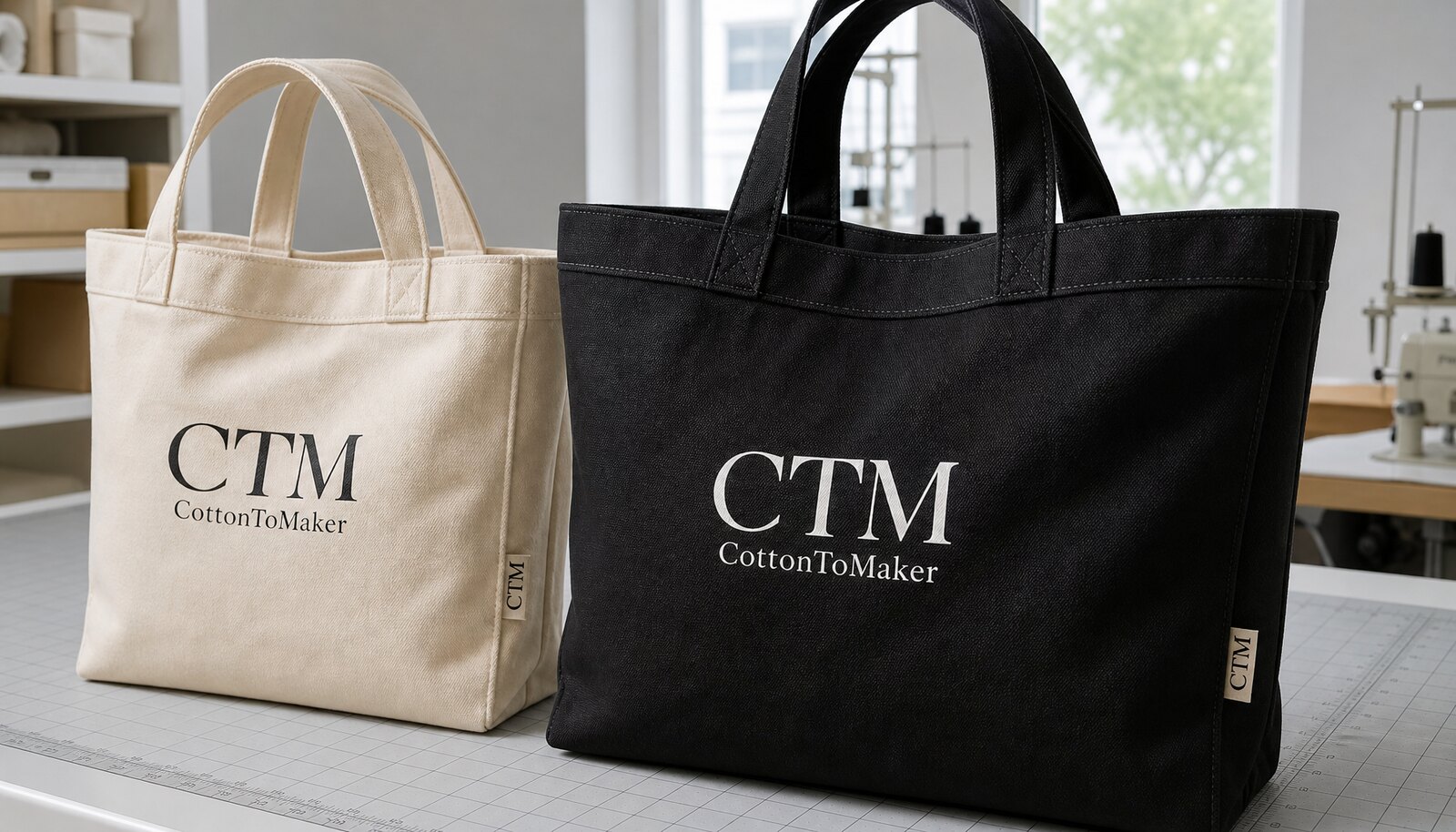
Start With the Use Case, Not the Bag
The fastest way to get a useless quote is to describe the product only as a printed canvas shopping bag. A factory can make that in several ways, and each way changes cost, lead time, and retail performance. An apparel brand needs to define how the bag will actually be used: as a checkout bag, a resale accessory, an e-commerce insert, a seasonal gift, or a bundle item with garments. Those use cases decide the right canvas weight, the handle length, whether the bag needs a gusset, and whether the print needs to look premium from arm's length or only hold a simple logo.
Once the use case is clear, the supplier can quote a bag that survives the real job instead of a generic tote. A resale bag needs cleaner seams, better print opacity, and a more consistent hand feel. An insert bag can be lighter, simpler, and packed in bulk to lower freight. If you do not define the use case first, one supplier will quote a promotional tote, another will quote a retail-grade bag, and the unit price comparison will be meaningless.
- State whether the bag is sold, gifted, or packed inside another order.
- Define the expected carry load, not just the bag size.
- Say whether the bag must look premium on shelf or only work as a utility item.
Choose Canvas Weight and Bag Build
For apparel brands, the most common buying range is usually 10 to 12 oz canvas, which translates roughly to the mid-300 gsm range depending on weave and finish. That range gives a good balance between drape, printability, and perceived value. An 8 oz canvas is lighter and cheaper, but it can feel thin and wrinkle easily. A 14 oz canvas feels firmer and more premium, but it costs more, can feel stiff, and may change how the print lays down on the surface. If your bag is meant to sit next to premium apparel, the fabric weight should support that price point instead of undercutting it.
The build matters as much as the fabric. Handle width, handle length, gusset depth, top hem, side seam reinforcement, and bottom seam construction all influence durability and presentation. A flat open-top tote is easy to make, but a side gusset and bottom gusset give more usable volume and a cleaner retail shape. If you need a dyed body or a black canvas bag, ask whether the supplier uses pre-dyed fabric or colors after cutting; that affects shade consistency, bleeding risk, and cost. For printed artwork with fine detail, a tighter weave is usually easier to control than a coarse fabric that lets ink sink unevenly.
- Use 8 oz for light promotional use, 10 to 12 oz for retail and repeat use, and heavier canvas when the bag must feel structured.
- Specify handle width and attachment reinforcement so the quote covers the real construction.
- Call out natural, bleached, dyed, washed, or recycled canvas instead of assuming the factory will choose correctly.
Pick the Print Method for the Artwork
The decoration method should match the artwork, not the other way around. Screen printing is usually the strongest option for simple brand marks, flat spot colors, and repeat orders because it is durable and cost-effective at volume. Heat transfer or DTF can handle more complex graphics, gradients, or small runs, but the hand feel can be less natural and the print may age differently. Digital direct-to-fabric printing works for shorter runs and softer graphics, but it is not always the best choice if you need strong opacity on dark canvas or very high wash resistance. Embroidery and sewn patches can look premium, but they are usually better for small logos than for large promotional graphics.
A useful RFQ should state the artwork type clearly: spot color, halftone, full bleed, or logo with fine typography. The factory also needs to know the print size, the position from edge and seam, and whether both sides carry the same artwork. Ask for a strike-off on the actual canvas, not a paper proof, because canvas texture changes how ink sits and how much detail survives. If the logo uses white ink on black fabric or a pale tone on natural canvas, opacity becomes a real issue, so the quote should include any underbase or extra pass needed to keep the mark clean.
- Keep line work and text large enough for the canvas weave; tiny details often close up in production.
- Provide Pantone targets or a clear color reference if brand color accuracy matters.
- Approve a physical strike-off on production fabric before bulk printing starts.
Build the RFQ Around Cost Drivers
Unit price changes for predictable reasons, and a good buyer should force those reasons into the quote. Fabric weight, fabric width, body color, number of print colors, print placement, handle style, packing method, and carton spec are the main drivers. If your RFQ only says printed canvas shopping bag, the factory fills in assumptions on its own and you lose quote-to-quote comparability. That is how procurement ends up comparing two numbers that are not actually the same product.
A proper quote should separate the bag body from the decoration and from the packing. It should also show where the factory is making assumptions about exclusions such as artwork setup, sample fees, special labeling, or rush delivery. Ask for the quote to be broken into bag construction, print setup, printing labor, inner packing, master carton, and any extra charge for mixed colors or unusual handling. When the numbers are separated, you can see whether a small spec change is worth the extra cost or whether it only looks cheap because the supplier left out a real line item.
- Ask every supplier to quote the same finished size, fabric weight, print area, and pack count.
- Separate blank bag cost from print and packing so you can see the real change drivers.
- Request an exclusions list so hidden charges do not appear after order confirmation.
MOQ, Sampling, and Pre-Production Logic
MOQ on printed canvas bags is not just a total quantity number. It changes with fabric color, print color count, cutting efficiency, and packing style. A single natural canvas tote with one logo on one side can often run at a lower MOQ than the same bag in three body colors with different placements and retail folding. If the supplier says the minimum is 3,000 pieces, ask whether that is per SKU, per color, or per artwork version. Otherwise, the low order quantity may disappear once you divide it by the real production rules.
Sampling needs a sequence, not a single photo. A blank sample confirms the size, fabric weight, handle feel, and seam shape. A printed strike-off confirms color, coverage, and placement. A pre-production sample confirms the final build, artwork, and packing. The gold standard should be the last approved sample, marked clearly and stored against the PO. If the bulk run differs from that sample, you need a written rule for who pays for correction and how deviations are handled.
- Ask for a blank sample first if the bag shape or fabric weight is new.
- Approve the print on actual production fabric before the bulk order starts.
- Treat the pre-production sample as the contractual reference for dimensions, print, and packing.
QC Thresholds That Matter at Import
Canvas bag defects are usually practical, not dramatic. The common failures are crooked handles, poor symmetry, weak bar tacks, print misregistration, and dimensions that drift enough to affect retail presentation. Agree the tolerance before production starts. In many programs, a body dimension tolerance around plus or minus 1 cm is manageable, with handle length slightly tighter. Print placement should be tighter than the body tolerance if the logo needs to sit visibly centered or align with seams. The point is not to force a perfect lab product; the point is to define what is acceptable before the shipment exists.
Functional testing should match the real use case. If the tote is sold as an apparel accessory, it needs enough strength to carry common shopping weight without seam failure or obvious print cracking. Random carton inspection should also cover odor, loose threads, fabric stains, ink cure, and count accuracy. If the factory says it passes inspection, that claim is only useful if your acceptance criteria are written down. Buyers lose money when they approve a sample on appearance and then reject a bulk shipment because the acceptance standard was never tied to that sample.
- Set size, handle, and print position tolerances before bulk production starts.
- Check bar tacks or box-X reinforcement at the handle stress points.
- Inspect random cartons for odor, stains, print cure, and carton count accuracy.
Packing, Cartons, and Retail Readiness
Packing is not a small detail. It changes freight cost, shelf appearance, and warehouse handling. A tote packed flat in bulk is cheaper to ship, but it arrives wrinkled and is harder to sell as a retail accessory. A folded tote in an individual polybag with a barcode label looks cleaner and works better for stores and 3PLs, but it adds labor and material. For apparel brands, the right answer depends on whether the bag is part of the customer-facing assortment or simply an internal pack-in item.
Master carton data needs to be accurate enough for the warehouse to receive without relabeling. Require the PO number, style, color, quantity, carton number, gross and net weight, and country of origin on the outer carton. Also ask for carton dimensions and pack count early, because a small tote can still become expensive if the carton shape is inefficient for palletizing or if the warehouse needs a custom case pack to fit its system. If the line will be distributed to stores, carton marks and barcode placement should be as deliberate as the print on the bag.
- Choose between bulk packing and individual polybag packing based on retail use, not habit.
- Confirm master carton size and pack count before freight booking.
- Align outer carton labels with the buyer's warehouse or 3PL receiving rules.
Lead Time and Schedule Risk
The factory lead time is not just sewing time. A printed canvas bag order moves through fabric reservation, cutting, printing, curing, sewing, trimming, packing, and final inspection. If any one of those steps waits for approval, the whole order slips. A quote that says 25 days is only meaningful if the factory states exactly when the clock starts and what happens before that clock starts. For example, if the quoted lead time begins only after sample approval and deposit receipt, then slow internal approvals can consume the entire schedule before production even begins.
The biggest schedule risk for apparel buyers is late sign-off on artwork, sample, and carton detail. If the buyer team changes one element after another, the factory keeps stopping and restarting. Peak season also matters, because canvas bags often get pushed behind garment production or packaging work. Build a simple calendar with one owner for each approval step, and add buffer before the retail launch or seasonal drop. If the bags support a collection launch, the schedule should be treated as part of the collection, not as a low-priority add-on.
- Confirm when the lead-time clock starts and which approvals must be complete first.
- Reserve time for print approval, not only sewing time.
- Avoid multiple late changes to artwork, packing, and carton marks.
Landed Cost and Supplier Route Comparison
The lowest factory quote is not always the lowest landed cost. You need to compare the bag price, print charges, packing, freight, import duty, inland delivery, and any rework or relabeling cost at destination. A quote that looks cheaper may hide expensive packing assumptions or leave out the cost of barcode labeling and warehouse readiness. For a procurement team, the better metric is landed cost per sellable unit, not the factory price on its own.
Supplier route matters too. Direct factories usually give better control over construction and decoration, but they require cleaner briefs and firmer approvals. Trading companies can simplify communication and consolidate mixed product orders, but they add a layer between you and the line. Domestic decorators are useful when time is tight and the run is small, while in-stock distributors help when the product must ship immediately. The correct route depends on the launch risk, the repeat potential, and how much control the brand needs over the final bag.
- Normalize every quote to the same incoterm before comparing numbers.
- Include freight, duty, and warehouse handling in the landed-cost view.
- Choose the supplier route that matches schedule risk and control needs, not just the lowest unit price.
Turn the RFQ Into a Usable Decision
A usable RFQ reads like a production instruction, not a marketing note. It should include the finished size, canvas weight, body color, print method, artwork file, print placement, handle spec, packing count, carton marks, target ship window, and approval owner. The more precise the brief, the less room there is for the factory to fill in assumptions. That is what makes the quotes comparable. It also shortens the sample loop because the supplier knows what standard it has to meet before bulk production starts.
The real goal is not to get the cheapest tote. It is to buy a tote that arrives on time, matches the brand, and does not create avoidable work in inspection, relabeling, or reordering. If one supplier quotes a lower number but leaves out print setup, assumes loose bulk packing, or ignores carton requirements, that quote is not cheaper. It is incomplete. Use the checklist, request the same quote structure from every factory, and compare only the offers that are built on the same assumptions.
- Write one spec sheet and send it to every supplier.
- Ask each factory to list exclusions and assumptions in the quote.
- Compare landed cost and risk, not only the ex-works or FOB number.
Specification comparison for buyers
| Spec decision | Recommended option | When it fits | Buyer risk to check |
|---|---|---|---|
| Supplier route: direct canvas bag factory | Best for repeat programs and tighter control over construction, print, and packing. | Private-label apparel brands that want stable quality and a clean quote for larger replenishment runs. | Confirm whether printing and carton packing are truly in-house; subcontracting changes lead time and liability. |
| Supplier route: garment-accessory factory | Useful when the factory already works with apparel buyers and understands retail presentation. | Launches where the tote has to match garment packaging, hangtags, or seasonal collections. | Check whether tote production is core work or just a side line behind garment orders. |
| Supplier route: trading company | Good when you need one contact to coordinate multiple factories or mixed SKUs. | Smaller sourcing teams, bundled programs, or buyers who do not manage factory communication directly. | Ask for the actual production site and who owns defects, delays, and rework. |
| Supplier route: domestic decorator or local printer | Best for urgent replenishment, pilot drops, or last-minute artwork changes. | Short-run launches, regional promotions, or a test order before moving offshore. | Unit cost is usually higher and base fabric choices are often narrower than at a canvas factory. |
| Supplier route: in-stock wholesale distributor | Good for immediate delivery and minimal development time. | Standard colors, simple branding, and orders where speed matters more than exact spec control. | Limited control over canvas weight, handle spec, carton configuration, and precise logo placement. |
| Supplier route: integrated bag-and-print factory | Strong choice when both decoration quality and sewing consistency matter. | Retail totes with recurring artwork and enough volume to justify setup and sampling. | Verify they do not split work to subcontractors during peak season. |
| Supplier route: low-MOQ sample vendor | Useful for design validation and market tests before committing to scale. | First-time styles, merchandising trials, or small regional launches. | Do not treat sample pricing as a reliable scale quote; ask for the full bulk cost logic. |
| Supplier route: mixed-product promo supplier | Only acceptable when the tote is one item in a broader promotional kit. | Corporate gifting or launch packs that combine bags with apparel, inserts, or accessories. | Bag construction can be secondary unless you lock the spec and approval standard. |
Buyer checklist before sampling
- Define the bag use case: retail accessory, free gift, e-commerce insert, or resale item.
- Lock finished size, gusset depth, and handle length with tolerances.
- Specify canvas weight in oz and gsm, plus whether the fabric is natural, bleached, dyed, or recycled.
- State the print method, number of colors, print placement, and artwork file format.
- Confirm whether the bag needs a structured base, zipper, snap, or open top.
- Set the MOQ by SKU, color, and packing style instead of using one total order number.
- Approve a blank sample and a printed pre-production sample before bulk release.
- Specify packing count per polybag or bundle and master carton quantity.
- Require carton marks, barcode format, and destination labeling rules.
- Agree the inspection method and load or stitch acceptance criteria before production starts.
Factory quote questions to send
- What exact canvas weight, weave, and fabric finish are included in the quote?
- Is the print produced in-house, and which decoration method are you pricing?
- What is the MOQ per color, per artwork version, and per packing style?
- What setup charges apply for screens, plates, color changes, or special placements?
- Can you separate the quote into bag body, print, packing, and carton costs?
- What sample types can you provide, and how long does each sample stage take?
- What tolerances do you hold for finished size, handle length, and print placement?
- What packing configuration, polybag spec, and carton dimensions are assumed?
- What is the production lead time after sample approval, and what is your capacity calendar?
- Which incoterm, loading port, and freight assumptions are built into the price?
Quality-control points to confirm
- Finished dimensions match the approved sample and stay within the agreed tolerance.
- Canvas weight, hand feel, and shade match the signed-off production reference.
- Seams, bar tacks, and handle attachments are even and strong at all stress points.
- Print placement, registration, opacity, and edge clarity match the approved strike-off.
- Ink is fully cured, does not crack easily, and passes the agreed rub or abrasion check.
- No stains, oil marks, loose threads, fabric holes, or needle damage are accepted.
- Packing count, barcode, carton marks, and outer labels match the PO exactly.
- Random cartons from the shipment reflect the same workmanship as the approved sample.