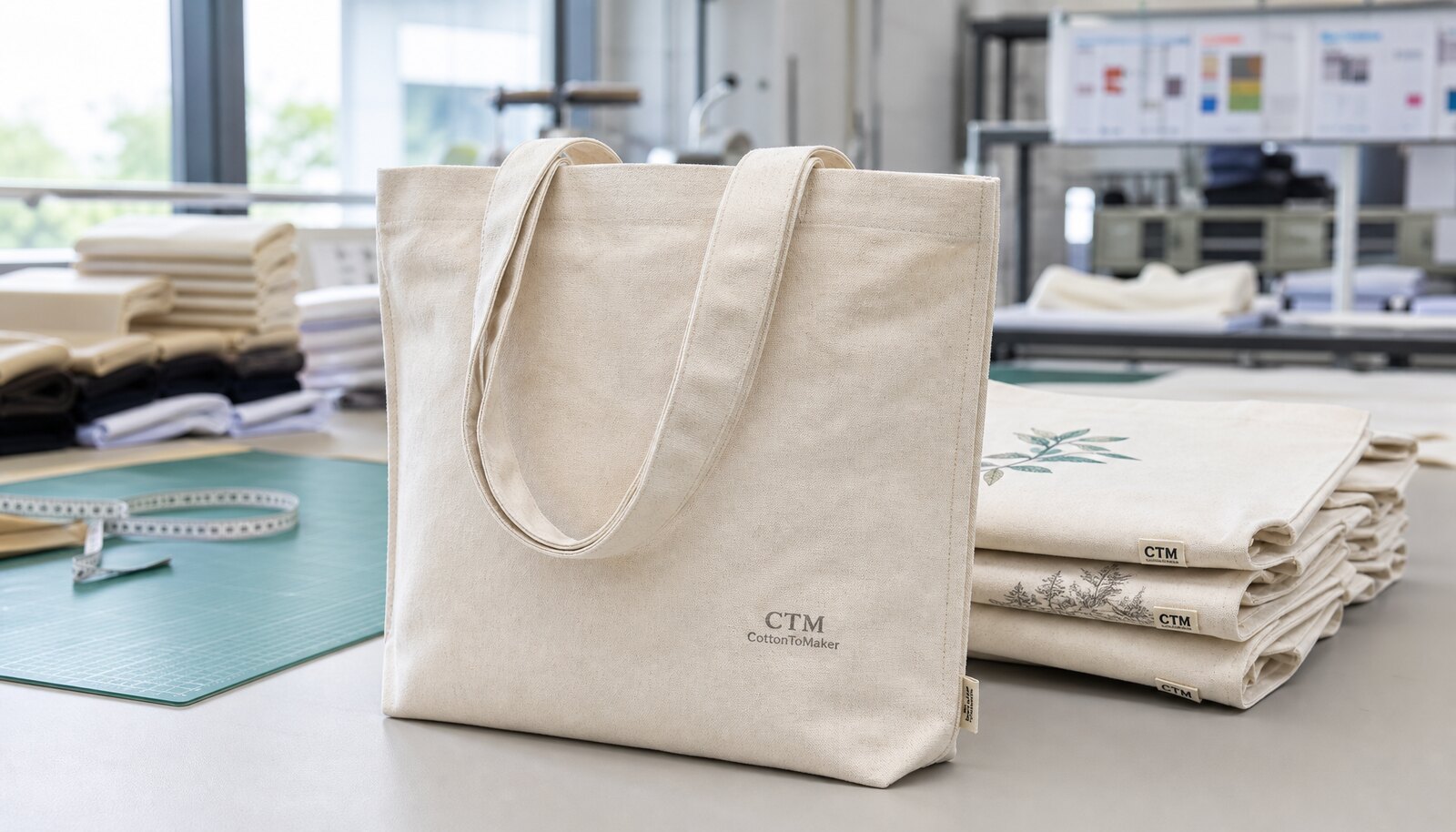
Start With the Channel, Not the Tote
Printed canvas shopping bags for apparel brands are not one product. A checkout bag, a gift-with-purchase bag, a resale accessory, and a launch giveaway all need different specs. The first sourcing decision is the channel, because that determines how much the bag needs to carry, how clean it needs to look on shelf, and whether it is meant to be reused or simply moved out the door with a garment purchase. If the bag is being sold, it needs to behave like a product. If it is being handed out, it can be simpler, but it still has to survive packing, shipping, and repeated customer handling.
A useful way to write the brief is to start with the actual use scenario. A small apparel checkout bag may only need to hold a folded tee or scarf, while a retail bag for outerwear or boxed accessories needs a stronger body, a wider gusset, and more stable handles. Most apparel programs land in a practical size band around 35 to 40 cm wide by 38 to 45 cm high, with a 8 to 12 cm gusset when the bag needs real carrying volume. Load expectation matters too: 2 to 3 kg is one profile, 4 to 6 kg is another. Once that is clear, the rest of the RFQ becomes much easier to price correctly.
- Define the bag by use case first, then by logo and print placement.
- Write the load expectation into the spec if the bag will carry more than a simple garment purchase.
- Treat resale-ready bags as finished accessories, not as disposable promo items.
Set Fabric and Construction With Intent
Canvas weight drives both cost and performance. In practical sourcing terms, 6 oz canvas is light and economical, 8 oz is the common middle ground for apparel retail, 10 oz starts to feel more premium and stable, and 12 oz plus is for heavier or more structured bags. In GSM, that usually maps roughly to 170 GSM, 220 to 240 GSM, 280 to 340 GSM, and above that for heavier builds. The right answer depends on the channel. A light promotional bag does not need a heavy body. A bag sold at retail usually does, because customers expect a cleaner drape, better opacity, and a more deliberate hand feel.
Construction is just as important as fabric weight. Self-fabric handles are usually the least expensive and can look clean, but they need enough width and reinforcement to avoid digging into the hand. Webbing handles carry load better and can feel more premium, but they change the visual language of the bag. Ask for bar tacks or equivalent reinforcement at the handle roots, and make sure the factory states whether the bag uses a bottom gusset, side gusset, or both. If the bag needs to sit upright in store or hold a box, that construction detail matters more than another logo revision. Buyers should also state whether the fabric can be pre-shrunk, because shrinkage affects both size and print placement.
- 8 oz canvas is often the practical default for apparel retail bags.
- 10 oz or heavier makes more sense when the bag must carry boxed goods or be reused often.
- Put handle width, handle drop, and reinforcement into the RFQ, not just the body size.
Match the Print Method to the Artwork and Volume
Print method changes unit cost, MOQ, and how the bag behaves after shipping. Screen print is usually the most practical option for bold logos, one or two spot colors, and repeat orders. It has a setup cost, but once the screens are approved it gives a consistent result and usually the best durability per dollar. Water-based ink is often preferred when the brand wants a softer hand and a more natural finish on canvas. If the artwork is complex, a short-run digital transfer or similar hybrid method can help the launch move faster, but it must be tested carefully because bags are folded, stacked, and handled more roughly than a hanging apparel tag or insert card.
Artwork setup is where many production problems begin. The supplier needs a vector file, the correct color reference if the brand is matching a Pantone, and a clear drawing that shows the print position relative to seams, edges, and folds. Fine lines and small text often break up on woven canvas, especially on natural fabric with a visible texture. A light logo on dark canvas may need an underbase or an extra print pass, which increases both cost and risk. Approve the artwork on the actual fabric color, not on a white proof. If the logo is going near a seam or fold line, verify that it still reads cleanly when the bag is packed flat.
- Use screen print for simple branding and repeat programs.
- Use transfer or digital methods only when the artwork complexity justifies the extra setup and rub-testing.
- Approve the print on the real fabric color and at the real print size before bulk starts.
Use MOQ Benchmarks Instead of Guessing
MOQ for printed canvas shopping bags is usually driven by fabric roll usage, cutting efficiency, print setup, and packing labor. For a direct factory using stocked canvas and one simple print, a realistic MOQ often starts around 500 to 1,000 pieces, and some factories can go lower if they are already running a similar base bag. Once the order becomes fully custom, or once you add a second print position, a woven label, or a custom dyed fabric, the practical MOQ can move into the 1,000 to 3,000 piece range. That does not mean a factory is being difficult. It usually means the setup cost is no longer spread over enough units to make the order efficient.
The lowest MOQ quote is not always the cheapest program. If a supplier offers 300 pieces but the quote includes a high setup fee, a heavy sample charge, and a more expensive blank bag, the economic MOQ is higher than it looks. For apparel brands, the cleanest way to control MOQ is to keep the first run simple: one size, one fabric weight, one print location, and standard flat packing. If the team wants to test several graphics, it is usually better to run one bag and one print version first, then reorder with the next art once the base spec is proven. Splitting the first order into three tiny variants almost always raises both cost and lead time.
- Lower MOQ usually comes from stock fabric, one print color, and one bag size.
- Higher MOQ usually appears when you add custom dye, extra labels, or more complex packing.
- If the supplier cannot explain why the MOQ exists, the quote is not ready for comparison.
Compare Supplier Routes by Control, Speed, and Risk
The sourcing route matters as much as the bag spec. Direct factory sourcing gives the best control over cutting, stitching, and print coordination, which is important when the bag is part of a seasonal retail program. Trading companies can be useful when they genuinely coordinate multiple product lines or consolidate a broader order, but they add another handoff between the buyer and production. A local decorator or domestic print shop can move quickly and is a sensible route for urgent drops, but the unit price is usually higher and the fabric choices are narrower. A stock blank bag plus local print is the fastest path for very small volumes, but the buyer loses control over the base bag unless the blank supplier is well vetted.
Qualification should change with the route. A factory should be able to show a real production line, not only a sales sample room. A trader should disclose the actual factory, the level of control they keep over spec changes, and how they manage approvals. A local decorator should show the blank bag source, the print method, and how they test alignment on the actual stock. For stock-bag sourcing, ask for lot consistency and a quick rub test on the blank plus print combination. If the route cannot show how the bag is cut, printed, packed, and labeled, the buyer is taking avoidable risk. That risk is acceptable for a test run. It is not acceptable for a retail rollout.
- Direct factory is best for repeat programs and tighter quality control.
- Trading companies are only useful when they add real coordination value.
- Stock-bag routes are fast, but the blank bag quality still has to be verified before print.
Plan Lead Time as a Sequence, Not a Single Number
Lead time should be read as a chain of smaller steps: sampling, approval, raw material booking, cutting, printing, sewing, finishing, packing, and pre-shipment inspection. Buyers often hear one total number and assume it covers everything. It does not. A stocked canvas bag with a one-color logo can move faster than a custom bag with new fabric, new artwork, and special packing. The supplier should quote the production lead time separately from transit time, because a bag that is finished on schedule can still miss launch if the freight window is missed.
Practical ranges help. For a stock-spec bag, a sales sample may take 3 to 7 days, a pre-production sample 7 to 14 days, and bulk production 12 to 25 days after PPS approval. A more custom bag often needs 7 to 14 days for sampling and 25 to 45 days for bulk after approval. If the fabric must be woven, dyed, or matched to a custom shade, add more time. Peak season needs its own buffer. Before major retail periods, holidays, or Lunar New Year, add at least 1 to 2 weeks of schedule margin if the order is small, and more if the fabric or print setup is new. Sample-to-bulk timing matters too. Do not let the factory book material before the art and the base fabric are frozen.
- Separate sampling, production, and freight in the schedule.
- Add buffer before peak season or holiday shipping windows.
- Freeze artwork and base fabric before the supplier books the line.
Compare Landed Cost, Not Just Unit Price
The cheapest piece price is rarely the cheapest landed cost. Canvas weight, print coverage, packing method, carton size, and quote basis all change what the bag really costs at the dock. A lighter bag may look cheap on paper but fail the retail use case. A heavier bag may feel right, but if the carton is inefficient the freight cost can rise faster than expected. The right comparison is a like-for-like quote sheet: same GSM, same finished size, same handle construction, same print method, same pack count, and the same incoterm. Without that, every supplier is effectively quoting a different product.
There are also real cost deltas by route. A trader often adds roughly 5 percent to 15 percent over direct factory pricing if the spec is identical. A local decorator can run 20 percent to 60 percent higher than direct factory ex-works on the same bag, but the total project can still land lower when it avoids air freight or launch delay. Stock-bag plus local print is often competitive for very small runs, but the blank bag quality and print cost can swing enough to erase the advantage. For freight, remember that canvas bags are bulky. Even one extra centimeter in carton height can affect air freight density. Ask for carton dimensions and gross weight before you compare two quotes as if they were equal.
- Compare only truly like-for-like quotes.
- Ask for FOB, EXW, and if needed DDP so the landed cost is visible.
- A higher unit price can still be the lower total cost if it protects the launch date.
QC Needs to Read Like a Production Gate, Not a Feel-Good Check
Quality control for canvas totes should be written as a production gate, not a visual preference. Start with the approved sample and define what a defect looks like in measurable terms. A common approach is to use AQL 2.5 for major defects and 4.0 for minor defects on standard retail bags, then tighten the standard for premium programs. The sample should be checked for fabric weight, finished dimensions, handle drop, stitch quality, print location, color match, label placement, and pack accuracy. Do not accept a bag simply because the front view looks correct. Open the carton, fold and refold the bag, and check the places that will actually fail in use.
The most useful tests are simple and repeatable. Ask for a dry rub test and a wet rub test on the finished bag, using the actual printed area. Check for open seams, skipped stitches, loose threads, broken needle marks, oil spots, print misregistration, and distortion at the handle points. If the bag is meant for resale, the fold line matters too, because a bad fold can damage the print or make the bag look careless on receipt. A useful acceptance rule is that the bag should survive a basic carry or pull check using the intended load without the handle stitching opening or the body twisting out of shape. When you inspect, ask the supplier to show the failure counts, not only the pass rate.
- Use the approved sample as the master reference for bulk inspection.
- Start with AQL 2.5 major / 4.0 minor unless the program needs tighter controls.
- Test the print after folding and reopening, not only while the bag is flat on a table.
Packing, Compliance, and Warehouse Reality Matter More Than People Expect
Packing format can change both presentation and freight cost. Flat packing is standard for canvas shopping bags because it saves carton space and makes counts easier. But the fold direction must be written down. If the print sits against a crease or seam in the wrong way, the bag can arrive with scuffing or visible fold marks. For premium retail programs, a simple polybag or sleeve may be worth it because it protects the print and reduces dust during sea transit. For a purely warehouse or wholesale route, the added packing often is not necessary and can just raise cost.
Carton data should be part of the quote from the start. Ask for carton dimensions, gross weight, pack quantity per carton, and whether the factory will use master cartons or inner bundles. That information affects warehouse receiving and freight booking. If the bags are sold as retail products, check the destination market rules for fiber-content, care, and origin labeling. If the brand wants sustainability language on the product page or packaging, make sure the material and claims are actually supportable. Do not let a marketing claim outrun the paperwork. The easiest way to avoid warehouse delays is to treat carton labels, barcode format, and country-of-origin marks as part of the core spec, not as an afterthought.
- Write the fold direction and bundle count into the pack spec.
- Use individual polybags only when the route or retail channel actually needs them.
- Require carton dimensions before booking freight so the landed cost estimate is real.
Lock the RFQ and Reorder Rules Before the First PO
A strong RFQ is not just a request for price. It is the document that keeps the bag, the sample, and the production run aligned. The order should define the master spec, the approved artwork version, the fabric swatch, the pack format, and the inspection standard in one place. If the project will be reordered, freeze the version once bulk approval is complete. Most repeat bag programs lose time because the second order reopens questions that were already solved on the first order. Keep the spec stable, and change only the artwork when the season changes.
It also helps to define how the supplier handles overrun, short-ship, and revision requests. A small overrun tolerance can be acceptable if it is written into the PO, but the brand should know exactly what that means for receiving and billing. If the order includes multiple sizes or colorways, ask for MOQ and lead time by SKU, not as one blended average. That is especially important for apparel brands that run seasonal drops. The cleanest supply chain is usually the one that limits variation, keeps the fabric base stable, and lets the artwork do the seasonal work. That reduces re-sampling, shortens the next quote cycle, and makes the second order much easier to place.
- Freeze the master spec, approved sample, and artwork version before bulk starts.
- Ask for MOQ and lead time by SKU if there are multiple sizes or colorways.
- Keep the fabric base stable if you want reorder lead time to stay predictable.
Specification comparison for buyers
| Spec decision | Recommended option | When it fits | Buyer risk to check |
|---|---|---|---|
| Direct factory sourcing | 500-1,000 pcs for a simple one-color run; 1,000+ for custom size or extra print | Best when the spec is stable, you need repeatability, and the bag will be reordered | Confirm the factory is actually cutting, sewing, and printing the bag, not relaying it |
| Trading company sourcing | 300-1,000 pcs when the trader is aggregating orders | Useful when you need one contact for bags, trims, labels, and export coordination | Watch for spec drift between the sample, the quote, and the bulk order |
| Local decorator or print shop | 50-300 pcs from stock blanks | Good for urgent launches, pop-ups, and pilot collections | Unit price is higher and blank-bag consistency can vary |
| Stock blank bag plus local print | 50-500 pcs with standard blanks | Best for the fastest turnaround and the lowest practical MOQ | Check bag weight, seam strength, and print adhesion on the exact blank |
| Fully custom bag run | 1,000-3,000 pcs for a new pattern or custom fabric | Fits hero retail SKUs and long-term brand programs | Expect longer sampling, more approvals, and more first-pass rejection risk |
| One-color screen print | 300-1,000 pcs | Best for bold logos, simple branding, and repeat orders | Confirm ink opacity and rub resistance on the actual canvas color |
| Multi-color screen print or transfer | 500-2,000 pcs | Fits seasonal artwork, detailed graphics, or short-runs with complex art | Alignment, curing, and rub resistance need tighter control |
| Woven label or side label add-on | 500-2,000 pcs | Useful when the bag is sold as a retail accessory, not just packaging | Check label placement, stitching neatness, and fold interference |
| Flat pack only | Any order over 300 pcs | Best for warehouse routing and lower freight density | Write the fold direction and bundle count into the pack spec |
Buyer checklist before sampling
- Write the finished bag size in centimeters, including width, height, and gusset depth if used.
- Specify canvas weight in GSM or oz, plus whether the fabric is natural, bleached, or dyed.
- Define the handle type, handle drop, handle width, and any reinforcement at the stress points.
- State the print method, print colors, print position, and the maximum print area.
- Set MOQ by SKU, colorway, and print configuration, not only as one blended number.
- Ask for a separate sample charge, screen or plate fee, and revision fee if art changes.
- Request a sample schedule for sales sample, pre-production sample, and bulk approval sample.
- Choose the pack format: flat pack, inner bundle, retail polybag, or with insert.
- Require carton dimensions, carton count, gross weight, and pack quantity per carton.
- Define the inspection standard and the exact defect list before bulk starts.
Factory quote questions to send
- What is your standard canvas weight for this bag size, and which weights do you stock without changing the line?
- What MOQ applies if we keep one size, one fabric, and one print color?
- How does MOQ change if we add a second print position, a woven label, or a custom dyed fabric?
- Please separate the quote into bag body, print, label, packing, carton, and setup charges.
- Can you quote the same item on EXW, FOB, and DDP terms so we can compare landed cost fairly?
- What is the pre-production sample timeline, and what must be approved before bulk can start?
- What are your finished-size, handle-drop, and print-position tolerances?
- What print method will you use, and how do you test rub resistance on the actual canvas?
- How do you pack the bags, and what are the carton dimensions, carton count, and gross weight?
- What overrun or short-ship allowance do you work to, and how are rejects handled?
Quality-control points to confirm
- Fabric weight matches the approved spec within the agreed tolerance, with no lighter substitute passed as standard canvas.
- Canvas shade, weave, and hand feel match the approved swatch, especially when the order uses natural or bleached fabric.
- Finished size, gusset, and handle drop stay within tolerance and do not vary materially carton to carton.
- Handle attachment uses clean reinforcement, with no skipped stitches, loose threads, or open stress points.
- Side seams and bottom seams are straight, closed, and free of puckering, twisting, or corner failures.
- Print is centered, aligned, and fully opaque where required, with no pinholes, smearing, or broken edges.
- Ink passes a dry rub and wet rub test on the finished fabric before bulk release.
- There are no oil marks, stains, fabric holes, broken needle marks, or visible contamination on the bag surface.
- Labels, barcodes, and country-of-origin marks match the PO and the destination market requirements.
- Flat-pack folding is consistent, carton counts are correct, and cartons arrive clean and correctly marked.