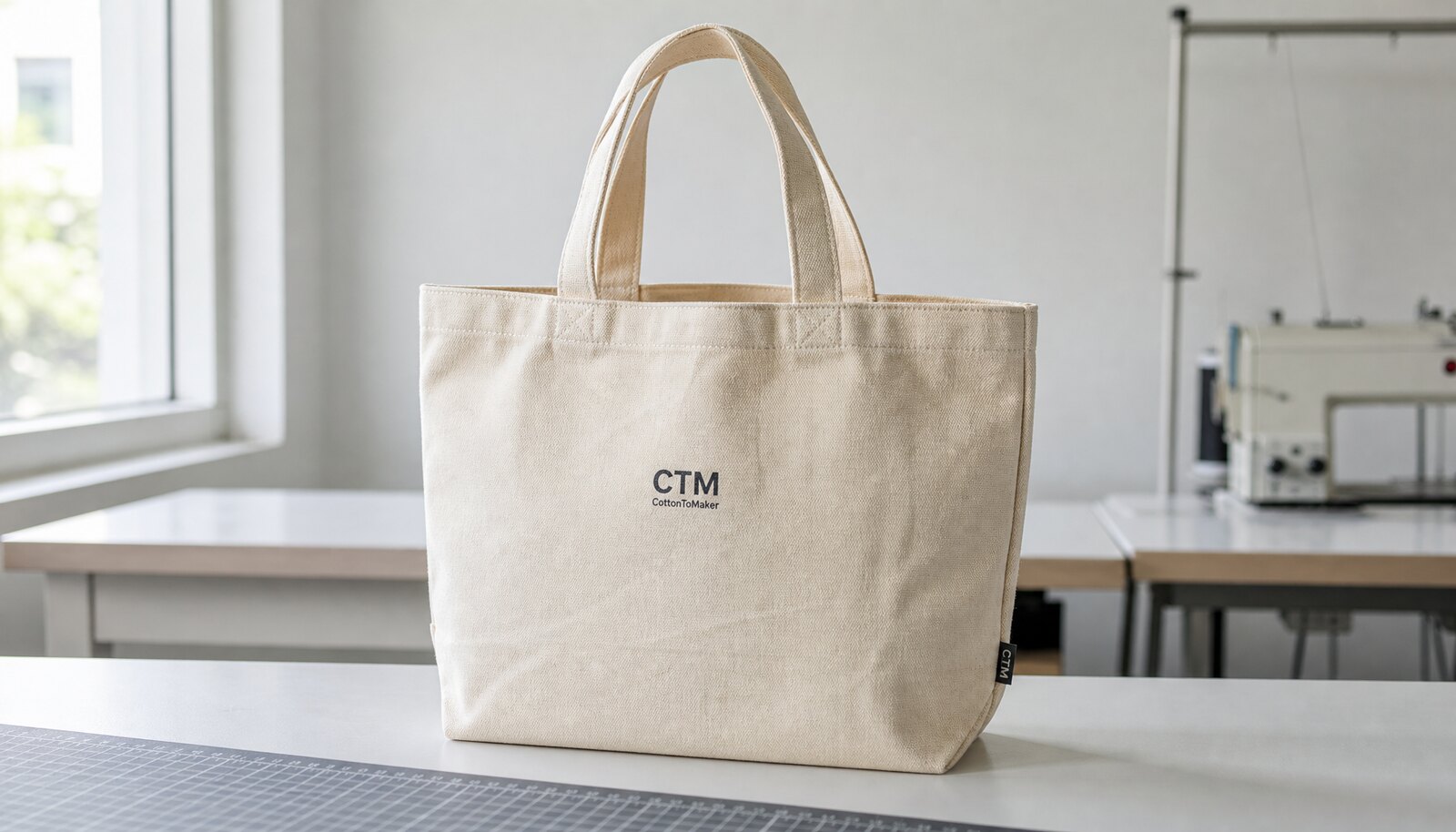
Start With the Bag’s Job, Not the Logo
Printed canvas shopping bags for apparel brands are not all doing the same job. Some are checkout carry-out bags for folded tees or small accessories. Others are reusable retail totes that need to look good on the sales floor, survive repeated use, and carry enough weight without losing shape. The bag spec changes once you decide whether it is packaging, a gift-with-purchase, a retail accessory, or a customer keep item.
Procurement teams often get pulled in the wrong direction because the creative team starts with the logo and the sourcing team starts with a unit price. Define the maximum carry load, whether the bag must stand upright, whether it needs to fit garment boxes or folded polybagged apparel, and whether the customer is expected to reuse it. Those answers should drive size, GSM, handle length, print area, reinforcement, and packing before the first factory quote is requested.
For an apparel brand, the bag also carries a brand signal. If the tote is meant to support a premium collection, it should feel like part of the product line, not an afterthought. That usually means cleaner weave, tighter seams, better print registration, and folding that looks intentional when the customer receives it. If the bag is purely functional, then capacity and cost control matter more than presentation. The right brief prevents overbuying in one direction and under-specifying in the other.
- Define the retail use case in one sentence before you request pricing.
- State the maximum load in realistic merchandise terms, not only in kilograms.
- Decide whether the bag must stand on a shelf, ship flat, or both.
- Confirm whether the bag is for customer reuse, one-time carry-out, or pack-in packaging.
- Agree internally on whether the bag is part of the product margin or a support item.
Write the RFQ Around Measurable Specs
A clean RFQ for a custom logo canvas tote should read like a manufacturing brief, not a creative note. The minimum fields are finished size, gusset depth, handle length, handle drop, target GSM, fabric color, print area, number of colors, packing format, carton count, and destination. If you leave any of those out, the supplier will fill the gap with its own assumption, and the lowest quote often hides the biggest spec change.
Use real tolerances. For smaller retail totes, a practical starting point is a written size tolerance around plus or minus 0.5 cm, with handle drop and print placement controlled even more tightly if the logo must sit in a fixed position. Larger bags may allow a wider tolerance, but the point is to set the range before sampling. A supplier can only quote against a spec that has a measurable finish, and your team can only compare bids if every factory is quoting the same dimensions and the same acceptance band.
The RFQ should also state what is not allowed. If the bag cannot have visible overprints, off-center handles, loose loose threads, or a substitute fabric on the sample, say so in the brief. That saves time during sample review and avoids the common situation where every vendor claims a “better interpretation” of the same bag.
- Write dimensions in millimeters or centimeters, not as rough artboard proportions.
- State whether the bag is flat, gusseted, or boxed at the base.
- List the handle width, handle drop, and any attachment overlap or fold-back requirement.
- Set print placement from a centerline or top edge measurement so the logo does not drift.
- Require the supplier to quote against the same spec sheet, not a revised email chain.
Fabric Choice Changes More Than Price
For canvas bags, buyers often focus on GSM first, but GSM alone does not tell the whole story. A loose weave at 300 GSM can feel weaker and print less cleanly than a tighter weave at 280 GSM. That is why you should ask the factory to state the weave construction, yarn count or thread count if they can provide it, and whether the cloth has been pre-shrunk or otherwise finished. On a procurement sheet, that matters as much as the headline weight.
Natural, bleached, and dyed canvas all behave a little differently. Natural cloth is usually the easiest path for reorder consistency, while bleached or dyed cloth can create more shade control work if your brand is sensitive to color variation. If the bag is meant to feel premium, ask for a tighter weave and a cleaner surface rather than only a heavier roll of cloth. Also ask how the supplier handles shrinkage and shade variation between lots, because those are the issues that show up after the first reorder, not on the first sample.
Two suppliers can both quote 320 GSM and still deliver very different bags. One may use a dense, smooth cloth that prints cleanly and folds neatly. Another may use a coarser fabric with the same weight but more visible slubs, wider gaps, and less stable shape. If your brand standards are visual as well as functional, ask for swatches and inspect them under daylight before you narrow the field.
- Ask for fabric swatches and a stated GSM, not only a photo.
- Request the weave description or thread count if the supplier can provide it.
- Confirm whether the fabric is pre-shrunk, washed, or expected to relax after packing.
- Check the surface texture under daylight because loose weave often makes print edges look less sharp.
- If reorder consistency matters, ask whether the supplier can reserve the same cloth lot or an equivalent approved replacement.
Choose the Print Method for the Artwork, Not the Catalog
Most apparel brands get the most predictable result from screen printing when the logo is simple, bold, and limited in color. Screen print generally gives better opacity on canvas and easier repeatability at scale. The tradeoff is that it depends on proper setup and cure control, so the factory has to prove that the ink is not tacky, brittle, or under-cured after folding. If the supplier cannot explain how it cures the print, the quote is not ready for production.
Transfer-based methods can solve detail-heavy logos, gradients, and multiple colors, but they introduce a different risk profile. You should expect a more film-like hand feel and you should test what happens where the bag creases, especially if the product will be folded tightly for shipment. Embroidery can work for a small mark or accent, but it is usually the wrong answer for a large front-panel graphic on a shopping bag. The right print method is the one the factory can repeat on your exact fabric at your exact volume, not the one that looks best in a one-off sales sample.
A buyer should also ask how the print will look after retail handling. If a shopper folds and refolds the tote, the design should not crack along the crease line after a normal amount of use. If the artwork includes small type, fine lines, or close registration, ask for a production strike-off on the same cloth rather than approving a computer mockup. That small extra step often saves a costly reprint.
- Use screen print first for simple logos with strong lines and one or two colors.
- Treat transfers as a detail solution and test them on the actual fold line.
- Ask the supplier to state how many print passes are needed for the quoted coverage.
- Require a cure or fixation description, because under-cured print is a common bulk defect.
- If the artwork is small and premium, ask whether embroidery or a woven patch is more durable than a full-panel print.
Construction Details Separate a Retail Bag From a Giveaway Tote
The bag body is only part of the spec. Handles, seams, reinforcement, and edge finishing decide whether the tote feels retail-ready or temporary. For apparel programs, the safest approach is to ask for double-layer handles or reinforced webbing when the bag is expected to carry garments, shoes, or mixed purchases. Add bar-tacks, box-X stitching, or another clearly defined reinforcement pattern at the load points. If the factory describes reinforcement as standard, push for the exact sewing pattern and the number of passes, because standard often means different things to different factories.
Ask about stitch density, seam allowance, and loose thread control. You do not need a textbook sewing spec, but you do need a written requirement that visible seams are straight, thread tails are trimmed, and the bag does not twist when opened. If the bag is going to sit on a retail counter or be photographed on a store floor, internal finishing matters more than many buyers expect. An imperfect inner seam or uneven handle attachment can be hidden in a carton, but it will show up the moment a customer takes the bag home.
Handle geometry is worth checking separately from handle material. A tote can be made from strong cloth and still feel awkward if the handle drop is too short for shoulder carry or too long for a neat hand-carry presentation. That affects customer experience and also changes how the bag packs. For buyer approval, measure handle length from stitch point to stitch point, not from a visual estimate.
- Specify handle material, handle width, and reinforcement method in writing.
- Ask for double-needle topstitching or equivalent reinforcement if the bag carries heavier apparel.
- Require consistent seam allowances so the bag does not skew left or right after assembly.
- Check whether the factory trims and inspects thread tails before packing.
- If the tote will be reused, ask for a stronger attachment point than the minimum needed for first-use carry.
Compare Supplier Routes Before You Compare Price
A direct factory is usually the cleanest route for a repeat program because fabric, sewing, and print can be controlled under one process. That does not automatically make it the cheapest option, but it often gives the buyer the clearest path to consistency. A trading company or sourcing partner is useful when the project spans several bag styles or when your internal team wants one point of contact across different vendors, but you are paying for coordination, not for lower production complexity. A local printer on imported blanks can be the right answer when lead time matters more than full spec control.
The key is to compare routes on repeatability, not only on headline cost. Ask who owns the print line, who buys the fabric, who controls carton packing, and who signs off the golden sample. If a supplier cannot show the exact process for the exact bag family, the quote is incomplete. For an apparel brand, a low price that depends on a thinner canvas, a smaller logo, or a simplified fold method is not a true comparator. The best bid is the one that can make the same bag again next season without changing the hand feel or the warehouse receipt process.
There is also a reorder-risk angle. Direct factories can be strong on continuity if they own the cloth and keep the same process notes, but they can also be slower to change if you need artwork updates or late packing edits. Trading companies can move faster on coordination but may hide which subcontractor made the bulk run. Blank-bag routes can be quick, yet the blank itself may vary from lot to lot. Buyers should choose the route that best fits the repeat-order risk they can tolerate.
- Ask whether printing is done in-house or outsourced after sewing.
- Request photos or video of the actual bag family being made, not just generic factory shots.
- Compare reorder stability and QC ownership, not only the first order unit cost.
- Treat any quote that does not name the fabric and print method as incomplete.
- If the supplier cannot explain its defect handling process, expect more risk at shipment.
Read the Quote Like a Buyer, Not a Shopper
A usable quote should separate the pieces that drive cost. At minimum, you want to see fabric spec, print method, color count, handle type, setup charges, sample charges, packing format, carton size, and trade term. If the supplier gives only one unit price, assume there are assumptions hidden inside it. Those assumptions are usually where the problem starts, especially if the quote excludes packing or if the unit price depends on a smaller print area than your brand actually needs.
The hidden cost drivers are easy to spot once you know what to look for. More print coverage means more ink and more cure control. Side gussets and bottom gussets increase cutting and sewing time. Reinforced handles increase both material and machine time. If you need barcode labels, inner packs, or retail inserts, those items should be in the quote now, not discovered when the cartons arrive. A good procurement comparison is not the cheapest source cost. It is the cleanest landed-cost model with the fewest surprises at warehouse receipt.
For printed canvas shopping bags, freight can become a bigger variable than many teams expect. Heavier GSM increases carton weight. Boxier shapes use more carton volume. Retail-ready packing can add labor and size. If you are comparing suppliers in different regions, include inland transport, export packing, duty, and warehouse handling in the same spreadsheet. That is where lower ex-factory quotes can stop looking cheap.
- Separate sample cost, setup cost, and bulk cost in the quote.
- Ask whether Pantone matching, art changes, or extra print passes add cost.
- Confirm whether retail packing or only export packing is included.
- Ask for the unit price at your target MOQ and the next price break above it.
- Compare landed cost, not only FOB or ex-factory price.
Approve the Sample Against Production Reality
A sample should prove that the factory can make the bag under production conditions, not just that it can make one nice-looking piece. For that reason, ask for a pre-production sample made with production fabric, production ink, and the intended packing method. A hand-finished display sample can hide weak stitching, extra trimming, or manual correction that will not exist in bulk. If the supplier substitutes cloth or changes the print method for the sample, you are not really approving the same product.
Your approval checklist should be physical, not just visual. Check finished size, handle drop, logo placement, seam straightness, and the feel of the printed area after folding. If the bag will ship flat, fold it the way the warehouse will fold it and see whether the print creases in a bad way. For color-critical orders, inspect under daylight and compare against a physical sample, not only a screen file. Keep a sealed golden sample in-house and another at the factory so there is no argument later about what was approved.
It also helps to write sample status clearly. A sample is either a pre-production approval, a photo sample, a sales sample, or a reference sample; it should not be all four. Buyers save time when they label the sample type, because the supplier then knows whether it is acceptable to use for production signoff or only as a visual reference.
- Approve the exact production fabric and not a substitute sample cloth.
- Check print registration and cure quality after a bend or rub test.
- Measure handle length and symmetry on every sample you review.
- Refold the bag in the intended packing pattern before you sign off.
- Record the approved sample as the reference for the purchase order.
Packing and Cartons Should Be Specified Early
Packing is where a clean tote order can become a receiving problem. If the bags are retail-ready, the factory may need individual polybags, inserts, barcode stickers, and carton marks that align with your warehouse rules. If the bags are wholesale replenishment units, bulk packing in export cartons may be the better choice, but then carton count and carton dimensions become production inputs, not afterthoughts. A bag that packs efficiently can save freight. A bag that looks cheaper at source but ships in a larger carton can cost more by the time it lands.
Canvas bags should be folded consistently so the print does not crease into an ugly line that later becomes visible in-store. Ask the supplier to confirm whether handles are tucked inside, whether the bag is inserted flat or rolled, and how many units go into an inner pack or master carton. Request carton dimensions and gross weight before you finalize the order. If the receiving warehouse scans barcodes or needs pallet labels, write that into the spec. The buyer who locks packing early usually avoids the last-minute rework that causes the most friction on the dock.
If the route is sea freight or long storage, moisture protection matters too. Bags can arrive visually fine and still pick up carton odors or moisture-related issues in storage. If your retail team is sensitive to that, specify a basic moisture barrier or a storage-friendly pack method before the order is released.
- Choose bulk export packing or retail-ready packing before production starts.
- Fix carton count, inner pack count, and carton labels in the spec sheet.
- Confirm moisture protection if the route includes sea freight or long storage.
- Align barcode format and placement with the warehouse receiving process.
- Ask the supplier how many units fit safely in a carton without crushing the bag shape.
Quality Control Needs Written Rules, Not Just a Visual Check
If the bags are going into stores, a visual inspection alone is too weak. The quality plan should include dimensional checks, print checks, stitch checks, packing checks, and a short functional test. If your team uses AQL, define the sample size and acceptance levels before shipment. If your team does not use AQL, write an equivalent pass/fail rule anyway. The point is to remove ambiguity before the goods are on the water or in the warehouse.
For printed canvas shopping bags, the most useful tests are usually simple. A dry rub and wet rub check tells you whether the print is stable enough for retail handling. A static load check on the handles tells you whether the reinforcement is doing its job. A carton compression or stack test tells you whether the order will survive a real warehouse environment. You do not need a laboratory report for every program, but you do need a documented acceptance rule that the factory understands and the buyer can enforce.
Here is a practical buyer-friendly starting point. For a bag order around several hundred to several thousand units, many teams inspect with AQL 2.5 for major defects and 4.0 for minor defects, then escalate if the bag is a higher-risk retail launch. A useful load test setup is a filled bag hung by the handles for 5 minutes at 1.5 times the intended carrying load; the bag should not tear, the handle attachment should not separate, and the seam should not open. For print stability, require no visible ink transfer after 10 dry rub cycles with moderate hand pressure and no obvious smearing after light wet contact. Define major defects as anything that affects use, safety, or retail presentation; define minor defects as cosmetic issues that do not affect function but are still outside spec. That gives the inspector and the supplier the same rulebook.
- Set a written pass/fail rule for print rub resistance, such as no visible transfer after repeated dry rubs and no obvious smudging after light wet contact.
- Set a written load rule for handles, such as a static hang test against your internal benchmark for the intended carry weight.
- Require no loose thread tails, no broken seams, no skipped stitches, and no crooked handle attachment on visible units.
- Ask for a carton compression or stack check if the goods will be palletized or stored for long periods.
- Use an AQL-style inspection plan or an equivalent document that names major and minor defects.
Specification comparison for buyers
| Spec decision | Recommended option | When it fits | Buyer risk to check |
|---|---|---|---|
| Sourcing route | Direct factory with cut-and-sew plus print in one line | You need repeat orders, one accountable process, and consistent logo placement | Confirm the factory controls fabric, printing, sewing, and final packing, not only assembly |
| Sourcing route | Trading company or sourcing partner | You are consolidating multiple bag styles or need one point of contact across vendors | Ask who owns line-level QC and whether any part of the work is outsourced without disclosure |
| Sourcing route | Local printer on imported blanks | Short turnaround matters more than exact fabric control or lowest landed cost | Make sure blank bag size, weave, and handle construction do not drift between reorders |
| Fabric weight | 240-280 GSM for light retail use | The bag is a simple carry-out item for folded tees or light accessories | A loose weave at this weight can feel thin or print poorly even if the number looks acceptable |
| Fabric weight | 300-340 GSM for most apparel retail programs | You want a balance of structure, packability, and a better retail hand feel | Check whether the supplier is offering real density or just a heavier but coarse cloth |
| Fabric weight | 360-420 GSM for premium or reuse-focused bags | The bag needs more body, stronger presentation, or heavier carry loads | Freight, sewing time, and fold bulk rise fast, so compare landed cost carefully |
| Weave and finish | Tighter plain weave with a clean surface and pre-approved shade | You need sharper print edges and a more premium visual finish | Ask for thread count, yarn count, or an equivalent construction note instead of a vague premium claim |
| Handle construction | Double-layer self-fabric handles or reinforced webbing handles | The bag will hold apparel packs, shoes, or multiple items | Weak attachment points are a common failure and should be tested, not assumed |
| Print method | Screen print for simple logos and solid color blocks | Your artwork is bold, limited in color, and volume is meaningful | Fine type, gradients, and large solid areas need cure control and proofing on the actual fabric |
Buyer checklist before sampling
- Write finished size, gusset depth, handle length, and handle drop in millimeters or centimeters, not in a rough sketch.
- Define the fabric as a real spec, including GSM, weave style, color, and whether the cloth is pre-shrunk or expected to relax after packing.
- Approve a tolerance window before sampling, such as finished size, handle symmetry, and print placement, so the supplier is not guessing.
- Lock the logo file, Pantone references, print area, and the number of print colors before asking for comparable quotes.
- Ask the supplier to identify whether the print is screen, transfer, or embroidery, and to state the cure or fixation method in writing.
- Request a pre-production sample made from production fabric, production ink, and the intended packing format, not a hand-finished display piece.
- Define reinforcement details such as bar-tacks, box-X stitching, double-needle topstitching, or binding before the order is released.
- Confirm carton count, inner pack count, carton dimensions, gross weight, and barcode placement with the warehouse team.
- Include rub resistance, seam integrity, and load-bearing expectations in the approval process, not only visual appearance.
- Keep one sealed golden sample in-house and one at the factory so both sides compare bulk output against the same reference.
Factory quote questions to send
- What exact canvas GSM, weave construction, and finished bag size are you quoting, and what tolerance do you hold in bulk?
- Is the screen fee, plate fee, color setup fee, or artwork revision fee included in the quoted unit price?
- Which print method will you use, and how do you control cure, drying, or fixation to avoid cracking, smudging, or tackiness?
- Will you print on production fabric, or is the sample built on a substitute cloth that may not reflect bulk behavior?
- What is the MOQ for the exact spec being quoted, and what price break do you offer at the next quantity tier?
- What handle construction, reinforcement, and stitch pattern are included in the price, and what becomes an add-on?
- What packing format is included, and are polybags, inserts, barcode labels, and carton marks extra?
- What is the expected lead time from artwork approval to shipment, and which steps can extend it?
- Can you share photos or a short video of the sewing and print line for the same bag family you are quoting?
- If we reorder, how do you keep fabric shade, print color, and carton spec aligned with the first approved run?
Quality-control points to confirm
- Finished dimensions should match the approved spec within the written tolerance, and the bag should open square without twisting.
- Canvas weight and hand feel should match the approved sample, with no obvious thin spots, weave gaps, or random slubs in visible panels.
- Print position, print color, coverage, and edge sharpness should match the strike-off or approved sample under daylight.
- Printed ink should pass a written rub test, for example no visible transfer after repeated dry rubs and no obvious smudging after light wet contact.
- If the bag will be folded, the print should not crack badly at the crease line when the sample is bent or refolded.
- Handle length should be even on both sides, and attachment points should show consistent reinforcement at every unit.
- Seams should be straight, seam allowances should be consistent, and loose thread tails should be trimmed cleanly for retail handling.
- Ask for a static load check on the handle attachment and write the pass/fail rule into the order, rather than relying on visual inspection only.
- Carton count, inner pack count, and barcode labels should match the packing list, and cartons should not be overfilled to the point of crushing shape.
- If you use AQL, define the sample size and acceptance numbers for major and minor defects before shipment, not at receiving.