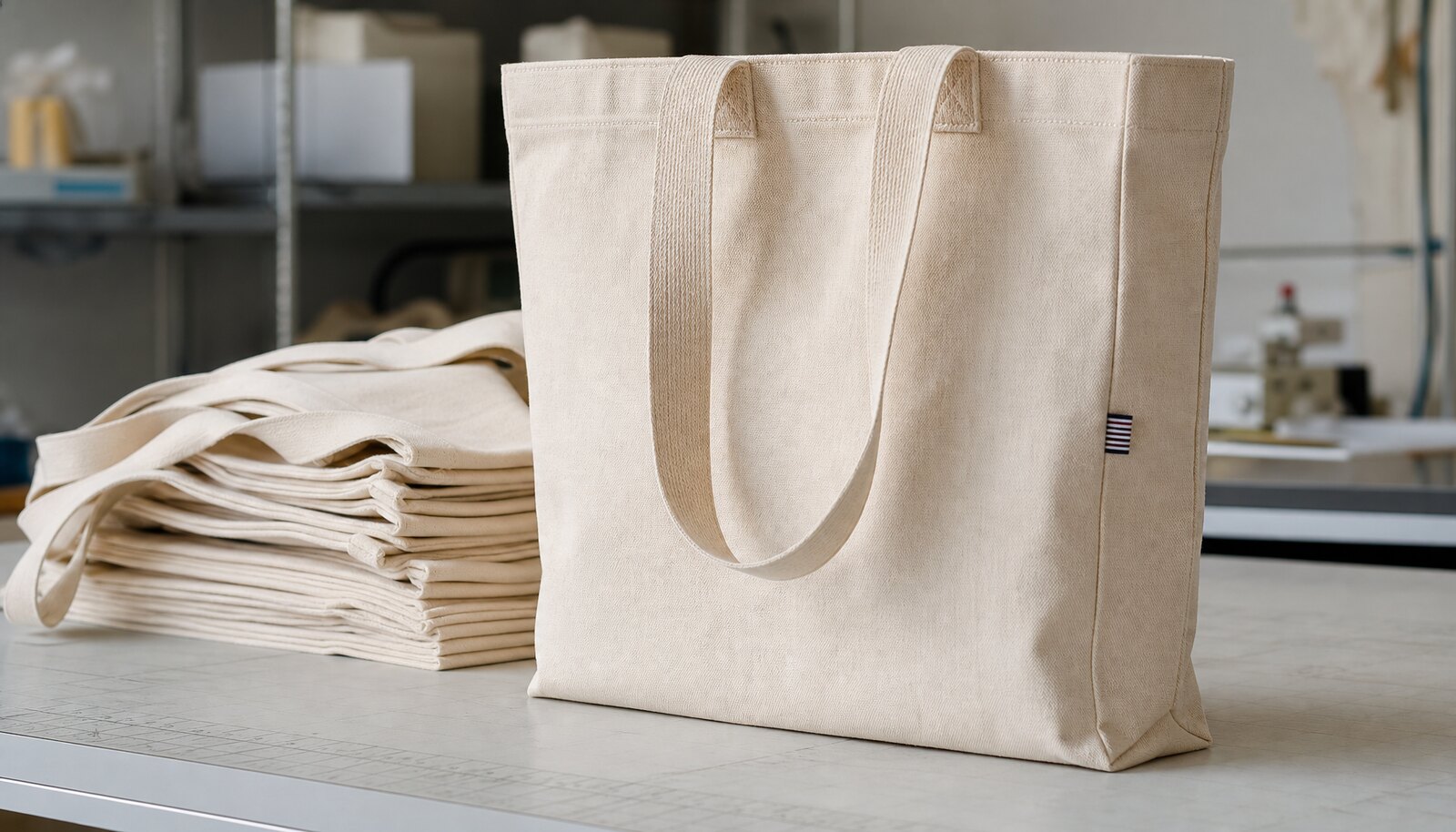
Why printed canvas shopping bags are a sourcing item, not just a merch item
Printed canvas shopping bags for ecommerce brands and retail launch programs are often treated like a simple branding add-on. In practice, they behave like a production item with real procurement risk. The price is influenced by fabric weight, weave density, print method, reinforcement, handle construction, folding method, carton size, and whether the supplier is quoting a stock template or a genuinely custom build. A buyer can approve the logo and still receive a bag that feels too soft, ships too bulky, or fails inspection because the construction spec was never written tightly enough.
That is why the most useful sourcing question is not, “Can you make this tote?” It is, “Can you make this exact tote repeatedly, at the same price, with the same finish, and within the same packing footprint?” For ecommerce and retail launches, the bag needs to protect the product experience, support inventory planning, and avoid post-launch complaints. A weak RFQ usually creates multiple versions of the same item, which makes quote comparison almost meaningless and creates surprises later in sampling or bulk production.
The buyer’s job is to reduce ambiguity before the supplier starts cutting fabric. When that happens well, the tote becomes a controlled purchase category rather than a vague branded accessory. The difference shows up in the sample stage, the landed cost, and the quality of the first production lot.
- A tote bag quote should be treated like any other retail component: same spec, same pack, same QC rule set.
- The lower the launch volume, the more important it is to define the spec tightly before samples are made.
- A bag that looks similar in photos may still differ materially in structure, freight volume, and print durability.
Start with the use case and loading requirement, not the artwork file
The right spec starts with how the bag will be used. A checkout bag that holds boxed skincare or apparel needs more body and handle security than a lightweight giveaway bag. A gift-with-purchase tote for an ecommerce launch may prioritize a clean print, neat folding, and shelf appeal over heavy carrying capacity. A retail launch bag may also need to sit upright in a store fixture, which changes the value of a gusset and the amount of stitching reinforcement required at the bottom corners.
Before asking for a quote, define the bag’s intended job in one line: what it carries, where it is used, and whether it is meant for repeated reuse or a single campaign. That one sentence helps the factory choose fabric weight, cut size, handle width, and sewing method. It also helps the buyer avoid overbuying strength or underbuying appearance. A tote meant for soft apparel can be overbuilt if the supplier is not given a real use case, while a bag that must handle boxed goods can be underbuilt if the launch brief only says “promo bag.”
If you need a load target, write it down. Even a simple target such as 5 kg, 8 kg, or a two-bottle test load gives the factory a better basis for recommending handle tape width, stitch density, and whether a reinforced base is appropriate. Ask the supplier whether that target is a carry test, a static hold requirement, or only a functional benchmark. Buyers often assume the same words mean the same thing; they do not.
- State the main contents the bag must carry, not just the brand name on the front.
- Define whether the bag is for checkout, shipment insert, event handout, or retail resale.
- If the product is heavy or boxy, ask for reinforcement at stress points before sampling begins.
Fabric weight, weave density, and shrinkage are the real cost and quality drivers
For printed canvas shopping bags, fabric weight is important, but it should not be the only fabric spec you care about. Two suppliers can both quote “12 oz canvas” and still deliver different results if one uses a looser weave, a different finishing process, or a fabric lot with more visible slub. That is why buyers should ask for the basis of the fabric weight, the weave description, and whether the material is natural, bleached, dyed, or washed. These details affect how the print sits on the surface, how the seams behave during sewing, and how the bag looks when it is unpacked at retail.
The often-overused “12 oz midpoint” is only a rough planning reference, not a universal answer. In many launch programs, 10 oz canvas can work for lighter merchandise or cost-sensitive campaigns, while 12 oz is often chosen when the buyer wants a more structured retail feel. 16 oz can be appropriate for premium carry programs or higher-load bags, but it increases material cost, sewing effort, and carton weight. The right weight depends on the use case, not on a generic rule of thumb.
Shrinkage needs explicit attention because canvas is cotton-based and may behave differently after printing, pressing, or washing. If the supplier does not account for shrinkage, the finished bag can drift in size enough to affect folding, carton fit, or shelf presentation. For procurement, ask the factory how shrinkage is controlled, whether the fabric is pre-shrunk, and what finished-dimension allowance is built into cutting. If the bag has to fit a very specific insert box or display tray, set that requirement before sampling.
- Ask for oz or GSM plus the supplier’s method of measurement; do not accept a vague fabric description alone.
- Request the actual weave or construction description if the bag needs structure or a cleaner print surface.
- If the bag must fit a mailer box, shelf tray, or insert carton, tie the finished dimensions to that packaging requirement.
- Natural canvas usually has fiber variation; judge appearance against the signed sample rather than expecting a perfectly uniform surface.
Choose the print method based on artwork, quantity, and acceptable feel
Printed canvas shopping bags are usually decorated with screen print, heat transfer, or digital print. Screen print is the most common route when the artwork is simple, the colors are limited, and repeatability matters. It generally gives strong color coverage on canvas and works well for logo-driven launches. The tradeoff is setup: screens, separations, and alignment take time, so it is most efficient when the order size and schedule justify the preparation.
Heat transfer can be practical for smaller launches, more detailed artwork, or designs that may change across campaigns. It offers more flexibility than screen print, but buyers should inspect the transfer film quality, edge definition, and whether the print remains flexible after folding. Digital print can be useful when the artwork includes gradients, fine detail, or many colors, though color consistency on textured canvas needs to be confirmed from a physical sample rather than assumed from a render.
The key is to avoid letting a generic sales quote decide the print method. A supplier may default to the process that is easiest for them, not the one that is best for your launch. If the bag is for a clean retail program with a stable logo, screen print is often the most controllable choice. If the launch is short-run, seasonal, or highly graphic, another method may reduce setup risk even if the unit cost appears slightly higher. The print decision should be made together with the art file, the MOQ, and the launch timeline, not after the factory has already priced the wrong process.
- Screen print suits simple logos, solid fills, and repeat orders.
- Heat transfer is useful for short runs and detailed art, but confirm hand feel and durability.
- Digital print is flexible, but test the actual color on canvas texture before approving bulk.
How to compare MOQ without losing sight of quality and consistency
MOQ is one of the most misunderstood parts of tote sourcing because it is not just a number; it reflects the amount of setup work the factory must absorb. Cutting, printing, sewing, and packing all require time and labor, so a low MOQ usually costs more per unit. A higher MOQ can improve pricing, but only if the design is stable and the supplier can keep the same fabric, print setup, and pack format throughout the run. For launch programs, the right question is not “What is the lowest MOQ?” but “What MOQ gives us a production lot we can trust?”
A 3,000 to 5,000 piece order is common in factory-direct custom production for straightforward printed tote programs, but that should be treated as an example of a typical custom run rather than a fixed market rule. Smaller test runs may be available through trading companies, decorators, or workshops, yet buyers should check whether those low-MOQ quotes still include the same fabric weight, seam reinforcement, and packing standard. Sometimes a lower MOQ hides a simpler construction, mixed lots, or a weaker control process.
For a retail launch, consistency often matters more than a slightly lower opening price. If the first order is a test run, make sure the supplier can repeat the same spec if the bag sells through and reorders quickly. Ask whether the MOQ is tied to one artwork, one color, one size, or one production batch. That answer tells you whether the supplier is actually quoting a production order or only a flexible but less repeatable sample run.
- Lower MOQ usually means higher unit cost or more handwork.
- Higher MOQ is only valuable if the design is stable enough to reorder.
- Clarify whether MOQ applies to one size, one print color, or one combined production batch.
Comparison table: which supplier route fits which launch strategy
There is no single best supplier type for printed canvas shopping bags. The right route depends on the launch phase, order size, tolerance for variation, and how much control the buyer wants over the production chain. A direct factory gives the best chance to lock construction and packing, while a trading company can simplify communication and coordinate smaller or more complex programs. Small-run decorators can be useful when the timeline is compressed or the artwork changes often, but they are not always the best fit for repeat retail orders.
Use the table below as a sourcing comparison tool, not just a price sheet. The goal is to understand what each route is likely to include, what it may leave out, and which risks should be checked before placing a PO.
Sample approval should verify structure, print, and finish—not just the logo placement
A production-ready sample is the point where the buyer stops guessing. The sample should be made from real production fabric, with the intended print method, real handles, and the final seam layout. A digital mockup is useful for design review, but it does not tell you whether the fabric is too soft, whether the handles twist, or whether the print sits cleanly on the weave. For retail launch programs, a blank physical sample is better than a render, but a pre-production sample is the standard that matters for approval.
When reviewing the sample, do not start by staring at the logo. First handle the bag, fold it, load it with the intended product weight, and inspect the inside seams. Check whether the top hem sits flat, whether the side seams pucker, and whether the handle stitching shows any gaps or skipped stitches. Then check the print. Look for alignment, edge sharpness, coverage, and whether the color is acceptably close to the approved reference under normal light. Natural canvas can have surface variation; the goal is not to eliminate every fiber mark, but to ensure the marks do not make the logo look uneven or off-color.
Set an approval rule before bulk starts. Common buyer criteria include allowed print placement tolerance, acceptable dimensional variation, and what counts as a defect versus a cosmetic feature of the fabric. Keep one sealed approved sample for production reference and one for incoming QC. If the supplier later argues about whether a seam or print shift is acceptable, you need a physical reference, not an email thread.
- Review the sample under the same lighting you expect in receiving or retail inspection.
- Test the bag with actual load, not just with empty hand feel.
- Keep written acceptance criteria for print, stitch, and size before mass production starts.
Construction details that matter more than buyers expect
The construction of printed canvas shopping bags often determines whether the tote feels premium or merely functional. Handle width, handle tape type, topstitching, corner reinforcement, and gusset design all influence perceived value and durability. A bag may have a strong logo but still feel cheap if the handle stitching is too sparse or the fabric at the mouth collapses when lifted. Buyers should inspect the bag from the inside out, because the hidden finishing usually tells you more about quality than the front print does.
For most ecommerce and retail launch totes, flat handles between roughly 2.5 cm and 3 cm in width are common, though the right width depends on the bag size and expected load. Wider handles can feel more comfortable but add material and sewing cost. Reinforced stress points at the handle join are worth confirming, especially if the bag is intended for repeat use. If the bag has a gusset, ask where the print area begins and ends once the bag is filled, because a wide gusset can change the visual placement of the logo in use.
Buyers should also ask whether the supplier uses single stitching, double stitching, or bartack-style reinforcement at the handle points. The quote should not just say “reinforced handles” without explaining how that reinforcement is achieved. In QC, a loose handle or weak join is one of the most obvious reasons for claim risk after launch. It is cheaper to clarify the stitch pattern before sampling than to discover that “reinforcement” meant a decorative line of thread rather than a load-bearing build.
- Check the bag mouth for reinforcement and seam flatness, not just the front panel.
- Confirm handle width and stitch pattern if the bag will carry heavier product loads.
- If a gusset is used, verify the print position on a filled bag, not just on a flat sample.
Packing, carton math, and freight planning should be part of the RFQ
Packing choice changes landed cost more than many buyers expect. Printed canvas shopping bags are bulky, so carton efficiency matters. Bulk packing is usually the cheapest route because it reduces labor and cube. It also suits ecommerce operations that will re-fold or relabel items at the warehouse. If the retailer needs cleaner presentation, inner packs, banded bundles, or individual polybags may be worth the extra cost, but the buyer should know that each added step increases labor, carton count, and freight volume.
When you compare quotes, ask for carton dimensions, gross weight, net weight, and pieces per carton. Those numbers are not administrative details; they drive freight estimates, warehouse receiving, and storage fees. Two suppliers may quote the same unit price but differ materially in carton size or packing density, which changes the true landed cost. For a tote launch, the unit price alone can hide a freight penalty if the bag is overfolded, overpacked, or shipped in oversized cartons.
If the destination warehouse has constraints, such as pallet height limits or barcode label placement, state them early. If inner packs are required, ask whether they are polybags, paper wraps, or banded stacks, and whether the packing method changes the carton count. Also verify whether the fold direction leaves a visible crease across the print area. A bag that looks great in a sample but arrives with a hard fold line across the logo is a packing problem, not a printing problem.
- Bulk pack is usually best for warehouse handling and lowest freight cube.
- Retail-ready inner packs should be used only when the channel actually needs them.
- Ask for carton dimensions and CBM before comparing supplier prices.
- Confirm that the fold pattern will not damage the visible print area.
Lead time planning: where tote projects actually slip
Lead time for printed canvas shopping bags usually consists of artwork confirmation, fabric sourcing, sample approval, cutting, printing, sewing, finishing, QC, and packing. Buyers sometimes hear a single production number and assume it is fixed. In reality, the schedule can move depending on material availability, print complexity, and how quickly the buyer signs off on proofing. A common planning range might be about 7 to 14 days for samples and about 25 to 40 days for bulk after sample approval, but that is best understood as a planning reference, not a guarantee. Actual timing depends on order size, print method, material availability, and seasonal factory load.
The biggest delay points are usually predictable. Late artwork changes can force re-screening or re-layout. A non-standard canvas weight may require material sourcing time. A retail pack requirement can add a separate packing step. If the bag needs a specific dyed color or a very exact print match, color approval may become the longest part of the schedule. Buyers should therefore build buffer time around launch dates rather than assuming the first quoted lead time is the final one.
A practical launch tactic is to freeze the most expensive-to-change items first: bag size, fabric weight, print method, and packing format. Keep artwork revisions to a minimum once the sample is in motion. If the launch date is fixed, simplify the first order. A clean first shipment is often better than a complicated specification that arrives late.
- Freeze the base spec before artwork enters sample production.
- Ask the supplier what would cause lead time to extend: fabric, print, packing, or carton changes.
- Build schedule buffer if the bags must arrive before a store opening or campaign launch.
Specification comparison for buyers
| Supplier type | Best use case | Typical strengths | Cost drivers to watch | Decision criteria |
|---|---|---|---|---|
| Direct factory | Stable retail launch, repeat reorders, higher-volume custom tote programs | Best control over fabric, stitching, print setup, and production scheduling | MOQ, print screen/setup charges, fabric sourcing if non-stock weight is requested | Choose when you need repeatability, clear QC ownership, and a bag spec that will not change after the first production run |
| Trading company / sourcing agent | Smaller first order, multi-item buying, buyers needing faster communication across factories | Flexible order handling, easier coordination, often more language support | Agent margin, less visibility into the actual factory, possible layer of markup on samples and freight | Choose when MOQ is still uncertain or the brand needs help coordinating several SKUs and packaging requirements |
| Small-run workshop / decorator | Low-volume tests, local merchandising programs, fast artwork iteration | Lower setup burden for short runs, sometimes faster sample turnaround | Higher unit cost, less consistent stitching or packing, limited capacity for retail-grade carton control | Choose when speed matters more than price and you can accept wider variation between lots |
| Integrated bag converter with printing | Programs that need fabric, sewing, print, and packing under one roof | Simpler accountability, fewer handoffs, easier QC traceability | May have fewer decoration options or less flexibility on unusual pack formats | Choose when you want one supplier to own the bag from cutting to cartons |
| Mixed-source brokered quote | Price shopping across multiple factories without committing to one plant early | Useful for market sounding and budgetary comparisons | Specs may drift between quotes; one supplier’s quote may include lighter fabric or simpler finishing | Use only if every quote is normalized against the same spec sheet and sample standard |
| Material | 8-12 oz cotton canvas, 120-220 gsm cotton, recycled cotton, or blended fabric selected by use case and target price | Before price comparison | Different cloth weights, backing, or certification claims make quotes hard to compare | |
| Construction | bag size, gusset, handle drop, seam allowance, stitch density, reinforcement patch, and loading expectation | Before sampling | Weak stress points create returns and failed inspections | |
| Decoration | screen print, heat transfer, embroidery, woven label, or hangtag matched to fabric texture and brand durability needs | Before artwork approval | The wrong method can crack, bleed, pucker, or fail on the chosen fabric |
Buyer checklist before sampling
- Lock the final bag size, gusset depth, handle length, and print area before requesting quotes.
- Write fabric weight in both oz and GSM if possible, and state whether you want natural, bleached, dyed, or washed canvas.
- Specify the decoration method allowed: screen print, heat transfer, digital print, embroidery, or woven label, and state how many colors appear on each side.
- Include the intended load target and use case, such as retail checkout, gift-with-purchase, or ecommerce insert, because that affects construction.
- State your packing requirement clearly: bulk packed, folded with inner insert, polybagged, banded, or retail-ready inner pack.
- Request pre-production samples made from production fabric with the real thread, real handles, and real print method.
- Ask for carton dimensions, pieces per carton, gross weight, and estimated CBM before approving the order.
- Define acceptance criteria in advance for color tolerance, print placement, stitch quality, and dimensional variation.
- Reserve one signed sample for production reference and one for incoming inspection at destination.
- Ask whether the supplier can maintain the same fabric lot or will source multiple lots across production.
Factory quote questions to send
- What exact canvas weight, weave type, and shrinkage allowance are included in your quote?
- Is the quoted print price for one side or two sides, and how many colors are included per side?
- Does the quote include handle tape, corner reinforcement, and topstitching, or are those extra?
- What is the MOQ for this exact size and print method, and does MOQ change if we reduce colors or use a simpler pack format?
- What sample will you provide: digital mockup, blank physical sample, or pre-production sample with actual production materials?
- What is the expected production lead time after sample approval, and which changes would extend it?
- Which QC points do you inspect before shipment, and do you use AQL, 100% inspection, or spot-checking?
- Can you provide carton dimensions, gross weight, net weight, and estimated CBM for freight planning?
- How do you control color consistency across cartons and between sample and bulk?
- What is your policy if a seam, print, or dimension issue is found in the pre-shipment inspection?
Quality-control points to confirm
- Fabric weight should match the agreed specification within a practical tolerance, and the canvas should not feel thin, limp, or visibly open-weave under normal light.
- Finished bag dimensions should stay within the approved tolerance band, ideally with no more than small variation between cartons for width, height, and gusset depth.
- Handle stitching should show full lock-off, no skipped stitches, no loose thread clusters, and no visible tearing at the stress points.
- The bag mouth, side seams, and base seams should sit flat without major puckering or twist that would affect shelf appearance or carton fit.
- Print placement should remain within the approved tolerance so the logo does not drift off-center or into the seam line.
- Color should remain reasonably consistent between sample and bulk, and across cartons from the same run.
- No severe stains, oil marks, needle holes, broken threads, or folded-in dirt should appear on finished units.
- If the bag is intended for retail scanning or sticker placement, barcode and label areas should be checked on sample cartons before shipment.
- Carton count, outer marks, and packing method should match the order instructions, with no mixed sizes unless explicitly approved.
- If the buyer has a load requirement, the bag should be tested with the intended product weight or an equivalent test load before bulk release.