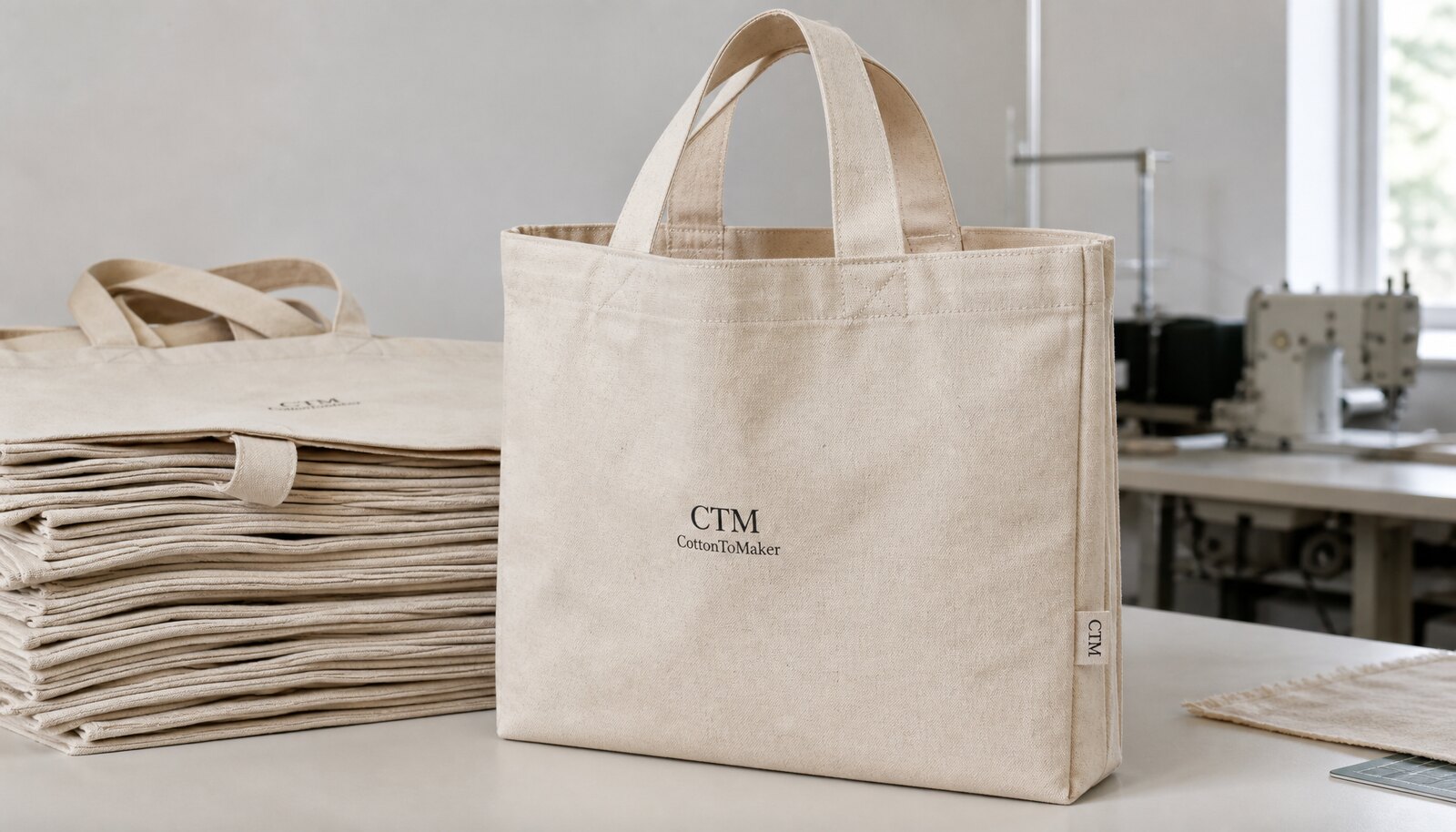
Start With the Job the Bag Has to Do
For ecommerce brands, a printed canvas shopping bag can play several very different roles. It may be a fulfillment insert, a gift-with-purchase, a premium retail item, or a campaign giveaway. Those are not the same buying problem. A bag that only needs to survive one warehouse pass does not need the same body, finish, or construction as a bag that a customer will carry, photograph, and reuse.
The fastest way to improve quote quality is to define the job before you ask for price. If the bag is part of the product experience, the buying team should care about hand feel, logo finish, and how the tote sits on a shelf or in a photo. If it is a packaging component, unit cost, packability, and warehouse handling matter more. The wrong priority order usually creates vague quotes and avoidable change requests later.
This is also where size planning starts. A small tote for a cosmetics insert, a medium tote for apparel, and a larger gusseted bag for bundled sets may all be canvas shopping bags, but they create different shipping, sewing, and storage profiles. Buyers should anchor the spec to the expected contents and the customer touchpoint, not to a generic tote description.
- Write one sentence that states the bag's purpose and where the customer will see it.
- Define the heaviest contents the bag must carry, even if the bag is usually used lighter than that.
- Decide whether the order should be optimized for warehouse efficiency or retail presentation.
- If the bag is part of a launch, set the design freeze date before sampling begins.
Fabric Weight Is Only One Part of the Spec
Canvas weight is useful, but it does not tell the whole story. Two bags both described as 10 oz can behave differently if one uses a tighter weave, a softer finish, a different yarn count, or a prewash step. Procurement teams should treat fabric as a material system, not a single number. The more precise the description, the fewer surprises at sample review and mass production.
For many ecommerce programs, 10-12 oz canvas is a practical middle ground because it balances structure, print clarity, and cost. That is not a universal rule. Lighter fabric can be fine for short-term promotional use or lower-load inserts, while heavier fabric may be worth it for premium retail presentation or loads that need a firmer body. The tradeoff is usually sewing difficulty, freight weight, and how the bag folds in the warehouse.
Finish matters almost as much as weight. Natural, bleached, dyed, and prewashed canvas all behave differently. Bleached or dyed fabric may give you the look you want, but it can create more variance in shade control. Prewashed fabric may feel softer and look more finished, but it can change the final dimensions if shrinkage is not managed correctly.
- Ask the supplier to quote GSM or oz, not just the word "canvas."
- Request a swatch from the same lot or a lot that matches the intended production standard.
- Confirm whether the fabric is natural, bleached, dyed, or prewashed.
- If the logo has small text or thin lines, ask for a strike-off on the actual fabric surface.
Size, Handles, Seams, and Reinforcement Decide the Bag's Real Feel
The shape of the bag affects how it is carried, packed, and judged. A narrow body with a modest gusset may work for small apparel orders, while a wider gusset helps when the bag needs to carry boxed goods or stacked bundles. Buyers do not need a universal standard size, but they do need a deliberate size choice tied to the use case. That choice should be documented in the RFQ so suppliers do not fill in the blanks with their default pattern.
Handles deserve the same attention as the body. Self-fabric handles can look seamless and can reduce part count, while cotton webbing handles may feel cleaner in the hand and hold shape better. Handle width, handle drop, and attachment method affect comfort and load path. A handle that looks fine on a flat sample can feel wrong once the bag is loaded and lifted from the shoulder or the hand.
The seam package is where cheap-looking bags are often exposed. Single-needle sewing may be acceptable on lighter programs, but many buyers will want double-needle seams, bartacks, or boxed reinforcement at stress points. Ask where the top hem is reinforced, how the gusset corners are finished, and whether the side seams are secured to prevent fray after repeated use. If the bag needs to support heavier contents, the reinforcement design should be part of the quote, not an afterthought.
- Specify the finished size, gusset depth, handle length, and handle drop on one sheet.
- Choose self-fabric or webbing handles based on load, feel, and presentation.
- Ask which seams are single stitched, double stitched, or reinforced with bartacks.
- Request the actual handle drop on the finished bag, not a flat-panel estimate.
- Use the sample to check whether the bag hangs square or twists when loaded.
Choose the Print Method Based on Artwork and Reorder Plan
Screen printing remains the most common option for custom logo canvas bags because it handles solid brand marks well and can be efficient once setup is spread across the run. It is usually the first method to evaluate when the artwork is simple, the color count is limited, and the brand expects repeat orders. The key procurement question is not whether screen print is popular. It is whether the method fits the logo, the quantity, and the performance expectation.
Ink system matters too. On canvas, buyers may see water-based or plastisol systems, and each brings different tradeoffs in hand feel, opacity, and curing behavior. A softer print may be attractive on natural canvas, but if the design includes fine text or needs strong opacity on a darker base, the supplier needs to explain how they will keep the logo sharp and durable. Ask how they control registration, drying, and rub resistance, especially if the tote will be handled often or reused.
Digital and transfer methods are not inherently better or worse. They can make sense for short runs, frequent artwork changes, or more complex visuals, but they can also raise unit cost or introduce texture differences that do not suit every brand. For procurement, the right question is how the print will wear in real use. Ask whether the supplier can show the expected look after folding, handling, and basic rub testing, and whether the artwork needs an underbase or a safe area away from seams and folds.
- Use screen print for simple logos and stable repeat orders unless the art clearly calls for another process.
- Ask what ink system will be used and how opacity and rub resistance are controlled.
- If the logo has thin lines or small text, request the supplier's minimum line thickness guidance.
- Require a clear print position drawing with seam-to-edge measurements.
- Treat each print method as a different commercial and durability choice, not just a cosmetic choice.
Compare Supplier Routes by Lead Time, Reorder Stability, and Control
Factory-direct sourcing usually gives the clearest control over fabric, sewing, print, and packing. That is valuable when the tote is part of a long-term packaging program or when reorders need to match the first order closely. The tradeoff is that you need a better spec. A factory will often quote exactly what you ask for, which is useful only if the buyer has already written the requirements clearly.
Trading companies can help when the order is mixed, the buyer needs one point of contact, or the purchase is small enough that coordination matters more than optimization. Local printers or domestic converters can be better for rush programs, samples, or very small volumes. They may cost more per unit, but they can save calendar time when artwork is still changing or launch timing is tight. The correct route depends on whether speed, cost, or reorder stability is the primary constraint.
A useful comparison is not just unit price. Look at lead-time risk, how easily the supplier can hold the same spec for a reorder, and what happens if the artwork changes by one color or the pack format changes from bulk carton to retail-ready. A cheap first quote can become the expensive route if the supplier cannot repeat the result later or if the quote did not include the real finishing steps.
- Use factory-direct when repeatability and spec control matter more than convenience.
- Use a trader when you need simpler coordination across multiple product types or smaller buys.
- Use a domestic converter when the launch window is short and the unit-cost premium is acceptable.
- Ask each supplier where printing, sewing, packing, and labeling actually happen.
- Compare lead-time assumptions and reorder stability, not just first-order price.
Build an RFQ That Forces Comparable Quotes
Most tote RFQs fail because the suppliers are not pricing the same thing. A good procurement RFQ gives the vendor enough detail to quote the same fabric, the same print method, the same handle construction, the same packing, and the same carton assumptions. If one supplier quotes a blank bag and another quotes a fully finished custom bag, the unit price comparison is meaningless even if the numbers look close.
The RFQ should include the use case, finished size, fabric weight, finish, artwork file, print area, color target, handle spec, seam spec, reinforcement, pack style, and destination terms. If a field is unknown, say so and ask the supplier to show the price impact of the options. That makes the quote useful instead of simply low. It also reveals how much of the price is setup and how much is recurring material or labor.
Ask for the commercial details that affect landed cost. Unit price alone is not enough. You need the setup charge, sample charge, packing cost, carton dimensions, carton count, gross weight, and any label or barcode work called out separately. For ecommerce teams, this matters because the bag may be cheap at the factory gate but expensive once it is cartonized, palletized, and shipped into a warehouse network.
- Send one spec sheet and one artwork version to every supplier you want to compare.
- Ask for separate lines for unit cost, setup, sampling, packing, and freight-related charges.
- State the expected quantity by SKU so MOQ and variant pricing are visible.
- Request carton dimensions, gross weight, net weight, and estimated CBM before approval.
- If a detail is not fixed, ask the supplier to quote the cost difference between options.
Sample Approval Should Prove the Real Production Result
A blank canvas sample is not enough for a printed order. It may confirm the rough shape, but it does not prove the print opacity, logo placement, stitch quality, or how the fabric reacts once the ink is on it. For custom logo printed canvas shopping bags, the pre-production sample should be made from final materials using the final print method and the final sewing spec. Otherwise the sample is only a partial preview.
A useful sample review is written, measured, and repeatable. Check the finished dimensions, handle drop, print placement, and seam symmetry against the approved spec sheet. If the bag will carry a product, load it with the actual contents or an equivalent test weight. If the logo has thin lines, inspect the edges under the same light you will use for approval. If the bag needs to sit flat for pack-out, fold it the way the warehouse will fold it, not the way the sample room finds convenient.
Keep the approved sample and the approved spec together. That matters on reorders, because memory fades and email threads get messy. If the supplier revises the sample after your sign-off, require a new approval cycle. A small change in print position, fabric finish, or handle length can turn into a bigger commercial problem once the full order has already been cut and sewn.
- Approve the final fabric, final print method, final artwork placement, and final sewing details together.
- Use the actual product or a realistic fill weight during sample testing.
- Measure print position from seam and edge on both panels.
- Keep the approved sample, photo set, and spec sheet in one controlled file.
- Treat any post-approval change as a new revision, not a casual tweak.
QC Needs Pass or Fail Rules, Not General Advice
Quality control should be defined before production starts. If the buyer only says the bags need to look good, the supplier has too much room to interpret the result. A better approach is to classify defects by severity. Critical defects are things that make the product unusable or wrong, such as the wrong artwork, missing handles, a wrong size beyond the agreed tolerance, or major seam failure. Those should be reject-level issues.
Major defects are the kind that a warehouse or customer would notice immediately and that reduce commercial value, such as a logo that is obviously off-center, visible print misregistration, large stains, broken stitching, or uneven handle attachment. Minor defects are small cosmetic issues that might be acceptable within a defined allowance, such as a few loose thread tails or a light fold mark that does not affect use. The point is not to accept poor work. It is to define what your buyer team will and will not tolerate.
Inspection should also be staged. Check the first pieces off the line, then spot-check cartons from the middle and end of production. Compare the fabric to the approved swatch, inspect print opacity and legibility, verify size and handle drop, and test representative units under load. If the order includes any sustainability or material claim, check that the documentation and the delivered product say the same thing. That is where many procurement mistakes become avoidable compliance problems.
- Define critical, major, and minor defects in the PO or quality annex.
- Measure size, handle drop, and print placement against the agreed tolerance.
- Reject obvious shade drift, print bleed, broken seams, or missing reinforcement.
- Inspect cartons from multiple positions in the shipment, not only the first carton.
- Verify all claim documents match the delivered goods and the PO wording.
Packing, Cartons, and Freight Can Move the Real Cost
Packing is one of the easiest places for tote costs to creep. A bag may be cheap to sew and print, but if it needs individual polybags, barcode labels, hangtags, or retail-style folding, the labor and cube can climb fast. Bulk carton packing is usually the simplest choice for warehouse-bound ecommerce orders because it reduces handling and keeps receiving straightforward. Retail presentation is valid too, but it should be a deliberate choice rather than a default.
The buying team should always ask for carton dimensions, gross weight, net weight, carton count, and the estimated pallet pattern if pallets matter. Those details let logistics estimate freight and warehouse handling before the order is placed. They also expose inefficient packing. A carton that is overly large or lightly filled can add freight cost even if the unit price looks strong. In practice, cube can matter as much as price per tote.
Warehouse friction is another hidden cost. If carton labels are unclear, inner counts are wrong, or the folding method changes by carton, your receiving team may need to recount and repack the shipment. Reorders often fail in the same place: the first order was handled manually and the second order assumes someone remembers the old method. That is why pack style belongs on the spec sheet, not in a side email.
- Define fold direction, bag count per master carton, and whether individual polybags are required.
- Ask for carton dimensions, gross weight, net weight, and estimated CBM before approval.
- Confirm whether cartons are pallet-ready and whether a pallet pattern is available.
- Make sure the carton SKU and barcode format match your warehouse receiving rules.
- Treat packing as a cost and operations decision, not just a presentation choice.
Design for Reorders, Not Just the First Purchase Order
The first tote order is only the first order if you let it be. Reorders are where sourcing systems are either proven or exposed. If the supplier cannot keep the same fabric, print setup, handle material, or packing method, the second order may drift from the first in a way that is visible to customers and annoying to operations. The best protection is a clean master file: final artwork, approved sample photos, spec sheet, and revision history in one place.
Buyers should also ask what assumptions sit behind the reorder price. Does the quote assume the same fabric lot, the same print screens, the same carton size, and the same freight path? If not, what changes when one of those variables changes? That question matters because reorder stability is often more valuable than a small first-order savings. A predictable second buy is usually more important than squeezing a few cents out of an initial pilot.
For seasonal or launch-driven programs, it helps to set the design freeze before sampling begins and to keep a simple change log. If the brand wants to adjust the artwork, the handle length, or the pack format after approval, document the impact on price and lead time right away. That keeps the sourcing process honest. It also gives the procurement team a better way to compare suppliers: not by who says yes fastest, but by who can repeat the approved result with the fewest surprises.
- Keep a controlled master sample and a versioned spec sheet for the next buy.
- Ask the supplier what reorder assumptions are built into the first quote.
- Record every post-approval change and its effect on cost or timing.
- Set the design freeze date before sample approval if the launch window is fixed.
- Compare suppliers on reorder stability as well as first-order price.
Specification comparison for buyers
| Decision area | Recommended option | Main cost drivers | Failure mode to watch |
|---|---|---|---|
| Fabric weight | 10-12 oz canvas, often about 340-400 GSM, when the bag needs structure and repeatability | Yarn density, weave tightness, finishing, shrink control, and sewing difficulty | Too light can look limp and show print irregularities; too heavy can raise sewing cost, handling time, and freight cube |
| Weave and finish | Firm plain-woven canvas in natural, bleached, or dyed finish matched to a physical swatch | Dye lot control, prewash or softening steps, and any shrinkage allowance | Shade drift across lots, unexpected shrinkage after sewing, or print behavior that changes by finish |
| Handle construction | Self-fabric or webbing handles with a defined width, drop, and attachment method | Webbing material, handle length, bartacks, folded ends, and extra sewing operations | Handles twist, dig into the hand, or fail at the attachment point under load |
| Seam and reinforcement | Double-needle or reinforced side seams with bartacks or boxed stress points | Extra stitching passes, thread use, and inspection time | Skipped stitches, seam popping, or corners that fray after a few uses |
| Print method | Screen print for simple logos and repeat orders; digital or transfer only when the artwork or volume requires it | Setup labor, color count, registration complexity, curing, and artwork prep | Fine text fills in, edges blur, or the ink cracks or rubs off too easily |
| Lead-time profile | Factory-direct with sample approval buffer for repeatable programs; local finishing only when speed matters more than cost | Capacity, fabric booking, artwork revisions, transit time, and seasonality | Late sign-off, skipped approval steps, or congestion in print or sewing that pushes launch dates |
| Reorder stability | A supplier that can keep the same fabric spec, print setup, and packing method on repeat buys | Material availability, stored artwork files or screens, and dye lot consistency | Requote surprises, visible lot drift, or a second order that no longer matches the first |
| Packing format | Bulk carton packing unless retail presentation or shelf-ready packing is required | Inner pack labor, polybags, label application, carton size, and pallet efficiency | Excess cube, receiving delays, or warehouse teams having to repack or recount |
| Supplier route | Factory-direct for repeat custom orders; converter, trader, or local printer only when the tradeoff is clear | Margin layers, subcontracting, coordination overhead, and visibility into production steps | Unclear QC ownership, hidden outsourcing, or inconsistent follow-through on reorders |
Buyer checklist before sampling
- Define the use case in one sentence: retail resale, gift-with-purchase, fulfillment insert, event giveaway, or bundle packaging. The use case should decide the fabric weight, construction, and presentation standard.
- Lock the finished size, gusset depth, handle drop, seam type, and reinforcement points on one spec sheet before you ask for price.
- Send vector artwork, Pantone targets if color matching matters, minimum line thickness, and exact print placement measurements from seam and edge.
- State the maximum load the bag must carry and whether it must survive repeated reuse or only one fulfillment cycle.
- Request a pre-production sample on final materials, not a blank bag, and ask for a print strike-off if the design has small text or thin lines.
- Ask for separate quote lines for unit price, setup or screen charges, sample cost, packing, carton work, labels, and freight if applicable.
- Confirm whether MOQ is per artwork, per size, per color, or per print method, and ask what changes if you combine variants.
- Agree in writing on acceptable color variance, print placement tolerance, stitch quality, and overrun or underrun policy before mass production starts.
- Ask the supplier to disclose where printing, sewing, washing, packing, and labeling happen if any step is outsourced.
- If the product has recycled, organic, or other material claims, collect the supporting document before approval and make sure it matches the PO wording.
Factory quote questions to send
- What exact canvas construction are you quoting: GSM or oz, weave type, and whether the fabric is natural, bleached, dyed, or prewashed?
- What handle construction are you pricing: self-fabric, cotton webbing, folded handle, or another build, and what is the finished handle drop?
- What seam type and reinforcement method will you use, and where are the stress points bartacked or double stitched?
- Is your MOQ based on artwork, size, color, or total order value, and how does it change if we combine variants?
- Which print method will you use for this artwork, and what setup, screen, plate, or color-change fees apply?
- What ink system will you use, and how do you handle opacity, rub resistance, and curing on textured canvas?
- Can you quote the same bag with bulk packing and with retail-style individual polybags so we can compare landed cost?
- What sample will you send for approval, and will it match the final fabric, stitching, print density, and label placement?
- What is your standard production lead time after sample approval, and which steps most often cause delay?
- Do you outsource any part of the order, including printing, washing, packing, or labeling?
Quality-control points to confirm
- Compare the bulk fabric against the approved swatch under consistent light before cutting starts, and hold production if the shade is materially off.
- Check the first completed bags against the spec sheet, not just the cut panels, because sewing and shrinkage change the final size.
- Measure finished width, height, gusset depth, and handle drop against the agreed tolerance; any out-of-tolerance dimension should be flagged immediately.
- Inspect print placement from seam to edge on both panels, and reject obvious drift, misregistration, or low-opacity coverage that weakens the logo.
- Look for print defects that matter in use: cracking, smearing, ink bleed, ghosting, or a surface that rubs off too easily.
- Inspect handles for symmetry, secure attachment, consistent width, and proper bartack or reinforcement placement.
- Check seams, corners, and top hems for skipped stitches, broken thread, loose thread tails, or gaps that would affect load-bearing performance.
- Pull-test representative samples from the first run and from random cartons using the actual expected load or a reasonable test weight.
- Verify fold direction, inner pack count, master carton count, carton labels, and SKU mix so warehouse receiving does not have to recount or relabel.
- If the order includes sustainability or material claims, confirm the delivered product and documentation match the approved wording before release.