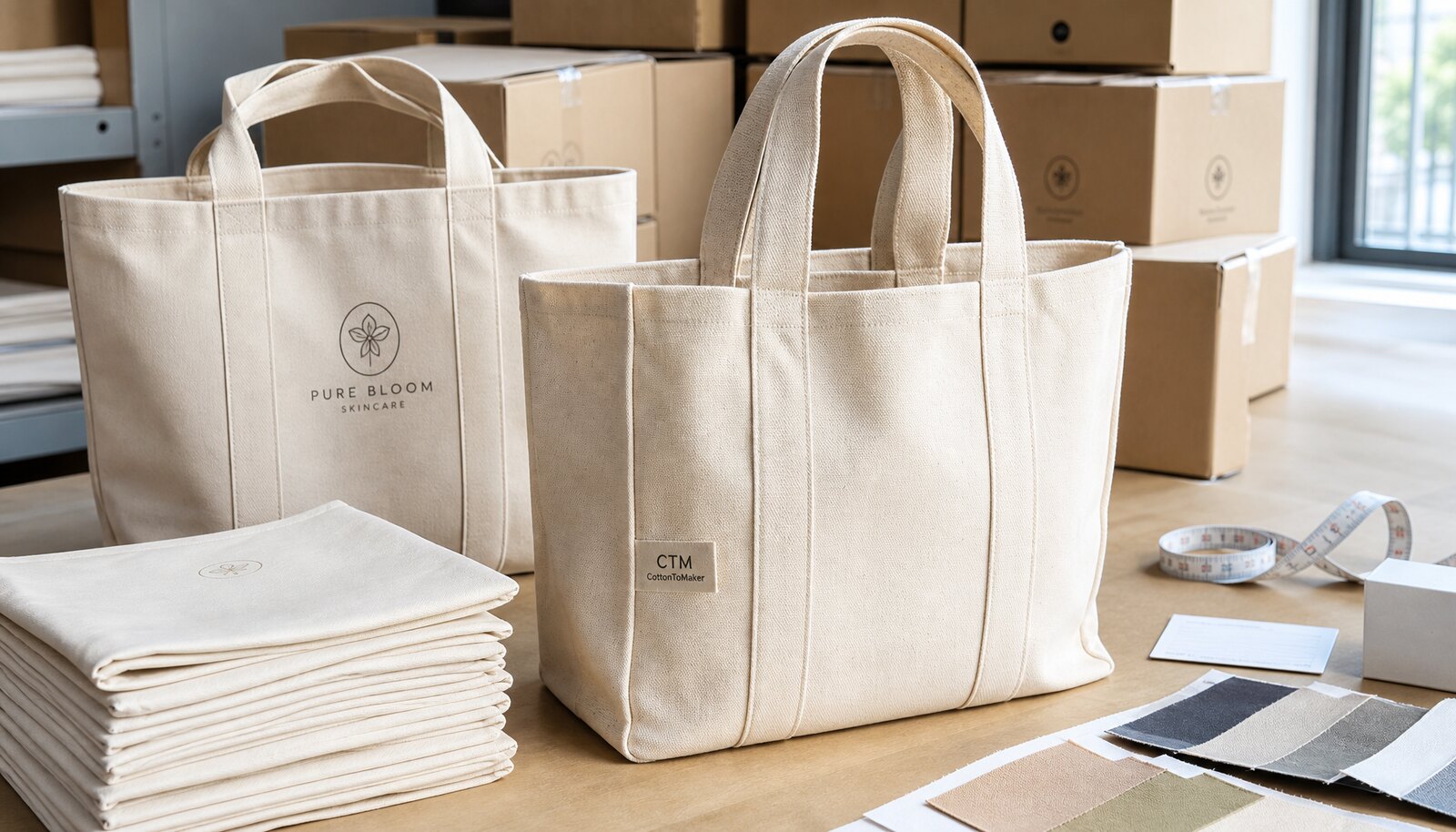
Why carton planning matters more for cosmetic brands than for basic tote purchases
For cosmetic brands, printed canvas shopping bags are not simply carry bags. They are often tied to launch kits, gift-with-purchase programs, influencer mailers, retail events, or premium checkout presentation. That means the bag has to do three jobs at once: present the brand well, protect the contents, and fit a shipping plan that does not inflate freight cost. If carton planning is ignored, the unit price may look good while the landed result is poor.
Procurement teams often treat the bag specification and the carton specification as separate workstreams. That split is risky. The way the bag is folded affects the carton size, the fold pressure affects print scuffing, and the carton dimensions affect both freight cube and warehouse handling. A supplier quote that does not state packing format, carton size, and gross weight is incomplete for B2B buying.
The practical rule is simple: define the tote, then define the fold, then define the carton, then compare freight impact. If those steps are reversed, buyers end up optimizing a line item instead of the full landed cost. For cosmetic programs, especially those with retail-facing standards, the carton plan is part of the product spec, not a shipping afterthought.
- A good carton plan reduces freight cube without crushing the logo print.
- A bad carton plan can turn a premium-looking tote into a wrinkled, low-value item on arrival.
- The most useful quote is the one that ties product dimensions, packing method, and carton spec together.
Start with the end use: gift set, retail purchase, event handout, or e-commerce insert
The first procurement decision should be use case, not artwork. A canvas tote for a boxed skincare set is not the same as a tote used as a paid retail add-on or event giveaway. Gift sets usually need more structure, wider gussets, and cleaner internal presentation. Event handouts may prioritize low cost and fast packing. Retail shopping bags often need stronger handles, better print opacity, and a fold that still looks neat after unpacking.
If the bag will carry rigid cartons, glass jars, or mixed-size cosmetic items, ask the supplier to estimate the expected load and then build in margin. For example, a bag that looks adequate in a flat sample may deform badly once jars and boxes are loaded. Buyers should define finished width, height, gusset depth, handle length, and a realistic carry weight before approving artwork. That information tells the factory how to cut, sew, reinforce, and pack the tote.
In cosmetic sourcing, the product brief should also state whether the bag is meant to be reused. Reusable bags usually justify stronger canvas, better handle stitching, and a more careful carton plan because buyers care about appearance after the first use, not just arrival condition. If the brand values sustainability messaging, a bag that feels flimsy at first touch can undermine the claim even when the spec technically passes.
- Define the primary content: boxed skincare, jars, tubes, samples, or mixed gift items.
- State whether the tote is a giveaway, retail accessory, or reusable shopping bag.
- Match bag structure to load weight rather than to a general marketing image.
- If the bag must stand upright, specify gusset and base requirements in the RFQ.
Fabric weight, weave density, and finish: where the real cost drivers sit
Canvas pricing is influenced by more than the stated ounce weight. Weave density, yarn quality, finishing method, dye consistency, and pre-treatment all affect both appearance and durability. Two suppliers can quote the same 12 oz canvas and deliver very different results. One may use a tight, even weave with a cleaner surface for print; another may use a looser construction that feels bulky but still shows uneven print fill. Buyers should ask for the fabric spec, not only the headline ounce number.
For cosmetic brands, the visual surface matters because the tote usually sits beside premium packaging. A cleaner weave supports sharper logo edges, especially for small text or thin line art. If the bag will be photographed, displayed in stores, or gifted to media and VIP contacts, a more consistent surface is usually worth the added cost. On the other hand, if the tote is only a short-life promotional item, buyers may accept a simpler fabric as long as the print remains legible and the seams hold.
Finish also matters for carton planning. A stiffer finish may hold shape better in the carton but can increase the risk of crease marks if the tote is folded too tightly. A softer finish may fold more neatly but can wrinkle more easily. Ask the factory whether the fabric is washed, pre-shrunk, or raw, and whether the spec includes any treatment that changes final size after sewing. That information affects both carton count and final dimensions.
- Ask for fabric weight in both ounce and GSM if the supplier can provide it.
- Request weave photos under close light so you can see density and uniformity.
- Confirm whether the fabric is pre-shrunk or likely to change size after pressing or washing.
- Use a tighter weave when print clarity and premium appearance are priorities.
Print method selection: what matters for brand quality, not just for art files
Screen printing remains the default option for most printed canvas shopping bags for cosmetic brands because it balances cost, repeatability, and durability. It performs well when the artwork is simple: a logo, slogan, or basic icon in one or two colors. It also tends to hold up better to folding than many decorative transfer methods. That said, screen print only works well when the supplier controls registration, ink thickness, curing, and the print area relative to seams and folds.
Heat transfer has a place, but it should be treated as a different sourcing decision. It may suit short runs or detailed graphics, yet it can create new risks in carton packing because the film layer can crack or mark if the bag is folded too sharply or rubbed during transit. Embroidery is less common on shopping totes because it adds cost, slows production, and can create bulk that interferes with flat packing. For most cosmetic brands, the easiest route is still a clean screen print with defined ink and curing standards.
Procurement teams should ask the supplier to show how the print behaves after folding, rubbing, and brief compression in the proposed carton format. One sample can look excellent on a table and fail after packing. That is why print approval should not be limited to a flat visual sign-off. It should include a packed-state check, especially if the logo sits near the center fold or close to the side seam.
- Use screen print for stable, repeatable branding and simpler artwork.
- Use heat transfer only when the design complexity or short-run volume justifies the risk.
- Avoid placing print too close to seams or fold lines.
- Ask for one sample packed in the proposed carton before final approval.
A decision guide for sourcing routes: direct factory, trader, or distributor
The right supplier type depends on how much control you need over sewing, printing, and packing. A direct factory usually offers the strongest visibility into the actual production line. That matters when you want a specific fabric weight, a tight print tolerance, and carton dimensions that support efficient freight. Direct communication also makes it easier to correct a problem early, because the people quoting you are closer to the actual process owner.
A trader can be useful when your buy is mixed and you need one contact to manage multiple accessories, but the trade-off is less visibility. Traders may not own the sewing line or the printing process, and they may not control carton packing directly. That means the buyer should push harder for proof of who actually does the work, how often the order is subcontracted, and whether the same factory will make the re-order. If that information is vague, the risk sits with the buyer, not the supplier.
Distributors or local resellers may help when speed and domestic inventory matter more than customization. They can reduce lead time on standard bags, but they often have limited control over carton specification and may not be able to change the fold, carton count, or packing mark format. For cosmetic brands, the decision should be driven by how much standardization the program needs. If the tote will be re-ordered, direct factory sourcing is often easier to control. If it is a one-off seasonal item, a distributor may be acceptable if the carton data is still precise.
How MOQ really works on printed canvas bags, and why carton format affects it
MOQ on printed canvas shopping bags is not only about fabric consumption. It is shaped by cutting efficiency, screen setup, sewing line scheduling, packing labor, and carton configuration. If you change artwork, color, size, or fold format, the practical MOQ can rise even when the supplier advertises a lower headline number. This is especially true for cosmetic brands that want multiple shades, seasonal messages, or different artwork for different channels.
A buyer should therefore ask for MOQ by artwork, by color, and by packing format. A supplier who gives one number without explaining the work behind it may be quoting a simplified scenario that does not match the actual order. The same is true for carton planning. If the carton needs a custom size or a special fold to protect the print, the packing setup may require additional labor and can affect the minimum quantity. The quote should say whether the MOQ is tied to print screen setup, fabric cutting loss, or carton pack-out efficiency.
When an order has to be launched quickly, it is often smarter to reduce complexity than to push for a lower MOQ. One artwork, one fabric weight, one carton spec, and one packing method are easier to control than several versions at once. That approach also makes re-ordering more reliable, because the factory can repeat the same line settings and carton density without revisiting a different packing logic each time.
- Ask for MOQ separately for print version, colorway, and packing format.
- Expect a higher effective MOQ when multiple artwork versions require separate setup.
- Use one standardized carton spec if the order needs repeatability.
- Confirm whether the supplier charges extra for custom carton marks or mixed cartons.
Carton planning in practice: dimensions, pack count, CBM, palletization, and freight trade-offs
Carton planning should start from the folded bag dimensions and the intended fold method. Do not choose a carton size first and force the bag into it later. The right carton is the smallest carton that still protects the print, allows easy counting, and avoids handle crushing. If the bag includes a cardboard insert, hangtag, or polybag, the carton needs enough clearance so those items do not press into the fabric and create a visible mark.
For buyers, the key calculation is not just carton size; it is cartons per CBM and cartons per pallet layer. A carton that looks economical may still be expensive if it creates poor cube efficiency. The buyer should request the supplier’s estimate of folded bag thickness, carton internal dimensions, gross carton weight, and quantity per carton. From there, it is possible to calculate approximate CBM and estimate whether the order will ship efficiently by sea, air, or domestic truck. When cartons are too large, the order pays for empty space. When cartons are too small, the bags can deform and the carton may burst under stacking pressure.
A practical carton spec usually balances three trade-offs. First, protection: the bag should lie flat without pinching the print or handles. Second, countability: the receiving team should be able to open a carton and verify quantity quickly. Third, freight efficiency: carton dimensions should stack cleanly on a pallet and avoid chargeable voids. If the supplier cannot explain how many bags fit per carton, how the carton will be sealed, and what gross weight the carton will reach, the quote is not ready for procurement comparison.
When palletization matters, ask the factory to state carton length, width, and height, then estimate how many cartons fit per pallet layer and how many layers are safe for stacking. This is especially important for export shipments and warehouse receiving. A carton that is slightly too tall may reduce the number of layers per pallet and increase the total pallet count, which adds handling cost. For freight-sensitive programs, a few millimeters of carton change can affect the whole shipment.
If you want a simple internal rule, use this sequence: determine folded bag size, choose the minimum safe carton, calculate pack count that keeps the carton gross weight manageable, and then compare the freight effect. If two pack-count options are possible, ask the factory to quote both. Sometimes a slightly lower pack count per carton creates better carton shape and better handling, which saves money at the warehouse even if carton count rises.
- Confirm how the bag is folded: flat, tri-fold, or loose fold.
- Measure folded length, width, and thickness from an actual sample, not from the flat bag spec.
- Set carton internal size from the fold dimensions plus protection allowance.
- Check whether the handles sit inside the fold or create pressure points at the carton edge.
- Ask for estimated cartons per CBM and cartons per pallet layer before final approval.
- Set a carton gross weight target that warehouse staff can lift safely.
- Request carton photos before shipment release, including one carton opened for fold verification.
Sample approval: what to check before the bulk order is released
A pre-production sample should prove the parts that are hardest to fix later. That means the fabric weight, the print method, the seam finish, the handle reinforcement, and the carton fit. If the sample is only a hand-finished version and not representative of the actual bulk method, it is not enough for approval. The sample must reflect the same fabric spec, ink system, sewing approach, and packing sequence that will be used in production.
For cosmetic brands, the sample should be checked in two states: flat and packed. Flat, the buyer can review print placement, color, size, and seam quality. Packed, the buyer can see whether the fold creates pressure marks, whether the handles create a bulge, and whether the carton closes cleanly. This is where many sourcing problems are caught. A tote that looks perfect on the table may show scuffing once folded three times and pressed into a carton.
If inserts, hangtags, or a printed care card are part of the program, test them at the sample stage too. Rigid items may seem harmless, but they can crease the canvas, bend the bag body, or scratch the print during transit. For that reason, the sample approval should include the exact pack-out sequence the factory will use in bulk. When the sample is approved, save photos and measurement notes so the final shipment can be compared against the same reference.
- Approve the same fabric weight and print method that will be used in bulk.
- Check the bag after folding into the proposed carton pattern.
- Confirm that the sample’s color, print alignment, and handle stitching match the approved reference.
- Keep dated photos of the approved sample and packed sample for internal record.
QC thresholds that are specific enough to use in a PO or inspection plan
Good QC language is measurable. For canvas totes, the buyer should avoid broad phrases like 'good quality' or 'no defects' and instead set thresholds the supplier can inspect consistently. Fabric should match the approved weight and show no obvious thin spots at corners, seams, or handle attachment points. If the fabric weight is expressed in ounces, define the allowable variation in writing. If it is measured in GSM, use the same approach. The important thing is consistency with the approved sample and a clear rejection point for underweight cloth.
Print quality should also be measurable. Ask for a defined safe area, color target, and alignment tolerance. If the logo is centered, state the distance from the top edge, side seam, or bottom fold. If the artwork includes small text, define the minimum readable size. For screen print, ask the factory how they check ink adhesion and curing. A simple rub check can catch weak curing before packing. If the print is expected to survive retail handling, include a fold test or compression test at the packed stage.
Stitch quality is another common failure point. Handle attachment should be checked for symmetry, stitch density, and thread trimming. If the handle is X-box reinforced, specify that the reinforcement must be present on both sides and that the stitching should not show skipped sections or loose ends. During inspection, pull-test a sample from the lot and compare it to the approved reference. The goal is not to create laboratory standards; it is to set a reliable pass-fail screen that the factory and the buyer can both use.
Carton QC should be just as practical. Cartons should match the declared pack count and should not bulge, crush, or split at the seam. If the carton mark says 20 pcs, then receiving should be able to count 20 pcs without confusion. If there are multiple artwork versions, carton labels must distinguish them clearly. The most expensive carton problem is often not damage but mislabeling, because it creates receiving delays and repacking labor. For cosmetic programs with deadlines, that delay can be more costly than a minor print imperfection.
- Fabric: match approved weight and avoid visible weak spots at seams or corners.
- Print: define placement tolerance, color target, and minimum readability for small text.
- Stitching: check handle reinforcement, stitch density, and loose thread removal.
- Carton: verify count, closure, label accuracy, and compression resistance.
What to ask about packing, labeling, and carton marks before you issue the PO
Packing details should be fixed before production begins, not after the bags are sewn. Decide whether the bags will be packed in bulk only, inside individual polybags, or with inserts and tags. Each choice affects carton cube, labor, and risk. Polybags may protect the print from rubbing, but they can also increase waste, slow packing, and reduce carton efficiency. Inserts can help with retail presentation, but they can also deform the fold if they are too stiff or too large.
Carton marks should be written to match the PO and packing list exactly. State the style code, color name or number, quantity per carton, total cartons, carton number sequence, and any handling mark needed for the receiving warehouse. If the bags are being sent to different retailers or fulfillment centers, ask whether the supplier can separate cartons by destination and label them accordingly. That small step often saves a lot of receiving time later.
The best RFQ language is concrete. Instead of asking for 'standard packing,' ask for the actual fold style, carton size, pack count, outer carton strength, and whether the factory will provide carton photos before dispatch. If a supplier cannot answer those questions clearly, the buyer should assume the packing process is not yet fully controlled.
- Specify whether bags are bulk packed, polybagged, or packed with inserts.
- Match carton marks to PO, style, color, and quantity.
- Ask whether cartons can be separated by destination or warehouse code.
- Request carton photos before shipment if the order is time-sensitive.
Specification comparison for buyers
| Decision point | Recommended option | Best fit for cosmetic brands | Procurement risk to check |
|---|---|---|---|
| Fabric weight | 10 oz for light promo, 12 oz for premium retail use, heavier only when load demands it | Choose 12 oz when the tote must carry boxed skincare, gift sets, or repeated retail use and you want a more structured shelf appearance | A low-ounce bag may pass a photo approval but still sag, show strike-through, or feel too soft for premium branding |
| Weave and finish | Tight, even weave with consistent dye and low linting | Best when the tote will be photographed, handled by retail staff, or used as a branded gift item | Uneven weave can cause print blur, seam weak points, and visible shading differences between lots |
| Print method | Screen print for simple logos; heat transfer only for short runs or complex artwork | Screen print is usually the safest option for recurring cosmetic campaigns with 1–2 color logos | Transfer films may crack, peel, or show edge lift if folding, curing, or washing tolerance is weak |
| Handle construction | Self-fabric handles with reinforced X-box or bar-tack stitching | Use when the bag will carry product samples, boxed sets, or repeated customer use | Weak reinforcement fails first; inspect the actual stitch density and pull performance, not just the strap width |
| Bottom construction | Gusseted body with a flat, stable base; add insert board only if needed | Useful for boxed cosmetics, jars, and retail displays where the bag must stand and hold shape | Too narrow a gusset reduces usable volume, while overstuffing increases seam stress and carton bulging |
| Logo placement | Front-center print with safe margin from seams and fold lines | Works well for retail visibility and clean brand presentation after folding and packing | Artwork too close to seams can distort after sewing or shift when the bag is folded into cartons |
| Packing method | Flat fold in bulk inner bag, then export carton unless shelf-ready presentation is required | Best for cost control, faster packing, and improved carton cube efficiency | Over-compression can crease the print; loose packing wastes cube and drives freight cost up |
| Supplier route | Direct factory when you need control over sewing, printing, and packing; trader when you need multi-item consolidation | Best when the tote is part of a recurring brand program and you need stable re-order performance | General traders may hide the actual maker, subcontract print work, or offer weak visibility into carton density |
| Carton planning | Carton size set from folded bag dimensions, not from a generic shipping box | Essential when freight cost, palletization, and damage control matter at the same time | Poor carton sizing causes crushed handles, print scuffing, underfilled cartons, or chargeable cubic freight |
Buyer checklist before sampling
- Lock bag dimensions, gusset depth, handle length, and target load weight before artwork approval.
- Choose fabric weight based on use case: 10 oz for light promotional carry, 12 oz for premium retail or gift programs, and heavier only if the tote must support larger boxed sets.
- Approve the print method against the logo complexity, required color accuracy, and expected order repeat rate.
- Ask the supplier to confirm whether the bag is self-fabric handled, reinforced with X-box stitching, or built with another handle construction.
- Define the carton plan in the RFQ: fold method, pack count per carton, carton internal dimensions, gross weight target, and whether polybags or inserts are included.
- Request a pre-production sample made from the approved fabric weight with the actual print method, ink, seam construction, and carton marking format.
- Ask for carton photos, carton measurements, and one packed sample before mass release if the order is for retail launch or seasonal promotion.
- Confirm the supplier’s overrun/underrun policy, mixed-carton policy, and how carton labels will match the PO and packing list.
- Set measurable QC thresholds for size, stitch quality, print placement, and carton compression before production starts.
- Keep all quote comparisons tied to the same spec version so unit price, packing density, and freight impact can be compared fairly.
Factory quote questions to send
- What exact fabric weight, weave density, and finished dimensions are included in your unit price? Please state whether the quoted canvas is pre-shrunk, enzyme-washed, or raw finish.
- Is the print quote for one side or both sides, and how many colors are included in the setup price? Please separate screen setup from per-unit printing cost.
- What is your MOQ per artwork, per colorway, and per carton packing format? If we change the fold method or add an insert, how does the MOQ change?
- Can you confirm whether sewing, printing, and packing are done in-house or subcontracted? If any step is outsourced, please identify the process owner.
- What fold style do you recommend for this tote, and what carton internal dimensions would you use for the proposed pack count?
- Please quote with and without inner polybags, silica gel, hangtags, and insert cards, and show the cost impact of each option.
- What tolerance do you allow for finished bag dimensions, handle length, print placement, and seam alignment? Please provide the measurement points you use.
- How many days are needed for sample making, bulk production, final packing, and carton-ready shipment after sample approval?
- What carton gross weight and carton count per CBM do you estimate for this specification? Please show the assumption used for the calculation.
- Which QC checks do you perform before packing and before carton sealing: seam inspection, print adhesion, stain check, needle damage, measurement check, and carton drop or compression test?
Quality-control points to confirm
- Fabric weight should match the approved spec within a defined tolerance; the factory should measure against the agreed ounce or GSM target, not just by visual feel.
- The weave should be even and the cloth should not show obvious thin spots, slubs, or weak corners at stress points.
- Print placement should stay within the approved safe area, with no visible shift after folding or sewing.
- Screen print should show clean edges, stable opacity, and no significant bleeding, ghosting, or pinholes; define the acceptable tolerance before production.
- If a transfer print is used, inspect for edge lift, cracking at fold lines, and rub resistance after packing.
- Handle reinforcement must be secure and symmetrical; check X-box or bar-tack density and inspect for loose ends, skipped stitches, or pulled threads.
- Bag dimensions should be checked at width, height, and gusset depth separately, since one dimension can pass while another drifts out of spec.
- Carton pack count should match the packing list exactly, with cartons closed flat and not bulging at the corners or center seam.
- Carton gross weight should remain safe for warehouse handling and should not exceed the buyer’s internal manual-handling limit without prior approval.
- Carton marks must match style, color, quantity, and PO number; receiving errors often come from label mismatch rather than product damage.