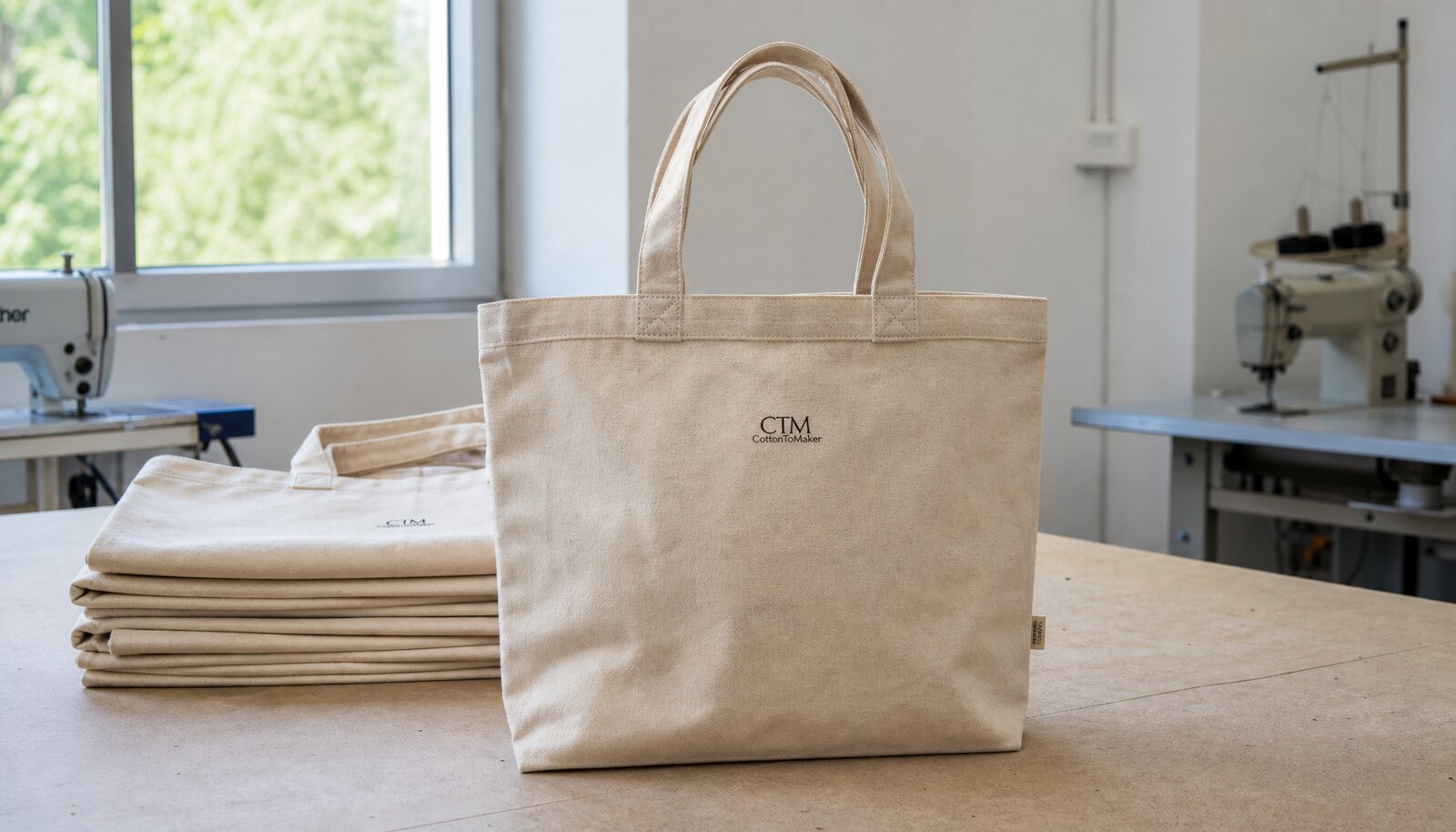
1) Start with the commercial job, not the logo
Printed canvas shopping bags are bought for very different reasons, even when the artwork looks similar. A conference handout tote, a launch-day retail bag, and a branded gift bag for customers all use canvas, but they are judged on different commercial outcomes. Procurement teams run into trouble when one spec is expected to satisfy all three use cases without saying which requirement matters most.
For a corporate event, the bag usually needs to be economical, easy to distribute, and durable enough to carry brochures, samples, or a light giveaway set. The buyer is paying for throughput: a simple spec that can be produced, packed, and handed out without delay. For a retail launch, the bag becomes part of the product presentation. It may sit beside the merchandise, appear in social photos, and stay with the customer after the event. That means the print quality, handle feel, fold behavior, and overall finish carry more weight than they do in a one-day giveaway.
The practical difference is that event bags are judged at the point of distribution, while retail bags are judged again after the customer gets home. If the canvas is too light, the bag can feel disposable. If it is too heavy, the cost can become hard to justify at scale. If the print is weak, the brand can look underfunded. The right source spec is the one that matches the use case, not the one that sounds premium in a catalog.
A good RFQ starts with four things: use case, quantity, artwork complexity, and delivery date. Add the expected fill weight if the bag will carry products rather than only literature. That is the quickest way to avoid a quote that looks low but fails in real use.
- Event programs usually optimize for cost, speed, and safe distribution.
- Retail launch bags usually optimize for presentation, repeat use, and print consistency.
- If the bag must do both jobs, spec to the stricter requirement first.
2) Lock the substrate spec before discussing decoration
The fabric specification is where many tote orders go vague. Buyers often start with the logo and only later realize they need a clearer view of the bag body, the weave, the finish, and the construction. For most printed canvas shopping bags, a practical starting band is around 10–12 oz canvas, or roughly 340–400 GSM. That range is common because it gives enough body for a real shopping tote without making the product unnecessarily bulky or expensive.
That said, the GSM number is only part of the story. Two fabrics with the same nominal weight can behave differently if one is tighter woven, smoother, bleached, slub-heavy, or made from a different yarn structure. A textured canvas can support a more natural or craft-led brand image, but it may not reproduce fine lines or small text as cleanly. A smoother weave is often safer when the logo contains small wording, thin rules, or high-detail art. Buyers who need a clean print should ask for the actual fabric photos, the weave description, and whether the supplier is using a stock roll or a custom fabric order.
Construction details matter just as much as the cloth. Top hem finish, seam allowance, handle attachment, gusset depth, and reinforcement all affect how the bag feels in the hand and how it ages under real use. A bag can be built from acceptable canvas and still look cheap if the top edge caves in, the handles twist, or the seams pucker under load. Procurement should require each construction point to be named in the quote or spec sheet rather than assuming a standard tote build will suit the job.
As a rule, use lighter canvas only when the bag is truly disposable or very short-life. Move heavier when the launch is retail-facing, the fill weight is meaningful, or the brand needs a more substantial feel. The caveat is cost: heavier canvas increases material use, sewing load, and freight volume, so it should be chosen deliberately rather than by default.
- Use the target GSM or ounces as a starting point, then confirm weave, finish, and lot control.
- Choose smoother canvas for fine text and detailed logos; choose texture only if the brand image benefits from it.
- Ask for construction details in writing: top hem, seam allowance, handle type, and reinforcement.
3) Compare supplier routes as a control decision, not only a price decision
The cheapest looking source is not always the lowest-risk procurement route. Factory-direct sourcing usually gives the best visibility into the actual production chain: cutting, printing, stitching, inspection, and packing. When the factory owns those steps or can show them clearly, it is easier to confirm whether the approved sample is the same as the bulk run. That matters for a repeat program or a retail launch where continuity is part of the brand promise.
A trading or sourcing-agent route can be useful when the buyer needs multiple SKUs, mixed decoration methods, or help coordinating several factories. It can also be practical if the internal team lacks the bandwidth to manage every detail. The tradeoff is that the buyer now has to verify what happens beyond the agent’s sales deck. A quote may be assembled from multiple subcontractors, which means the real bag body, the print finish, and the packing standard may not all be under one roof. In those cases, one clean sample does not prove that the whole order will match.
Local decorators and regional printers sit at the other end of the spectrum. They can be ideal for rush jobs, short runs, and same-country delivery, especially when the event date is tight. But the product range is often narrower. The supplier may stock only certain canvas weights or handle styles, and the cost per bag may rise quickly once the order moves beyond a simple one-color run. In some markets, local speed is worth that premium; in others, factory-direct sourcing is the only route that makes sense for the quantity.
The useful comparison is therefore not “who is cheapest?” but “who can document the right production path at the least risk for this order?” If the bag is going to a one-day event, convenience may win. If the bag will sit in a retail environment or be reordered later, traceability matters more.
- Factory-direct is usually strongest for repeatability and QC visibility.
- Trading routes are useful for consolidation, but require subcontracting disclosure and proof of the real maker.
- Local decorators are best for urgent or small runs, but their material options and unit economics are often tighter.
4) Match the print method to the artwork and the wear pattern
Canvas is a strong print substrate, but it still has limits. A bold logo on a clean surface is easy to reproduce. Fine typography, multi-color gradients, and tiny registration details are where problems show up quickly. For simple logos and bulk quantities, screen printing is often the most commercial choice because it gives strong coverage, good durability, and a cost structure that usually works at scale. It remains the default option for many B2B tote programs for a reason.
Heat transfer and digital printing can be sensible when the design is more complex. They may be the better route if the artwork includes full-color imagery, multiple tones, or a short-run campaign that does not justify a full screen setup. The risk is that the buyer can be seduced by the first sample and miss what happens in handling. Heat transfer can lift at the edges. Digital print can vary with substrate and curing. A design that looks strong in a photo may crack, fade, or show edge wear after folding and packing if the process was not controlled.
This is why artwork control needs to be more specific than “approve the mockup.” Send vector files where possible. State the print area in millimeters. Show the exact position relative to the centerline, seam, and top hem. If the logo must sit at a certain height for shelf presentation, write that into the art sheet. The more a logo depends on exact placement, the less useful a casual visual approval becomes.
Embroidery is sometimes proposed for premium positioning, but it changes the hand feel, drape, and cost profile enough that it should be treated as a separate sourcing decision, not a default upgrade. On a tote bag, printed decoration is usually the more predictable and scalable answer unless the brand has a specific tactile reason to choose otherwise.
- Screen print suits simple logos, larger volumes, and cost discipline.
- Heat transfer and digital print suit more complex artwork, but durability must be checked on the final fabric.
- Always define print position in millimeters and not only by eye.
5) Read MOQ as a production signal, not just a minimum number
MOQ on printed canvas shopping bags is usually shaped by more than one factor. Fabric cutting efficiency, screen setup, print labor, handle sewing, and packing time all influence where the break-even point sits. A supplier can quote a lower minimum for a plain tote and a higher one for a more complex version with multiple print areas, gussets, liners, or retail-ready folding. That is not necessarily a problem. It is a sign that the supplier is pricing real setup work rather than hiding it in a generic number.
What procurement needs is a clear explanation of what is driving the minimum. If the bag body can be sewn in a modest lot but the print setup requires a much larger run, the buyer should know that upfront. That distinction matters when a brand wants to trial a launch with one city or one channel before committing to a larger season order. A low bag MOQ may look flexible, but if the decoration minimum is high, the effective order floor is still large.
Price breaks should be read with care. A quote may drop meaningfully at a higher quantity, but the actual savings can be smaller once freight, carton volume, and rework risk are included. For example, a larger order may lower unit price while increasing the cash tied up in inventory or raising warehouse handling cost because the bag is more bulky than expected. The smart move is to ask the supplier to show where the step changes happen: fabric cost, print setup, sewing efficiency, or packing labor. Then the buyer can judge whether moving to the next quantity band is worth it.
For programs that may repeat, ask for the MOQ at reorder as well as first order. Some suppliers can reduce the minimum on repeat if the screens, patterns, or packing plan already exist. That is useful only if the original sample and production records are clean enough to support it.
- Separate the MOQ for bag sewing from the MOQ for print setup.
- Ask which cost element creates each price break.
- If the order includes multiple sizes or artwork positions, request a separate MOQ for each variation.
6) Approve a production sample, not a polished sales sample
A sample is only useful if it reflects the real production path. One of the most common sourcing errors is approving a sample that was made from a better fabric, a different print process, or more careful manual handling than the bulk order will receive. That creates a gap between what the buyer approved and what actually ships. For a custom bag order, that gap is where disputes usually begin.
The sample should use the final fabric weight, final handle material, final stitch pattern, final print method, and final packing style. If the supplier cannot make a sample with the same route, the quote should note the difference clearly so the buyer knows what is being approved. The sample should also be tested in a way that mirrors the real use case. Load it with actual contents, check how it hangs, look at the handle comfort, and fold it the way it will be packed or distributed.
Retail launch projects need a second check: the bag should be viewed folded, stacked, and opened quickly under neutral light. Canvas can look very different once it is compressed in a carton or displayed under store lighting. A logo that looks centered on a flat sample may appear slightly off once the bag is folded or creased. Fine type near a seam can also disappear more easily than expected.
Keep one approved sample tied to the final spec sheet and artwork file. That archived sample is not just a reference for the next order; it is often the fastest way to resolve a disagreement if the supplier asks whether a minor variation is acceptable. If the project is important enough to source, it is important enough to document properly.
- Approve only a sample made from the final production route, or document any difference explicitly.
- Test the bag with realistic contents before you sign off on handle feel and structure.
- For retail use, inspect the bag folded and compressed, not only flat on a table.
7) Separate event packing from retail packing because the cost and risk profile is different
Packing is often treated as a small detail, but for tote bags it changes cost, freight volume, warehouse receiving, and presentation. Corporate event orders are usually best packed in bulk cartons by exact count. That keeps labor down and makes distribution simple when the bags are being handed out at a conference, internal launch, or sponsor activation. In those jobs, the most important packing issue is not elegance; it is count accuracy and carton labeling.
Retail launch bags are a different story. They may need a folded individual polybag, a belly band, or an insert card so they arrive clean and ready for shelf display. Those additions improve presentation, but they also add labor and raise the chance that folding exposes seam variation, print offset, or crush marks. If the bag is intended to sit in a store display before use, the buyer should request a folded sample exactly as it will be packed for shipment.
Carton data should be part of the quote, not an afterthought. Bulk canvas bags are bulky once folded, so the packing style can materially affect cubic volume. Ask for carton dimensions, gross weight, and unit count per carton before comparing freight options. That helps the buyer estimate warehouse storage, inbound handling, and the likelihood of damage in transit. A quote that looks favorable at unit level can become less attractive once the packing format is included.
If the supplier offers both event pack and retail-ready pack, ask for them separately. They are not interchangeable. One is optimized for speed and cost; the other is optimized for appearance and distribution control. Comparing them as if they were the same usually produces a misleading answer.
- Bulk pack is best for event distribution and lower labor cost.
- Individual polybagging is better for retail presentation but adds materials and labor.
- Ask for carton dimensions and gross weight before booking freight or warehouse space.
8) Compare quotes by manufacturing line item, not by a single headline price
A useful quote lets the buyer see where the money is going. At minimum, it should make clear the fabric spec, print method, sewing or assembly cost, packing format, carton assumptions, and delivery term. If everything is hidden inside one unit price, the procurement team cannot tell whether the supplier is quoting a better bag or just a thinner one. The cheapest number is often not the cheapest option once quality risk is included.
The landed cost conversation should begin only after the quotes are normalized. Every supplier should be bidding the same bag size, same fabric weight, same print method, same artwork count, same pack style, and same Incoterm. If one supplier is quoting bulk-packed cartons and another is quoting retail-ready folded units, those prices do not compare meaningfully. The same is true if one quote includes screen setup while another separates it out. Before the spreadsheet comparison starts, the spec has to be locked.
Beyond the unit price, buyers should look for hidden cost triggers: sample revision charges, extra color fees, screen changes, packing changes, and remake policy. Freight is another common blind spot because canvas totes are often more volume-heavy than buyers expect. Even when the bag price is acceptable, carton size and gross weight can push the freight estimate higher than planned. That is why carton data belongs in the quote stage, not after order confirmation.
For procurement teams, the most useful quote is the one that answers three questions at once: what exactly is being made, what is included in the price, and what happens if the first production result needs correction? If a supplier cannot answer those three cleanly, the quote is not yet ready for commercial comparison.
- Separate the price of the bag body, decoration, and packing.
- Normalize size, fabric, artwork, pack style, and delivery term before comparing vendors.
- Request clear rules for sample revisions, screen changes, and remake responsibility.
9) Vet the supplier with documents and artifacts, not just promises
Factory vetting should be evidence-led. For printed canvas shopping bags, a supplier should be able to show the real production path: cutting, printing, sewing, inspection, and packing. Ask for recent production photos that show the same fabric weight, handle style, and decoration method as your order. If possible, request sample room photos, in-process photos, and finished bag images from the same project. Those are more useful than generic catalog pictures because they reveal whether the supplier truly handles the type of order you need.
The best suppliers can also provide process records. That might include a basic QC checklist, a first-off approval record, a sample approval sheet, or a packing confirmation showing carton count and pack method. If part of the work is subcontracted, ask specifically which steps are outsourced and who owns the final signoff. A trading company may still be a good commercial partner, but the buyer needs to know where the real control point sits. Otherwise, the quote can look tidy while responsibility is scattered.
Watch for red flags in the response, not only in the price. Vague answers about the fabric source, reluctance to name the real maker, no production photos, or inconsistent details about lead time are all warning signs. Another warning sign is overconfidence without documentation: a supplier who says everything is standard but cannot show the sample route, QC steps, or packing method. For a retail launch, that gap matters because the bag is part of the customer-facing brand experience.
The goal is not to eliminate all risk. It is to choose a supplier that can describe, prove, and repeat the process well enough for procurement to manage the order with confidence. That is a very different standard from simply having a nice-looking quote.
- Request real production photos, not only catalog images.
- Ask for QC checklists, sample approval sheets, or packing records when available.
- If steps are outsourced, require subcontracting disclosure and final QC ownership in writing.
10) Set QC gates that let you reject defects before shipment
Quality control on canvas tote bags works best when the buyer defines measurable limits before production begins. Vague approvals like “looks good” or “premium enough” do not help when a shipment lands with crooked print, weak handles, or a different shade than the sample. Buyers should define what counts as acceptable for dimensions, stitching, print alignment, color, surface condition, and packing accuracy. If the supplier knows the acceptance criteria early, there is less room for disagreement later.
A practical inspection plan usually has three stages: first-off inspection, mid-run checks, and final carton sampling. First-off inspection confirms that the first units coming out of the line match the approved sample. Mid-run checks catch drift in print, fabric handling, or stitch quality before hundreds of bags are finished incorrectly. Final carton sampling verifies counts, cleanliness, and outer carton condition before dispatch. Larger orders may justify a simple AQL-style method or another documented random sampling plan so the inspection does not stop at the top carton.
The most common defects are predictable. Handles may be stitched too close to the edge or with inconsistent reinforcement. Print may show misregistration, weak solids, or color variation across the run. Bags can arrive with oil marks, adhesive residue, or creases that distort the logo. Cartons can be crushed or wet. Those are all issues that can be written into the buyer’s QC checklist with clear rejection language so the factory knows what must be corrected before shipment.
For a retail launch, the most important question is not whether the bag looks acceptable at a glance. It is whether the bag will look the same across the whole lot and hold up long enough to support the brand instead of distracting from it. That is why the QC gate should be part of the sourcing plan, not an afterthought at loading time.
- Use measurable tolerances for print position, dimensions, and seam quality.
- Inspect handle reinforcement, stitch density, and loose-thread control at the load-bearing points.
- Check cartons for count accuracy, dryness, and outer damage before release.
- Use first-off and mid-run checks for larger orders so early defects do not scale into a full lot.
Specification comparison for buyers
| Decision area | Factory-direct route | Trading / sourcing agent route | Local decorator / regional printer route |
|---|---|---|---|
| Fabric weight and weave | Best when you need the supplier to state GSM, weave, yarn count, and lot control in writing. Lower risk of silent fabric substitution if the factory owns cutting and sewing. | Useful for mixed orders, but you must verify the real mill and sewing source. Ask for production photos and subcontracting disclosure because fabric grades can be obscured behind one price. | Often limited to the fabrics they stock or can source quickly. Good for speed, but material choice may be narrower and the exact canvas spec can be harder to lock. |
| Print method and artwork control | Usually strongest for simple screen print and repeat orders, because the maker can control screens, cure, and registration directly. Better for reorder consistency. | Can coordinate several decorators, but that convenience comes with more handoffs. Request who owns the final artwork approval and print QC when multiple vendors are involved. | Fastest for urgent short runs and simple graphics. Less suitable when you need a special fabric, a specific tote construction, or tighter control over the production route. |
| MOQ and price breaks | Often more efficient at scale. MOQ may be driven by fabric cutting, printing setup, or packing labor, so the buyer should ask what actually sets the minimum. | Can sometimes combine small programs or mixed SKUs into one shipment, which helps with consolidation. However, setup costs may be hidden inside a blended quote. | Can be flexible on minimums, but unit price may stay high because labor and decoration are not spread across a large run. |
| QC visibility and rework risk | Strongest when the factory shares first-off photos, in-process checks, and final inspection records. Easier to trace a defect back to a specific line step. | You need extra proof because the agent may not control sewing, printing, or packing. Ask who signs off at each stage and who pays for remake if the subcontractor misses spec. | Can be very responsive, but quality depends on the shop’s own capability. Ask for sample approval records and actual production photos rather than only a sales sample. |
| Packing and carton control | Best for buyers who need carton marks, gross weight, pack count, and export packing to be consistent across repeats. | Good for coordination, but the buyer should confirm whether packing is done in-house or by the final factory. Mixed responsibility can create count errors. | Often practical for domestic distribution or rush delivery. Retail-ready folding and insert packing may be available, but it can add meaningful labor cost. |
| Best-fit commercial use | Repeatable event programs, retail launch bags, and procurement teams that need traceability. | Programs with multiple SKUs, limited internal sourcing bandwidth, or a need to coordinate different production steps. | Urgent local drops, small test orders, or launches where proximity matters more than deep spec control. |
Buyer checklist before sampling
- Write the bag’s job first: event giveaway, retail launch carry bag, or a mixed-use program that must meet the stricter requirement.
- Lock the exact canvas spec in GSM or ounces, plus weave type, finish, and whether the fabric is stock, dyed, or custom sourced.
- Freeze artwork size, print placement, color count, and acceptable logo movement on a signed art sheet or annotated dieline.
- Request a pre-production sample made from final fabric, final handles, final stitch pattern, and the final packing method.
- Define the acceptable tolerance for dimensions, print position, seam allowance, and handle reinforcement before bulk production starts.
- Choose the packing format early: bulk pack, folded individual polybag, or retail-ready insert pack.
- Ask for carton counts, carton dimensions, and gross weight before you compare freight or warehouse receiving cost.
- Confirm whether the supplier owns sewing and printing or outsources part of the work, and ask for proof of the actual production route.
- Set the production clock to start after sample approval, not after PO issue, unless the supplier has explicitly accepted a different start date in writing.
- Require first-off photos or first article approval if the artwork uses fine text, small marks, tight registration, or a large print area.
Factory quote questions to send
- What exact canvas specification are you quoting, including GSM or ounces, weave type, and whether the fabric is natural, bleached, dyed, or custom milled?
- Is the quoted price based on stock fabric or a custom fabric order, and will the same roll lot be used across the full production run?
- Which print method will you use for this artwork, what inks will you use, and what is included in the color count, screen setup, or transfer setup charge?
- What is the MOQ tied to fabric cutting, printing setup, sewing efficiency, or packing labor, and does that MOQ change by size, color, or print position?
- What exactly is included in the unit price: handle webbing, seam reinforcement, top hem, labels, packing, and export cartons?
- When does your lead time start: artwork approval, sample approval, deposit receipt, or fabric receipt? Please state the number of working days from that point to ready shipment.
- Can you provide carton dimensions, carton quantity, net weight, gross weight, and pack count per carton for freight and warehouse planning?
- What inspection standard do you use for print alignment, stitch quality, shade variation, and packing accuracy, and can you share the inspection checklist?
- Do you produce the bags in-house, or do you outsource sewing, printing, or packing to another workshop? If outsourced, who owns the final QC signoff?
- Can you share sample photos, first-off photos, or in-process production photos before final packing so we can verify the actual output?
Quality-control points to confirm
- Check fabric weight against a stated target and tolerance band; do not accept vague language such as 'heavy', 'premium', or 'good quality' without a number.
- Inspect handle stitching at the top join and anchor points for skipped stitches, loose threads, uneven bar-tacks, or low stitch density.
- Set a measurable print-position tolerance in millimeters for the logo centerline, top offset, and side offset rather than relying on visual approval alone.
- Use a tape test, rub test, or comparable adhesion check on a production sample, especially for screen print, heat transfer, or digital print.
- Approve color against a physical swatch or reference under neutral light or daylight, not only under warm warehouse lighting.
- Verify finished bag dimensions, especially opening width and gusset depth, so shelf display, warehouse stacking, and insert packing do not fail at receiving.
- Inspect gusset width and seam alignment if the bag uses a gusset, because small cutting errors can change both print placement and the open shape.
- Review the bag folded and compressed if it will be retailed folded; the logo should not distort permanently at the crease line.
- Check cartons for dryness, crush damage, mixed counts, or missing outer marks such as SKU, quantity, and packing style.
- Use first-off inspection and mid-run spot checks for larger orders so a clean top carton does not hide a broader production issue.