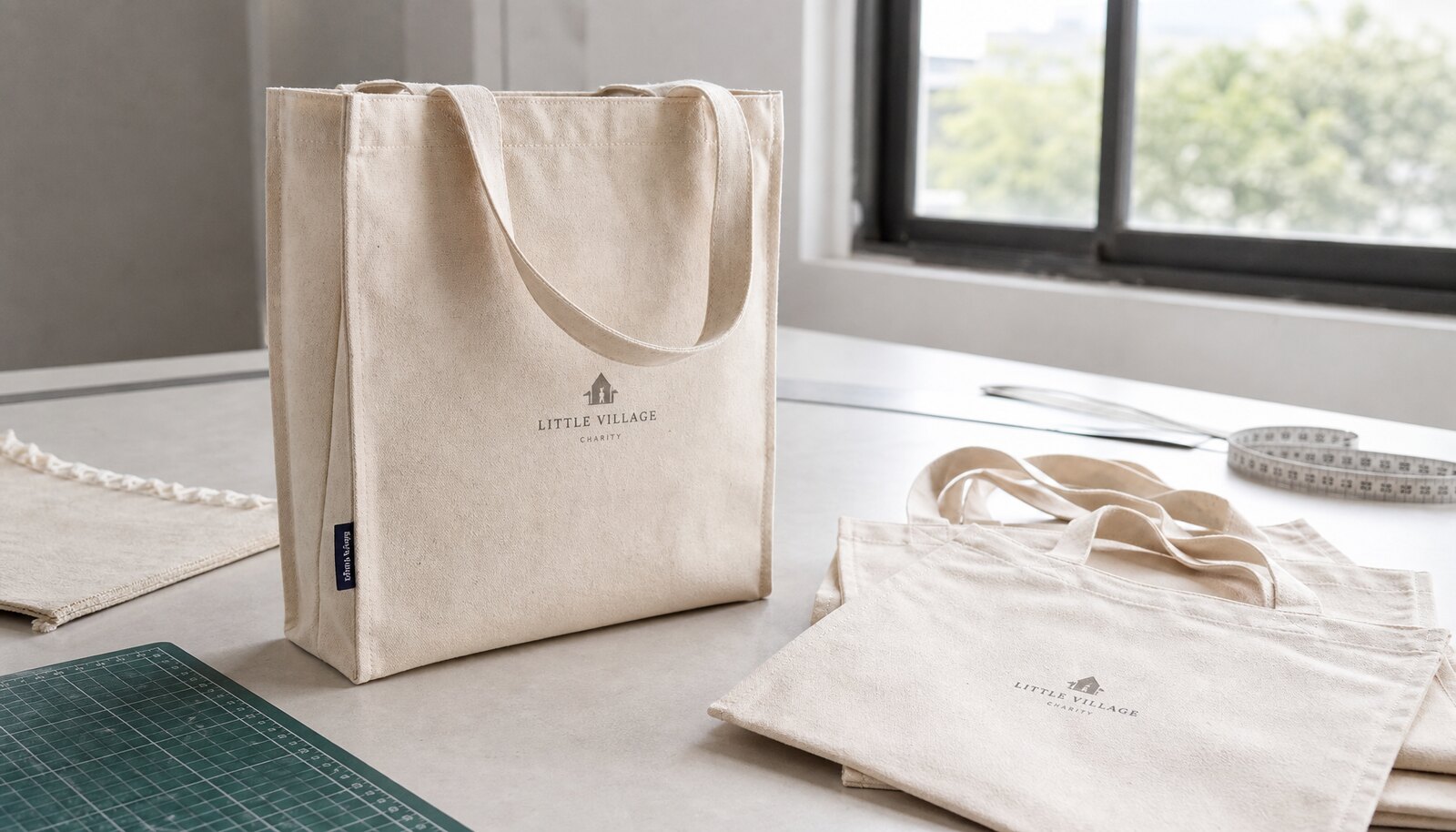
Why charity campaign bags need a sourcing plan, not just a price check
Printed canvas shopping bags for charity campaigns sit in a very specific procurement zone. They are not simple giveaways, but they are also not high-fashion retail goods. The bag has to support a cause, represent sponsors cleanly, and usually survive repeated handling across events, donation drives, retail counters, or fundraising programs. That means the sourcing decision has to cover image quality, functional strength, packing efficiency, and private label presentation at the same time.
For B2B buyers, the risk is usually not a catastrophic failure. It is a series of small misses that become expensive: a logo that prints too lightly on natural canvas, a handle length that looks fine on paper but feels awkward at the point of handoff, a sewn label that twists after folding, or a carton pack that creates warehouse rework. Those issues are avoidable if the sourcing plan is built around the actual job the bag must do.
Private label makes the brief more demanding. A charity bag may need a woven side label, a printed internal mark, or a sponsor-approved brand layout that survives reorders. If the buyer only shares artwork and asks for a unit price, the supplier will quote a generic tote. If the buyer wants repeatability, the RFQ has to define the bag as a controlled product, not just a promotional item.
- Treat the bag as a repeatable product with a production spec, not as a one-off print job.
- Build the private label details into the first RFQ so the supplier quotes the right construction and packing from day one.
- Compare quotes on the same fabric weight, print method, label requirement, and carton pack before deciding who is really competitive.
Start with a bag specification that can survive the real distribution channel
A usable starting point for many charity programs is natural or bleached canvas in the 10 oz to 12 oz range, roughly 280–340 GSM. That range usually gives enough body for a good print surface, a cleaner retail look, and better performance under moderate loads without pushing the bag into unnecessary cost and freight weight. If the event is a mass giveaway and the bag only carries brochures or lightweight merchandise, the low end of that range may be enough. If the bag is intended for books, clothing, or donor packs, a more structured fabric and reinforced stitching make commercial sense.
Size matters as much as fabric weight. A common donor or campaign size is around 38 x 42 cm with handles around 60–65 cm, but that is not a universal answer. A bag for a showroom or fundraiser display may need a longer handle drop. A bag for boxed merchandise may need a wider gusset or a flatter fold. If the buyer does not define the use case, the factory may optimize for manufacturing convenience instead of the end user.
The buyer should also specify whether the bag must sit upright, fold flat, or nest into a fixed carton count. That one detail changes cutting, stitching, and packing. A bag that looks good loose on a table can become awkward if it must fit 50 or 100 units into a shipping carton with no bulge. For procurement, the spec should include the intended load, presentation, and storage behavior, because those are the things that determine whether a tote is actually fit for the campaign.
- State fabric weight in GSM or oz and define an acceptable tolerance range.
- Specify the intended load or use scenario, not just the bag dimensions.
- If the bag needs to fit a fixed carton count, confirm the folded size before you approve the pattern.
- Ask for a construction sketch showing seam allowance, handle attachment, and any reinforcement patch.
Print method decisions: the quote changes for reasons buyers can measure
For printed canvas shopping bags for charity campaigns, one- or two-color screen print is still the most common and procurement-friendly option. It usually gives strong visibility, stable color blocks, and a predictable setup cost. For simple sponsor logos or charity messages, screen print is often the best combination of durability and unit economics. The key is to define the print area and color count clearly, because each added color can change the setup cost, the production sequence, and sometimes the minimum order quantity.
Heat transfer can work when the artwork is more detailed, variable, or not suited to screens, but buyers should treat it as a decision with tradeoffs rather than a generic substitute. Some transfer applications look clean at receipt and then begin to show edge wear, cracking, or surface rubbing after repeated folding or warehouse handling. If the charity bag will be distributed in high volume and used beyond a one-day event, the buyer should ask the supplier how the print behaves after handling, not only how it looks in a sample photo.
A procurement-grade print discussion should include ink type, cure method, color matching approach, and any artwork limitations. For example, very fine text, thin sponsor lines, and small registration marks can all look different on a canvas weave than on paper or on a smooth tote substrate. The supplier should explain what line thickness they can reliably hold, whether they can hit the requested Pantone target on the first run, and whether they have already printed similar artwork on the same fabric weight.
- Ask whether the print is screen print, heat transfer, digital print, or a combination of methods.
- Request a sample showing the actual line thickness and smallest text size that will remain legible.
- For natural canvas, confirm how the supplier manages print opacity and ink coverage over the weave.
- If the artwork may repeat next season, ask the supplier to retain screens or setup data and to quote that reuse separately.
How to compare suppliers without getting trapped by a low headline price
MOQ is usually driven by cutting efficiency, screen setup, sewing line planning, and the supplier’s willingness to reserve production capacity. A quote can look attractive until the buyer asks for a second print position, a woven label, or a different handle length. Then the MOQ rises or the unit price jumps. That is normal in tote manufacturing, but it is also why comparisons have to start with a clean product definition.
A practical way to short-list suppliers is to separate the order into a base bag and each add-on. Ask for a base blank-bag price, a printed price, a label-sewing price, and a packed-carton price. That makes it easier to compare true manufacturing efficiency. It also helps reveal whether the supplier is bundling labor, packing, and markup into one opaque total. If the order may be repeated later, ask whether the pricing remains valid for a second run under the same spec, because repeatability matters more than the lowest first-order number.
Buyers should also ask what happens when the campaign changes. For example, if the charity decides to add a sponsor, extend the artwork, or switch from one-color to two-color print, does the supplier treat that as a simple revised artwork or as a new order with new tooling or setup? A good supplier will answer this directly. A weak one will only talk about unit price and avoid the cost triggers that usually show up later on the invoice.
- Compare MOQ by exact spec, not by “similar bag” descriptions.
- Ask for a breakdown of blank bag, print, label, and packing cost.
- Confirm whether screens, plates, or setup fees are one-time or repeatable on reorders.
- Clarify which artwork changes trigger a change order and which do not.
Comparison of sourcing routes for private label charity totes
The right supplier type depends on how much control the buyer needs over the finished bag. A direct sewing and printing factory is usually the cleanest option when the charity program needs repeatable color, label placement, and delivery timing. A specialist tote workshop can be strong on construction details, especially if the buyer wants reinforced handles, a custom fold, or a more retail-ready finish. Trading companies can be useful when the program needs coordination, mixed items, or lower-touch communication, but they should be judged by evidence, not by the smoothness of the sales pitch.
For procurement teams, the important question is not “who is cheapest?” but “who can prove they can make this exact bag repeatedly, with the same print and packing result?” That proof should include finished-bag photos, construction close-ups, production line images, and a sample that matches the quoted spec. If the supplier subcontracts printing or packing, the buyer should know that in advance because accountability becomes more complicated when problems arise.
The most common field mistake is to accept a low quote from a source that is vague on where the printing happens. The buyer later discovers that the “factory” is actually a coordination layer and that the actual print shop has different capacities, different QC standards, or different packing habits. That is not automatically disqualifying, but it should be visible in the buying decision so the buyer can price the risk correctly.
- Prefer direct factory sourcing when the bag is branded, reordered, or tied to sponsor visibility.
- Use a trading company only if it can name the production site and show who owns QC decisions.
- For retail or fundraising resale, insist on evidence of the exact print line, label attachment method, and carton packing standard.
A decision-grade comparison table for supplier shortlisting
Use the table below to normalize supplier offers before you compare price. The goal is to see which route protects the charity program’s actual priorities: print consistency, low rework, simple packing, and predictable delivery. A slightly higher unit price can be the better commercial outcome if it reduces rejects, re-labeling, or warehouse repacking.
The strongest comparisons are built on the same bag dimensions, the same GSM, the same print count, the same label content, and the same packing count. If one quote includes a sewn label and retail folding while another is only a bulk bag, the unit price is meaningless. Normalize first, then compare the delta.
For sourcing teams that need a quick shortlist, this table can also be used as a call script. If a supplier cannot answer the verification items clearly, they should not move to sample stage until they can. That saves time and keeps the sample budget focused on candidates that can actually produce the order.
- Normalize every quote to one base spec before comparing the numbers.
- Do not compare bulk-pack pricing against retail-ready pricing without adding the extra labor and carton cost.
- If two suppliers look close on price, choose the one with better proof of process ownership and more transparent QC.
Sample approval should test handling, folding, and print behavior, not only appearance
A useful sample process for these bags has three stages: blank sample, printed sample, and pre-production sample. The blank sample checks fabric body, dimensions, handle feel, seam finish, and whether the bag folds the way the packing plan expects. The printed sample checks artwork position, color density, legibility, and the way the print sits on the canvas weave. The pre-production sample should reflect the full order configuration, including labels, folding, inner packs, and carton marks.
Buyers often stop after a visually acceptable print sample, but that is not enough for private label sourcing. The sample should be handled the way the actual campaign bag will be handled. Fold it, load it, store it, and open it again. If the charity will distribute the bags with catalogs, clothing, or books, place a realistic test load inside the sample and inspect the seam stress. A bag that looks perfect when hanging on a hook can still be the wrong product once it is packed and distributed in quantity.
If the artwork includes sponsor text, small type, or a fine line graphic, look at the sample from normal use distance, not only from a photographer’s distance. A slightly fuzzy print may pass on a screen and still fail in a donor retail setting where the bag is expected to look polished. The approval note should state exactly what is being accepted: artwork, color tolerance, placement, stitch quality, label position, and pack method. If any of those are still open, the sample is not fully approved.
- Sign off on the blank sample, printed sample, and pre-production sample separately.
- Test folding and handling exactly as the distribution team will receive the cartons.
- Keep one signed golden sample, a photo record, and the approved measurement sheet linked to the PO.
Quality control standards buyers should ask for before mass production
Strong QC on canvas bags should be measurable. Buyers should not rely on a general promise that the goods will be “good quality.” They should define what defect levels are acceptable, what measurement tolerances apply, and what inspection method will be used. If the order is small, a 100% check may be possible at the factory. For larger campaigns, AQL-based inspection is more practical and gives the buyer a known sampling discipline before shipment.
The critical defect list for charity tote sourcing is usually straightforward: open seams, broken stitches, failed handle attachments, major print misalignment, missing or twisted labels, and carton count errors. Minor issues may include loose threads, slight fold variation, or small print tone variation within an agreed visual range. The important point is to state which issues are major and which are minor before production starts. If the supplier only hears “please check quality carefully,” the inspection result will be hard to enforce.
For a procurement buyer, the deeper question is not only whether the bag passes inspection, but whether the supplier can show the evidence. Ask for a measurement sheet, in-line photos, top-of-line approval photos, final packed carton photos, and the AQL report if inspection is third-party or factory-led. If the supplier cannot provide a basic evidence trail, claims become harder to resolve and reorders become riskier.
- Define critical defect, major defect, and minor defect before the PO is issued.
- Set measurement tolerance for finished bag dimensions and handle length, not just the fabric weight.
- Ask for AQL sampling details, inspection count, and the pass/fail rule used on the lot.
- Require evidence photos for print, sewing, labels, and packing before shipment release.
Packing, cartonization, and warehouse receiving details can move landed cost
Packing decisions affect more than appearance. They influence labor, carton volume, shipping weight, damage risk, and warehouse receiving speed. A charity campaign bag that is meant for rapid distribution can usually be folded in a simple bulk pack or bundled inner pack, provided the print is protected and the cartons are sized sensibly. If the bags need to arrive shelf-ready, be barcode-scanned, or be sorted by artwork version, the packing plan becomes part of the product spec and should be priced accordingly.
Canvas totes crease easily, and printed surfaces can scuff if they rub against rough carton board or loose accessories. That means the buyer should decide early whether the bag will be flat-folded, semi-folded, individually bagged, or bundled by quantity. The chosen pack method changes carton dimensions, gross weight, and the way freight is calculated. A quote that ignores packing can look cheaper than it is because the landed cost only becomes visible when the cartons are finalized.
Warehouse receiving should also be specified in practical terms. If the receiving team needs a barcode, SKU label, quantity mark, or carton number on each carton end, say so before the factory confirms the job. If the campaign includes multiple colors or sponsor versions, define carton separation rules so mixed cartons do not create internal sorting work on arrival. These are small details, but they are exactly the details that determine whether the shipment is easy to receive or expensive to process.
- Ask for carton dimensions, gross weight, and units per carton in every quote.
- Specify whether the bags should be individually bagged, bundled, or bulk packed.
- Include carton mark wording, SKU rules, and any barcode or receiving label requirements.
- If shipping by sea, check crush risk and keep carton density reasonable.
Lead time planning for charity deadlines and private label reorders
A realistic production plan usually follows a sequence: artwork confirmation, blank sample or photo reference, printed sample, pre-production approval, bulk production, final inspection, and shipment. If the fabric is standard and the print is one or two colors, the cycle can be manageable once the approvals are frozen. The schedule becomes fragile when the buyer changes the artwork after sampling, adds a woven label late, or requests a non-stock fabric color. Those changes can move the order more than the sewing time itself.
The biggest schedule risk is often approval discipline rather than factory capacity. Many charity campaigns miss their window because artwork sign-off drifts, sponsor names change, or the buyer tries to combine multiple revision rounds into one final approval. The better practice is to lock the commercial elements early and leave only the approved tolerance range open. That allows the factory to move without waiting for repeated clarification.
For repeat programs, buyers should also ask whether the supplier can preserve the spec for a reorder window. A supplier that understands reorders should be able to confirm the exact canvas weight, print setup, label content, and packing method used on the first run. If they cannot, the second order may not match the first one even if the price appears unchanged.
- Build approval time into the project calendar, not just factory production time.
- Treat artwork sign-off and label approval as hard production gates.
- Ask which steps can run in parallel and which must wait for prior approval.
- For reorders, confirm whether screens, patterns, and packing specs are archived and reusable.
Specification comparison for buyers
| Supplier option | What to verify | Commercial advantage | Buyer risk to control |
|---|---|---|---|
| Direct sewing factory | fabric swatch, approved sample, seam close-ups, logo test photos, packing pilot, and final inspection evidence | Better sample-to-bulk control and faster production feedback | May be weaker on export paperwork or branded packing unless checked early |
| Trading company | Factory name, production photos, trim-source proof, and who owns QC decisions | Can coordinate small mixed orders and extra services | Markup can hide real factory capability and slow defect decisions |
| Specialized bag workshop | bag size, gusset, handle drop, seam allowance, stitch density, reinforcement patch, and loading expectation | More practical for detailed construction, trims, and repeat programs | Capacity may be limited during peak seasons |
| Low-price general supplier | 8-12 oz cotton canvas, 120-220 gsm cotton, recycled cotton, or blended fabric selected by use case and target price | Useful for simple promotional runs with loose specs | Material downgrades, weak packing, and vague inspection scope can erase savings |
| Retail-ready supplier | fold method, inner bundle, carton count, carton mark, moisture protection, SKU separation, and warehouse receiving needs | Can handle labels, SKU separation, carton marks, and receiving rules | Higher unit cost must be compared against reduced warehouse work |
| Compliance-focused supplier | Fabric records, labeling review, test plan, and production traceability | Safer for retail programs and repeat brand orders | Documentation claims need evidence, not only sales language |
| Local sample room plus bulk factory | Signed sample, bulk factory handoff, first-piece photos, and deviation owner | Good for complex branding before large production | Sample room quality may not match bulk line unless handoff is controlled |
Buyer checklist before sampling
- Approved artwork file with Pantone targets, print size in centimeters, exact placement drawing, and a note for any overprint or underprint tolerance
- Fabric specification stated in GSM or oz, with acceptable tolerance range, target opacity, and whether the canvas is natural, bleached, recycled, or blended
- Finished bag dimensions, handle length, handle width, handle drop, gusset depth if any, and whether the bag must stand upright or fold flat
- Construction details including seam allowance, stitch density target, reinforcement at handle joins, and whether bartacks or cross-stitch reinforcement are required
- Private label details such as woven label size, label position, sew direction, label content, and whether the label must remain visible after folding
- Packing standard covering units per inner pack, polybag or no polybag, carton count, carton dimensions, gross weight limit, and carton mark wording
- Sample stages required before bulk: blank sample, printed sample, pre-production sample, and final golden sample approval
- MOQ split by color, print version, and label version, plus whether mixed artwork or mixed sizes are allowed in the same order
- Acceptance criteria for appearance, measurement tolerance, defect limit, test method, and the person responsible for sign-off
- Required shipping and compliance documents, such as packing list, commercial invoice, country-of-origin statement, and any destination-specific test records
Factory quote questions to send
- Please quote the base bag separately from print, label sewing, and packing so we can compare real landed cost.
- What exact fabric weight are you quoting in GSM or oz, and what tolerance do you allow on the finished fabric and finished bag?
- Is the quoted print price based on one color, one location, and one screen setup, and what is the added cost for extra colors or second-side printing?
- What is your MOQ for this exact size, fabric weight, print method, and label configuration, and does MOQ change if the artwork changes?
- Are cutting, sewing, printing, label attachment, folding, carton making, and final inspection all done in-house or subcontracted?
- What sample stages do you provide, who pays sample freight, and are sample charges deductible after order confirmation?
- Can you share a production schedule with approval gates, and what changes would trigger a revised lead time or change-order fee?
- Please state your packing method, units per carton, carton dimensions, gross weight, carton marks, and whether you can carton-pack to our warehouse receiving rules.
- What inspection records can you provide before shipment, such as inline photos, final AQL report, measurement sheet, or carton count verification?
- If we change artwork, label content, or packing after approval, what cost and schedule impact will apply?
Quality-control points to confirm
- Fabric weight should match the agreed GSM or oz band, with no obvious underweight hand feel, weak body, or see-through weave beyond the approved tolerance.
- Finished dimensions should stay within an agreed tolerance, for example ±0.5 cm to ±1.0 cm on critical measurements depending on bag size and use case.
- Stitching should be straight, consistent, and secure, with reinforcement at handle joins, side seams, and bottom stress points where the load will sit.
- Set a seam or handle-strength expectation in the spec, such as no visible seam opening, skipped stitches, or pull failure during practical load checking; if a lab test is used, name the method rather than saying only “strong seam.”
- Print should be centered, legible, and aligned to the approved placement drawing, with no major misregistration, bleeding, pinholes, or ink rub-off after folding and light handling.
- For natural canvas, check print opacity under normal viewing distance because the weave can reduce visual sharpness and make thin lines look weak.
- Labels should be sewn flat, correctly oriented, and secure after folding; no twisting, curling, loose threads, or cover-over of brand text.
- Carton count should match the packing list exactly, with carton marks, SKU separation, and outer carton condition verified at dispatch.
- Use AQL-based inspection for bulk lots rather than a vague visual check; set the sample size, major defect limit, and minor defect limit before inspection starts.
- Pre-production sample, top-of-production approval, and final packed goods should all match the signed reference sample, with any deviation documented and approved before shipment.