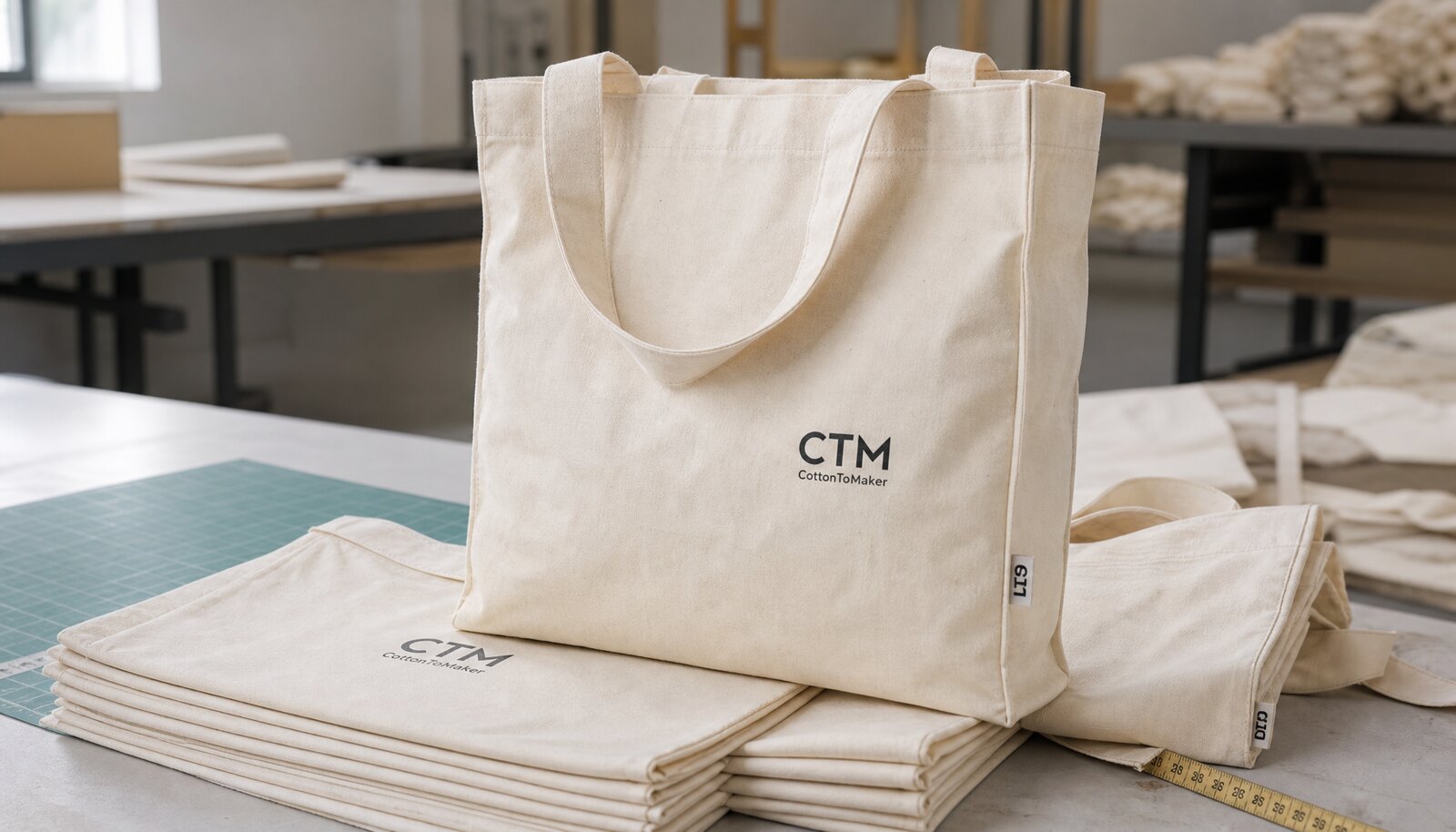
Why carton planning matters as much as the bag spec
For charity campaigns, the bag itself is only part of the job. The bigger sourcing mistake is usually carton planning: buyers approve a nice-looking sample, then discover the carton pack makes freight expensive, warehouse handling awkward, or volunteer distribution slow. Printed canvas shopping bags are bulky by nature, so the way they are folded, packed, and cartonized has a direct effect on landed cost and launch timing.
If your campaign will move through a warehouse, a fulfillment center, a retail backroom, or a donation partner, the carton spec should be treated as a commercial requirement, not an afterthought. A supplier who can quote only unit price without carton dimensions, gross weight, and packing count is not giving you a complete buying picture.
- A 10 oz bag and a 12 oz bag can look similar in photos but behave very differently in freight and stacking.
- Flat packing lowers carton volume, but the fold method must avoid permanent crease marks on the print area.
- A charity campaign often has more touchpoints than a standard retail bag order, so carton labels and pack count matter.
Start with the right canvas weight, not the cheapest quote
For printed canvas shopping bags used in charity campaigns, the practical sweet spot is usually 10 oz to 12 oz canvas, which is roughly 340 to 400 GSM. That range gives a bag enough body for retail appeal and repeated use without making the bag unnecessarily heavy to ship. If the campaign is very price-sensitive, 8 oz to 9 oz can work, but it is easier to look soft, collapse in carton, and show print distortion on lighter weave cloth.
The buyer should choose fabric weight based on use, not marketing language. A donor gift bag for a one-day event can tolerate a lighter spec than a fundraising store bag that will be sold at point of sale. For reusable shopping use, the feel of the fabric and the handle reinforcement will influence perceived value more than a small difference in unit cost.
- 8-9 oz / 280-320 GSM: lower price, lighter feel, higher risk of wrinkling and poor structure.
- 10-12 oz / 340-400 GSM: balanced for most charity retail programs and gift-with-donation campaigns.
- 14 oz and above: premium feel, but freight cost rises and the bag may be overbuilt for the campaign.
Choose the print method that survives real campaign handling
The safest print choice for printed canvas shopping bags for charity campaigns is usually screen print when the artwork is simple and the order volume is meaningful. Screen print gives strong color on canvas, better opacity on natural fabric, and a cost structure that improves as the quantity rises. For a one- or two-color logo, it is generally the most dependable option for repeat orders.
Heat transfer can work when the artwork has fine detail or small type, but it should be treated as a specialist route rather than a default choice. The buyer needs to know whether the print is direct ink on fabric, transfer film, or another method, because the wash and rub behavior can differ. A campaign bag distributed to volunteers, donors, or retail customers will be handled, folded, and carried, so print durability matters more than design convenience.
- Screen print: best for 1-3 solid colors and strong logo contrast.
- Heat transfer: useful for complex artwork, but sample approval must include rub and fold visibility.
- Digital print: only consider when the artwork complexity justifies the higher unit cost and the supplier can prove color stability.
Compare supplier routes before comparing unit price
A direct factory, a trading company, and a local distributor can all quote printed canvas bags, but the risk profile is not the same. A direct factory usually gives you better control of fabric, sewing, print, and packing because the core production steps are closer to one management team. That matters when your shipment needs a specific carton count and your campaign launch cannot absorb rework.
A trader may be useful when you need mixed products or a very small order, but the buyer should expect more handoffs. More handoffs mean more chances for sample drift, delayed approvals, or carton inconsistency. When you compare quotes, compare the production route, not just the unit price line.
- Direct factory: better for standard specs, repeat orders, and carton control.
- Trader/distributor: useful for small or mixed orders, but ask who actually prints and packs the bags.
- Local sourcing: can reduce freight time, but fabric and print options may be limited and unit cost higher.
Supplier comparison table: what matters for charity campaign buying
The right supplier route depends on how much control you need over the bag, the artwork, and the carton plan. A charity buyer often has to balance retail presentation, donation value, and freight cost at the same time. Use the comparison below to narrow the route before you send a formal RFQ.
If two quotes look close, the hidden difference is usually in sample quality, carton packing, and how the supplier handles change requests after artwork approval. Those details decide whether the order lands on time and whether the bags arrive ready for campaign use.
- Write decisions in measurable language, not only descriptive wording.
- Ask for sample photos plus one physical approval sample for important orders.
- Keep quotation, sample approval, and inspection notes tied to the same spec version.
Set MOQ logic around artwork complexity and packing reality
MOQ for printed canvas shopping bags is not just a factory preference; it is a production setup issue. The more colors in the print, the more time the factory spends on screen setup, color matching, and waste during startup. If your campaign has one simple logo on one side, the MOQ can often be lower than a complex multi-color design with front and back prints.
For buyers, the most useful way to talk about MOQ is by design version and carton plan. If you need 2,000 bags in one color and 500 in another, that may be possible, but the factory will likely price each version separately. Mixed designs also affect packing because cartons must stay clearly labeled for distribution, storage, or donor fulfillment.
- One design, one fabric, one print position: best setup for lower MOQ and cleaner pricing.
- Multiple print colors or second-side print: expect higher setup cost and tighter approval control.
- Mixed sizes or mixed colors: only use if your distribution plan truly needs them.
Use sample approval to catch the expensive mistakes early
A PDF proof is not enough for printed canvas. The sample approval should cover the actual fabric, actual print method, handle construction, and carton fold. On canvas, artwork can shift with weave texture, and natural fabric can carry small shade variation that changes the look of the logo. Buyers should not approve based on a white-screen image alone.
The practical sequence is fabric swatch, strike-off or pre-print sample, then pre-production sample with final sewing and packing. If the campaign has a launch date or partner approval gate, request a packed sample photo and measurements before bulk production. That extra step often prevents the most common complaints: off-center print, bag size drift, and cartons packed differently from the quote.
- Verify the print sits within the agreed placement tolerance.
- Compare the sample fabric against the swatch for shade and weave consistency.
- Review one packed sample in a carton if shipping presentation matters.
Packing and carton planning for warehouse and freight efficiency
Canvas bags are compressible, but the buyer should not assume that more per carton is always better. If the carton is packed too tightly, the print can crease, the fabric can wrinkle permanently, and the bag may arrive looking less retail-ready. If the carton is too loose, you pay to move air and your freight cost rises without adding value.
The better approach is to set a carton target by gross weight and volume together. For many printed canvas shopping bags, a flat-packed carton with a reasonable fill ratio gives the best balance. Ask the supplier to provide carton dimensions, gross weight, net weight, and the number of pieces per carton. Then compare that against your warehouse receiving rules and shipping method.
- Use flat packing if you need efficient export volume and easy warehouse counting.
- Avoid over-compressed cartons that damage print surfaces or crease the bag body.
- Label cartons by design, color, and quantity so downstream distribution is simple.
Lead time risk: where campaigns usually slip
Lead time for printed canvas shopping bags is usually driven by three things: fabric availability, print approval speed, and packing finalization. Buyers often focus only on sewing time, but in practice the delays happen earlier. If the fabric is not in stock, or the print sample is revised twice, the order can lose a week or more before production even begins.
For a charity campaign, schedule risk matters because the bag may be tied to launch events, donor mailings, retail displays, or partner handover dates. A realistic plan usually includes sample approval time, mass production time, and export transit time as separate blocks. If the supplier gives one single lead time number without distinguishing these stages, the quote is too optimistic to rely on.
- Ask whether the lead time starts at artwork approval, sample approval, or deposit receipt.
- Build in one buffer for print revision and one buffer for packing approval.
- For peak seasons, reserve extra time for carton and freight booking.
How to compare quotes on landed cost instead of headline unit price
A useful quote for printed canvas shopping bags should be comparable across suppliers, which means the carton data must be fixed before pricing is judged. Two suppliers can offer the same unit price but differ materially in carton pack, gross weight, and freight class. That difference will show up later in shipping, storage, and handling costs, not in the unit line you first reviewed.
When comparing EXW, FOB, and DDP, use one scenario sheet. Put the same bag spec, same print method, same carton count, and same destination assumption into every quote. Then calculate the landed cost including packing materials, inland transport, ocean or air freight, duties if relevant, and warehouse receiving cost. The quote that looks cheapest on paper is not always the cheapest delivered.
- EXW helps you see factory pricing, but it hides pickup and export handling costs.
- FOB is useful when you control freight and want standardized port-based comparison.
- DDP can simplify budgeting, but only if carton data and destination charges are clearly stated.
Specification comparison for buyers
| Spec decision | Recommended option | When it fits | Buyer risk to check |
|---|---|---|---|
| Fabric weight | 10 oz to 12 oz canvas, or about 340 to 400 GSM | Charity retail, event merch, and reuse-driven campaigns where the bag must feel substantial without turning into a heavy-cost item | Too light feels flimsy; too heavy pushes carton weight and freight cost up fast |
| Print method | 1-2 color screen print for volume, heat transfer only for small runs or complex art | Simple logo, donation message, or campaign artwork with limited colors and repeat orders | Fine lines, gradients, and small type can lose clarity; color matching must be approved on a strike-off |
| Supplier route | Direct factory with in-house cutting, sewing, printing, and packing | When you need tighter control of fabric, print, carton pack, and lead time | If printing is outsourced, sample consistency and delivery dates are more likely to slip |
| MOQ logic | Start with 1,000-3,000 pcs for standard size and one print position | Best for first-time charity campaigns or test markets with one or two fundraising channels | Very low MOQs often carry high unit cost, loose spec control, or mixed production lots |
| Packing method | Flat packed with bulk inner poly and export carton marking | Useful when freight efficiency and easy distribution to volunteers, stores, or campaign kit assembly matter | Overstuffed cartons can crush print areas or distort bag shape; underfilled cartons waste freight space |
| Handle construction | Same fabric self-fabric handles or 24-26 inch cotton webbing handles | For shopping bags that need comfortable carry and a cleaner retail presentation | Handle stitching must be reinforced; weak bar-tacks fail early under real retail loads |
| Sample approval route | Pre-production sample with fabric swatch, print strike-off, and packed-carton photo approval | Any campaign with fixed launch dates, partner approval, or exact logo placement requirements | Approving only artwork PDFs is risky; physical color and carton pack often differ from screen views |
| Carton strategy | Pack to a target carton weight and volume rather than only a piece count target | When shipping cost, warehouse handling, and parcel re-distribution are part of the campaign plan | Ignoring carton size can raise air space cost or create overweight cartons that are hard to lift and stack |
| Landed-cost route | Compare EXW, FOB, and DDP only after carton dimensions, gross weight, and destination charge assumptions are fixed | For importers comparing multiple suppliers or routing to different markets | Quotes without packing data are not comparable and usually understate freight exposure |
Buyer checklist before sampling
- Lock the final bag size, fabric weight, handle length, print area, and number of colors before requesting quotes.
- Request a physical sample or pre-production sample with the exact print method that will run in bulk.
- Get carton dimensions, carton count, gross weight, and packing quantity per carton in writing.
- Confirm whether the supplier uses in-house printing and sewing or outsources any step.
- Ask for a fabric swatch or fabric spec sheet showing weave count, GSM, and finish.
- Set an acceptable tolerance for print placement, bag dimensions, and handle length.
- Plan how the bags will be used after arrival: shelf display, volunteer distribution, retail packing, or event handout.
- Compare quotations on the same Incoterm and the same carton assumptions, not just unit price.
Factory quote questions to send
- What is the exact fabric weight in GSM or oz, and is it bleached, natural, or dyed canvas?
- Is the quoted print method screen print, heat transfer, or digital print, and how many colors are included?
- What are the exact bag dimensions, handle length, and seam allowance?
- How many bags go into one carton, and what are the carton dimensions and gross weight?
- Is the sample a true pre-production sample with the final fabric, print method, and packing method?
- What is the MOQ per color and per design, and can the order be split across sizes or print variants?
- What is the standard lead time after sample approval, and what causes a schedule extension?
- Which QC points are inspected before shipment: print alignment, stitch strength, size tolerance, and carton drop performance?
- Can you quote EXW, FOB, and DDP using the same carton data so I can compare landed cost accurately?
Quality-control points to confirm
- Canvas weight matches approved GSM/oz range with no thin or patchy sections.
- Print position, color density, and edge clarity are verified on at least the first approved batch and compared with the strike-off.
- Seam strength, handle reinforcement, and bar-tack quality are checked on representative samples from production.
- Bag dimensions, handle length, and opening width stay within agreed tolerance.
- Carton count, carton markings, and packing method match the approved packing list and sample photo.
- Finished goods are checked for odor, visible stains, loose threads, and compressed print marks before shipment.