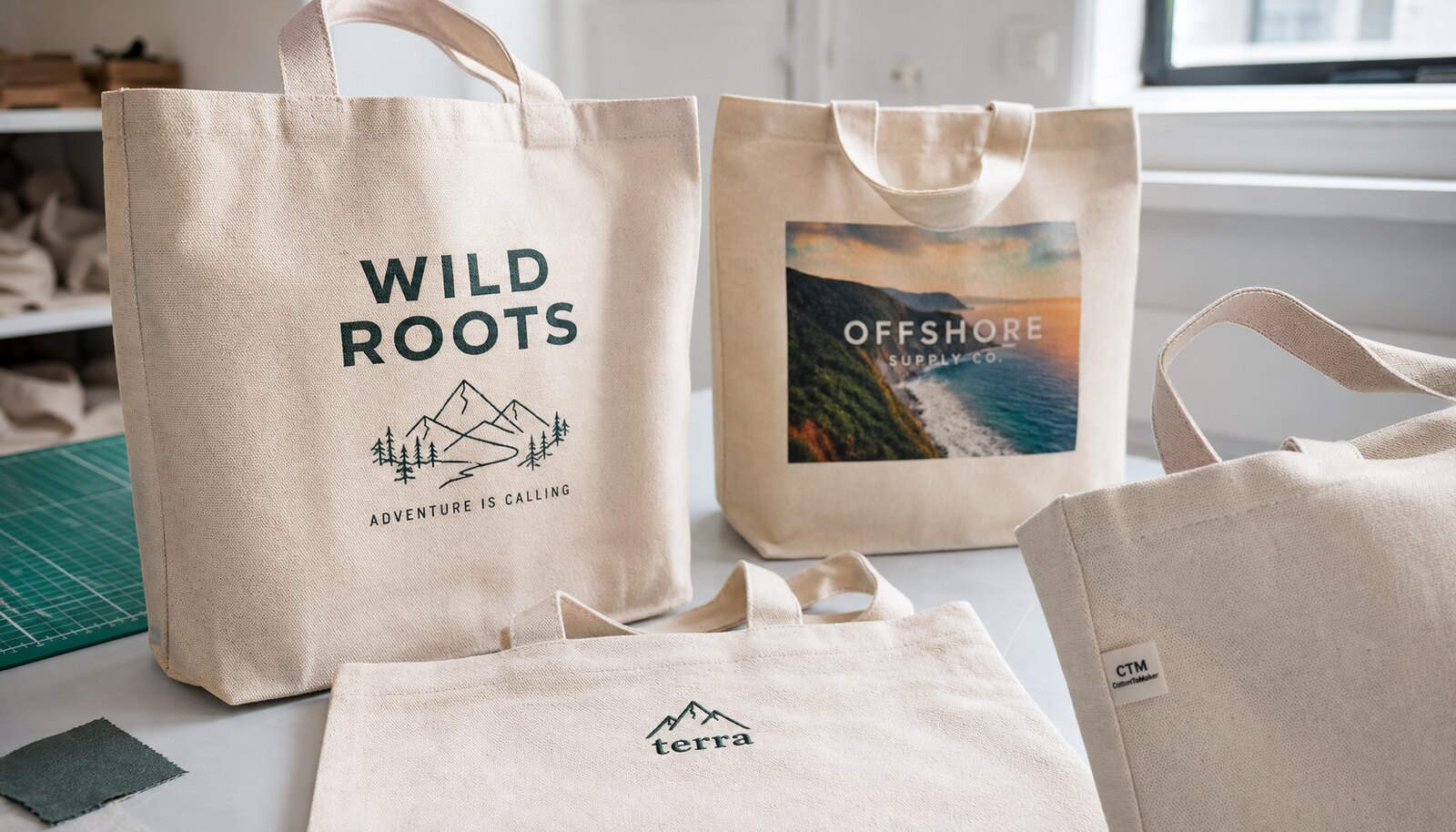
Why print method matters more than artwork in canvas bag sourcing
For apparel brands, the same logo can look like a premium retail accessory or a cheap giveaway depending on the print method. Printed canvas shopping bags for apparel brands are usually judged first by feel, print clarity, and how well the bag holds its shape on the shop floor. That means the decoration process is not a cosmetic detail; it is a sourcing decision that affects landed cost, minimum order quantity, and defect rate.
The main mistake buyers make is asking for a quote before deciding how the bag will be used. A seasonal promo bag, a shopping bag sold at retail, and a packaging bag inserted with garments do not need the same print durability or fabric weight. If the use case is not written into the RFQ, suppliers will quote different constructions and decoration methods that are impossible to compare fairly.
- Retail sale bags need cleaner print edges and better shape retention than event giveaway bags.
- A one-color logo on heavy canvas often costs less long term than a full-color transfer that peels later.
- The best print method depends on artwork complexity, order size, and whether the bag must survive resale, reuse, or washing.
Choose the canvas weight first, then match the decoration method
Most apparel buyers end up in the 10-12 oz canvas range, roughly 340-410 GSM. That range gives enough body for a retail-looking tote without making the bag overly stiff. It also prints well because the fabric is tight enough to support screen ink, heat transfer, or embroidery backing without excessive distortion. If you go much lighter, the bag can look soft but the print may wrinkle when folded. If you go much heavier, unit cost rises quickly and the finished bag may feel too rigid for fashion retail.
The print method should follow the fabric, not the other way around. Screen print performs best on stable canvas with a flat panel. Heat transfer and DTF are more forgiving on small runs and complex art, but they can sit on top of the weave and feel less integrated. Embroidery looks premium, but it needs a heavier base fabric and usually a simplified logo. Ask the factory to quote the same bag spec across two or three decoration methods so you can see the real cost of each route.
- 8 oz canvas can work for lightweight merchandising, but it is more likely to pucker under heavy ink coverage.
- 10 oz canvas is often the most cost-efficient retail option for apparel brands.
- 12 oz and above supports premium appearance, stronger seams, and better embroidery backing.
Comparison of supplier routes and print methods
For bulk orders, there are usually three sourcing routes: a direct factory with in-house decoration, a factory that outsources printing, or a trading supplier bundling multiple workshops. The right choice depends on how much control you need over color, schedule, and correction responsibility. A direct factory is easier to manage when the order has repeated reorders or multiple SKUs. Outsourced decoration may be acceptable for niche designs, but the buyer must be ready for more schedule risk and less transparent defect handling.
The table below is the practical view: it compares what the buyer actually needs to decide, not just technical labels. Use it to align your RFQ and avoid quote shopping on unit price alone.
How screen print, transfer, digital print, and embroidery compare on real orders
Screen print is still the default for many apparel brands because it is efficient on repeat graphics and holds up well on canvas when the ink system is matched to the fabric. It usually gives the lowest unit cost once the order size and color count justify screen setup. The tradeoff is setup complexity: the factory needs clean art separations, proper registration, and a stable fabric lot. If the logo uses solid shapes and a limited palette, screen print is usually the cleanest business choice.
Heat transfer or DTF is useful when the artwork changes often or when the print includes gradients, fine lines, or photographic detail. It reduces screen setup burden, which helps smaller MOQs, but the buyer should pay attention to edge feel and adhesion after folding. Digital print works when the supplier has strong pretreatment and stable canvas handling, but it can be less forgiving on natural-fiber variation. Embroidery is the premium route for a logo-first look, yet it changes the budget quickly and may require logo simplification to avoid thread crowding.
- Screen print: best for 1-3 colors, repeat orders, and lower cost at scale.
- DTF/heat transfer: best for short runs, complex art, and launch testing.
- Digital print: best for color-heavy artwork if the supplier can manage fabric pretreatment and lot consistency.
- Embroidery: best for premium branding, but not ideal for detailed illustrations or very fine lettering.
MOQ logic: what changes minimums and why quotes are not comparable at first glance
MOQ in canvas bag sourcing is rarely one number. A factory may quote a low bag MOQ but still require separate minimums for screens, print panels, embroidery digitizing, or carton pack configuration. That is why one supplier can look cheaper at 1,000 pieces while another becomes cheaper at 5,000 pieces. The real comparison is not just the bag body; it is the decoration setup spread across the order.
For screen print, the MOQ is often driven by screen setup and ink changeover. For transfer and digital routes, MOQ is more influenced by labor efficiency and color handling. For embroidery, the stitch file and hooping time matter. Ask for the MOQ by print method and by artwork version. A supplier that accepts 500 pieces total may still require 250 pieces per design if you have two logos or two colors.
- One colorway across one artwork is always cheaper than multiple art versions in the same order.
- If the supplier is mixing bag colors, print colors, and size variants, the MOQ should be written per SKU, not per style.
- A low MOQ quote that excludes screens, digital setup, or embroidery digitizing is not a complete quote.
What a usable quote should include line by line
A serious factory quote should separate the base bag from decoration, packing, and export handling. For example, the bag body price, the print setup cost, the per-piece print charge, the handle upgrade if any, the polybag or bulk pack cost, and the carton packing charge should be visible. Without that breakdown, it is difficult to compare a screen-print quote with a transfer quote or to identify where a supplier is hiding cost.
For apparel brands, quote structure matters because the bag is often part of a larger launch calendar. If one supplier offers a lower unit price but charges extra for sample approval, carton specification, or artwork changes, the savings can disappear quickly. The buyer should ask the factory to state whether pricing is based on a natural canvas body, dyed canvas, or prewashed canvas, because each one changes yield and print behavior.
- Separate body cost, decoration cost, and packing cost.
- Confirm whether the quote includes one or two side prints, a label, and any hangtag.
- Request the carton size and gross weight so freight can be estimated before PO placement.
Sample approval: the checks that actually prevent bulk problems
Sample approval should start with the exact same print method, not a close substitute. A blank canvas sample is useful for hand feel and dimensions, but it does not prove print behavior. For printed canvas shopping bags for apparel brands, the most important sample is the pre-production sample or sales sample made on the approved fabric with the approved art. That sample should show print placement, handle length, seam quality, and label position in one piece.
When reviewing a sample, do not stop at whether the logo looks correct. Fold the bag several times and watch for cracking on the print surface. Rub the printed panel against clean white paper or tissue to see whether excess ink transfers. Check the bag opening, gusset, and handle drop against the approved spec sheet. If the sample is for a retail brand, place it on a shelf or hanger and judge whether it holds its shape the way the store requires.
- Print must be centered and aligned to the approved panel dimensions.
- Logo edges should be clean; fuzzy edges are a warning sign on canvas texture.
- Sample should include the actual carton packing style if the order will ship direct to a distribution center.
QC thresholds that reduce claims after shipment
Quality control on canvas bags is usually won or lost in a few measurable points. Fabric weight variation should be within an agreed range, especially if the bag body is sourced from different dye lots. Stitch density should be consistent at stress points such as handle attachment and side seams. Print registration should be tight enough that the logo does not look blurred from normal viewing distance. These are not aesthetic preferences; they directly affect retail acceptance and complaint rates.
A buyer should also set acceptance criteria for odor, moisture, and surface scuffing. Canvas can hold warehouse smell if packing is poor, and printed panels can rub during transit if cartons are overfilled. If the bags are for apparel retail, specify whether you accept minor natural slub or shade variation, because natural canvas is not a uniform substrate. The supplier should know the boundary between acceptable fabric character and rejectable inconsistency.
- Reject loose thread buildup at handle ends and inside the top hem.
- Reject visible print offset on logos with text or fine outlines.
- Set a clear threshold for acceptable shade variation on natural canvas, especially across replenishment orders.
Packing, carton load, and warehouse handling for apparel buyers
Packing is where many canvas bag orders lose value after the product itself is approved. A retail brand may need individual polybags, barcode stickers, and a master carton count that fits DC receiving rules. A distributor may prefer bulk inner packs to lower handling cost. The buyer should write the pack-out requirement into the RFQ, because the same bag can ship very differently depending on the channel. Overpacking creates volume charges; underpacking creates scuffs and shape distortion.
For printed bags, the safest default is to separate printed surfaces with tissue or a clean interleaf if the print is fresh or tacky. If the bags are stacked directly one on another, the decoration method must have enough cure or set time to avoid transfer. Cartons should be strong enough for stacking, and the factory should state carton dimensions and gross weight so freight can be modeled before approval. If the buyer requires a retail hangtag or insert, that should be packed in a way that does not crease the print panel.
- Specify whether each bag is polybagged, tissue-separated, or bulk packed.
- Confirm carton quantity by SKU and make sure it matches warehouse receiving rules.
- Require moisture protection for sea freight if the bags will sit in transit or port storage.
Lead time planning and landed-cost comparison
Lead time is not just sewing time. For printed canvas shopping bags for apparel brands, the schedule usually includes artwork confirmation, screen making or digital file setup, fabric booking, sample signoff, bulk decoration, sewing, packing, and final inspection. Screen print can be efficient on repeat orders but may take longer on the front end because of setup. Digital or transfer routes can shorten setup time on small runs, though they may not always be the cheapest at scale. Embroidery often adds labor time and approval steps because stitch density and logo size need to be tested.
To compare landed cost properly, model the order from ex-factory to warehouse receipt. Add decoration setup, packaging, carton volume, inland transport, ocean or air freight, and potential rework risk. A quote that looks cheaper on unit price can become more expensive if it requires extra handling, more carton volume, or a longer production queue that misses a retail launch window. Buyers should compare at least two sourcing routes: the cheapest production method and the most reliable production method.
- Screen print usually wins on unit cost at scale, but setup can slow the first run.
- Transfer and digital methods can save time on short runs, but the decorated surface may sit more visibly on the fabric.
- Landed cost should include rework risk, not just the factory invoice.
Specification comparison for buyers
| Spec decision | Recommended option | When it fits | Buyer risk to check |
|---|---|---|---|
| Print method | Water-based or plastisol screen print for 1-3 colors | Best for apparel brands with repeat graphics, logo marks, and medium-to-large orders | Registration tolerance, ink cracking after folding, and whether the factory screens are built for canvas rather than apparel fabric |
| Print method | Heat transfer or DTF for full-color art, gradients, or seasonal drops | Useful for small launches, photo-style graphics, or many SKUs with different artworks | Wash/rub durability, edge feel on heavy canvas, and whether the transfer hides the natural fabric texture too much |
| Print method | Reactive or pigment digital print on pretreated canvas | Fits complex artwork and short runs when the supplier has stable digital capability | Color drift between lots, slower production queue, and higher reject risk on uneven canvas surfaces |
| Brand finish | Embroidery or applique for premium retail positioning | Good for elevated brand marks, heritage collections, and limited-edition merch | Higher labor cost, needle marks, design simplification, and distortion on thin canvas |
| Fabric weight | 10-12 oz canvas, about 340-410 GSM, for most apparel retail bags | Balances print clarity, shape retention, and acceptable unit cost | Too light will collapse at the bottom gusset; too heavy can raise cost and reduce print softness |
| MOQ route | Factory standard colors with one print screen or one transfer panel | Best when you need lower MOQs and faster sampling approval | What looks like a low MOQ may still require screen setup, art separation, or carton minimums |
| Supplier route | Direct canvas bag factory with in-house printing | Best for controlled lead time, clearer QC ownership, and better landed cost on bulk orders | Confirm whether printing is truly in-house or subcontracted, because subcontracted decoration often adds delay and defect handling gaps |
| Packing spec | Bulk packed with size stickers and moisture protection; individual polybag only if retail requires it | Works for distributor orders, wholesale replenishment, and warehouse fulfillment | Overpacking raises cost and carton volume; underpacking can create scuffing, odor, or print abrasion during transit |
| Lead time plan | Split sample approval, bulk fabric booking, then print production schedule | Useful when the apparel launch date is fixed and artwork is already approved | If artwork changes after screen making or transfer proofing, lead time resets and rush fees appear quickly |
Buyer checklist before sampling
- Define the bag use case first: retail shopper bag, event giveaway, or premium brand carry bag. The print method should match the intended shelf life, not just the artwork.
- Lock fabric weight in GSM or oz and state the acceptable range. For most apparel brands, 340-410 GSM canvas is the practical middle ground; lighter cloth needs different handling.
- Specify print area in millimeters and whether art must wrap over gusset or stay on one face only.
- State color count, Pantone references, and whether white underbase is allowed on dark canvas.
- Request a sealed sample or pre-production sample with the actual fabric, print method, stitching, and label position.
- Confirm whether handles are self-fabric, webbing, or contrast cotton tape, because handle structure changes print placement and packing.
- Ask for carton pack-out data: inner pack quantity, master carton quantity, carton size, and gross weight.
- Require wash/rub guidance if the bags will be sold through apparel retail rather than used only for hand carry.
- Separate bag cost from decoration cost in the quote so you can compare suppliers on a like-for-like basis.
- Get a production photo or swatch approval before bulk printing starts if the order includes more than one colorway or artwork version.
Factory quote questions to send
- What is the canvas weight in GSM or oz, and what tolerance do you allow in bulk production?
- Is the print done in-house? If not, who handles it and how does that affect lead time and defect responsibility?
- What is your MOQ by print method: screen print, heat transfer/DTF, digital print, or embroidery?
- How many colors are included in the base quote, and what is the surcharge per additional color or print position?
- What are your sample costs for blank sample, printed sample, and pre-production sample, and are they refundable on order?
- What are your standard packing details: one bag per polybag or bulk pack, how many per carton, and do you include moisture protection?
- What is the artwork file requirement and what file format do you need to avoid plate or screen rework?
- How do you handle color matching on natural canvas, and what is the acceptable shade variation between sample and bulk?
- What is the estimated lead time from artwork approval to bulk completion, and what steps can extend it?
- What inspection standard do you use for print defects, stitching defects, measurement tolerance, and packing accuracy?
Quality-control points to confirm
- Fabric weight matches the approved range and is checked by lot, not only by supplier claim.
- Canvas weave is even enough that the print does not break, blur, or sink into thin streaks.
- Print registration stays within an agreed tolerance; multi-color logos do not drift at the edges.
- Ink adhesion passes a rub check and does not transfer heavily onto folding paper, tissue, or adjacent bags.
- Handle stitching is secure at stress points and does not distort the printed panel.
- Bag dimensions, gusset depth, and handle drop are within the approved spec sheet.
- Seams are straight, seam allowance is consistent, and loose threads are trimmed before packing.
- Cartons are packed to prevent print scuffing, moisture marks, and compression wrinkles during export transit.