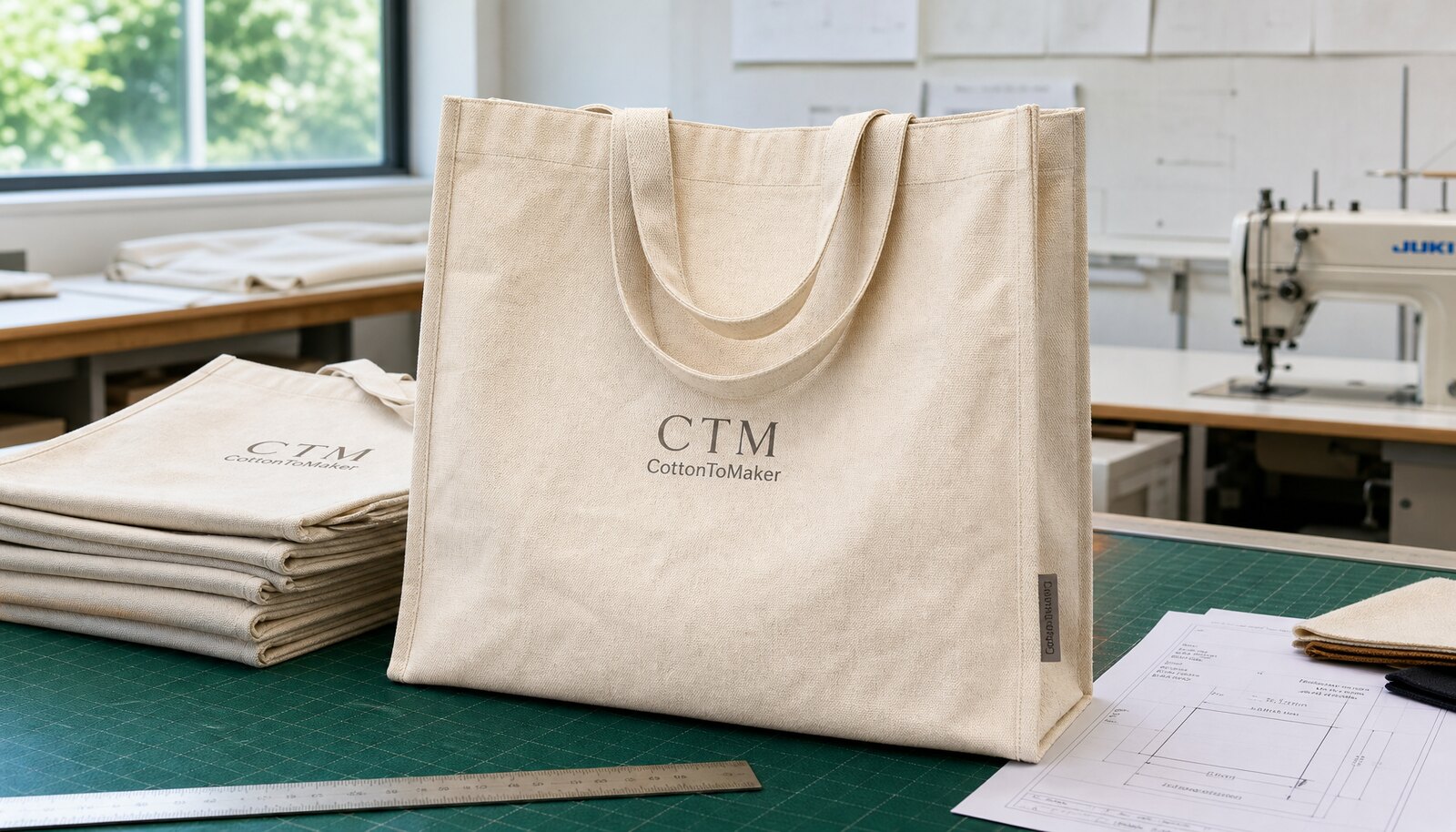
Why apparel brands get the spec wrong on giveaway bags
Printed canvas shopping bags for apparel brands event giveaway planning usually goes wrong for one simple reason: the buyer treats the bag like a logo carrier instead of a product that has to be packed, carried, handed out, and reused. At an apparel launch, the bag is often the first physical item a guest touches after the invite, and it quickly becomes a proxy for brand quality. If the tote feels weak, the event feels underfunded; if the tote feels overbuilt, the budget gets consumed by a promotional item that no one actually needs.
The right starting point is not artwork. It is the use case. A bag handed out at a store opening, a wholesale showroom, an influencer preview, or a trade show booth all has different functional requirements. One may carry only a postcard and discount card; another may need to fit a folded hoodie, a shoebox, and a press kit. Those differences change the fabric weight, handle length, gusset depth, and even carton size. Buyers who skip that mapping process end up comparing quotes that are not truly comparable.
A second common mistake is assuming the cheapest-looking quote is the cheapest landed-cost option. Canvas bags seem simple, but the quote can hide very different assumptions about fabric width, whether the bag is sewn before or after printing, whether print setup is included, and whether packaging is bulk or retail-ready. If your team only asks for “printed canvas tote bags,” the supplier fills in the blanks in the way that best matches their own production system, not necessarily your event plan.
For procurement teams, the practical goal is to lock the bag spec around the event outcome, not the promotional idea. The bag should protect the goods inside, look good in guest photos, survive the distribution channel, and arrive on time. Once those outcomes are clear, the rest of the sourcing process becomes easier to compare and much less dependent on back-and-forth emails.
A useful rule: define the bag backward from the handout moment. What will be inside it? Who will carry it? How far will it travel after the event? Will it be reused as a shopping tote or discarded after one day? These answers determine whether you need a basic giveaway bag, a more retail-like canvas tote, or a heavier reusable style with stronger stitching and cleaner finishing.
- Define the actual contents the bag must carry before asking for a quote.
- Separate visual branding goals from functional load requirements.
- Compare supplier quotes only after every vendor is quoting the same dimensions, fabric weight, and print method.
Choosing canvas weight, size, and construction for real carrying needs
For most apparel programs, 10 oz to 12 oz canvas is the practical band. Around 8 oz can work for lightweight flyer packs or low-cost handouts, but it tends to look and feel promotional rather than retail-ready. Around 12 oz or roughly 340 GSM gives the bag a firmer hand, better opacity for print, and a more stable shape when it is standing on a display table or stuffed with garments. Heavier fabric can be worth the extra cost when the tote is part of the brand experience rather than only a carrier.
Size matters just as much as weight. A common mid-size tote around 38 x 42 cm with a 10-12 cm gusset is flexible enough for most event use, but the buyer should check the actual contents. A folded tee and brochure fit very differently from a hoodie or boxed accessory. If the opening is too narrow, stuffing becomes awkward at the event site. If the gusset is too shallow, the bag looks full too quickly and can stress the side seams. A slightly larger size can improve usability, but only if freight volume and packing cost remain under control.
Construction details are where many orders fail. Handle attachment is often the first point of weakness because the load concentrates there when a guest picks up the bag with one hand. Look for reinforced box-X or equivalent bar-tack reinforcement at both ends of the handle. Bottom seams also matter: a visually clean seam with poor allowance consistency can split if the bag is packed with garments and a hard accessory. If the bag will be sold or reused repeatedly, the buyer should consider a slightly stronger stitch density and more careful edge finishing.
Natural canvas and bleached canvas each have their own sourcing implications. Natural fabric often gives a more organic, premium apparel look, but shade variation can be more visible from batch to batch. Bleached or lightly processed canvas can look cleaner for bright logos, yet buyers should verify that the finish does not lead to extra shrinkage, a harsher hand feel, or a weak print surface. A lab dip or approved swatch is useful when brand color integrity is important against an off-white base.
In procurement terms, the most efficient spec is usually the one that is standard enough for the factory to run well, but not so basic that it feels disposable. Buyers often save more by standardizing one proven body size and two or three print placements across multiple events than by trying to optimize each campaign individually.
- 10 oz / about 280 GSM: workable for lighter giveaways and flyer packs.
- 12 oz / about 340 GSM: best all-around choice for apparel launches and repeat-use tote programs.
- Reinforced handles and consistent seam allowance are more important than decorative extras.
- Choose size based on the real contents, not only on the logo design area.
- Ask for fabric shade reference if the tote is part of a premium retail presentation.
Print methods, artwork rules, and what changes the quote
Screen printing remains the main route for canvas event bags because it offers solid color coverage, repeatable results, and good durability for simple artwork. If your logo is one or two colors with strong blocks and clean shapes, screen print usually gives the best balance of unit cost and appearance. The more complex the design becomes, the more the risk rises: thin type can fill in, small reversed-out details can break up, and large solids may show uneven ink laydown if the printer does not control tension and squeegee pressure well.
Transfer printing and digital transfer are useful when the campaign needs short runs, multiple versions, or very fast turnaround. They are often chosen when the event date is fixed and the artwork still changes close to approval. The tradeoff is durability and hand feel. Some transfer systems sit on the surface more than screen ink does, so they can be more visible on the fabric and more vulnerable to abrasion where the bag folds repeatedly. That may be acceptable for a one-time event handout, but it is worth testing if the bag will be reused.
The artwork itself affects pricing more than many buyers expect. Each color can add setup work, and registration becomes more sensitive as the design grows. Large flood-print areas raise the risk of uneven coverage and may require more careful drying. Fine serif fonts, hairline rules, and tiny QR codes are all high-risk on canvas, especially if the weave is open. If the message must remain legible, simplify the artwork rather than asking the factory to overcome an incompatible design.
A more procurement-friendly approach is to separate “branding must-haves” from “design preferences.” For example, the must-have may be the logo and date lockup on one side, while the preference is a secondary slogan on the reverse. If budget or lead time tightens, the supplier can quote a fallback version without changing the bag body. This is a better way to manage event deadlines than repeatedly revising the whole tote spec.
For buyers comparing suppliers, ask not only what print method is included but also what is excluded: screen setup, plate charges, color matching, overprint tests, and post-print inspection. Two quotes that look similar can diverge sharply once these items are added.
- Use screen print for simple logos and repeat volumes.
- Use transfer methods when artwork changes frequently or the run is short.
- Avoid thin serif fonts, small QR codes, and gradient-heavy graphics on open-weave canvas.
- Ask whether plate charges and color matching are included in the quote.
- Request a photo of the actual print on the same fabric type, not on a generic tote.
MOQ, lead time, and the commercial logic behind both
MOQ is best understood as the point where setup cost, material waste, and labor efficiency become acceptable for the supplier. On canvas totes, the minimum is influenced by fabric width, cutting efficiency, print setup, and whether the bag uses stock components or custom materials. Standard sizes in natural canvas with a single print color tend to quote better because they align with how factories already buy and cut fabric. Custom dimensions, dyed body fabric, multiple print positions, or special labels all add complexity and can push the MOQ upward.
Lead time follows the same logic. A supplier quoting a seemingly short delivery window may be assuming that blank fabric is already available, print plates are simple, and packing is standard bulk. If you ask for custom dyeing, special woven labels, or retail-level packing, the timeline changes. The most common schedule slip is not the sewing step itself; it is sample review, artwork sign-off, or waiting on an accessory item such as a label or carton print. Procurement teams should treat those as schedule-critical rather than administrative details.
For event programs, the best commercial decision is often to keep one bag body constant and change only the printed message by season or event. That allows the buyer to negotiate a better fabric and sewing base, while still creating campaign-specific content. If different store regions need different names or dates, consider whether the artwork can be standardized with a small variable panel rather than a full re-layout. Every version you create usually becomes its own setup cost and its own approval cycle.
There is also a landed-cost effect that is easy to miss: smaller batch sizes reduce purchasing leverage but can increase per-unit freight and warehouse handling. A supplier quote that looks cheap at the factory may still be expensive once you add cartons, palletization, and the receiving effort for multiple SKUs. For buyers with several event dates, one consolidated order with staged distribution is often more efficient than placing many fragmented short runs, provided the artwork can remain stable.
A practical approach is to ask suppliers to quote three versions at once: a standard base spec, an upgraded retail-like spec, and a short-run rush option. That makes the tradeoff visible and helps the buyer decide whether the event actually needs premium finishing or only a reliable handout bag.
- Standardize the body to improve pricing and reduce schedule risk.
- Treat labels, carton printing, and packaging as lead-time items, not extras.
- Ask for three quote paths if possible: standard, upgraded, and rush.
- Watch freight and handling costs when comparing low-MOQ offers.
- Separate what must change for the campaign from what can remain fixed across events.
How to compare supplier routes without losing control of quality
There are usually three sourcing routes for printed canvas shopping bags: direct factory, trading company, and local decorator or converter. Each route has different strengths. A direct factory can often control cutting, sewing, printing, and packing in one flow, which helps with repeatability and can improve cost efficiency on standard specs. The tradeoff is that communication may be more technical, and if the factory outsources a step, buyers need to know where control actually sits.
Trading companies can be useful when you need portfolio management across multiple product types or when you want a single point of contact for sourcing coordination. They may also help if your procurement team lacks time to manage factory follow-up. The risk is margin stacking and less visibility into which workshop is doing the actual work. That matters for print consistency, carton accuracy, and corrective action if there is a defect.
Local decorators or small converters may be attractive for very short lead times or last-mile customization, especially if the event is domestic and the order is small. However, they often rely on sourced blank bags and add print afterward, which can limit fabric options and raise unit cost at scale. They can be a practical route for rush programs but are usually not the lowest landed-cost option for larger apparel campaigns.
The buyer should compare routes using the same questions: who sources the fabric, who prints, who packs, who inspects, and who signs off on the final shipment. A lower quote is not automatically better if the vendor cannot identify where the work happens or cannot show the same production route on the sample they sent. For repeat programs, consistency matters more than chasing the absolute cheapest one-off order.
If the order is important enough to be tied to a product launch, ask for production photos from the actual line, a sample built on the same fabric, and a simple traceability note showing the order version, print version, and packing spec. That does not guarantee perfection, but it dramatically improves accountability compared with a quote that only lists size and price.
- Direct factory: best for repeat control and integrated production.
- Trading company: useful for coordination, but verify the real maker and the real QC owner.
- Local converter: useful for rush customization, but often higher landed cost at scale.
- Always confirm who sources fabric, who prints, and who packs.
- Request production photos and traceability details before approving a larger order.
Comparison table: what buyer should expect from each sourcing route
Use the comparison below to evaluate the route, not just the tote. The right decision depends on your timeline, artwork stability, and how much control you need over quality and packing.
If your team is buying for a seasonal launch, a direct factory with stable specs usually gives the best combination of cost and repeatability. If the order is small, urgent, and highly customized, a local converter may be the practical choice even if unit price is higher. Trading companies are strongest when your procurement team needs project management, but they require more diligence on transparency and source control.
- Do not compare quotes from different routes without identifying where the real production happens.
- Ask for the same approval sample path on each route so the comparison is fair.
- Choose the route based on risk and timing, not only on unit price.
Sample approval: what should be checked before bulk release
The sample should be judged as a working product, not just as a branded object. Start with the blank bag: measure finished size, check the handle drop, look at the squareness of the panel, and verify that the gusset opens as expected. Then move to the print: is the logo centered, readable, and the correct size when viewed at arm’s length? A sample that looks acceptable on a table can still be wrong in the hand if the opening is too tight or the handle sits too short on the shoulder.
For apparel brands, the sample should also be tested with the actual intended contents. Put in a folded tee, a hoodie, or the planned press kit and see whether the bag collapses, bulges, or stretches awkwardly. This is especially important if the tote will be photographed at an event. A bag that stands up well with a light load may sag with real inserts, which changes the brand presentation even if the sewing is technically acceptable.
Approval should not stop at appearance. Ask the supplier to confirm the fabric lot, print ink or color formulation, handle webbing width, stitch type, and carton plan that will be used in production. A factory can sometimes produce an attractive sample with one material source and then switch to a different lot for mass production. That is not necessarily malicious; it is often a supply efficiency decision. But if the buyer has approved a specific feel or shade, the sample record must be detailed enough to prevent unannounced substitutions.
A practical approval pack should include a ruler photo, a front and back photo, a detail shot of the handle reinforcement, and one image of the bag filled with the intended load. If there is any change from the approved sample later, the supplier should be required to flag it before shipment rather than hoping the difference will go unnoticed.
The best sample review questions are not “do you like it?” but “does it match the approved spec, and does it work under the event load?” That framing keeps the decision commercial and measurable.
- Measure finished size, not cut size only.
- Confirm print location with a ruler and photo reference.
- Test the bag with the actual intended contents.
- Document fabric lot, ink, handle webbing, and stitch type in the approval record.
- Require a change notice for any material or packing substitution after approval.
QC thresholds and defect examples procurement teams should actually use
A useful QC plan is specific enough that a factory can inspect to it and a buyer can enforce it. For canvas giveaway bags, the most important defect categories are appearance defects, functional defects, and packing defects. Appearance defects include print blur, off-center logos, stains, shade patches, broken letters, and visible fabric flaws in the printed area. Functional defects include weak handle attachment, skipped stitches, uneven bottom seams, or holes near stress points. Packing defects include mixed SKUs, wrong carton labels, under-count cartons, or missing PO references.
Instead of saying “acceptable quality,” define what is acceptable and what is not. For example, a minor loose thread at the seam edge may be acceptable if it does not affect function, but an open stitch on the handle attachment is not. A small centered shift may be acceptable on a low-cost giveaway bag, but a shifted logo on a retail-facing apparel tote may not be. The standards should reflect the bag’s role in the event, not just a universal tolerance statement.
A good inspection sequence usually starts with carton verification, then visual screening of a sample group, then measurement and functional checks. Check the carton count first so the receiving team knows whether the shipment itself is coherent. Then inspect print placement, artwork legibility, stitching quality, handle reinforcement, and bottom seam integrity. If the order is large or high risk, a simple pull test on the handle attachment is more useful than a vague visual impression. The bag should be tested with the intended weight rather than only pressed with a hand.
Common defects worth calling out explicitly include: ink pooling at the edges of solid areas, needle holes or skipped stitch lines near the handle base, fabric slubs crossing the logo zone, oil marks from machinery, misfolds that crease the print area, carton mismatches, and accidental mix of natural and bleached bodies. If those issues are named in the QC sheet, there is far less room for disagreement later.
For buyers who need a practical standard, use a pre-agreed inspection sequence: 1) carton label and quantity check, 2) visual print check, 3) seam and handle check, 4) dimension check, 5) load check, 6) packing confirmation. That sequence is simple, repeatable, and better aligned with real receiving problems than an open-ended “inspect quality” instruction.
- Define appearance, functional, and packing defects separately.
- State which defects are rejectable and which are only minor observations.
- Inspect carton count before detailed item checks.
- Use the real carry load in the functional test.
- Call out common defects such as stain marks, skipped stitches, print pooling, and mix-ups by SKU.
Packing, carton math, and landed-cost drivers buyers should not ignore
Packing is one of the easiest places to lose money quietly. A tote may look inexpensive at the factory, but if it ships in bulky cartons or requires unnecessary retail bagging, the landed cost can increase quickly. Flat packing is usually the most efficient route for giveaway bags, but it still needs to be controlled so handles do not crease the print area and the bag is easy to receive by the warehouse team. If the tote is going to stores or event sites directly, the carton mark and SKU system should be clear enough that the receiving team can identify versions without opening every box.
When comparing quotes, ask suppliers to provide estimated carton dimensions, carton count per 1,000 units, and gross weight. Those three numbers change freight quotes materially. A slightly heavier canvas weight, a wider gusset, or a less efficient fold can reduce carton density and increase cubic volume. A buyer can easily end up paying more for freight on a “cheaper” bag than on a better-designed bag that stacks more efficiently.
Packing method also affects claims risk. Mixed packing may seem harmless on a simple order, but it often creates receiving errors when different artwork versions are in one shipment. If the bags are for multiple store openings or regional campaigns, insist on carton segregation by SKU and version, with clear outer marks. That reduces warehouse time and helps the event team distribute by location without hand-sorting on site.
There are also hidden landed-cost drivers inside the quote. Extra hangtags, woven labels, polybags, individual barcode stickers, and custom carton print all add labor and materials. None of those are automatically bad, but they should be chosen intentionally. For a giveaway bag that will be handed out immediately, over-packaging can be wasted cost. For a retail distribution program, the same packaging may be essential.
The procurement takeaway is simple: compare not only unit price but the complete delivery system. A tote price, freight price, carton plan, and receiving workload should be evaluated together so the buyer knows what the program really costs.
- Request carton dimensions and gross weight early in the quote stage.
- Compare freight and warehouse handling as part of the landed cost.
- Use carton segregation by SKU/version when multiple artworks are involved.
- Avoid unnecessary packaging steps unless they solve a real receiving or retail need.
- Check fold pattern and carton density before awarding the order.
Lead time planning for launch calendars and event deadlines
For a launch or event giveaway, time risk is often more important than unit cost. A canvas bag order can appear straightforward, but the total schedule includes artwork approval, sample production, sample transit, revisions, bulk production, packing, final inspection, and shipping. The most common delay is not sewing capacity; it is waiting for the buyer to approve a proof or to answer a question about color, logo placement, or carton labeling. If the event date is fixed, procurement should protect the approval window aggressively.
The other hidden risk is assuming that standard materials mean no delay. Natural canvas may be common, but if the order needs a specific webbing width, label style, or special carton print, those components can become critical path items. A supplier can often sew bags quickly once everything is on site; the delay usually comes from the longest-lead accessory. That is why buyers should decide early which features are essential and which can be removed if the date tightens.
A good planning method is to build the order backward from the event date. Subtract shipping time first, then final inspection and packing, then production, then sample approval. That leaves a realistic window for supplier sourcing. If the supplier cannot meet that window without cutting corners, the buyer should reduce complexity rather than hoping the factory will “make it work.” In procurement, compressed schedules often lead to relaxed QC, but that tradeoff is rarely visible until the shipment arrives.
For repeat event programs, a stable tote platform is easier to manage than a brand-new bag design every time. If the body, size, and print method stay constant, only the artwork changes. That usually shortens approval time, makes sample comparison easier, and reduces the risk of production variation between events. It also helps the buyer benchmark actual price changes over time instead of chasing a new spec each season.
If the supplier promises unusually fast lead time, ask exactly what assumptions make it possible. The answer should specify whether fabric is in stock, whether printing is in-house, whether the sample is already approved, and whether shipping is included in the promise. Fast is useful only if the assumptions are true.
- Build the schedule backward from the event date.
- Protect sample approval time; it is often the real bottleneck.
- Keep the tote platform stable across events when possible.
- Ask what assumptions support any unusually short lead time claim.
- Remove nonessential custom features if the deadline becomes tight.
Specification comparison for buyers
| Spec decision | Recommended option | When it fits | Buyer risk to check |
|---|---|---|---|
| Fabric weight | 12 oz / 340 GSM canvas | Standard apparel giveaways that need a better hand feel and a stable print surface | Too light and the bag collapses; too heavy and unit cost rises quickly, especially once freight volume increases |
| Fabric finish | Natural or bleached canvas with controlled shrinkage | When the brand wants a clean retail look and predictable print registration | Unwashed fabric can shrink after printing and distort artwork, panel alignment, or handle placement |
| Print method | 1-2 color screen print | High-volume event giveaways with bold logos and simple artwork | Fine gradients, small type, and very thin lines can fill in or misregister on canvas |
| Print method alternative | Heat transfer / digital transfer for short runs | When artwork changes by event, region, or seasonal campaign | Higher unit cost, possible edge lift, and weaker abrasion resistance than screen print |
| Handle construction | Self-fabric or cotton web handle with reinforced stitch box/X | For tote-style handout bags carrying lookbooks, samples, or folded apparel | Weak handle bartacks fail first if the bag is loaded with catalogs or garment packs |
| Bag size | Approx. 38 x 42 cm with 10-12 cm gusset | Most apparel event giveaways, trade shows, store openings, and product launches | Too small for catalog inserts; too large increases fabric and print cost without much extra value |
| MOQ route | Stock fabric + standard size + one-color print | When the buyer needs price control and faster turnaround | Custom sizing, multi-location print, or special packaging can push MOQ up and extend lead time |
| Supplier route | Direct factory with in-house cutting, sewing, and printing | When you need consistent specs across repeat orders and tighter QC control | Factories without in-house print control may outsource and lose registration or shade consistency |
| Packing spec | Flat packed with size sticker and carton mark by SKU | For multi-SKU programs, distribution centers, or retail chain allocation | Loose mixed packing causes receiving errors and slows count verification |
Buyer checklist before sampling
- Confirm finished bag size, gusset depth, fabric GSM, handle length, and whether the spec is before or after washing/printing.
- State the actual carry scenario: flyer-only giveaway, folded tee, hoodie, shoe box, or full event kit. Handle and seam specs change with load.
- Specify print artwork format, number of colors, print placement, and acceptable Pantone tolerance if color matching matters.
- Define packing needs: bulk packed, polybagged, barcode stickered, inner carton, or master carton labeling by SKU.
- Request a blank sample first, then a pre-production sample or clear production photo approval for artwork placement, stitch quality, and logo size.
- Ask for shrinkage or wash-test expectations if the bags will be reused, retailed, or shipped into humid climates.
- Align destination terms, carton dimensions, pallet height, and carton quantity per SKU with your freight forwarder before production starts.
- Ask the supplier to identify any outsourced steps, especially printing, labels, or carton sourcing, so the quote reflects the real production route.
Factory quote questions to send
- What is the finished bag size, cut size, and fabric GSM quoted, and are these values before or after sewing allowance and washing/shrinking?
- Is the quote based on in-house screen printing, outsourced printing, or transfer printing, and how many colors are included in the base price?
- What is the MOQ by size and by artwork version, and does the MOQ change if we choose natural canvas versus dyed canvas or special finishing?
- What stitch reinforcement is included on the handle attachment and bottom seam, and is there an upgrade option for heavier loads?
- What is the packing method, carton size, gross weight estimate, and carton count per 1,000 units?
- What sample type is included first: blank sample, digital artwork proof, or production-like pre-production sample?
- What is the standard lead time after sample approval, and what factors could extend it such as fabric dyeing, print plate prep, label sourcing, or carton printing?
- Can you share photos of previous similar bags, production line images, and a simple QC checklist for print alignment, seams, and carton counts?
- If production is split across more than one workshop, who owns final QC responsibility and who signs off on the release before shipment?
Quality-control points to confirm
- Fabric GSM matches the agreed range, typically within ±5% unless the buyer approves a different band in writing.
- Print placement stays within the allowed shift; for simple logo work, a practical target is no more than 5 mm off center or off height on the main panel.
- Artwork edges are sharp, with no major pinholes, ink smears, broken letters, or visible ghosting on the front panel.
- Handle stitches are locked and reinforced, with no loose threads, skipped stitches, missed bartacks, or uneven box-X reinforcement.
- Seam allowance is consistent and bottom corners are secure under a reasonable load test for the intended use; if the bag is intended for garments, test with a weighted fill rather than by hand only.
- Finished size and gusset remain within the buyer’s tolerance after production; watch for shrinkage on washed, heat-pressed, or aggressively steamed fabric.
- Cartons are labeled by SKU, quantity, and PO reference, and inner packaging matches the distribution plan.
- Color on natural canvas is not unexpectedly yellow, gray, or patchy compared with the approved lab dip, reference sample, or signed-off photo.
- No oil stains, broken needles, fabric slubs in critical print areas, or contamination from packing tape should be accepted on visible retail-facing surfaces.