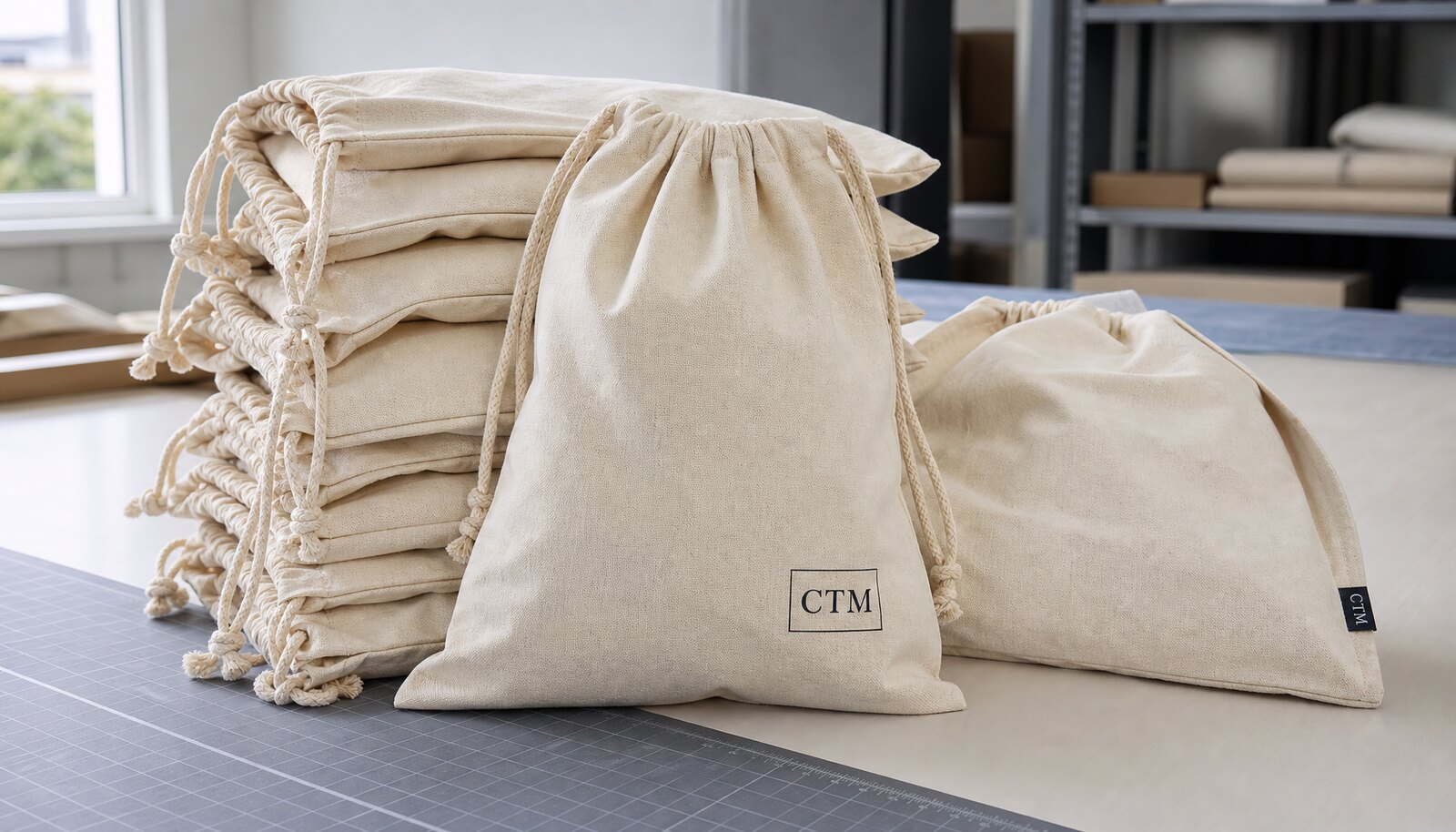
What buyers actually need from printed canvas drawstring bags
Most procurement problems start when the bag is treated as a simple accessory instead of a functional part of the product presentation. Printed canvas drawstring bags are usually bought for gift sets, retail packaging, promotional kits, cosmetics, apparel, or small merchandise bundles. In all of those cases, the bag has to do three jobs at once: carry the product, present the brand, and survive handling from factory to shelf or end user.
That is why the right buying spec is not just “canvas with logo printing.” You need a finished size that fits the packed item, a canvas weight that gives shape without being bulky, and a print method that matches the artwork. If you get those three points wrong, the quote may still look cheap, but the first production run can fail on appearance, closure function, or overall retail value.
- Use the bag as part of packaging, not as a decorative afterthought.
- Prioritize finished size, fabric weight, and print method before comparing unit price.
- Treat the drawstring bag as a branded surface with functional wear, not a flat print item.
Fabric weight and structure: where most quote gaps begin
Canvas weight changes the entire economics of the bag. A 10 oz canvas is lighter and usually easier to price for promotional use, but it can look soft and less structured if the bag is meant for retail display. A 12 oz canvas is the common middle ground for many buyers because it keeps shape better, handles routine packing, and still stays within a manageable cost band. A 14 oz canvas gives a thicker, more premium feel, but it can increase sewing time and create more bulk at the hem and seam areas.
When you compare supplier quotes, make sure the weight is tied to a real spec, not a marketing description. Some suppliers quote “heavy canvas” or “premium canvas” without stating whether the fabric is pre-shrunk, bleached, enzyme washed, or simply a heavier weave. The finish changes how the bag prints, how it folds, and how cleanly the cord channel behaves.
- 10 oz: good for light promotional items, mailers, and low-cost event packs.
- 12 oz: balanced choice for most retail and brand packaging applications.
- 14 oz: useful for premium gifting, heavier inserts, and stronger shelf presentation.
- Ask whether the quoted weight is before or after finishing; that affects actual handfeel and performance.
Print method choice: cost, texture, and image quality
For printed canvas drawstring bags, the print method should match the artwork and the order volume. Screen printing is usually the most practical option for one to three solid colors because it gives strong opacity and a clean retail look on canvas. It also scales well when the order repeats. If the artwork has more colors, gradients, or a short run that does not justify screens, heat transfer can work, but it needs careful placement and temperature control. Digital printing is better reserved for smooth, well-prepared canvas and designs that truly need tonal detail.
The wrong print method is a common quote trap. A supplier may offer a very low price for a logo that looks simple, but that price may assume a different print size, fewer colors, or a smaller print area than the buyer actually needs. If the print needs to sit across folds or near the hem, the factory also needs to know where the image ends so the seam does not distort the design. On canvas, a small artwork can look cheap if it is too tiny, while an oversized print can crack or lose crispness if the fabric is rough.
- Screen print: best for simple logos and repeat volume.
- Heat transfer: better for small runs with multi-color artwork, but inspect adhesion carefully.
- Digital print: only when the design really needs tonal detail and the canvas finish supports it.
- Confirm print size in millimeters, not just “large” or “centered.”
MOQ logic: why one quote may not be comparable to another
MOQ for printed canvas drawstring bags is not a fixed number; it is a function of setup cost, fabric availability, print colors, and packing labor. A natural canvas bag with a one-color logo may have a relatively low MOQ because the fabric is stable and the print setup is simple. If you switch to dyed canvas, custom cord color, or a higher print count, the MOQ usually climbs because the factory needs to buy or reserve extra materials and absorb more setup risk.
Buyers should separate true MOQ from “sales MOQ.” Some factories will quote a low entry quantity to win the inquiry, then recover the cost through higher artwork charges, packing fees, or a price jump at the proof stage. The better way to compare is to ask for the MOQ by specification: fabric color, bag size, print color count, and packing format. That tells you whether the supplier is actually set up for your job or just trying to keep the conversation alive.
- Natural canvas + one-color print usually supports the lowest practical MOQ.
- Custom dyed fabric, custom cord, or retail unit packing raises MOQ and cost.
- Compare suppliers on the same structure: same size, same fabric weight, same print count, same packing.
Supplier comparison: direct factory, trading company, or local stock route
The right sourcing route depends on how stable your demand is and how much control you need over the spec. Direct factory sourcing is usually the best option when the bag is a repeat item and the artwork, size, and packing are already defined. You get better visibility on fabric weight, stitching, and print control, and you can lock down a repeat order with fewer middle layers. Trading companies can be useful when you need multiple packaging items in one shipment or when your team wants one contact for several product lines. Local stockists are useful for urgency, but they usually offer less control over exact weight, print size, and carton packing.
The table below is the simplest way to compare the routes before you request quotes. For printed canvas drawstring bags, the cheapest per-unit price is not always the lowest-risk route. If the bag is part of a brand launch, the cost of a bad print or wrong size can be far higher than a small unit-price difference.
- Direct factory: best for repeatable specs and tighter cost control.
- Trading company: useful for bundled sourcing and fewer admin steps.
- Local stock route: fastest, but usually weakest on exact customization.
How to read a quote line by line
A useful quote for printed canvas drawstring bags should separate material, sewing, printing, packing, and freight assumptions. If everything sits in one number, you cannot see whether the factory is using the right canvas weight or whether the print cost includes one side or two. The quote also needs to state whether the price is based on natural canvas, bleached canvas, or dyed canvas because each option affects shade consistency and print clarity.
Look closely at what happens when the buyer changes the bag size or artwork. If the supplier’s price barely changes when the bag grows significantly, that can be a sign that the original quote was padded or that the material spec is not fixed. A clean RFQ should allow you to compare apples to apples: same size, same canvas weight, same cord, same print area, same packing, same carton count.
- Separate quote items: fabric, sewing, print, cord, packing, carton, and shipping basis.
- Identify whether price is based on one side or both sides printed.
- Make sure the quote states currency, Incoterm, and validity period.
- Watch for hidden charges such as artwork setup, screen fee, or special carton labeling.
Sample approval: the fastest way to avoid a bad first run
For this product, a photo sample is rarely enough. The buyer needs to feel the canvas, see the print opacity, and test the cord action. A pre-production sample should use the actual fabric weight, actual print method, actual cord, and actual hem construction. If the supplier substitutes any of those parts for the sample, the approval loses value. The sample is not a showpiece; it is the reference standard for the production line.
A solid sample approval also needs practical acceptance criteria. For example, the print should be centered within the agreed tolerance, the hem should close without twisting, and the bag should support the intended load without visible seam strain. If your end use involves retail gift packs, put the insert product in the sample and assess whether the bag still closes neatly. That single test often exposes a size problem before production begins.
- Approve with the real artwork, real fabric, real cord, and real packing method.
- Test the bag with the intended insert or product load.
- Treat color shade, print placement, and draw performance as approval criteria.
Packing and carton strategy: where hidden cost shows up
Packing decisions influence both labor cost and landed cost. Bulk packing in polybags and export cartons is usually the most efficient route for wholesalers, distributors, and fulfillment buyers. If the bags are for retail shelves, a belly band, insert card, barcode label, or individual polybag may be needed. That improves shelf appeal but can also increase unit handling time and carton volume. For printed canvas drawstring bags, higher packing complexity often matters more than buyers expect because the item is soft, compressible, and easy to crease if packed badly.
Carton count should also be realistic. A bag that is too tightly packed can wrinkle the print and make carton unloading messy. A bag that is too loosely packed may shift in transit and create count confusion. Ask for the proposed carton size and carton weight, then compare the shipping cube. Sometimes a slightly lower unit price is wiped out by a much larger carton volume, especially in air freight or mixed pallet shipments.
- Bulk pack is usually cheapest for wholesale and distribution channels.
- Retail-ready packing adds handling cost but may reduce downstream labor.
- Review carton size and cube, not only bag unit price.
Lead time risk: what can actually delay production
Lead time for printed canvas drawstring bags is usually driven by fabric prep, print setup, sample approval, and packing complexity. Natural canvas with a one-color logo can move faster than custom dyed canvas with unit packing. If the factory must source a special cord color or wait for artwork confirmation, the schedule stretches quickly. The most common delay is not sewing; it is waiting for a buyer to approve a sample that was not clearly specified at the RFQ stage.
Procurement teams should map the schedule in three parts: sample lead time, production lead time after approval, and freight time. Then add contingency for peak season or artwork revisions. A supplier who promises an unrealistically short lead time without detailing the prep steps may simply be assuming partial approval or a material substitution. That is not a real schedule; it is a sales estimate.
- Sample lead time and production lead time should be stated separately.
- Custom fabric, special cords, and unit packing usually extend the schedule.
- Build in time for one revision loop if print placement matters to the brand.
Landed-cost comparison: cheapest quote is not always the lowest cost
When you compare supplier quotes, convert them into landed cost per sellable unit. That means including bag price, print setup, packing, carton volume, inland handling, freight mode, duty if relevant, and the cost of reject risk. A slightly higher factory price can still win if it reduces carton size, lowers damage risk, or avoids a costly reprint. This matters a lot on printed canvas drawstring bags because they are usually low to moderate value items, so freight and packing can become a large share of the total cost.
A practical comparison should also account for the use case. For a retail gift line, the bag’s appearance can justify a heavier canvas and cleaner print even if the unit cost rises. For a trade show kit, speed and low packing cost may matter more. The right answer is rarely the lowest piece price; it is the lowest cost that still meets the brand’s presentation and durability target.
- Compare factory price, packing cost, freight cube, and rejection risk together.
- Use landed cost per sellable bag, not just ex-works unit price.
- Match the spec to the commercial role of the bag: retail, promotional, or utility.
Specification comparison for buyers
| Spec decision | Recommended option | When it fits | Buyer risk to check |
|---|---|---|---|
| Fabric weight | 12 oz canvas for everyday retail use; 10 oz for light promotional use; 14 oz for premium handfeel | Choose 12 oz if the bag must keep shape, hold small gifts, cosmetics, or apparel inserts, and survive repeated retail handling | Too light a canvas can wrinkle, sag, or show print distortion; too heavy can raise unit cost and reduce closure flexibility |
| Print method | Screen print for simple solid logos; heat transfer for multi-color short runs; digital print for photographic art only if the fabric is smooth enough | Use screen print when the artwork is one to three spot colors and you need strong opacity and lower unit cost | Fine lines, gradients, or very small reversed text can fill in or blur on textured canvas |
| Cord style | Cotton rope or cotton braided cord for a natural retail look; polyester cord for lower cost and better abrasion resistance | Use cotton cord for brand image consistency on eco-oriented packaging; use polyester cord when the bag will be pulled hard or sold as a utility pouch | A thick cord can crowd the hem channel and make closing uneven; too thin a cord can cut into the fabric and feel cheap |
| Closure construction | Double-channel hem with reinforced side seams | Best for bags that must open smoothly and close cleanly without twisting under frequent use | Weak channel stitching causes cord pull-through, uneven gather, and early seam failure |
| Bag size | Match finished size to packed product dimensions plus 10-15 mm clearance per side | Best for gift sets, retail bundles, brand launches, and event kits where the item inside should not look cramped | A bag built too close to the product size often creates corner stress and awkward print placement |
| Supplier route | Direct factory for repeat volume; trading company for multi-item consolidation or lower admin load; local stockist for urgent small quantities | Direct factory fits stable forecasts and custom specs; trading companies fit mixed baskets and multi-SKU projects | Middleman quotes can hide real fabric weight, different print setup, or weak QC control if details are not fully disclosed |
| MOQ logic | Base MOQ on fabric color, bag size, print colors, and whether the cord is stock or custom dyed | Use a higher MOQ for custom color canvas, full-color print, or special packaging; keep MOQ lower for natural canvas and one-color print | A low quoted MOQ may exclude print setup, fabric loss, or carton packing; the final price can jump after artwork is approved |
| Packing format | Bulk packed polybag + export carton for wholesale; individual retail insert or belly band only if shelf presentation matters | Use bulk packing for distributor and fulfillment channels; use unit packing when retail presentation is part of the sale | Overpacking adds labor and carton volume; underpacking can cause dust, creases, and count disputes |
| Approval sample | Pre-production sample with actual fabric, print, cord, and packing standard | Required when artwork placement, color match, or bag handfeel affects the buying decision | A photo sample is not enough for judging print opacity, seam behavior, or cord draw quality |
Buyer checklist before sampling
- Finished bag size with tolerance, not just flat width and height
- Fabric weight in GSM or oz, plus whether the canvas is bleached, natural, or dyed
- Print artwork format, number of colors, print placement, and acceptable color variance
- Cord material, cord diameter, and whether cord ends are knotted, heat sealed, or tucked
- Stitching detail at side seams, hem channel, and stress points
- Sample approval method: photo, courier sample, or pre-production sample
- Packing requirement: bulk pack, retail pack, carton marks, and carton quantity
- Target order quantity and expected repeat volume
- Lead time for sample, production, and shipping
- Required testing, if any, such as seam strength, colorfastness, or bag loading requirement
Factory quote questions to send
- What exact canvas weight are you quoting, and is that measured before or after finishing?
- Is the print price based on one side or both sides, and how many colors are included in the quoted setup?
- What is the MOQ by size, fabric color, and print method, and what changes the MOQ?
- Can you confirm the cord material, cord diameter, and whether it is stock or custom dyed?
- What is included in your unit price: sewing, printing, packing, carton marks, and master carton?
- Can you provide the finished size tolerance and seam construction drawing or sample photo?
- What is the sample lead time, pre-production sample charge, and whether the charge is refundable against order?
- What carton pack count and carton size do you propose, and how many bags per master carton?
- What quality inspection standard do you use for print alignment, stitch defects, and loose threads?
- What production lead time applies after sample approval, and what factors can extend it?
Quality-control points to confirm
- Finished size should stay within an agreed tolerance, typically plus or minus 0.5 to 1.0 cm depending on bag size
- Fabric weight must match the approved spec and not be substituted with a lighter canvas after sample sign-off
- Print registration should stay centered within the agreed placement window, with no obvious smearing, pinholes, or washout
- Seams should be straight and secure, with no skipped stitches, broken thread tails longer than agreed, or loose side seams
- Cord movement should be smooth without jamming, twisting, or uneven channel tension
- Bag opening and closure should function with the intended product load, not only when empty
- Carton count should match the packing list, with carton labels readable and consistent with the PO
- No odor, oil stains, needle damage, or visible fabric defects in the front-facing area of the bag