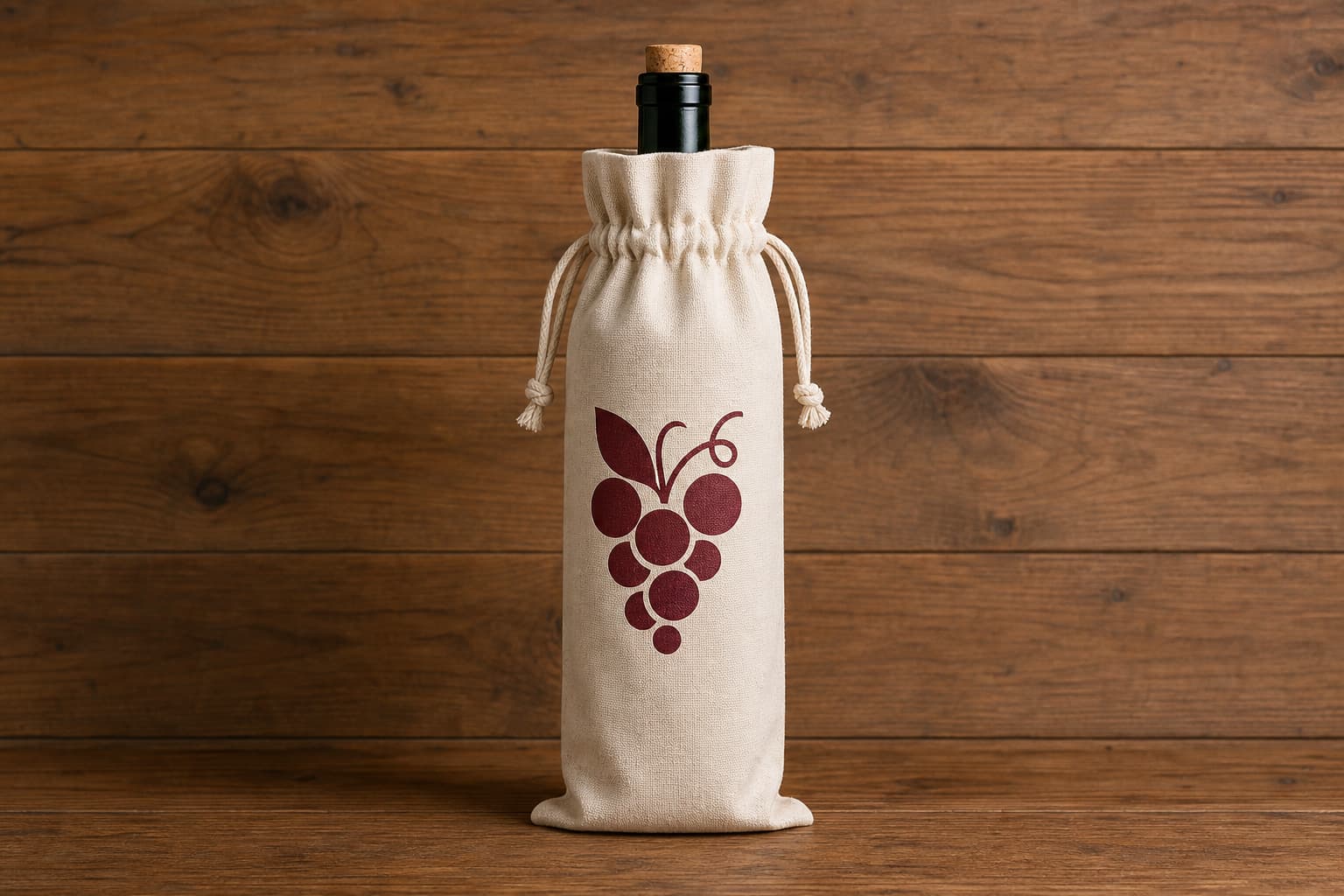
The Buying Problem: Simple Bag, Many Quote Variables
A printed bottle gift bag supplier cannot quote accurately from a product photo and a logo file only. Bottle bags depend on bottle diameter, bottle height, fabric stiffness, handle strength, print position, closure style, and packing method. If these details are missing, factories may quote different materials and constructions, making the lowest quote difficult to compare.
The most common procurement mistake is treating all bottle gift bags as the same item. A 750ml wine bottle bag for event giveaway use is not the same as a heavier canvas bottle carrier for retail gifting. A jute bag for a natural product line prints differently from a smooth cotton canvas bag. Your RFQ should control these variables before comparing unit prices.
- Use bottle dimensions, not only bottle capacity, because bottle shoulder and base shapes vary.
- Ask for finished bag size and tolerance, not only fabric cutting size.
- Define the use case: retail gift packaging, event giveaway, distributor promotion, or premium hamper insert.
- Compare suppliers on the same fabric GSM, handle type, print method, and packing standard.
Start With Bottle Fit Before Discussing Logo Printing
Bottle fit should be confirmed before artwork placement. A bottle bag that is too tight will stress the seams and distort the printed logo. A bag that is too loose can look cheap on shelf and may fold around the bottle during handling.
For a standard 750ml wine bottle, buyers often request a finished size around 15 cm wide by 35 cm high with a small gusset, but this is only a starting reference. Champagne, spirits, olive oil, and tall beverage bottles may need different width, height, or bottom construction. Send the supplier the bottle drawing or physical sample if the shape is not standard.
- Confirm bottle height, base diameter, shoulder diameter, and maximum body diameter.
- Decide whether the bottle neck should remain visible or be covered by a drawstring or ribbon closure.
- For two-bottle bags, specify divider requirement and loaded balance when carried.
- Allow enough top clearance for easy insertion, especially for thicker jute or canvas.
Choose Fabric GSM Based on Use, Not Only Price
Fabric weight affects hand feel, print result, strength, and carton volume. Non woven PP is economical and suitable for large promotional runs, but the bag can feel light if the GSM is too low. Cotton and canvas give a softer retail feel and better reusability. Jute gives a natural texture but needs more attention during printing and sewing because the weave is less uniform.
For procurement comparison, require every supplier quote to state fabric composition and weight. If one supplier quotes 140gsm non woven and another quotes 220gsm non woven, the price gap is not a real saving; it is a different bag.
- Non woven PP: commonly requested around 180 to 220gsm for better bottle support.
- Cotton: suitable for softer gift bags; confirm GSM and shrinkage if washing is mentioned.
- Canvas: 10oz to 12oz is a practical range for stronger bottle gift bags.
- Jute: 260 to 320gsm is common for a structured natural look; confirm lamination if stiffness is needed.
- Linen blend or specialty fabric: request sample swatches before approving bulk artwork.
Match Print Method to Artwork and Fabric Surface
Logo quality on bottle bags depends on both the print method and the fabric surface. Screen printing is usually efficient for solid logos, simple text, and one to three colors. Heat transfer can handle gradients, small details, and full-color artwork, but buyers should check edge bonding and long-term rub resistance. Embroidery may look premium on canvas or cotton but can pucker light fabric and is usually less suitable for large filled logos.
If the bag uses jute, expect a more textured print edge. This can be acceptable for natural branding, but it should be approved on a real sample. Do not approve a digital artwork layout as proof of print quality.
- For screen print, provide Pantone references and confirm whether the supplier uses water-based or plastisol-style ink.
- For heat transfer, check film softness, cracking risk, and whether the print leaves a visible border.
- For dark fabric, ask whether a white underbase is required to keep logo color accurate.
- For jute, avoid very fine text unless a woven label or patch is acceptable.
- Confirm logo placement from the bottom seam, side seam, and top opening, not by visual estimate.
Understand MOQ Logic Before Negotiating
MOQ is not only a factory preference. It is driven by fabric availability, fabric dyeing, printing setup, cutting efficiency, labor arrangement, and packing work. A supplier may accept a lower MOQ for stock natural canvas with one-color screen print, but require a higher MOQ for custom dyed fabric or multiple logo versions.
When asking for a printed bottle gift bag supplier quote, separate the MOQ by fabric color, print design, and bag size. If your order has four wine brands using the same bag body but different logos, the practical MOQ may be calculated per logo because each design needs separate screens, setup, and QC records.
- Stock fabric usually supports more flexible MOQ than custom dyed fabric.
- Multiple artwork versions increase setup time even if the bag size is identical.
- Small orders may carry sample, screen, or setup charges that should be shown separately.
- Mixed-color assortments need clear packing instructions to prevent warehouse receiving errors.
- Ask whether repeat orders can use stored screens or require new setup charges.
Sample Approval Should Simulate Bulk Production
A sales sample made from substitute fabric is useful for shape checking, but it is not enough for final production approval. The pre-production sample should use the confirmed bulk fabric, print method, handle construction, thread color, closure, and packing method where possible.
Procurement teams should check the sample with an actual filled bottle, not an empty display bottle. The bag must carry the loaded bottle without handle stretching, bottom seam opening, or visible distortion around the print. If the product will be displayed in retail, also check whether it stands upright or collapses when placed on a shelf.
- Measure sample size after sewing and compare with the RFQ tolerance.
- Insert the target bottle and check top clearance, side fit, and gusset expansion.
- Lift the sample several times by the handle and inspect stitch stress points.
- Rub the logo with dry cloth and slightly damp cloth to check ink transfer.
- Photograph the approved sample from front, side, bottom, and packed condition for supplier reference.
Packing Details Affect Arrival Condition
Bottle gift bags can be damaged before they ever reach the bottle filling line or retail store. Heat transfer logos may mark if stacked under pressure too soon. Jute can crease heavily if cartons are over-compressed. Light non woven bags can deform if packed unevenly or exposed to moisture.
Packing should be included in the RFQ, not decided after production. Importers and distributors should specify units per inner pack, carton quantity, carton dimensions if warehouse systems require limits, carton marks, barcode labels, and whether polybags are allowed under their packaging policy.
- Flat packing is efficient but may create fold lines across large print areas.
- Inner polybags protect against moisture but may not fit plastic-reduction policies.
- Paper banding can be used for grouped packing if the bag surface can tolerate pressure.
- Carton gross weight should match warehouse handling limits.
- Mixed SKU cartons need clear assortment labels and packing list references.
Lead Time Must Include Artwork and Sample Decisions
Lead time is often misunderstood because buyers ask only for production days. In practice, the timeline includes artwork checking, material confirmation, sampling, sample approval, bulk production, inspection, packing, and export handover. If artwork files are incomplete or Pantone references are missing, the schedule can stop before production starts.
A practical RFQ should ask suppliers to show separate time estimates for sample making and bulk production. For urgent seasonal orders, confirm whether stock fabric is available before issuing the purchase order. If the order requires custom dyed fabric, special handles, woven labels, or retail packaging, plan more buffer.
- Send vector artwork in AI, EPS, or PDF format with fonts outlined.
- Confirm sample approval deadline and what happens if revisions are needed.
- Ask whether bulk fabric is in stock before relying on quoted lead time.
- Include inspection date and shipping handover date in the order schedule.
- Avoid changing logo size or bag color after sample approval unless the timeline is revised.
Specification comparison for buyers
| Spec decision | Recommended option | When it fits | Buyer risk to check |
|---|---|---|---|
| Fabric for standard 750ml wine bottle | 10oz to 12oz cotton canvas or 180 to 220gsm non woven PP | Retail gifting, brand promotion, winery events, distributor giveaways | Too light fabric may show bottle shape, stretch at seams, or feel low value |
| Fabric for natural or premium look | 260 to 320gsm jute, laminated jute, or 12oz canvas | Organic wine, craft beverage, seasonal gift packs, premium retail display | Jute weave variation can affect print edge sharpness and logo color consistency |
| Logo printing method | Screen print for solid 1 to 3 color logos; heat transfer for gradients or small details | Most promotional bottle bag orders with clear brand graphics | Pantone matching, ink coverage, and rub resistance must be checked on actual fabric |
| Handle construction | Self-fabric handle, cotton webbing handle, or reinforced die-cut handle depending on bag type | Single bottle bags, two bottle carriers, or lightweight non woven giveaway bags | Handle stitch box, bartack strength, and bottle weight test are often missed in RFQs |
| Closure style | Open top, drawstring, snap button, or ribbon tie | Open top for fast retail use; drawstring or tie for gift presentation | Closure position can interfere with tall bottles or damage printed decoration |
| Packing method | Flat packed in export carton with inner polybag or paper banding as requested | Bulk import, retail replenishment, distributor warehouse handling | Over-compression can crease print area, deform jute, or mark heat transfer logos |
Buyer checklist before sampling
- Confirm the bottle size: 750ml wine, champagne, spirits, olive oil, or custom beverage bottle, including diameter and total height.
- Specify finished bag size, not only bottle size, and include seam allowance, gusset depth, and tolerance.
- Choose fabric type and GSM or ounce weight: non woven PP, cotton, canvas, jute, linen blend, or laminated material.
- Define logo size, print position from top and side seams, Pantone colors, and whether artwork is vector format.
- State whether the bag needs to pass a loaded hanging test, retail shelf display check, or drop handling check.
- Request a pre-production sample using the confirmed bulk fabric, handle, closure, and printing method.
- Clarify packing: units per inner pack, carton quantity, carton size limit, barcode or carton mark requirements.
- Ask for the quotation to separate bag cost, printing cost, sample cost, mold or screen charge, packing cost, and freight terms.
Factory quote questions to send
- What fabric GSM or ounce weight will you quote, and is it regular stock fabric or custom dyed material?
- What is your recommended bag size for our bottle dimensions, and what tolerance do you apply after sewing?
- Which print method do you recommend for our artwork, and what is the maximum print area on this bag construction?
- Can you quote MOQ by fabric color and print design instead of only giving one total order quantity?
- Will the sample be made with the same fabric, handle, thread, and printing process as bulk production?
- What tests do you perform for handle strength, print rub resistance, seam durability, and carton packing?
- How many pieces are packed per carton, and can the carton weight stay within our warehouse handling limit?
- What quote validity, sample lead time, bulk production lead time, and artwork approval cut-off should we plan for?
Quality-control points to confirm
- Check finished bag width, height, gusset, handle length, and logo placement against the approved sample.
- Load test the bag with the target bottle weight for hanging, lifting, and short-distance carrying.
- Inspect seam strength at the side seam, bottom seam, gusset corners, and handle attachment points.
- Rub test the printed logo dry and lightly damp, especially on dark fabric or jute with uneven surface.
- Check color consistency between sample and bulk for fabric, thread, handle tape, and printed logo.
- Verify packing method prevents print transfer, deep creases, moisture exposure, and carton crushing.
- Confirm carton marks, SKU labels, barcode labels, and mixed design packing match the purchase order.