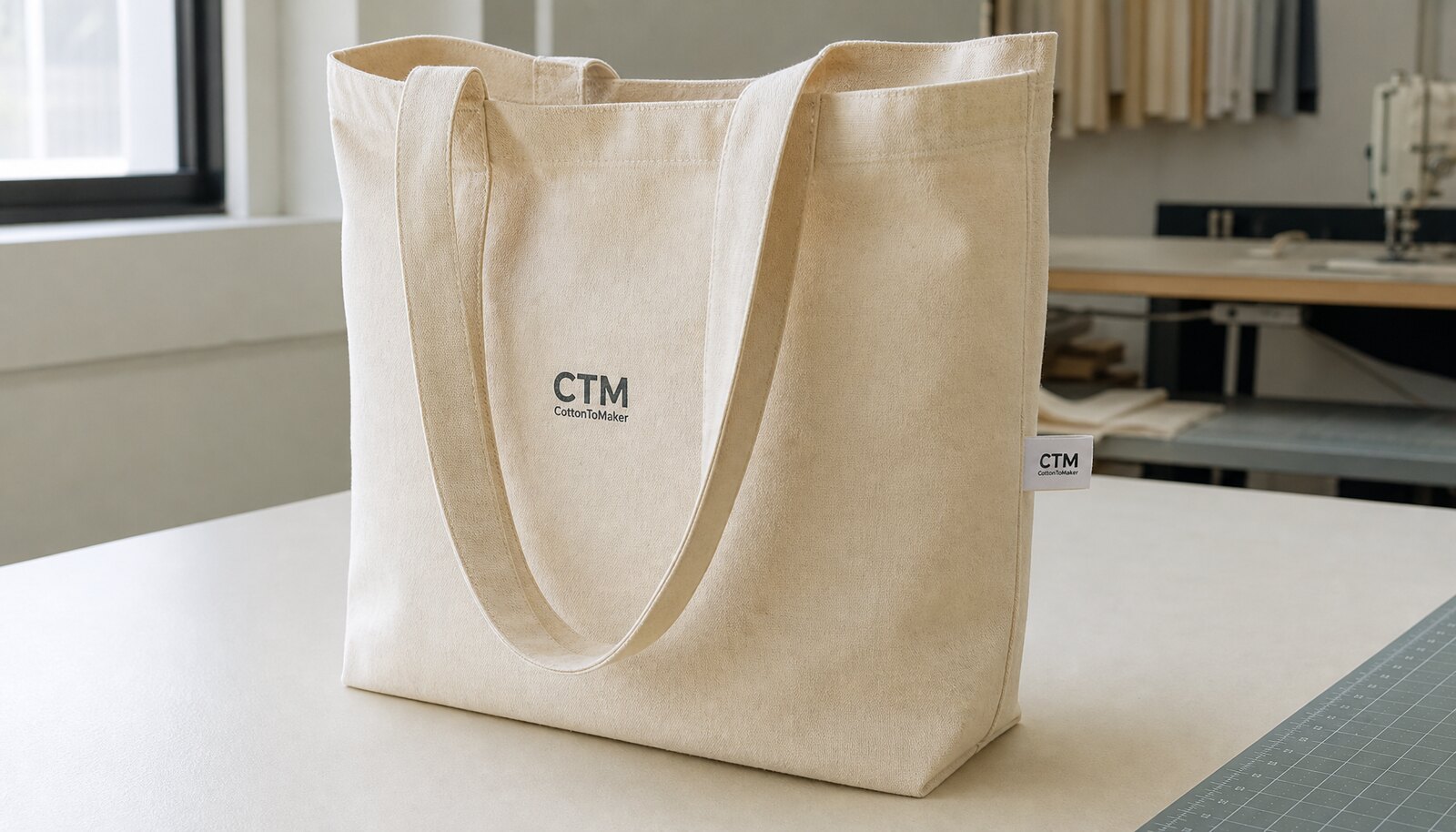
Start With The Finished Tote, Not The Product Name
The phrase printable canvas tote bags is too broad to price on its own. A supplier can hear the same request and quote a flat promo tote, a gusseted retail bag, or a heavier carry bag with reinforced handles. Those are not interchangeable products. They use different fabric widths, different sewing time, different print risk, and different carton density. If the RFQ does not define the finished bag, the quote may look comparable while the actual goods are not.
A usable spec should describe the finished item in one line a factory can build from. Include finished width, height, gusset depth, top finish, handle length, handle drop, canvas weight, print area, packing format, and the intended end use. If the bag must hold books, groceries, cosmetics, or apparel, say so. The intended load and channel change how the factory should reinforce the seams and what quality level is acceptable. A tote for a trade show handout does not need the same build discipline as a tote for retail resale.
- Define the bag as a finished product, not just as a canvas tote with logo print.
- Use measured dimensions in millimeters or inches, not labels like large or standard.
- Tell the factory whether the bag needs to stand upright on shelf or only travel in bulk cartons.
- Call out the print area with distance from seams and top edge.
- State whether the supplier may offer an equivalent spec or must match your target exactly.
Choose Fabric Weight And Finish For The Channel
Fabric weight affects more than cost. It changes how the tote drapes, how well the print covers, how much the seams bulk up, and how the bag survives loading and compression. Lighter canvas, often in the 200 to 270 GSM range, can work for promotional distribution or short-life use. Mid-weight canvas, roughly 280 to 340 GSM, usually gives a better balance of body, opacity, and retail appearance. Heavier construction can support a premium feel and higher load, but it also raises sewing difficulty and shipping weight. There is no universal best choice; there is only a better fit for the channel.
Finish matters too. Natural canvas, bleached canvas, and dyed canvas behave differently when printed. Natural fabric can make the bag feel more artisanal, but the weave shows through more clearly, which can affect small text and fine line art. Darker fabric can look stronger on shelf, but it makes opacity, edge sharpness, and rub performance more important. Ask the supplier what shrinkage, color variation, and dye consistency they expect on the chosen fabric, and whether they can hold the same roll lot through a full order if color consistency matters.
- Use lighter canvas for low-cost distribution or short-life promotional programs.
- Use mid-weight canvas when shelf appearance and moderate load matter.
- Use heavier construction only when the channel justifies the added weight and freight.
- Ask for fabric weight, weave type, color lot control, and shrinkage expectation in the quote.
- Do not ignore thread color and topstitch visibility because they show on plain canvas.
Specify Construction Around Load And Handling
Construction should follow the way the bag will be carried. A tote that only holds papers for one event can be built differently from a tote that will be stuffed with books, groceries, or merchandise every day. Handle width, handle length, handle drop, seam allowance, and reinforcement method all affect whether the bag feels stable in use. Ask the supplier how the handles are attached, whether bartacks or box-X stitching are used, and whether the body seam is designed to carry load or just close the bag.
The top finish also changes the result. A clean hem can improve appearance and reduce fraying, but it adds labor and can change the opening feel. A gusset increases volume and retail value, yet it also introduces more sewing variables and more chance for artwork shift if printing happens before the bag is fully controlled. For buyer specs, it helps to state the target load in practical terms, such as expected contents and approximate weight, so the factory can propose a structure that matches the use case rather than a generic tote build.
- State the expected load in practical terms, not just as a bag type.
- Ask the factory to identify the handle attachment method and reinforcement pattern.
- Specify whether the opening should be hemmed, bound, or left raw inside.
- Require a drawing that shows handle drop, gusset depth, and print-safe zones.
- Ask for a pull or load test if the tote will carry meaningful weight.
Match Decoration Method To Artwork, Volume, And Surface
Decoration method should follow the artwork and the order pattern, not the supplier's default. Screen printing is usually the right choice for simple spot-color logos, repeated replenishment, and strong unit economics at volume. It tends to give a flatter, more durable result on canvas when the art is limited in color. Digital transfer and DTF can solve short-run work, gradients, and multi-color designs, but they need closer scrutiny on hand feel, rub resistance, and how the print sits on woven fabric. Embroidery and sewn patches work when the brand wants texture or a premium look, but they are not a substitute for detailed illustration reproduction.
The real sourcing question is whether the decoration survives on the actual canvas at the actual size. Fine lines, small type, and dense logos can disappear on woven fabric if the print method is wrong or the artwork is scaled badly. Ask for a strike-off on the same canvas weight, not a paper proof. If the graphic is near a seam or fold, require a placement drawing with exact offsets. On a tote, a few millimeters of drift can turn a clean logo into a bad retail sample. This is where procurement saves money by forcing proof on the real material before bulk starts.
- Use screen print for simple logos, stable artwork, and repeat orders.
- Use digital transfer or DTF for short runs or artwork with gradients and many colors.
- Use woven labels, patches, or embroidery when brand texture matters more than photo realism.
- Require a strike-off on the same fabric weight and color as bulk production.
- Set a minimum legibility check for small text and fine lines at normal viewing distance.
Use A Tote Decision Matrix, Not A Generic Comparison
A comparison table should help you choose a tote configuration, not just identify a sourcing route. Procurement teams need to see how the bag build changes the economics, quality risk, and channel fit. A flat 8 to 10 oz tote for giveaways behaves differently from a gusseted 12 oz tote for retail, and both are different again from a heavy structured carry bag with a premium print or label treatment. If the comparison only talks about factory type, it does not help you decide what to buy.
Use the matrix to compare the actual product decision levers: fabric weight, structure, decoration, load target, and packing. For each configuration, ask whether the bag will survive the intended use, how the decoration will hold up, and how expensive the bag becomes once packing and freight are added. The best option is not the one with the lowest unit price on paper; it is the one that balances appearance, durability, stackability, and landed cost for the sales channel you actually have.
- Compare flat, gusseted, heavy structured, labeled, and digitally decorated tote options separately.
- Use the same finished size and pack format when comparing options.
- Check whether the bag will stack flat, stand upright, or lose shape in carton compression.
- Ask the supplier to price the same tote with one-side and two-side decoration.
- Treat packaging as part of the product decision, not as an afterthought.
Build The RFQ So Every Supplier Prices The Same Thing
A good tote quote should reveal how the supplier is building the price. If the document shows only a single unit price, you are not comparing procurement risk, only headline cost. Ask for the bag body price, print or decoration cost, setup charges, packing cost, carton cost, and any special handling line. Some suppliers hide true cost in the unit price and then add it back through artwork changes, packing adjustments, or minimum order conditions. Others quote low and later add fees for every practical detail. The only way to compare accurately is to normalize the quote structure.
The cost levers that move most on printable canvas tote bags are usually fabric weight, handle construction, print method, color count, pack format, and carton density. A wider handle, double-sided print, or reinforced seam can raise cost more than buyers expect. Bulk packing can lower labor but may increase scuff risk and reduce presentation quality. Retail packing protects appearance but consumes labor, material, and carton volume. Ask the supplier to quote both the unit price and the packaging assumptions so you can see where the money is really going.
- Separate bag body cost from decoration cost.
- Ask whether the quote includes one-side print or both sides.
- Clarify whether sample fees are credited if the order converts.
- Compare carton counts and carton dimensions because freight can change the ranking quickly.
- Request the same trade term for every supplier so landed cost comparisons stay clean.
Set MOQ, Sample Gates, And Change Control Early
MOQ is usually a reflection of production efficiency, not a fixed industry rule. Fabric width, cut yield, print setup, and packing complexity all influence the minimum. A factory may quote one MOQ for a plain tote and a much higher MOQ once you add decoration, a second color, or custom packing. That is normal. What matters is whether the buyer understands which step is driving the minimum so the order does not get reworked later. If you do not ask, the factory may quote a number that looks small but only applies to a narrower spec than the one you need.
Sampling should have clear gates. For a new bag body, start with a blank sample to verify shape, top finish, handle drop, and seam behavior. Then approve a printed strike-off on the actual canvas so you can see color, opacity, and placement. Before bulk release, request a pre-production sample that reflects the actual material, trim, print method, and packing method. A PDF approval alone is not enough for a physical product with stitching and print registration. Keep the signed sample, dated artwork, and packing spec together as the production reference.
- Treat MOQ as a function of fabric, print setup, and packing, not as a random rule.
- Do not approve bulk from artwork alone if the bag is new.
- Measure the sample for size, handle drop, and print position.
- Keep one signed master sample for construction and one approved sample for print.
- Ask whether screens, files, or label tooling will be reused on repeat orders.
Define QC Around The Defects That Cause Returns
Quality control should focus on defects that create returns, rejections, or channel complaints. On a tote, the most common issues are uneven handles, skipped stitches, weak print opacity, misregistration, stains, loose threads, and cartons that crush the bag shape. Cosmetic variation matters less than whether the bag matches the approved sample and can survive the intended load. For retail programs, appearance defects can be the primary issue. For promotional or grocery use, seam strength and print visibility usually matter more. The inspection standard should reflect that difference.
The strongest QC plans are measurable. State which defects are zero tolerance, which are rework, and which are acceptable within a range. For example, wrong size, wrong artwork, or mixed styles in the same carton should be zero tolerance. Minor thread tails may be acceptable within a defined limit if they are trimmed before packing. Ask for a simple load or pull test on the handle attachment if the bag will carry real weight. If the supplier says the bag is strong, ask what method they use to verify that claim and what the pass criteria are. Without that, the promise is just marketing language.
- Set zero tolerance for wrong print, wrong size, broken seams, and mixed styles.
- Define allowed ranges for width, height, gusset depth, and handle length.
- Write a visible defect standard for stains, loose threads, print haze, and blotches.
- Require the factory to state the load or pull test used for handle reinforcement.
- Compare bulk goods against the approved master sample before shipment release.
Plan Packing, Cartons, And SKU Count Up Front
Packing changes both quality and cost. Bulk packing is the cheapest option and often the right choice for internal distribution, event handouts, or low-touch B2B shipments. It also increases the chance of print rub, crushed corners, and count errors if the factory is not disciplined. Single polybag packing protects the tote and gives a cleaner retail presentation, but it adds labor and material. Hangtags, insert cards, and barcode labels are not optional extras if the bag is going to a retail shelf or an e-commerce fulfillment flow. The bag should be packed to suit the channel, not to satisfy a generic factory default.
Cotton canvas can pick up moisture, odors, and fold marks if storage and transit are poor. For printed bags, define the polybag thickness, carton liner requirement, and fold method so the graphic does not sit on a hard crease. If the tote needs shelf-ready appearance, ask the supplier to show the fold pattern before packing starts. If the bag will ship in master cartons to a distribution center, carton dimensions may matter more than individual presentation because freight costs and storage density will drive the economics. Packing also affects SKU count, so decide early whether you are managing one body with many print variants or several separate SKUs with different pack rules.
- Use bulk packing for events, promotions, and internal distribution.
- Use single-bag packing for retail, e-commerce, and brand programs with presentation standards.
- Confirm whether the supplier counts bags by hand, by pack weight, or by an electronic count process.
- State master carton count, barcode format, and carton mark rules in the PO.
- Approve the fold method if the print is close to a crease or top edge.
Compare Lead Time, Landed Cost, And Supplier Risk
The cheapest tote quote is rarely the cheapest finished purchase. Freight, duty, setup charges, carton volume, inspection cost, packing labor, and remake risk all affect the landed number. A slightly higher factory price can still win if the bags stack better, ship denser, pass inspection more cleanly, or need less rework. That is the procurement logic that matters. Unit price is a useful input, but it is not the decision.
Normalize every bid against the same assumptions. Use the same finished size, the same canvas weight, the same print method, the same pack format, and the same shipping term. Then compare the cost of sample approval, expected reject risk, carton efficiency, and likely rework. If one supplier quotes low but gives weak answers on seam reinforcement, print control, or packing discipline, the hidden cost is real even if it does not show up on the first page. Procurement teams make better decisions when they compare the cost of getting acceptable bags to the right destination on time.
- Compare quotes on the same spec sheet, not on similar product names.
- Include print setup, packing, and sample fees in the cost model.
- Check carton dimensions because freight savings can be material.
- Treat poor registration or weak seam control as risk, not just quality noise.
- Ask for one apples-to-apples landed cost view before awarding business.
Specification comparison for buyers
| Tote configuration | Best use case | Typical load target | Decoration compatibility | Packing / SKU implications |
|---|---|---|---|---|
| Flat 8-10 oz tote, one-color screen print | Events, handouts, low-cost merch, and internal promotions | Light carry, usually papers, samples, or a few small items | Best for one- or two-color screen print with a large logo and simple line art | Stacks flat, gives the lowest carton cube, and is the easiest option for one-SKU replenishment |
| Gusseted 10-12 oz tote, reinforced handles, one- or two-side print | Retail, bookstores, lifestyle programs, and resale channels | Moderate carry, often books, apparel, or mixed shopping loads | Works well for screen print or transfer print if the artwork is kept clear of seams and folds | Adds carton bulk and more sewing variables, but still stays manageable for a core SKU program |
| Heavy 12-16 oz structured tote with top hem and web handles | Premium retail, gifting, and higher-load programs | Heavier carry, usually a more rigid bag meant to hold shape in use and on shelf | Good for screen print, woven labels, sewn patches, or limited embroidery on cleaner panels | Uses more material, ships in fewer units per carton, and raises freight cube and handling cost |
| Natural canvas tote with woven label or sewn patch instead of large print | Minimal branding, premium hand feel, or multi-channel resale | Moderate carry, with the brand story driven by trim rather than full-body decoration | Best for woven labels, patches, or small print accents rather than dense full-panel graphics | Creates a trim-dependent SKU and can add a second approval path for labels, thread, or patch artwork |
| Dyed or dark canvas tote with light ink or transfer print | Fashion, retail, and shelf-facing programs that need contrast | Moderate carry, with more emphasis on appearance than raw load | Requires strong contrast, controlled ink opacity, and careful testing for rub and edge sharpness | Usually needs stricter packing to protect the printed surface and may require a separate colorway SKU |
| Short-run tote with DTF or digital transfer decoration | Seasonal drops, frequent artwork changes, and smaller MOQs | Light to moderate carry, depending on fabric weight and construction | Best for complex art, gradients, or many colors when screen setup would be inefficient | Useful when SKU turnover is high, but each artwork change can create a fresh production setup |
| Blank tote with custom hangtag, insert card, or carton branding only | Private label trials, channel tests, and budget-sensitive launches | Depends on the base bag spec, not the branding layer | Keeps decoration simple, so packaging and inserts carry the brand and compliance information | Adds packaging SKUs instead of print SKUs, which can simplify the body order but complicate pack-out |
Buyer checklist before sampling
- Define the finished bag in one line: width, height, gusset depth, handle length, handle drop, fabric weight, top finish, and print area.
- State the intended channel and use case, such as events, retail resale, grocery carry, internal distribution, or gifting.
- Specify whether the bag must hold a target load, stand upright on shelf, or stack flat for carton efficiency.
- Lock the allowed decoration method, number of print colors, placement tolerances, and whether printing can cross seams or folds.
- Provide vector artwork and say whether exact Pantone matching is required or whether a visual match is acceptable.
- Choose the packing format before quoting: bulk, polybag, hangtag, insert card, or retail-ready carton pack.
- Ask for a blank sample, a printed strike-off on the actual fabric, and a pre-production sample if the tote is not a repeat order.
- Set measurable tolerances for size, handle length, print placement, stitch quality, and defect categories that are not acceptable.
- Require carton count, carton dimensions, gross weight target, barcode rules, and master carton mark format in the RFQ.
- Ask the supplier to separate bag body cost, decoration cost, packaging cost, tooling, and any test or setup fee.
Factory quote questions to send
- What exact canvas weight are you quoting, and what tolerance do you hold at incoming inspection?
- Is the print or decoration done in-house or by a subcontractor, and who signs off on strike-off approval?
- What is the MOQ for this bag body, this decoration method, and this colorway separately?
- What is included in the unit price: sewing, print setup, thread changes, packing, carton marks, and barcode labels?
- Can you quote the same tote in bulk packing and retail packing so I can compare landed cost?
- What sample stages are available before bulk production, and what is the lead time for each stage?
- What are your standard tolerances for finished size, handle length, print placement, and stitch defects?
- Which seam construction do you use at the handle attachment, and can you show a load or pull test result?
- If artwork changes after approval, what remake, screen, or transfer rework cost should I expect?
- How do you protect printed surfaces during carton packing so the graphic does not scuff or transfer?
Quality-control points to confirm
- Canvas weight matches the approved spec or stays within the agreed tolerance band.
- Finished width, height, and gusset depth stay within the buyer's tolerance, and a sample lot is checked against the signed master sample.
- Handle lengths are even, and the handle drop stays inside the approved range so the tote wears correctly.
- Handle attachment uses the specified reinforcement, with no skipped stitches, broken backtacks, or loose bartacks at stress points.
- Print placement stays inside the approved position tolerance and does not run into seams, folds, or stitching.
- Ink opacity is sufficient for the chosen fabric color, with no visible pinholing, bleeding, ghosting, or major registration drift.
- No visible stains, oil marks, broken threads, loose fibers, or seam skips appear on the main panels or gusset panels.
- Carton count, packing method, barcode data, and label text match the purchase order and approved pack spec.
- Bulk goods are checked against the signed pre-production sample for size, print color, hand feel, and packing quality.
- The bag passes the agreed load, pull, or drop test for the intended use, and the method is documented before production.